
 Worksheets
#7-Dilations
Total questions: 56
Worksheet time: 3hrs 56mins
Question 1
An image is dilated by a scale factor of 41 . This will result in ____________ of the original image.
an enlargement
a reduction
Question 2
An image is dilated by a scale factor of 25 . This will result in ____________ of the original image.
an enlargement
a reduction
Question 3
Find the scale factor that was used to dilate the point below:
(12,6)→(4,2)
3
31
41
Question 4
A triangle has the following vertices:
A(3,6), B(3,3), and C(6,3)
If the triangle undergoes a dilation using the origin as the center of dilation with a scale factor of 34 , what will be the location of A'?
(4, 8)
(8, 4)
(4, 4)

Question 5
What is the scale factor of the dilation that maps ΔABC→ΔA′B′C′ ?
32
23
2

Question 6
In the diagram, ΔR'S'T' is the image of ΔRST. Which type of transformation is shown?
translation
reflection
dilation

Question 7
Triangle PQR is shown.
What are the coordinates of P' when ΔPQR is dilated by a scale factor of 3 using the origin as the center?
(6, 18)
(32, 3)
(18, 6)

Question 8
ΔMNP is shown.
The triangle is dilated by a factor of 2.5 using the origin as the center of dilation to form ΔM'N'P'.
What is the length of the line segment P′N′ ?
5 units
10 units
10 units
Question 9
Which pair of figures must be similar?


Question 10
Which of the following is similar to the given rectangle?
(Figures are NOT drawn to scale.)


A dilation produces a congruent figure
True
False
State the coordinate of the image of the given point B (4,9) under a dilation with center at the origin with the given scale factor of 2.
B' (2 , 4.5)
B' (-8 ,-18)
B' (8 ,18)
B' (9 ,4)


The point A (8, 12) was dilated to become point A' (2, 3). What was the scale factor?
½
¼
4
2
If your SF = 0.8, what type of dilation is it?
Reduction
Enlargement
If your SF = 6/5, what type of dilation is it?
Reduction
Enlargement
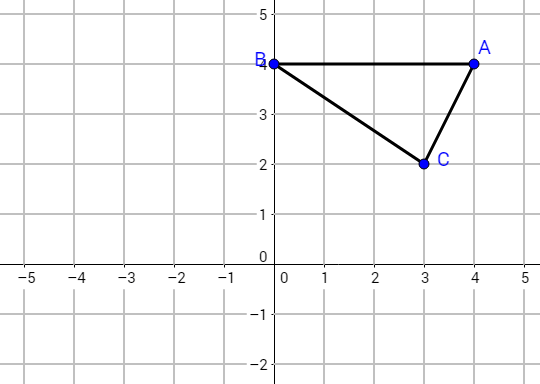


A(3,3) B(6,6) C(9,3)
A(3,3) B(6,6) C(9,3)

E
F
G
H

A
B
C
D
Congruent figures are figures that are the SAME size and the SAME shape.
A dilation produces a congruent figure.
True
False

In this figure, triangle TRS is the (a) , triangle T'R'S' is the (b) and a(n) (c) occurred.

Which of the following statements is true about the scale factor (k) for this dilation?
k>1
k=1
0<k<1

In this figure, triangle ABC is the (a) and triangle A'B'C' is the (b) . The scale factor for this dilation is (c) . A(n) (d) occurred.
Quadrilateral NDPM was dilated to quadrilateral N'D'P'M'. What was the scale factor for this dilation?
2
3
1/3
1/2

If triangle ABC was dilated by a scale factor of 3, with the origin as the center of dilation, what would the coordinates of B' be?
(12,0)
(12,12)
(4,3)
(0,12)

What is the correct scale factor for this dilation?
2.5
1.5
3.5
4

State the coordinates of point C after a dilation with a scale factor of 1/2 and center of dilation at point P.
(-6, 1)
(-3, -2)
(1, -6)
(-2, -3)
A triangle has vertices with coordinates A(2,0), B(3, -1) and C(-2,-5). If the triangle is dilated by a scale factor of 3, with the origin as the center of dilation, what are the coordinates of the vertices of the new image?
A'(5,3), B'(6,2), C'(1,-2)
A'(6,0), B'(9,-3), C'(-6,-15)
A'(2/3,0), B'(1,-1/3), C'(-2/3,-5/3)
A'(-1,-3), B'(0,-4), C'(-5,-8)

State the coordinates of point B after a dilation, with the center of dilation at the origin, and a scale factor of 1/2.
(1.5,-4)
(-1.5,1)
(-1,-1.5)
(-2,-2)
State the coordinates of point A after a dilation, with the center of dilation at (0,0), and a scale factor of 1/2.
(2,2)
(8,8)
(0,12)
(4,12)

The red triangle has been dilated by a scale factor of 1/4, with the center of dilation at (0,0), which triangle is it's new image?
green triangle
red triangle
black triangle
none of these
Which of the following algebraic rules represents an enlargement? Select all that apply.
(x, y) --> (3x, 3y)
(x, y) --> (0.5x, 0.5y)
(x, y) --> (0.75x, 0.75y)
(x, y) --> (0.999x, 0.999y)
(x, y) --> (5x, 5y)
Point A is ( 7, 3) and Point A' is ( 21, 9). What is the algebraic rule for this dilation if the center of dilation is at the origin?
f(x,y) →(31x, 31y)
f(x,y)→(3x, 3y)
f(x,y) →(x+14, y+6)
f(x,y) → (0x, 0y)

