
 Worksheets
Direct and Indirect Control Basics
Total questions: 53
Worksheet time: 27mins
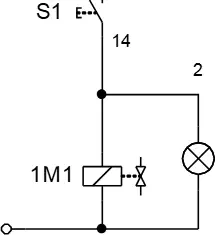
In the diagram labeled 1), what is being directly controlled when S1 energizes 1M1?
A relay coil K1 for interlock
A 3/2 way normally closed valve
A 5/2 way spring return valve
An OR logic branch with S2
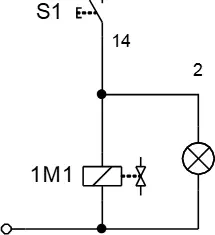
Which statement best describes direct control in electro-pneumatics?
Relay coil latches to hold state
Solenoid coil drives valve spool directly
Pilot air shifts main valve via sub-valve
Two switches wired in OR energize a relay
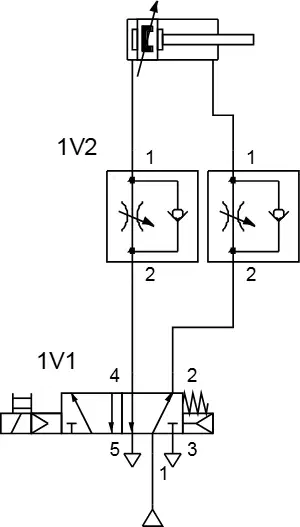
For the 5/2 valve direct control circuit in 2), what causes the spool to return when 1M1 is de-energized?
Mechanical spring on valve end
Pilot air from port 5
Electrical relay K1 dropping
S2 switch opening in OR branch

Which component provides electrical isolation and logic in the indirect control circuit 3)?
Pneumatic 5/2 valve spool
Manual switch S1 lever
Solenoid 1M1 coil
Relay K1 with contacts 11–14

In indirect control 3), what is the path for energizing 1M1?
24 V → direct to 1M1 coil
24 V → port 1 → valve spool
24 V → S2 contact → 1M1 → 0 V
24 V → K1 contact → 1M1 → 0 V

Compare direct vs indirect control for a 5/2 valve: what is the key benefit of indirect control using K1?
Eliminates need for exhaust ports
Increases air flow through port 1
Allows low-current switches to command high loads
Converts valve to normally open type
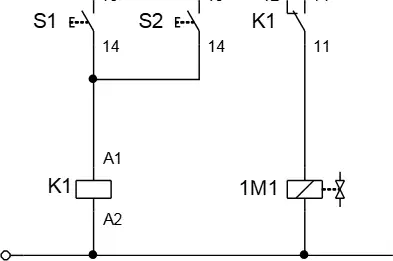
On page 2 diagram 4), what function do S1 and S2 provide together?
AND logic interlock for safety
OR logic to start the circuit
XOR logic to toggle states
NOR logic to inhibit starting
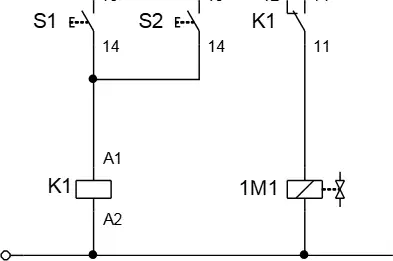
In the OR gate circuit 4), which device ultimately actuates the pneumatic valve when either S1 or S2 closes?
Pressure regulator PR1
Manual operator on 1V1
Diode network D1
Solenoid coil 1M1

In a 5/2 valve with double solenoid actuation, which statement best describes how S1 and S2 influence cylinder motion shown in the diagram?
S1 energizes K2 to retract, S2 energizes K1 to extend
S1 de-energizes both relays to extend, S2 de-energizes to retract
S1 energizes K1 to extend, S2 energizes K2 to retract
S1 and S2 energize the same relay for both motions

Which component pair forms the indirect electrical control of the double solenoid valve to switch pneumatic sides?
Pushbuttons S1 and S2 with relays K1 and K2
Flow restrictors 1V2 and 1V3
Limit switches 1B1 and 1B2 with relay K3
Power supply rails 24 V and 0 V

In the single-cycle circuit with one-way flow restrictors, what is the primary purpose of 1V2 and 1V3 in the pneumatic diagram?
Latch the cylinder position mechanically
Adjust extension and retraction speeds independently
Provide pressure feedback to relays
Reverse electrical polarity to the solenoids

When 1B2 is added along with S1 in the single-cycle circuit, what role does 1B2 play electrically?
Provides limit switch feedback to change relay state
Acts as a series resistor for speed control
Replaces K1 as the main contactor
Supplies the 24 V source to coils

In the oscillating circuit, which sequence causes repeated extend–retract cycling?
K3 alone powers both solenoids simultaneously
Flow restrictors bypass all electrical control
S1 holds both relays on continuously
S1 starts, limit switches 1B1 and 1B2 alternately toggle relays

What is the effect of one-way flow restrictors in the oscillating circuit compared with unrestricted lines?
Control speed during extend and retract strokes
Increase supply voltage to the coils
Force equal speeds regardless of load
Prevent limit switches from actuating

In the latching circuit, what keeps K1 energized after S1 is released?
1M1 coil mechanically locks the valve
Series flow restrictor maintaining current
K1’s self‑holding contact across S1
S2 supplies constant power to K1

How is the latch released to return the cylinder in the latching circuit?
Press S2 to open the holding path
Press S1 to increase supply voltage
Remove the flow restrictors from lines
Trip 1B1 to energize both coils
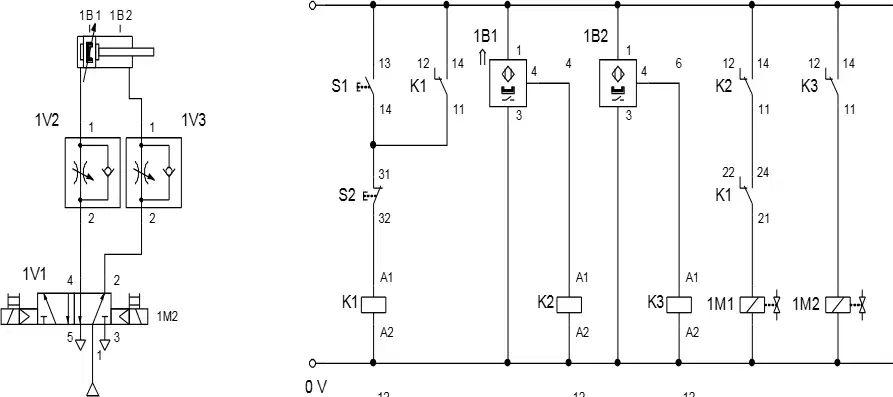
In the oscillating circuit with solid-state reed switches, which component senses cylinder end position to toggle the relay coil?
1B1 solid-state reed switch near piston
S1 manual pushbutton start switch
1M1 solenoid valve output stage
K1 relay contact in control bus

A pressure switch labeled 1B3 at 0.55 MPa is wired into an oscillating circuit. What function does this switch most likely provide?
Generates pneumatic pilot for valve actuation
Stops oscillation when pressure exceeds setpoint
Provides latching power to relay K3
Measures cylinder displacement directly

In the A+B+ sequence, which order of solenoid energization correctly extends cylinders A and B?
1M2 then 2M2 for A- then B-
2M2 then 1M1 for B- then A+
1M1 then 2M1 for A+ then B+
2M1 then 1M2 for B+ then A-

Which relay contact is shown interlocking the sequence to prevent B+ until A+ is complete?
S1 contact interlocked with 1B2 sensor
K1 contact bypassing S1 start input
K2 contact gating 1M1 drive line
K3 contact gating 2B2 input line

Displacement‑step diagram shows sloped lines for A and B motions. What does each slope represent?
Electrical voltage versus time delay stage
Relay coil current versus piston area
Cylinder displacement versus control step index
Supply pressure versus valve spool position

In an oscillating reed-switch circuit, what typically causes the direction change of the double-acting valve?
Relay K1 shorting the 24 V supply line
Manual switch S1 toggling both coils alternately
Pressure switch venting pilot pressure line
Reed sensors toggling opposite solenoid coils

Which statement best describes integrating a pressure switch with oscillation control?
Pressure threshold enables motion only when system is charged
Pressure switch directly controls piston speed by throttling flow
Pressure switch measures rod position using magnetic field
Pressure threshold disables reed sensors during retraction only
What is the main function of a relay (such as K1) in an indirect control circuit for a pneumatic valve?
To directly actuate the valve spool
To regulate air pressure in the cylinder
To provide mechanical feedback to the operator
To allow low-power switches to control high-power loads
Which device is responsible for detecting the end position of a cylinder in an oscillating electro-pneumatic circuit?
Manual pushbutton S1
Pressure regulator PR1
Limit switch 1B1 or 1B2
Flow restrictor 1V2
In a latching circuit, what action must be taken to break the self-hold and stop the cylinder motion?
Remove the flow restrictors from the pneumatic lines
Increase the supply voltage to the relay
Manually reset the relay K1
Press S2 to open the holding circuit
Which component in an electro-pneumatic circuit is typically used to sense when a cylinder has fully retracted?
Manual pushbutton S2
Flow restrictor 1V2
Limit switch 1B2
Pressure switch 1B3
What is the main advantage of using a relay (such as K1) in the control circuit for a pneumatic valve?
It allows direct manual operation of the valve
It enables low-power switches to control high-power devices
It increases the speed of cylinder movement
It provides pressure feedback to the operator
In an oscillating circuit, which device is responsible for alternating the extension and retraction of the cylinder?
Manual switch S1
Reed switches at cylinder ends
Pressure regulator PR1
Flow restrictor 1V3
What is the primary role of a limit switch (such as 1B1) in an electro-pneumatic sequence circuit?
To provide manual override for the relay
To regulate air pressure in the supply line
To detect cylinder position and trigger the next control step
To directly actuate the solenoid valve
Which component combination is essential for achieving AND logic in an electro-pneumatic control circuit?
Two pushbuttons wired in series
Two solenoid coils in parallel
One relay and one flow restrictor
One pressure switch and one reed sensor in parallel
In a double-acting cylinder circuit, what is the effect of adjusting the one-way flow restrictor on the exhaust line?
It alters the electrical control logic
It changes the speed of cylinder extension or retraction
It disables the pressure switch function
It switches the valve from direct to indirect control
What is the function of a flow restrictor in the supply line of a double-acting cylinder circuit?
To detect the end position of the piston
To control the speed of cylinder movement
To energize the relay coil directly
To provide electrical interlocking
Which component is typically used to provide feedback for automatic retraction in an electro-pneumatic circuit?
Manual pushbutton S2
Limit switch at the cylinder end
Flow restrictor 1V2
Pressure regulator PR1
What is the main advantage of using indirect control with a relay in a pneumatic valve circuit?
It allows the use of smaller control switches
It directly actuates the valve spool
It increases the air pressure in the system
It eliminates the need for limit switches
Which component in an electro-pneumatic circuit is primarily responsible for converting an electrical signal into mechanical valve movement?
Manual switch S1
Solenoid coil 1M1
Flow restrictor 1V2
Relay K1
What is the main function of a limit switch (such as 1B1 or 1B2) in an oscillating cylinder circuit?
To adjust the speed of cylinder movement
To provide manual override for the valve
To detect the cylinder's end position and trigger relay switching
To regulate air pressure in the system
In a direct control circuit, what happens when S1 is pressed and held?
The pressure switch 1B3 opens the circuit
The solenoid coil 1M1 is energized, directly actuating the valve
The flow restrictor 1V3 increases pressure
The relay K1 latches and holds the circuit on
Which device in an electro-pneumatic circuit is used to initiate the extension of a double-acting cylinder?
Flow restrictor 1V2
Pressure regulator PR1
Manual pushbutton S1
Limit switch 1B2
What is the primary role of a relay (such as K1) in an indirect control circuit for a pneumatic valve?
To provide electrical isolation and enable logic control
To adjust the speed of cylinder movement
To regulate air pressure in the cylinder
To directly actuate the valve spool
In a circuit with two limit switches, how is the automatic reversal of cylinder direction typically achieved?
By using the limit switches to trigger relay switching for extend and retract
By removing the flow restrictors from the supply lines
By manually pressing S2
By energizing both solenoid coils simultaneously
Which component in an electro-pneumatic circuit is used to provide feedback for automatic cycling of a double-acting cylinder?
Flow restrictor 1V2
Manual pushbutton S1
Limit switch 1B1 or 1B2
Solenoid coil 1M1
What is the function of relay K1 in an indirect control circuit for a pneumatic valve?
To directly actuate the valve spool
To provide electrical isolation and enable control logic
To regulate air pressure in the cylinder
To adjust the speed of cylinder movement
In a circuit with two pushbuttons S1 and S2 wired in parallel, what logic function is achieved for starting the pneumatic cycle?
OR logic
NAND logic
XOR logic
AND logic
Which device is commonly used to provide feedback for automatic cylinder retraction in an electro-pneumatic circuit?
Manual pushbutton S1
Pressure regulator PR1
Flow restrictor 1V1
Limit switch 1B2
What is the effect of wiring two pushbuttons in parallel in an electro-pneumatic control circuit?
Increases supply voltage
Implements OR logic
Directly actuates the relay coil
Implements AND logic
In an indirect control circuit, what happens when the relay K1 is energized?
The flow restrictor increases air flow
The pressure switch opens the main circuit
The cylinder retracts due to spring force
The solenoid coil 1M1 is energized via K1 contacts
Which component is responsible for detecting the end position of a cylinder in an electro-pneumatic circuit?
Manual pushbutton S2
Pressure regulator PR1
Limit switch 1B1
Flow restrictor 1V2
What is the effect of wiring two pushbuttons S1 and S2 in series in a control circuit?
XOR logic for toggling the cycle
NAND logic for safety interlock
OR logic for starting the cycle
AND logic for starting the cycle
In an indirect control circuit, which device allows a low-power switch to control a high-power solenoid valve?
Relay K1
Flow restrictor 1V1
Limit switch 1B2
Manual pushbutton S1
Which device in an electro-pneumatic circuit is used to detect when a cylinder has reached its fully extended position?
Manual switch S1
Limit switch 1B1
Solenoid coil 1M1
Pressure regulator PR1
What is the purpose of using a relay in an indirect control electro-pneumatic circuit?
To regulate the speed of cylinder movement
To allow low-current switches to control high-current devices
To sense the position of the valve spool
To directly supply air to the cylinder
In an electro-pneumatic circuit, what happens if both S1 and S2 are wired in series?
The circuit will oscillate automatically
OR logic is implemented; either can actuate the circuit
AND logic is implemented; both must be pressed to actuate
The relay will latch regardless of switch position

