
 Worksheets
Seminar_Circuit System
Total questions: 84
Worksheet time: 42mins
Which statement best defines voltage in an X-ray tube context?
Potential difference that drives electron motion
Total electrons stored within the tube housing
Amount of charge contained in the cathode material
Rate of heat produced at the anode surface
In an X-ray tube, what primarily causes electrons to accelerate toward the anode?
Magnetic focusing coils around the tube
Difference in charge between cathode and anode
Increase in filament temperature only
Vacuum level inside the glass envelope
Which sequence correctly describes electron behavior in the tube when voltage is applied?
Repelled by cathode, attracted to anode, accelerate
Orbit the filament, slowly drift to the anode
Attracted by cathode, repelled from anode, decelerate
Randomly scatter, collide with cathode, stop
What does one volt signify in relation to current and resistance?
Force to create two amperes through two ohms
Energy to move one coulomb per second
Push to move one ampere through one ohm
Power to deliver one watt across one ohm
Which statements are true about amperage in this context? Select all that apply.
Is unrelated to electron flow quantity
Indicates how fast electrons are moving
Measures electric current magnitude
Is increased by greater potential difference
An X-ray unit in North America is powered by 60 Hz alternating current. What does 60 Hz indicate about the current?
It alternates between 60 and 120 volts
It remains constant for 60 seconds
It reaches 60 volts at peak value
It changes direction 60 times per second
Why is RMS voltage used for X-ray machines rather than average voltage?
Average gives higher safety margins
Average equals the highest instant voltage
Average ensures smoother waveforms
Average is not useful for power calculations
Match each voltage term to its description.
Peak voltage
Highest instantaneous value
Average voltage
Not useful for power in AC
RMS voltage
Effective working strength
Most X-ray machines operate around 210–220 volts RMS. This falls within which typical supply range?
80–100 volts for safety mode
260–300 volts for heavy loads
120–180 volts for small devices
200–240 volts for incoming power
Which statement best explains why RMS voltage matters for X-ray production?
It measures the maximum instantaneous voltage
It reflects usable electrical power delivered
It reduces the frequency of the AC waveform
It eliminates the need for transformers
Select ALL characteristics provided by an adequate RMS voltage in the 200–240 V range for X-ray equipment.
Variable enough to test tube resilience
Controlled enough to avoid equipment damage
Stable enough to keep output consistent
Strong enough for high-demand components
Where does the electrical power for an X-ray generator originate and how is it prepared for imaging?
From internal batteries as DC, then inverted to AC
From the power company as AC, then controlled by the generator
From solar panels as DC, then sent directly to tube
From capacitors as AC, then rectified at the outlet
Which statement best describes single-phase power as used in X-ray equipment?
Voltage drops to zero each half cycle
Power is delivered smoothly without variation
Voltage remains constant without ripple
Current flows only in one direction always
In a three-phase power supply for an X-ray tube, why is X-ray production more continuous?
Single waveform produces fewer current reversals
Lower frequency allows longer electron travel
Higher peak voltage increases exposure time
Combined waveforms reduce zero-voltage intervals
Select all effects produced by three-phase power on X-ray tubes.
Heat is spread more evenly across the anode
Steadier power reduces filament and anode stress
Voltage often falls to zero between cycles
Image quality improves due to consistent output
Match each power type to its typical waveform behavior.
Single-phase AC
Voltage crosses zero each alternation
Three-phase AC
Overlapping phases reduce voltage ripple
Rectified single-phase
Pulses remain positive with zero gaps
The term voltage ripple in three-phase systems refers to what feature of the output?
Random spikes unrelated to phases
Perfectly flat constant potential
Small residual fluctuations above minimum
Complete drops to zero every cycle
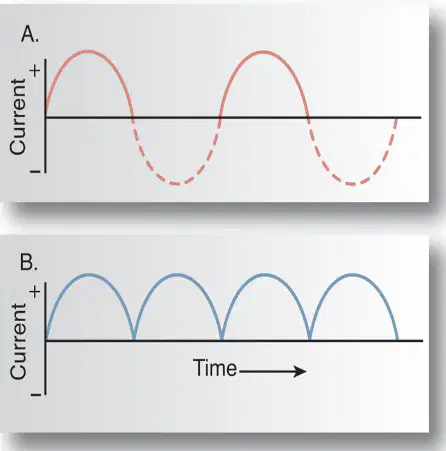
Looking at the two waveforms shown (A and B), which change would most directly convert A into B for single-phase power?
Increasing amplitude of the sine wave
Reducing the frequency by half
Full-wave rectification of the AC signal
Adding two more phase-shifted sources
Why does three-phase power help prevent tube damage during exposures?
Heat delivery is gradual rather than in spurts
Electrons completely stop between cycles
Anode receives fewer total electrons overall
Filament temperature oscillates to cool rapidly
What is the primary purpose of rectification in medical imaging power supplies?
Increase voltage without changing polarity
Reverse DC into alternating bidirectional flow
Convert AC into usable DC for the tube
Reduce current ripple using capacitors only
Which statement best describes a rectifier in an X‑ray generator circuit?
Device that permits one‑direction electron flow
Component that stores charge for later release
Switch that alternates cathode and anode roles
Sensor that monitors tube heat capacity
Half‑wave versus full‑wave rectification: which comparison is accurate?
Half‑wave passes one half; full‑wave flips negatives positive
Half‑wave doubles frequency; full‑wave blocks both halves
Half‑wave smooths output; full‑wave increases resistance
Half‑wave creates constant polarity; full‑wave alternates
Select all true statements about solid‑state diodes used as rectifiers.
They convert DC back to AC after the transformer
They ensure correct cathode‑to‑anode flow
They require moving mechanical parts
They are semiconductor one‑way valves
Where are rectifiers positioned within an X‑ray generator?
After the tube and before the collimator
Between step‑up transformer and X‑ray tube
Before the primary side of autotransformer
Inside the image receptor assembly
What output characteristic results from full‑wave rectification compared to half‑wave?
Lower voltage with greater heat loss
Smoother, more efficient DC output
Alternating polarity with zero average
Complete blocking of the positive half
MATCH the rectification type to its defining action.
Half‑wave rectifier
Blocks one half of AC cycle
Full‑wave rectifier
Flips negative half to positive
Solid‑state diode
Acts as one‑direction current valve
A student claims: “Rectifiers are optional because AC can drive X‑ray production directly.” What is the best response?
Partly true; AC works if frequency is very high
Incorrect; DC is required for proper electron flow
Correct; AC naturally produces steady anode current
Irrelevant; rectifiers only regulate tube temperature
Which statement best describes a solid-state X-ray control component?
Uses no moving parts; current flows in solids
Uses spinning parts; current flows in air gaps
Uses liquid switches; current flows in electrolytes
Uses mechanical relays; current flows through gaps
Match each term to its definition.
Solid-state
No moving parts; current flows in a solid
Semiconductor
Partly conducts; between conductor and insulator
Diode
One-way valve; current in only one direction
Which statements are true about a semiconductor material? Select all that apply.
It allows current only one direction
It does not conduct as freely as metal
It partly conducts electrical current
It behaves exactly like an insulator
In rectifying an X-ray generator’s AC to DC, which component primarily enforces one-way current flow?
Mechanical commutator brushes
Semiconductor lattice structure
Solid-state housing enclosure
Diode acting as a one-way valve
Which section of the X-ray system determines when and how long exposure occurs?
Primary circuit at the control panel
Secondary circuit high-voltage section
Filament circuit near the cathode
X-ray tube housing assembly
The secondary circuit’s main role is to produce what for X-ray production?
Low resistance for filament heating
Alternating current for timing signals
Mechanical motion for anode rotation
High voltage for accelerating electrons
What does the filament circuit directly control in the X-ray tube?
Line voltage entering generator
Length of exposure in seconds
Peak kilovoltage applied to tube
Tube current measured in mA
Match each circuit section to its primary function.
Primary circuit
Control and preparation of exposure
Secondary circuit
Power and X-ray production
Filament circuit
Regulates tube current (mA)
Which component allows power to enter the system by turning the unit on or off?
Exposure switch at the console
High-voltage rectifier assembly
Main switch on the control panel
Step-up transformer input
Which device ends the exposure after a precisely preset time?
mA selector in the filament circuit
Rectifier in the secondary circuit
Autotransformer in the filament
Timer in the primary circuit
Which list correctly identifies devices found in the secondary circuit?
Step-up transformer and rectification system
Autotransformer and line compensator
Collimator and rotating anode motor
Filament transformer and rheostat
Select all statements that describe the filament circuit.
Ensures current flows in one direction
Determines quantity of X-rays produced
Controls how many electrons are boiled off
Increases voltage to the kVp range
The X-ray generator modifies incoming current and boosts voltage mainly to:
Power ancillary room equipment
Reduce patient dose through filtration
Calibrate the automatic exposure control
Reach the range needed for X-ray production
Pressing the exposure switch primarily permits what immediate event?
Timer resets to standby mode
kVp drops to protect the tube
Filament cools to reduce mA
Current flows to initiate exposure
Which statement best distinguishes the primary and secondary circuits?
Primary raises kVp, secondary heats filament
Primary handles control, secondary supplies power
Primary accelerates electrons, secondary selects mA
Primary rectifies current, secondary times exposure
Which component adjusts and selects the desired kilovoltage before it is increased to high voltage?
Rectifier diodes after the transformer
Step-up transformer in the secondary
Autotransformer in the primary circuit
High-voltage cables to the tube
What is the main function of the primary (low-voltage) circuit in an X-ray system?
Convert DC back to alternating current
Produce high voltage and move electrons
Control and prepare power before the X-ray tube
Shield the tube from scattered radiation
Which device increases voltage to the kilovolt range required for X-ray production?
Step-up transformer
Timer
Line voltage compensator
Autotransformer
Select all components that protect or manage incoming power quality before high-voltage generation.
Rectifiers after the transformer
High-voltage cables to the tube
Line voltage compensator
Circuit breakers or fuses
Match each component to its primary function.
Main power switch
Allows power into the system
Exposure switch
Starts current flow for exposure
Timer
Stops exposure after a preset time
kVp selector
Lets operator choose exposure voltage
Rectifiers
Convert AC to DC one-way flow
Which statement best describes the role of rectifiers in the secondary circuit?
They convert AC to DC for one-way current
They adjust line voltage for consistency
They choose the exposure kilovoltage
They carry high voltage to the X-ray tube
During an exposure, which two components directly control when current starts and when it stops?
Exposure switch and timer
kVp selector and cables
Main switch and rectifiers
Compensator and step-up
Which part safely transports the high voltage from the generator to the X-ray tube?
High-voltage cables
Autotransformer
Line compensator
Circuit breakers
In the X-ray tube, which event directly produces X-rays?
Voltage carried by the high-voltage cables
Electrons striking the anode target
Kilovoltage selected by the autotransformer
Current converted to DC by rectifiers
A technologist notices inconsistent incoming voltage from the wall supply. Which primary-circuit device corrects this to maintain stable operation?
High-voltage cables
Line voltage compensator
Step-up transformer
Rectifier assembly
Which component primarily determines how many electrons are released from the filament in an X‑ray tube?
Oil cooling system around tube
mA selector on the control panel
Step-up transformer in the circuit
Anode target rotation speed
What is the main purpose of the step‑down transformer in the filament circuit?
Reduce voltage and increase current
Increase voltage and reduce current
Stabilize frequency and phase
Store charge for later use
Thermionic emission refers to which process in the filament circuit?
Photons release from a cold anode
Protons drift through the vacuum
Electrons boil off a heated filament
Neutrons escape the focusing cup
Select ALL actions that directly increase the number of electrons available for X‑ray production.
Cooling the focusing cup
Raising the mA setting
Heating the filament wire
Reducing filament current
Match each filament circuit part to its function.
mA selector
Sets tube current value
Step‑down transformer
Lowers voltage, raises current
Filament wire
Releases electrons when heated
Focusing cup
Narrows electron cloud direction
Increasing the mA from 50 mA to 200 mA will most directly cause what change at the filament?
More electrons emitted per second
Higher photon energy at the anode
Lower heat at the filament wire
Wider focal spot without focusing
Where is the filament wire located within the X‑ray tube assembly?
At the cathode side of the tube
Embedded in the rotating anode
Outside the evacuated glass
Inside the primary transformer
What role does the focusing cup play after thermionic emission occurs?
Directs and narrows the electron cloud
Amplifies voltage to the anode
Removes heat from the cathode
Measures exposure time settings
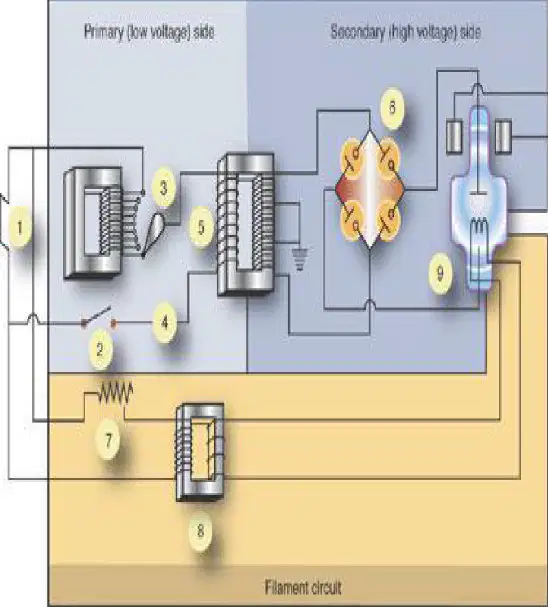
Which component supplies alternating current from the electrical source to power the X‑ray circuit?
Exposure switch on console
Four-diode rectifier bank
Timer circuit auto-stop
Main breaker (on/off switch)
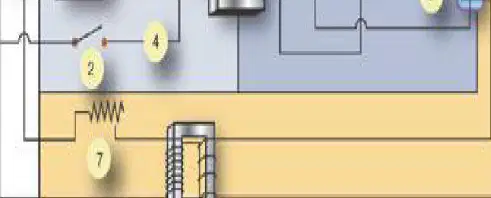
Pressing which control closes the circuit to start an exposure, allowing current to flow?
Exposure switch control
kVp selector knob
Rotor–stator assembly
mA selector rheostat
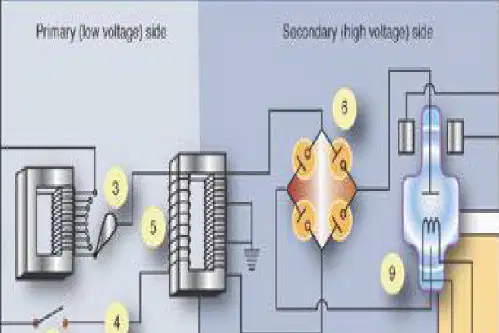
What is the primary function of the kVp selector in the X‑ray circuit?
Converts AC into DC for tube current
Stops exposure after the set time interval
Selects filament current to heat cathode
Adjusts peak kilovoltage to control beam energy
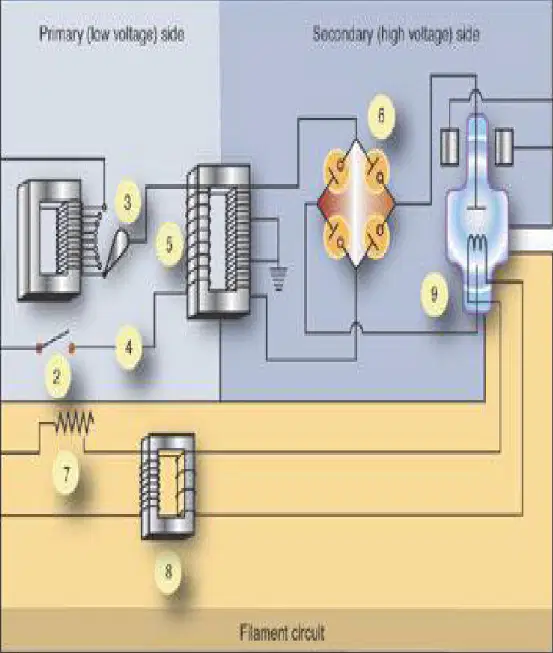
Match each primary-side component to its function.
Main breaker
Supplies AC power to circuit
Exposure switch
Closes circuit to initiate exposure
kVp selector
Sets peak kilovoltage for beam energy
Timer circuit
Stops exposure after selected time
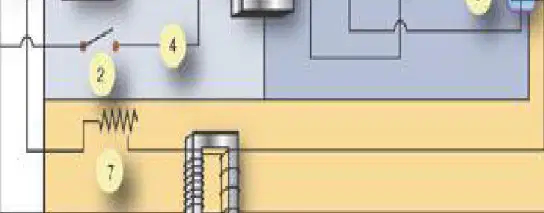
The timer circuit primarily controls which aspect of X‑ray production?
Focal spot size selection
Duration of exposure time
Anode rotation speed
Rectifier conduction direction
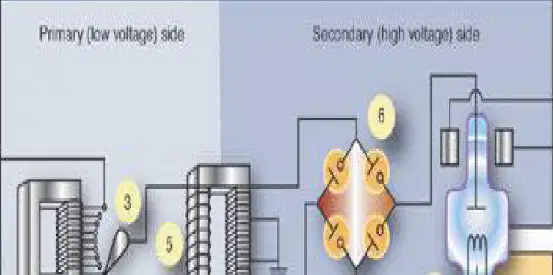
In the main X‑ray circuit, what does the high‑voltage step‑up transformer do?
Regulates rotor stator speed
Lowers voltage while increasing current
Raises voltage into kVp range
Rectifies AC into DC pulses
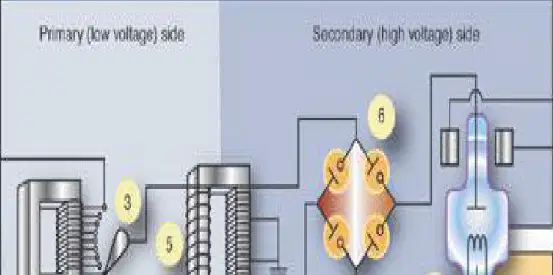
Which statement about the four‑diode rectification circuit is correct?
Times the exposure using electronic delay
Decreases voltage to protect the filament
Selects milliampere setting for tube current
Converts alternating current to direct current
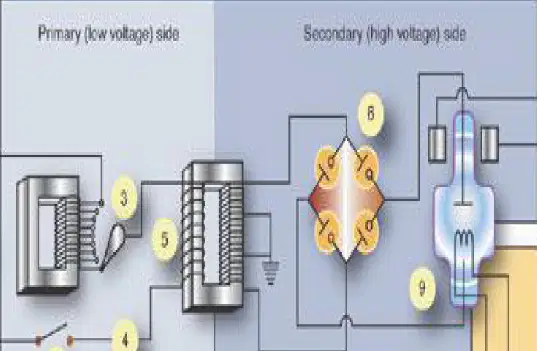
Select all components that directly control electron energy reaching the anode.
Timer circuit duration
mA selector rheostat
High‑voltage step‑up transformer
kVp selector setting
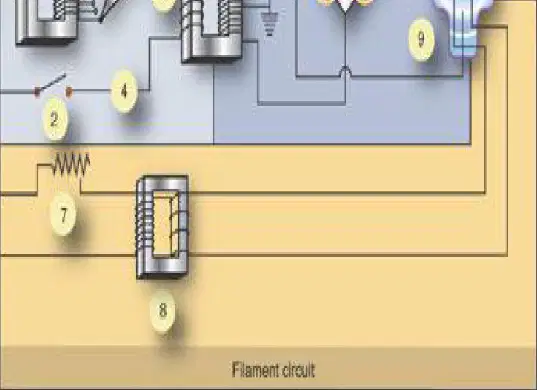
What is the role of the mA selector (rheostat) in the filament circuit?
Rectifies AC for tube current
Adjusts filament current to set mA
Stops exposure after preset time
Raises voltage to kVp levels
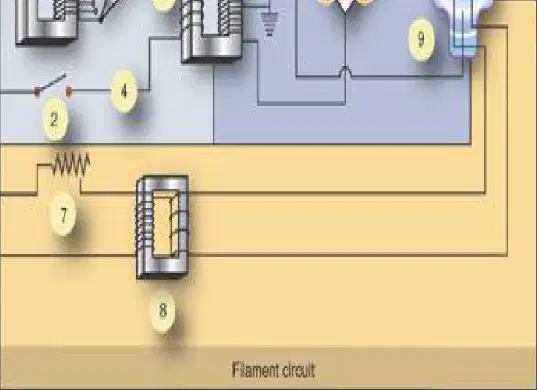
The filament step‑down transformer primarily:
Reduces voltage and boosts current
Filters ripple from rectified output
Increases voltage to accelerate electrons
Stores charge for timer hold
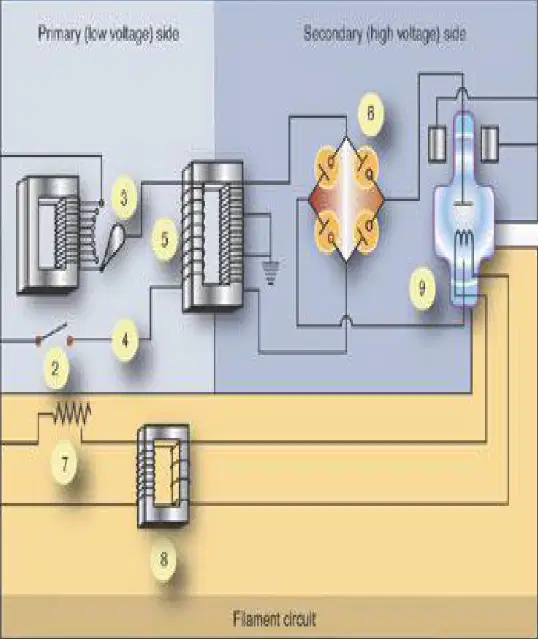
Match each secondary‑side component to its description.
Four‑diode rectifier
Converts AC to DC for tube current
X‑ray tube
Site where X‑rays are produced
Rotor–stator assembly
Rotates anode to spread heat
Which pair correctly links a quantity control with a quality control in the X‑ray circuit?
Main breaker and exposure switch
Timer circuit and rectifier
mA selector and kVp selector
Step‑down transformer and rotor
Which transformer in an X-ray circuit allows kVp selection by providing a small voltage increase before the step-up stage?
Step-down transformer primary
Step-up transformer secondary
Isolation transformer pair
Autotransformer with single winding
What feature distinguishes an autotransformer from other transformer types used in X-ray equipment?
Two separate secondary windings
Air core with split primaries
Rotating magnetic commutator
Single winding on an iron core
In a step-up transformer, how do voltage and current change between primary and secondary?
Both voltage and current decrease
Voltage increases, current decreases
Voltage decreases, current increases
Both voltage and current increase
Which statement about turns ratio in a step-up transformer is correct?
More turns on secondary than primary
More turns on primary than secondary
Turns number does not affect output
Equal turns on both windings
What is the main role of the step-up transformer in X-ray production?
Raise voltage to kVp range
Control exposure time
Stabilize filament temperature
Rectify alternating current
A step-down transformer is placed in the filament circuit primarily to achieve which outcome?
Decrease heat at the filament
Produce kilovoltage for xrays
Increase voltage to the anode
Increase current to the cathode
For a step-down transformer used for thermionic emission, which winding has more turns?
Turns are dynamically switched
Primary winding has more turns
Secondary winding has more turns
Both windings have equal turns
Match the transformer type to its primary effect.
Autotransformer
Small voltage increase, kVp selection
Step-up transformer
Increase voltage, decrease current
Step-down transformer
Decrease voltage, increase current
Which component do all three transformers described share in common?
A photoelectric control grid
An iron core for magnetic coupling
A vacuum tube for rectification
A rotating anode assembly
If the secondary coil has fewer turns than the primary coil, what happens to the output?
Both voltage and current rise
Voltage rises while current drops
Voltage drops while current rises
Both voltage and current drop
Which statement best explains why current changes inversely with voltage in ideal transformers?
Power conservation across windings
Core losses dominate behavior
Air gaps increase reluctance
DC bias saturates the core
Select all statements that are accurate for the step-up transformer in X-ray systems.
Used to raise voltage to kVp levels
Increases current to the filament circuit
Decreases current in proportion to voltage
Secondary has more turns than primary