
 Worksheets
Introduction to Artificial Intelligence
Total questions: 28
Worksheet time: 14mins
Which statement best defines artificial intelligence in engineering contexts?
Any software that automates repetitive office procedures
Hardware that increases computational speed for tasks
Machine capability to imitate human functions for goals
Human reasoning modeled without algorithmic implementation
Who is widely regarded as the father of artificial intelligence and coined the term in 1955?
Marvin Minsky
Geoffrey Hinton
Alan Turing
John McCarthy
Natural Language Processing primarily enables machines to do what?
Understand and generate human language reliably
Optimize power consumption in embedded systems
Control mechanical actuators with precision timing
Recognize objects in images and videos accurately
Deep learning is best described as which of the following?
A data compression method for reducing storage requirements
A rule-based AI relying on symbolic logic and ontologies
A hardware architecture for parallel mathematical operations
A specialized form of ML using multilayer neural networks
Which scenario most appropriately requires Generative AI rather than traditional ML?
Creating original text, images, or code from prompts
Classifying emails into spam or non-spam categories
Detecting fraudulent transactions in large datasets
Estimating house prices from structured numeric features
An AI system is described as learning from data without constant human assistance. Which subfield does this describe?
Machine Learning
Computer Graphics
Operations Research
Human–Computer Interaction
Which application pairing aligns with the listed AI domain?
Transportation: road repairs and driver license issuance
Healthcare: medical diagnosis and image analysis
Finance: manual reconciliation and branch scheduling
Customer service: in-person concierge and call routing
An engineer must choose an AI technique to power a customer-support chatbot that both understands queries and drafts responses. Which combination is most justified?
Graph optimization with deterministic shortest paths
Image segmentation with a convolutional pipeline
Reinforcement learning with robotic control policies
NLP capabilities with a generative model for responses
Which statement best defines machine learning in engineering contexts?
A database method storing data without using algorithms
A subset of AI learning patterns from data for decisions
A hardware discipline optimizing circuits for computation
A field creating rules explicitly programmed for tasks
In supervised learning, what distinguishes the training data?
It excludes any patterns that can be learned
It contains only numerical features without targets
It is labeled with known outcomes for each example
It is collected from agents exploring environments
Which scenario best fits unsupervised learning?
Predicting loan default using past labeled defaults
Grouping customers by behavior without predefined labels
Training an agent to play a game via reward signals
Filtering emails using a labeled spam dataset
Reinforcement learning primarily involves an agent that
Learns from labeled examples to predict categories
Discovers clusters from unlabeled data distributions
Learns through trial and error to maximize cumulative rewards
Memorizes training data to minimize reconstruction error
A team wants to segment users to discover new marketing groups but has no labeled outcomes. Which learning paradigm should they choose, and why?
Supervised learning, because labeled targets guide segmentation
Rule-based AI, because explicit logic identifies clusters
Unsupervised learning, because hidden structures can be discovered
Reinforcement learning, because rewards drive classification
Which pair correctly matches paradigm and typical application?
Supervised learning — customer segmentation discovery
Unsupervised learning — labeled spam email filtering
Reinforcement learning — decision making via reward optimization
Rule-based systems — learning patterns from large datasets

Which role is explicitly shown guiding the supervised learning process in the diagram?
Critic evaluating reward functions
Supervisor aligning desired outputs
Oracle generating random features
Environment providing observations

In the unsupervised learning figure, what is stated about outputs during training?
Outputs are predefined by labels
Outputs are validated by rewards
Outputs are unknown during training
Outputs are fixed by supervisors

Which tasks are highlighted as primary uses of unsupervised learning in the diagram?
Policy optimization in agents
Classification and regression
Clustering and dimensionality reduction
Hyperparameter grid searching
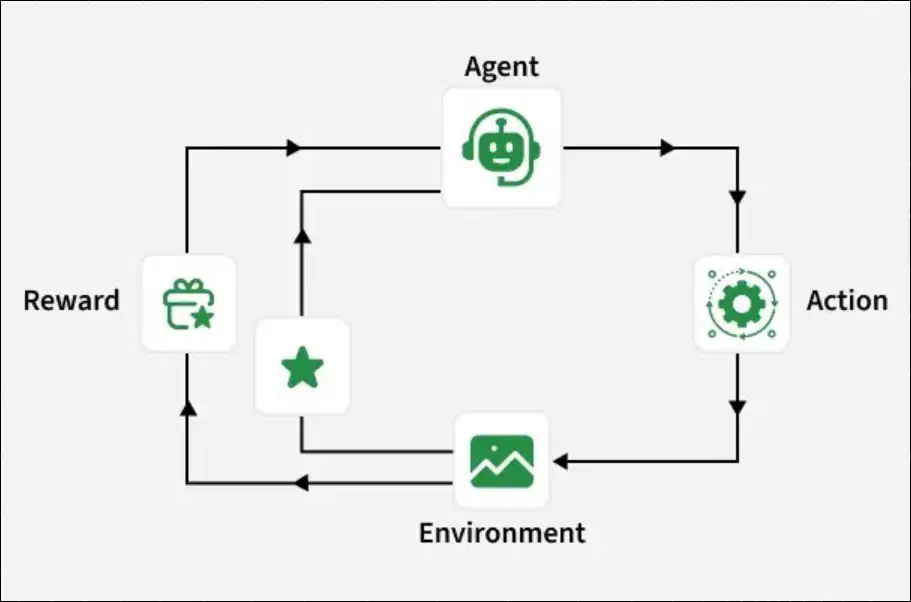
In reinforcement learning, which sequence best matches the interaction loop shown?
Model processes inputs, labels compared, loss minimized
Dataset clusters, algorithm reduces, labels assigned
Supervisor labels data, algorithm trains, output predicts
Agent takes action, environment responds, reward updates
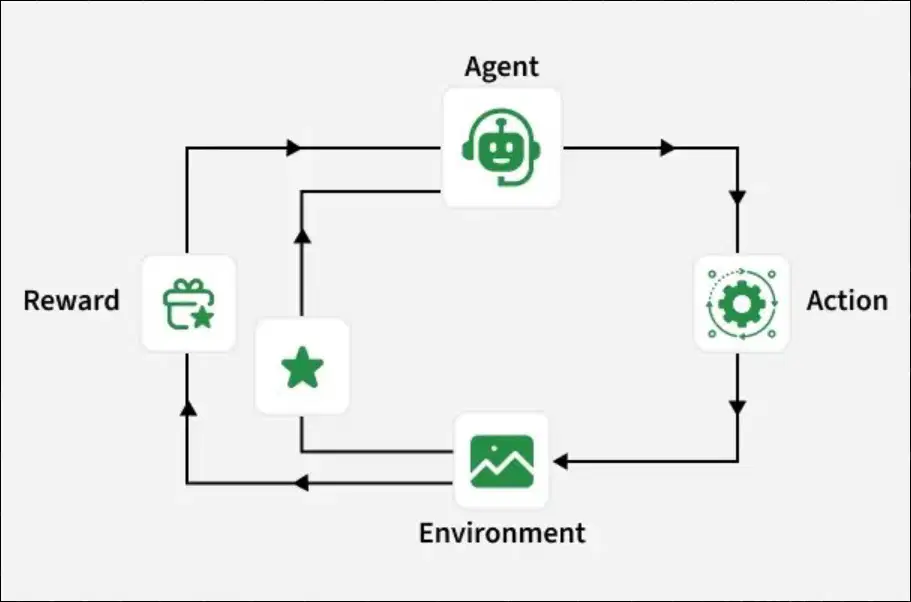
According to the reinforcement learning diagram, what feedback drives learning over time?
Cluster memberships from features
Rewards and penalties from environment
Unknown outputs without datasets
Manual labels from supervisors
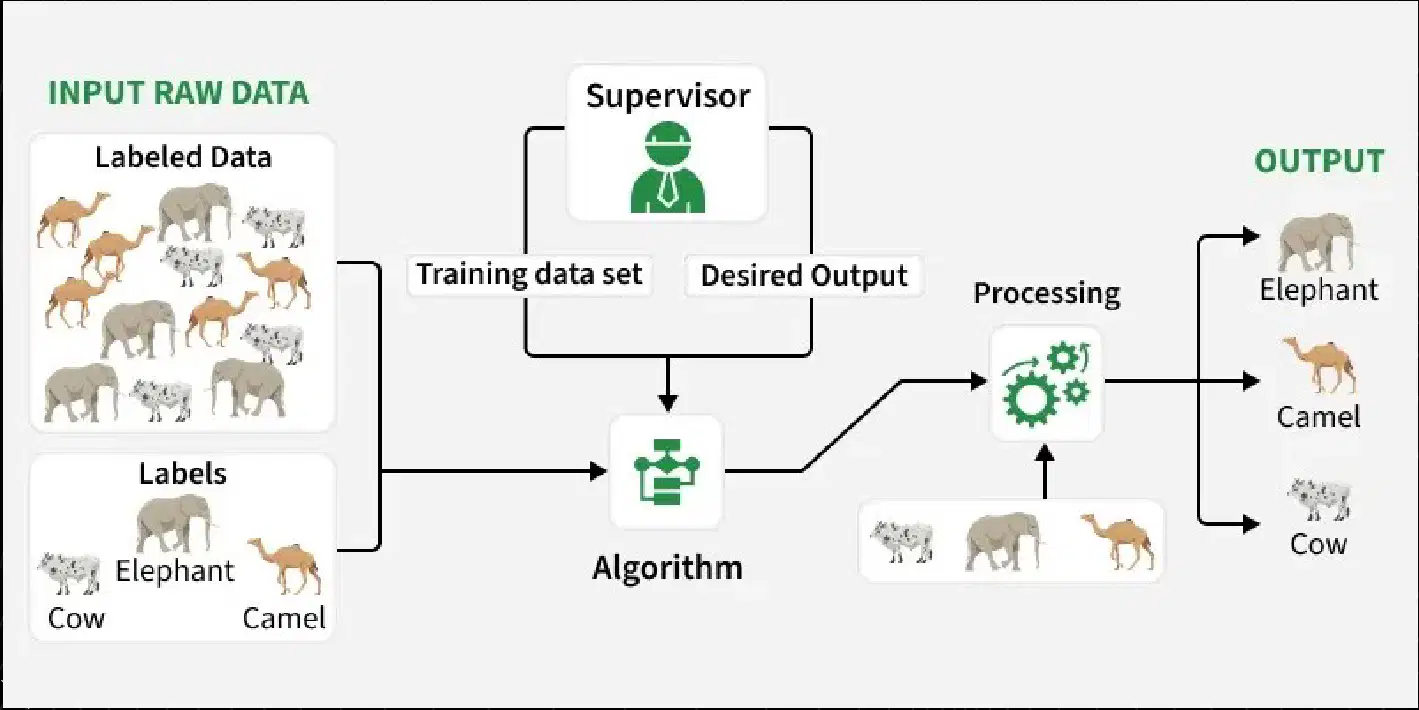
From the supervised diagram, which example best fits the model’s output type?
Dimensionality-reduced feature map
Cluster index without ground truth
Estimated reward for each action
Predicted class like elephant or camel

A dataset of animal images without labels is processed to find groups and reduce features before visualization. Which paradigm and pipeline align with this goal?
Unsupervised learning with interpretation and processing
Supervised learning with supervisor and labels
Reinforcement learning with rewards and actions
Semi-supervised learning with few labels
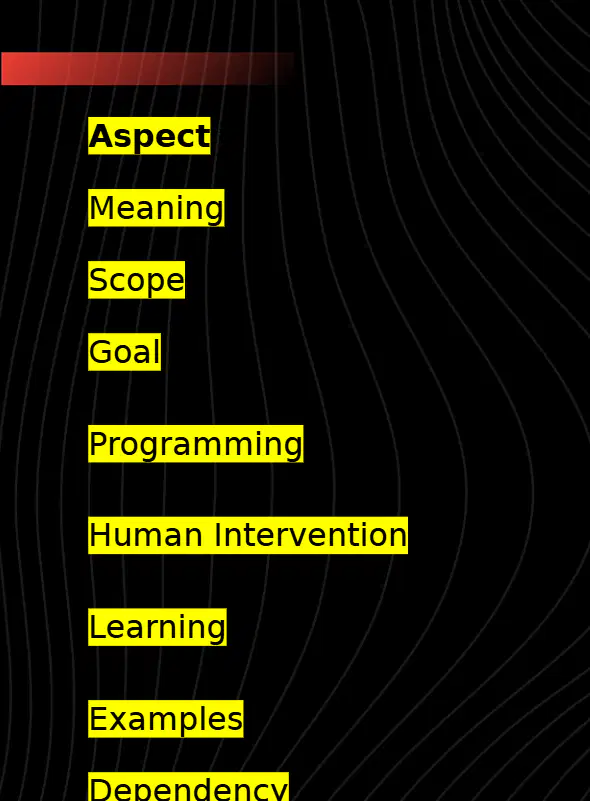
Which statement best captures the scope relationship between Artificial Intelligence (AI) and Machine Learning (ML)?
AI is a subset within ML scope
ML and AI have identical scope
ML is a subset within AI scope
AI and ML are disjoint fields
What is the primary goal distinction between AI and ML?
AI aims to mimic human emotions
AI aims to make machines think and act like humans
ML aims to replace all programming with rules
ML aims to improve performance using experience
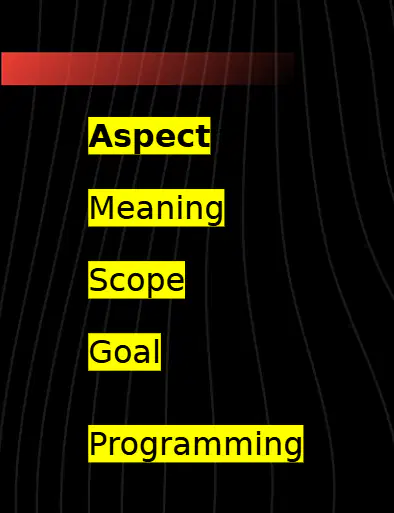
Which pairing correctly matches the programming approach emphasized by each field?
AI: rule-based or data-driven; ML: mostly data-driven
AI: mostly data-driven; ML: rule-based only
AI: statistical only; ML: symbolic only
AI: deterministic only; ML: probabilistic only

Regarding human intervention, which statement aligns with the comparison?
ML decisions never need human involvement
AI requires extensive human oversight during decisions
AI requires humans to label no data at all
ML requires intervention for training and model selection
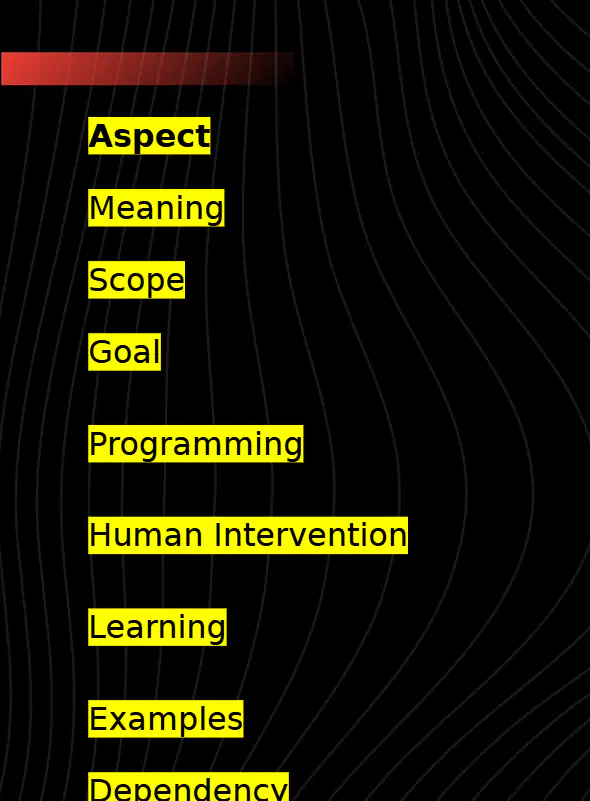
Which example aligns best with the field it illustrates?
Robots illustrate ML pipelines primarily
Spam filtering and recommendations illustrate AI
Spam filtering and recommendations illustrate ML
Chatbots and expert systems illustrate ML
Choose the accurate statement about learning dependencies in each field.
AI always involves learning algorithms
ML may or may not involve learning
AI may or may not involve learning
ML rarely involves learning components
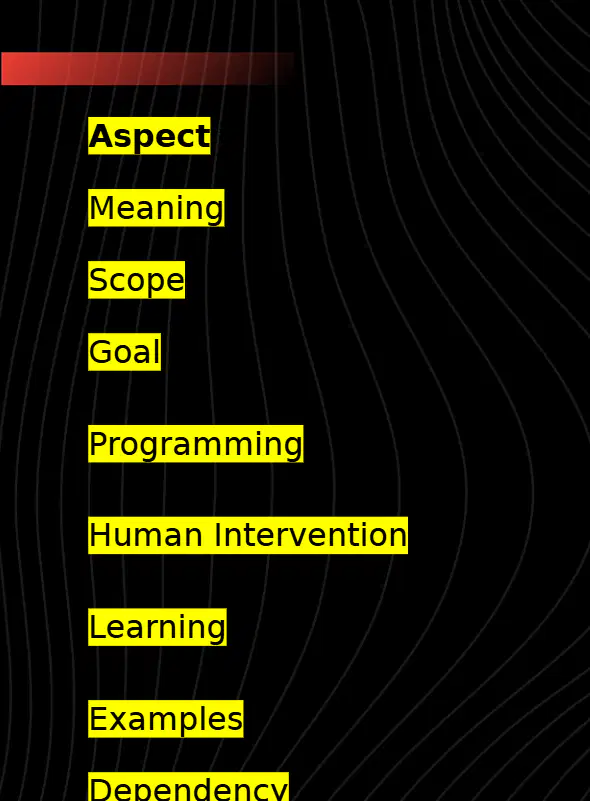
Which dependency relationship is correctly stated?
AI depends on ML concepts to function
Neither AI nor ML depends on each other
Both AI and ML always require each other
ML depends on AI concepts in many cases