
NEW
Font size
 Worksheets
CNS001_Q1
Total questions: 20
Worksheet time: 10mins
Which statement best captures the core purpose of security in an IT context?
Protect assets through prevention, detection, and recovery
Ensure systems operate faster under heavy network load
Eliminate all risks by blocking every external connection
Focus mainly on software updates for operating systems
Network security primarily aims to protect which combination of properties for data and networks?
Integrity, confidentiality, and availability
Scalability, usability, and portability
Bandwidth, latency, and throughput
Redundancy, virtualization, and automation
Which example best illustrates the detection aspect of security measures?
Applying access control lists to prevent unauthorized logins
Using monitoring to identify when and by whom assets were altered
Configuring backups to restore lost files quickly
Encrypting data to keep transmitted information unreadable
Which consequence is a likely impact of a network security breach on organizations and society?
Guaranteed protection of intellectual property and user safety
Immediate improvements in e-commerce performance
Lost revenue, privacy threats, and compromised information integrity
Increased public trust and reduced legal exposure
Which term best describes anything of value to an organization, including people, equipment, resources, and data?
Asset
Risk
Threat
Exploit
A weakness in a system or its design that could be leveraged by a threat is called a:
Vulnerability
Mitigation
Functionality
Asset
Which term refers to a potential danger to a company’s assets, data, or network functionality?
Mitigation
Threat
Exploit
Risk
In security, what is a mechanism that takes advantage of a vulnerability?
Exploit
Asset
Policy
Backup
Which option best defines mitigation in network security?
Counter-measure that reduces likelihood or severity
Probability that an event will occur
Inventory of valuable organizational items
Process that increases exposure to attacks
Risk in information security is best described as:
List of organizational hardware resources
Likelihood a threat exploits a vulnerability
Tool used to patch software defects
Confirmed attack with known impact
In the diagram, what does the term attack vector most closely refer to?
A backup process for disaster recovery
A firewall rule that blocks all traffic
A device that stores encryption keys only
A path used to gain unauthorized access
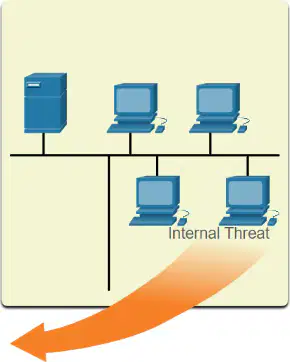
Based on the visuals, which scenario best represents an external threat entering a network?
Admin reboots a core switch at noon
Employee moves laptops between offices
Printer updates drivers overnight
Malware from Internet bypasses firewall
Which internal user action is most likely to directly compromise infrastructure devices?
Requesting Wi‑Fi password resets
Changing desktop wallpaper weekly
Archiving emails to local folders
Installing rogue firmware on a switch
Why can internal threats cause greater damage than external threats?
Outsiders always lack network connectivity
Firewalls fully stop all external attacks
Backups instantly undo insider mistakes
Insiders have direct access and knowledge
Which statement best defines data loss or data exfiltration in an organization?
Data is archived for future regulatory audits
Data is intentionally or unintentionally exposed externally
Data is migrated to a new internal database
Data is compressed to reduce storage costs
Which item is a direct consequence of data loss for a company?
Reduced legal scrutiny and penalties
Immediate increase in customer loyalty
Improved market share and pricing power
Brand damage and loss of reputation
Which example best matches the data loss vector: Unencrypted Devices?
A patched OS prevents exploitation during travel
A stolen laptop reveals files due to no encryption
A VPN timeout logs the user out automatically
A firewall blocks all inbound connections overnight
Sensitive data could be exposed if cloud storage is misconfigured. Which description aligns with this vector?
Excessive on-premises backups consume storage space
Weak cloud security settings allow unauthorized access
Frequent password changes frustrate end users
Single sign-on consolidates authentication events
Which practice mitigates the data loss vector related to hard copy records?
Store paper records in unlocked desk drawers
Email printed pages to the compliance mailbox
Scan and upload files to any public folder
Shred confidential documents when no longer needed
A USB drive with corporate files goes missing after an office move. Which vector and impact pair is most accurate?
Cloud vector; automatic gain of competitive edge
Hard copy vector; improved legal compliance
Email vector; guaranteed loss of all customers
Removable media vector; potential loss of revenue

