

Wayground
Grammar quiz: Homophones, Homographs, & Homonyms - Printable English Worksheets série 5 - Wayground

Grammar quiz: Homophones, Homographs, & Homonyms

22 questões

4th - 6th Série

English

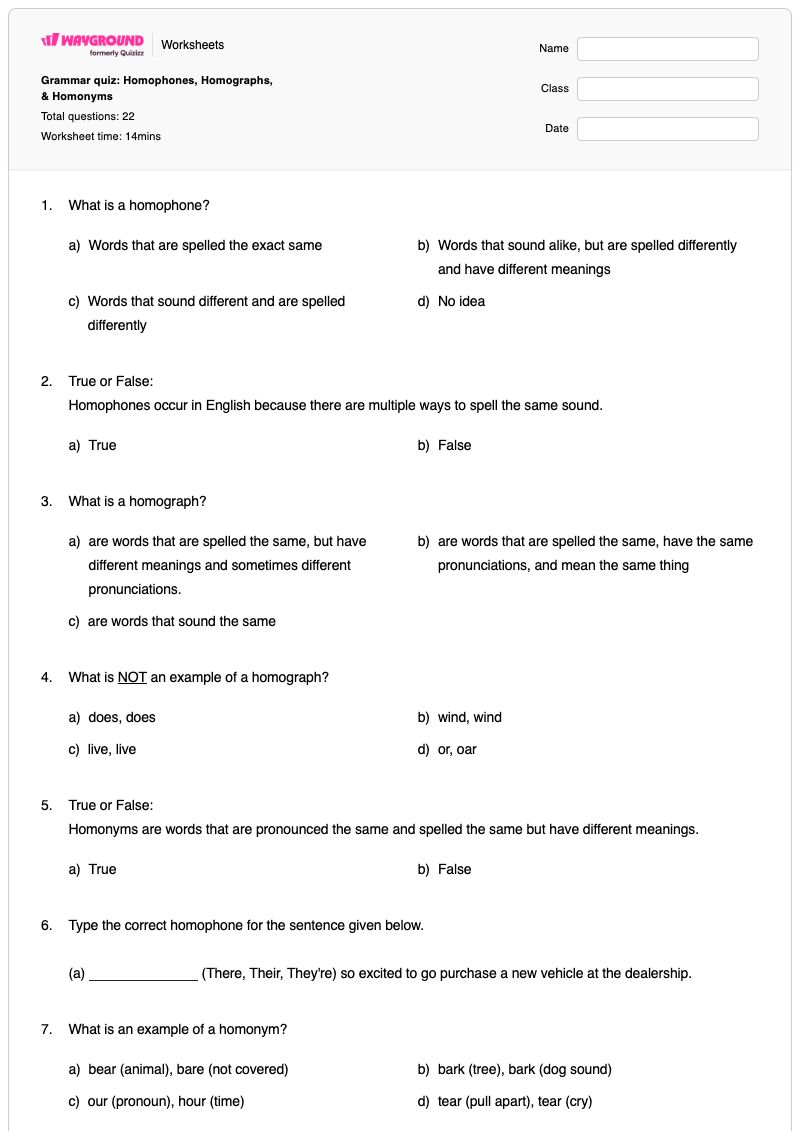
Esta folha de exercícios de inglês gratuita para alunos do 4º ao 6º ano ajuda os estudantes a distinguir homófonos, homógrafos e homônimos. Inclui 21 questões de múltipla escolha e uma questão de preenchimento de lacunas que pedem aos alunos que identifiquem definições de grupos de palavras, reconheçam exemplos e contraexemplos, interpretem homógrafos como “bow”, “present”, “light” e “spring” em contexto e escolham homófonos com a grafia correta, como “too”, “your/you’re”, “loose/lose” e “there/their/they’re”. Os alunos desenvolvem vocabulário e precisão gramatical ao conectar ortografia, pronúncia, significado e contexto da frase. A questão de preenchimento de lacunas exige que os alunos selecionem a forma correta de “they’re”, enquanto as questões de múltipla escolha verificam tanto a terminologia quanto a aplicação. Use esta folha de exercícios gratuita para prática independente, revisão ou uma breve avaliação e utilize o gabarito incluso para verificar a compreensão de forma eficiente.

Configurações da planilha

Tamanho da fonte

S
M
L
XL
Lista de exercícios

Grammar quiz: Homophones, Homographs, & Homonyms

Total de perguntas: 22

Nome
Turma
Data
1.
What is a homophone? 
a)
Words that are spelled the exact same 
b)
Words that sound alike, but are spelled differently and have different meanings
c)
Words that sound different and are spelled differently 
d)
No idea
2.
True or False: 
Homophones occur in English because there are multiple ways to spell the same sound. 
a)
True
b)
False
3.

What is a homograph?

a)

are words that are spelled the same, but have different meanings and sometimes different pronunciations.

b)

are words that are spelled the same, have the same pronunciations, and mean the same thing

c)

are words that sound the same

4.

What is NOT an example of a homograph?

a)

does, does

b)

wind, wind

c)

live, live

d)

or, oar

5.

True or False:

Homonyms are words that are pronounced the same and spelled the same but have different meanings.

a)

True

b)

False

6.

Type the correct homophone for the sentence given below.


(a)   (There, Their, They're) so excited to go purchase a new vehicle at the dealership.

7.

What is an example of a homonym?

a)

bear (animal), bare (not covered)

b)

bark (tree), bark (dog sound)

c)

our (pronoun), hour (time)

d)

tear (pull apart), tear (cry)

8.

The singer made a low bow to the audience after the concert.

a)

decorative ribbon (rhymes with so)

b)

bend at the waist (rhymes with how)

c)

a weapon for shooting arrows

9.

All the students were present today.

a)

a gift

b)

existing or occurring now

c)

give (rhymes with resent)

d)

here (rhymes with pleasant)

10.

Can I go to the party _______?

a)

too

b)

to

c)

two

d)

toe

11.

The grocery bag was light because it was packed with bread and hotdog buns.

a)

not heavy

b)

sunshine

c)

to illuminate

d)

bright

12.

Carlo's pants were much too _____________ after his weight loss.

a)

loose

b)

lose

c)

loss

d)

lost

13.

______ my best friend.

a)

your

b)

you're

14.
Spring is my favorite time of the year. 
a)
A season 
b)
A coil of metal that bounces 
15.
Select the correct homophone.
(Theirs/There's) not going to be school on President's day! 
a)
Theirs
b)
There's
16.

What is: bass, bass

a)

homophone

b)

homonym

c)

homograph

d)

N/A

17.

What is: bat, bat?

a)

homophone

b)

homonym

c)

homograph

d)

n/a

18.

What is: buy and by?

a)

homophone

b)

homonym

c)

homograph

d)

n/a

19.

What is: tail, tale

a)

homophone

b)

homonym

c)

homograph

d)

n/a

20.

What is a homonym?

a)

Words that are spelled the same and sound the same but have different meaning.

b)

Words that spelled differently, but sound the same and have different meaning.

c)

Words that are spelled the same but sound different and have a different meaning.

d)

Words that sound the same, are spelled the same and mean the exact same thing.

21.

What is: live, live

a)

homophone

b)

homonym

c)

homograph

d)

n/a

22.

What is: bark, bark

a)

homophone

b)

homonym

c)

homograph

d)

n/a

Chave de respostas

Grammar quiz: Homophones, Homographs, & Homonyms

Total de perguntas: 22

1.
b) Words that sound alike, but are spelled differently and have different meanings
2.
a) True
3.
a)

are words that are spelled the same, but have different meanings and sometimes different pronunciations.

4.
d)

or, oar

5.
a)

True

6.
They're, they're
7.
b)

bark (tree), bark (dog sound)

8.
b)

bend at the waist (rhymes with how)

9.
d)

here (rhymes with pleasant)

10.
a)

too

11.
a)

not heavy

12.
a)

loose

13.
b)

you're

14.
a) A season 
15.
b) There's
16.
c)

homograph

17.
b)

homonym

18.
a)

homophone

19.
a)

homophone

20.
a)

Words that are spelled the same and sound the same but have different meaning.

21.
c)

homograph

22.
b)

homonym

Perguntas frequentes

O que esta folha de exercícios abrange e como ela ajuda os alunos a distinguir homófonos, homógrafos e homônimos?

Esta folha de exercícios de inglês para alunos do 4º ao 6º ano utiliza 21 questões de múltipla escolha e uma questão de preenchimento de lacunas para ensinar como homófonos, homógrafos e homônimos diferem em ortografia, pronúncia e significado. Os alunos aplicam essas distinções interpretando palavras como “bow”, “present”, “light” e “spring” em contexto e selecionando as formas escritas corretamente, como “too”, “you’re” e “there’s”.

Como posso usar esta folha de exercícios para ensinar homófonos, homógrafos e homônimos?

Apresente as três categorias de palavras com as perguntas de definição da folha de exercícios e, em seguida, demonstre como o contexto altera o significado de palavras como "bow" (arco) e "present" (presente). Peça aos alunos que expliquem por que "or/oar" (outro/remo) não é um homógrafo e por que "bark" (latido/casca) é um homônimo antes de completarem os itens de ortografia contextual, incluindo "too/to/two" (também/para/dois) e "there/their/they're" (lá/deles/eles são).

Que erros devo observar quando os alunos completarem esta folha de exercícios sobre homófonos, homógrafos e homônimos?

Os alunos podem confundir palavras que compartilham o mesmo som com palavras que compartilham a mesma grafia, especialmente ao classificar palavras como “bark” (latido), “tear” (lágrima), “wind” (vento) e “live” (viver). Nos exemplos de frases, fique atento à escolha de uma forma familiar sem verificar o significado ou a gramática, como “your” (seu/sua) em vez de “you’re” (você/você é), “lose” (perder) em vez de “loose” (solto/solto) ou “theirs” (deles/delas) em vez de “there’s” (lá/há).

Como faço para atribuir e avaliar esta folha de exercícios sobre homófonos, homógrafos e homônimos?

Você pode atribuir esta folha de exercícios como um PDF para impressão ou como um questionário digital no Wayground. Ela inclui um gabarito completo, e as versões impressas podem ser corrigidas por meio da digitalização do trabalho do aluno com o aplicativo Wayground para Professores. A opção de impressão também pode ser útil para escolas que desejam reduzir o tempo de tela enquanto os alunos praticam a escolha de palavras em contexto.

Como posso adaptar esta folha de exercícios para meus alunos?

Nas Configurações Avançadas da folha de exercícios, ajuste o espaçamento e o tamanho da fonte para facilitar a leitura da definição, do contexto e dos itens de escolha de homônimos. Você também pode ativar uma fonte adequada para disléxicos ou traduzir a folha de exercícios para outro idioma, caso seja útil para alunos que estejam trabalhando com questões de escolha de palavras como “there/their/they’re”, “your/you’re” e outras.

Onde posso encontrar mais fichas de exercícios como esta no Wayground?

A Wayground oferece uma ampla coleção de planilhas e exercícios imprimíveis gratuitos em diversas disciplinas, com PDFs para download e gabaritos para ajudar os alunos a dominar habilidades e conceitos essenciais. Explore mais recursos em https://wayground.com/en-us/worksheets.