
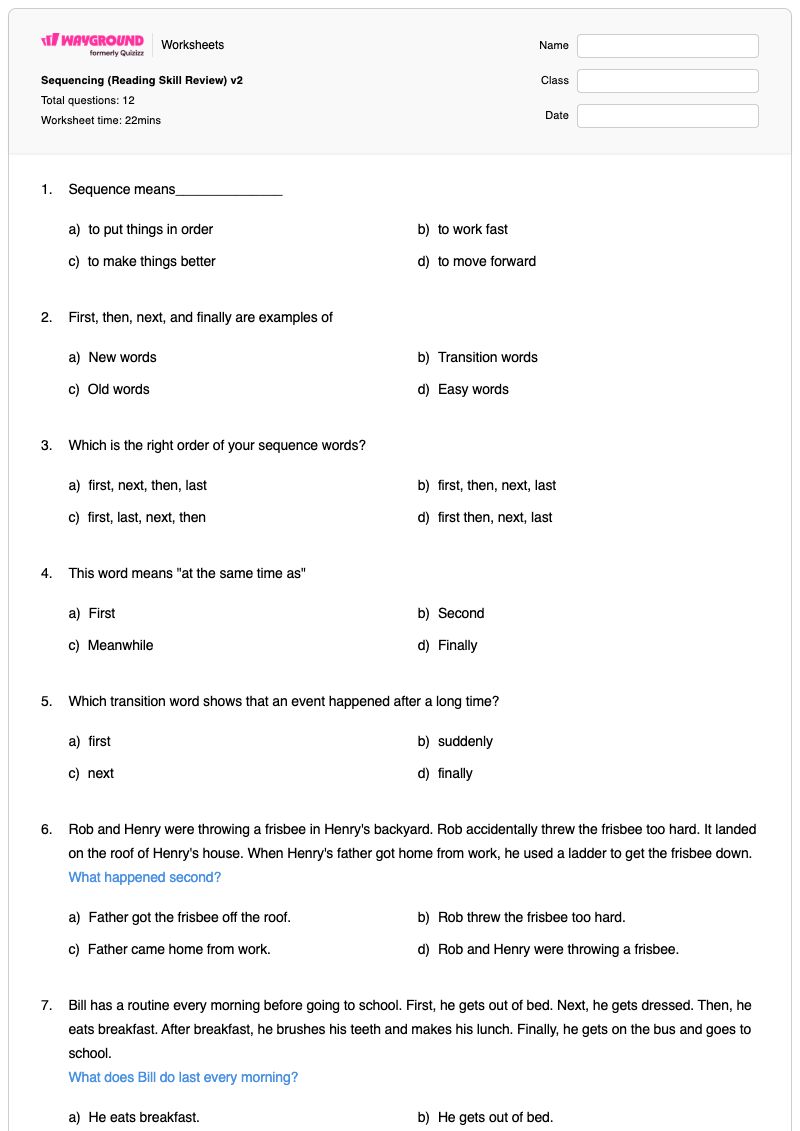

A atividade "Sequenciamento (Revisão de Habilidades de Leitura) v2" ajuda alunos do 4º ao 6º ano a identificar e aplicar palavras de sequência e transição em contexto. Esta folha de exercícios de inglês com 12 questões aborda o significado e a ordem de palavras como "primeiro", "em seguida", "depois", "finalmente" e "enquanto isso", incluindo como as palavras de transição sinalizam eventos que acontecem posteriormente, após um longo período ou simultaneamente.
Os alunos também usam pistas de sequência para determinar o que aconteceu em segundo lugar, por último ou imediatamente após um evento em pequenos cenários e textos de leitura. As questões incluem rotinas diárias, eventos históricos e trechos narrativos, proporcionando aos alunos prática na ordenação de eventos e na interpretação de transições, em vez de memorizar definições isoladas. Esta folha de exercícios gratuita e imprimível é útil para revisão de habilidades de leitura, prática independente ou uma verificação rápida de compreensão, e inclui um gabarito completo para uma correção eficiente.
Configurações da planilha
Tamanho da fonte
S
M
L
XL
Lista de exercícios
Sequencing (Reading Skill Review) v2
Total de perguntas: 12
Nome
Turma
Data
1.
Sequence means______________
a)
to put things in order
b)
to work fast
c)
to make things better
d)
to move forward
2.
First, then, next, and finally are examples of
a)
New words
b)
Transition words
c)
Old words
d)
Easy words
3.
Which is the right order of your sequence words?
a)
first, next, then, last
b)
first, then, next, last
c)
first, last, next, then
d)
first then, next, last
4.
This word means "at the same time as"
a)
First
b)
Second
c)
Meanwhile
d)
Finally
5.
Which transition word shows that an event happened after a long time?
a)
first
b)
suddenly
c)
next
d)
finally
6.
Rob and Henry were throwing a frisbee in Henry's backyard. Rob accidentally threw the frisbee too hard. It landed on the roof of Henry's house. When Henry's father got home from work, he used a ladder to get the frisbee down. What happened second?
a)
Father got the frisbee off the roof.
b)
Rob threw the frisbee too hard.
c)
Father came home from work.
d)
Rob and Henry were throwing a frisbee.
7.
Bill has a routine every morning before going to school. First, he gets out of bed. Next, he gets dressed. Then, he eats breakfast. After breakfast, he brushes his teeth and makes his lunch. Finally, he gets on the bus and goes to school. What does Bill do last every morning?
a)
He eats breakfast.
b)
He gets out of bed.
c)
He goes to school.
d)
He gets dressed.
8.
During the Age of Discovery, Europeans began to colonize North America. The Spanish started a settlement at St. Augustine, Florida in 1565. Forty-two years later, the English started a colony at Jamestown, Virginia. Then, in 1608 the French had started a colony in what is now Canada. What happened right after the English started a colony at Virginia?
a)
Europeans began to colonize North America.
b)
The French started a colony in what is now Canada.
c)
The Spanish started a settlement in Florida.
d)
The Age of Discovery started.
9.
Darrell realized that his rabbit was missing. Then, he noticed tiny footprints on the table.
What does the transition word thenshow?
a)
It shows that Darrell noticed footprints after he realized his rabbit was missing.
b)
It shows that Darrell noticed footprints before he realized his rabbit was missing.
c)
It shows that Darrell noticed footprints after a very long time.
10.
Darrell followed the footprints into the hallway. He followed them down the hall and into the bathroom. Finally, Darrell saw Slippers swimming happily in the tub!
What does the transition word finallyshow?
a)
It shows that the first thing that happened was Darrell seeing Slippers in the tub
b)
It shows that Darrell saw Slippers in the tub before he followed the footprints.
c)
It shows that Darrell saw Slippers in the tub after following the footprints for a long time.
11.
Read the passage below.
The terrible villain Metal Man was attacking the city. All of the citizens were scared. Suddenly, the superhero Blue Flame showed up to save the day. He defeated Metal Man. He banished the villain from the city. Soon after, the citizens of the city had a parade for Blue Flame.
What happened right after Blue Flame showed up?
a)
The citizens had a parade for Blue Flame.
b)
Blue Flame defeated Metal Man.
c)
Metal Man attacked the city.
d)
Everyone died.
12.
Read the passage below...
In the 1860s, a writer in France had an idea. He wanted to give the US a gift that was a symbol of its independence. Years later, a sculptor designed this gift, the Statue of Liberty. After raising money for the statue, the French built it. Then, they took it apart. They put the pieces on a boat and shipped it across the ocean to the United States.
Which of the following shows the right order of events?
a)
A writer in France decided to give the US a gift; a sculptor designed the Statue of Liberty; the French built the statue.
b)
A sculptor designed the Statue of Liberty; the French built the statue; a writer in France decided to give the US a gift.
c)
A writer in France decided to give the US a gift; the French built the statue; a sculptor designed the Statue of Liberty
Chave de respostas
Sequencing (Reading Skill Review) v2
Total de perguntas: 12
1.
a)
to put things in order
2.
b)
Transition words
3.
a)
first, next, then, last
4.
c)
Meanwhile
5.
d)
finally
6.
b) Rob threw the frisbee too hard.
7.
c) He goes to school.
8.
b) The French started a colony in what is now Canada.
9.
a)
It shows that Darrell noticed footprints after he realized his rabbit was missing.
10.
c)
It shows that Darrell saw Slippers in the tub after following the footprints for a long time.
11.
b)
Blue Flame defeated Metal Man.
12.
a)
A writer in France decided to give the US a gift; a sculptor designed the Statue of Liberty; the French built the statue.
140 %
Browse by subjects
Navegue por níveis de escolaridade
Navegue por formato
Perguntas frequentes
O que esta folha de exercícios de sequenciamento ajuda os alunos a aprender?
Esta folha de exercícios ajuda alunos do 4º ao 6º ano a sequenciar eventos e interpretar palavras de transição em 12 questões de múltipla escolha. Os alunos identificam palavras como primeiro, em seguida, depois, finalmente e enquanto isso, organizam os eventos em ordem e usam essas pistas para determinar o que aconteceu em segundo lugar, por último ou imediatamente após um evento em pequenos trechos e cenários.
Como posso usar esta folha de exercícios para ensinar sequenciamento com palavras de transição?
Apresente o conceito de sequenciamento como a organização de eventos em ordem, e então demonstre como as palavras "primeiro", "em seguida", "depois", "finalmente" e "enquanto isso" sinalizam relações entre os eventos. Antes que os alunos respondam às questões de múltipla escolha, peça-lhes que recontem uma rotina familiar usando as palavras de transição; depois, discuta como essas palavras ajudam os leitores a acompanhar as passagens sobre o frisbee, o coelho, o super-herói e a Estátua da Liberdade.
Que erros devo observar quando os alunos completarem esta folha de exercícios de sequenciamento?
Os alunos podem confundir a ordem padrão de primeiro, depois, em seguida e por último, ou tratar "finalmente" como o primeiro evento em vez de um evento que ocorre após um atraso ou uma série de etapas. Eles também podem inverter a ordem em perguntas que questionam o que aconteceu em segundo lugar ou imediatamente após um evento, ou ignorar que "enquanto isso" significa que os eventos ocorrem simultaneamente.
Como faço para atribuir e avaliar esta folha de exercícios de sequenciamento?
Atribua a atividade como um PDF para impressão ou como um questionário digital no Wayground; ambas as versões utilizam as 12 questões de múltipla escolha da folha de exercícios sobre palavras de transição e ordem dos eventos. A folha de exercícios inclui um gabarito completo, e as atividades impressas podem ser corrigidas por meio da digitalização do trabalho do aluno com o aplicativo Wayground para Professores.
Como posso adaptar esta folha de exercícios de sequenciamento para meus alunos?
Use as Configurações Avançadas da folha de exercícios para ajustar o espaçamento e o tamanho da fonte, facilitando a leitura das perguntas de transição e dos trechos. Você também pode usar uma fonte adequada para disléxicos ou traduzir a folha de exercícios para outro idioma, caso essas opções facilitem o acesso às tarefas de sequenciamento.
Onde posso encontrar mais fichas de exercícios como esta no Wayground?
A Wayground oferece uma coleção completa de planilhas e exercícios imprimíveis gratuitos em todas as disciplinas, com PDFs para download e gabaritos para auxiliar no desenvolvimento de habilidades e conceitos essenciais. Explore mais recursos em https://wayground.com/en-us/worksheets.