

Wayground
Newton's Third Law of Motion - Printable ศาสตร์ Worksheets ระดับ 12 - Wayground

Newton's Third Law of Motion

Alicia Arevalo

By Alicia Arevalo

15 คำถาม

9th - 12th ระดับชั้น

ศาสตร์

396 เล่น

อัปเดตแล้ว ก.ย. 2569

แบบฝึกหัดวิทยาศาสตร์เรื่องกฎการเคลื่อนที่ข้อที่สามของนิวตันนี้ สามารถพิมพ์ได้ฟรี เหมาะสำหรับนักเรียนระดับชั้นมัธยมศึกษาตอนปลาย (เกรด 9-12) ประกอบด้วยคำถามแบบเลือกตอบ 15 ข้อ ที่ช่วยพัฒนาความเข้าใจเกี่ยวกับแรงที่เท่ากันและทิศทางตรงกันข้าม ผ่านคำจำกัดความโดยตรง คู่แรงกิริยาและแรงปฏิกิริยา การเปรียบเทียบขนาดและแรง และตัวอย่างในชีวิตประจำวัน เช่น นักยิงธนู ไม้เบสบอล นักว่ายน้ำ นักวิ่ง รถบรรทุก รถยนต์ และการชนกัน นอกจากนี้ นักเรียนยังได้ทบทวนความรู้พื้นฐานที่เกี่ยวข้อง เช่น จำนวนและชื่อของกฎการเคลื่อนที่ของนิวตัน ความหมายของน้ำหนัก และบทบาทของนิวตันในการอธิบายกฎเหล่านี้ คำถามจะทดสอบให้นักเรียนระบุว่าแรงใดเป็นแรงกิริยาหรือแรงปฏิกิริยา กำหนดทิศทางและขนาดของแรงคู่ และประยุกต์ใช้กฎการเคลื่อนที่ข้อที่สามของนิวตันกับสถานการณ์การเคลื่อนที่ แบบฝึกหัดนี้มีเฉลยคำตอบครบถ้วนเพื่อการตรวจสอบที่มีประสิทธิภาพ และเหมาะสำหรับการฝึกฝนแบบมีผู้แนะนำ การทบทวนด้วยตนเอง หรือการประเมินผลระหว่างเรียน

การตั้งค่าแผ่นงาน

ขนาดตัวอักษร

S
M
L
XL
Waygroundแผ่นงาน

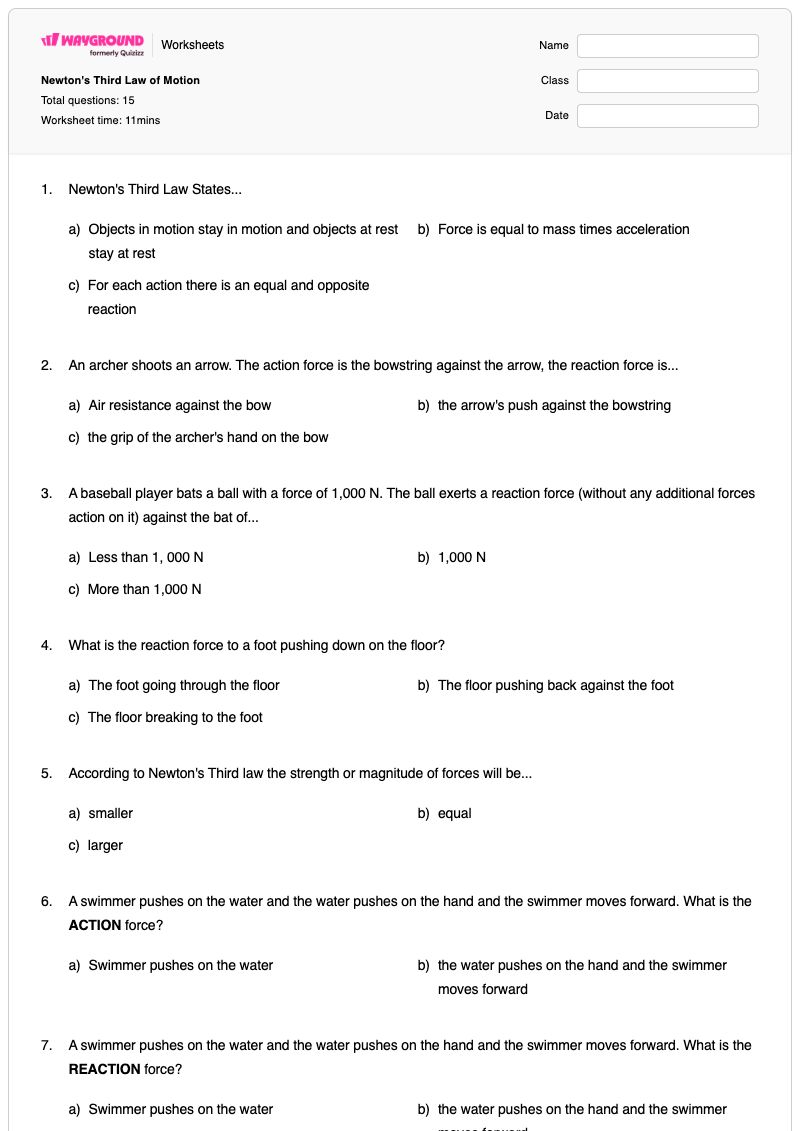
Newton's Third Law of Motion

คำถามทั้งหมด: 15

ชื่อ
ระดับ
วันที่
1.
Newton's Third Law States...
a)
Objects in motion stay in motion and objects at rest stay at rest
b)
Force is equal to mass times acceleration
c)
For each action there is an equal and opposite reaction
2.
An archer shoots an arrow. The action force is the bowstring against the arrow, the reaction force is...
a)
Air resistance against the bow
b)
the arrow's push against the bowstring
c)
the grip of the archer's hand on the bow
3.
A baseball player bats a ball with a force of 1,000 N. The ball exerts a reaction force (without any additional forces action on it) against the bat of...
a)
Less than 1, 000 N
b)
1,000 N
c)
More than 1,000 N
4.
What is the reaction force to a foot pushing down on the floor?
a)
The foot going through the floor
b)
The floor pushing back against the foot
c)
The floor breaking to the foot
5.
According to Newton's Third law the strength or magnitude of forces will be...
a)
smaller
b)
equal
c)
larger
6.

A swimmer pushes on the water and the water pushes on the hand and the swimmer moves forward. What is the ACTION force?

a)

Swimmer pushes on the water

b)

the water pushes on the hand and the swimmer moves forward

7.

A swimmer pushes on the water and the water pushes on the hand and the swimmer moves forward. What is the REACTION force?

a)

Swimmer pushes on the water

b)

the water pushes on the hand and the swimmer moves forward

8.
Newton's _____ Law of Motion means that for every force there is a reaction force that is equal in size, but opposite in direction.
a)
First
b)
Second
c)
Third
d)
Fourth
9.
The ____ of an object is the force of gravity on the object.
a)
mass
b)
weight
c)
volume
d)
density
10.
How many Laws of Motion are there?
a)
1
b)
2
c)
3
d)
4
11.
Who was the scientist who gave us the Laws of Motion?
a)
Sir Isaac Newton
b)
Albert Einstein
c)
Galileo Galilei
d)
Aristotle
12.
For every action there is an equal and opposite re-action.
a)
Newton's First Law of Motion
b)
Newton's Second Law of Motion
c)
Newton's Third Law of Motion
d)
Newton's Fourth Law of Motion
13.
Which best explains why we are able to accelerate forward when starting to run?
a)
As one leg moves backward, it provides an equal and opposite force for the other foot to move forward.
b)
No acceleration takes place. Runners are always at a fixed velocity.
c)
The striking foot pushes backward against the ground. The friction with the ground provides an equal and opposite force forward.
d)
The runner's upper body quickly leans forward, causing the entire body to begin accelerating forward
14.
When a large truck pushes a small car with a given force, the small car is applying an equal and opposite force on the truck.
a)
True
b)
False
15.

What happens when two objects, such as a baseball and a bat, collide?

a)

They hit each other with the same force in the same direction.

b)

They hit each other with the same force in opposite directions.

c)

They hit each other with unequal force in opposite directions.

d)

One remains still while the other one moves in the same direction.

Waygroundแป้นคำตอบ

Newton's Third Law of Motion

คำถามทั้งหมด: 15

1.
c) For each action there is an equal and opposite reaction
2.
b) the arrow's push against the bowstring
3.
b) 1,000 N
4.
b) The floor pushing back against the foot
5.
b) equal
6.
a)

Swimmer pushes on the water

7.
b)

the water pushes on the hand and the swimmer moves forward

8.
c) Third
9.
b) weight
10.
c) 3
11.
a) Sir Isaac Newton
12.
c) Newton's Third Law of Motion
13.
c) The striking foot pushes backward against the ground. The friction with the ground provides an equal and opposite force forward.
14.
a) True
15.
b)

They hit each other with the same force in opposite directions.

คำถามที่พบบ่อย

แบบฝึกหัดเรื่องกฎการเคลื่อนที่ข้อที่สามของนิวตันครอบคลุมหัวข้ออะไรบ้าง?

แบบฝึกหัดสำหรับนักเรียนระดับชั้น ม.3-ม.6 นี้ ประกอบด้วยคำถามแบบเลือกตอบ 15 ข้อ เพื่อฝึกฝนการระบุแรงปฏิกิริยาที่เท่ากันและตรงข้ามกัน นักเรียนจะได้นำกฎไปใช้กับตัวอย่างต่างๆ เช่น ลูกศรที่ออกจากคันธนู เท้าที่ดันพื้น นักว่ายน้ำที่เคลื่อนที่ในน้ำ นักวิ่งที่เร่งความเร็ว และไม้เบสบอลที่ชนกับลูกเบสบอล นอกจากนี้ พวกเขายังจะได้ทบทวนความหมายของน้ำหนักและข้อเท็จจริงพื้นฐานเกี่ยวกับกฎการเคลื่อนที่ของนิวตันด้วย

ฉันจะใช้แบบฝึกหัดนี้ในการสอนกฎข้อที่สามของนิวตันได้อย่างไร?

เริ่มต้นด้วยการอธิบายว่าแรงกระทำทุกแรงย่อมมีแรงปฏิกิริยาที่เท่ากันและตรงข้ามกัน จากนั้นให้นักเรียนระบุแรงทั้งสองที่กระทำต่อกันในตัวอย่างนักยิงธนู นักว่ายน้ำ เท้ากับพื้น และไม้เบสบอลกับลูกบอล ขอให้นักเรียนอธิบายว่าวัตถุใดได้รับแรงแต่ละแรง และเหตุใดแรงที่เท่ากันจึงไม่ได้หมายความว่าวัตถุเหล่านั้นเคลื่อนที่ไปในทิศทางเดียวกัน หลังจากนั้นให้ใช้แบบทดสอบแบบเลือกตอบเพื่อการอภิปรายและการฝึกฝนรายบุคคล

ฉันควรสังเกตข้อผิดพลาดอะไรบ้างเมื่อนักเรียนทำแบบฝึกหัดนี้เสร็จ?

นักเรียนอาจสลับการกระทำและปฏิกิริยาในสถานการณ์นักยิงธนูและนักว่ายน้ำ หรือระบุการเคลื่อนที่ที่เกิดขึ้นแทนที่จะระบุคู่แรง โปรดระวังตัวเลือกที่ทำให้แรงไม่เท่ากัน ชี้ไปในทิศทางเดียวกัน หรือกระทำต่อวัตถุเดียวกัน คำถามเกี่ยวกับเบสบอล รถบรรทุกและรถยนต์ และการชนกันนั้นทดสอบข้อผิดพลาดเหล่านี้โดยเฉพาะ นักเรียนอาจสับสนระหว่างน้ำหนักกับมวล หรือสับสนระหว่างกฎข้อที่สามของนิวตันกับกฎข้อที่หนึ่งหรือข้อที่สอง

ฉันจะมอบหมายและตรวจงานแบบฝึกหัดกฎข้อที่สามของนิวตันนี้อย่างไร?

คุณสามารถส่งเป็นไฟล์ PDF ที่พิมพ์ได้ หรือใช้เป็นแบบทดสอบดิจิทัลบน Wayground ก็ได้ แบบฝึกหัดนี้มีเฉลยคำตอบครบถ้วน และสามารถตรวจงานที่ส่งมาได้โดยการสแกนงานของนักเรียนด้วยแอป Wayground for Teachers ตัวเลือก PDF ยังช่วยสนับสนุนห้องเรียนและโรงเรียนที่ต้องการลดเวลาการใช้หน้าจอในขณะที่นักเรียนฝึกฝนเรื่องแรงปฏิกิริยาและการกระทำ

ฉันจะปรับแบบฝึกหัดนี้ให้เหมาะสมกับนักเรียนของฉันได้อย่างไร?

ในการตั้งค่าขั้นสูงของแบบฝึกหัด ให้ปรับระยะห่างระหว่างตัวอักษรหรือเลือกขนาดตัวอักษรที่ใหญ่ขึ้นเพื่อให้คำถามแบบเลือกตอบ 15 ข้ออ่านง่ายขึ้น นอกจากนี้ คุณยังสามารถเปิดใช้งานแบบอักษรที่เหมาะสำหรับผู้ที่มีภาวะดิสเล็กเซีย หรือแปลคำถามเกี่ยวกับปฏิกิริยาตอบสนองและสถานการณ์จำลองสถานการณ์แรงในโลกแห่งความเป็นจริงเป็นภาษาอื่นได้

ฉันจะหาแบบฝึกหัดแบบนี้เพิ่มเติมได้ที่ไหนบน Wayground?

Wayground นำเสนอชุดแบบฝึกหัดและโจทย์ฝึกหัดฟรีที่ครอบคลุมทุกวิชา พร้อมไฟล์ PDF และเฉลยคำตอบ เพื่อช่วยให้นักเรียนเชี่ยวชาญทักษะและแนวคิดที่สำคัญ ดูแหล่งข้อมูลเพิ่มเติมได้ที่ https://wayground.com/en-us/worksheets