

Wayground
Boyle's Law and Charles' Law - Printable Science Worksheets - Wayground

Boyle's Law and Charles' Law

25 คำถาม

7th - 8th ระดับชั้น

Science

แบบฝึกหัดวิทยาศาสตร์สำหรับนักเรียนชั้น ม.1-ม.2 นี้ ประกอบด้วยคำถามแบบเลือกตอบ 25 ข้อ เพื่อช่วยเสริมสร้างความเข้าใจเกี่ยวกับกฎของบอยล์และกฎของชาร์ลส์ นักเรียนจะได้ระบุการเคลื่อนที่ของอนุภาคแก๊ส อธิบายว่าการชนกันของอนุภาคทำให้เกิดความดัน ตระหนักว่าแก๊สสามารถถูกอัดได้ และแยกแยะความสัมพันธ์ผกผันระหว่างความดันและปริมาตรในกฎของบอยล์ออกจากความสัมพันธ์โดยตรงระหว่างปริมาตรและอุณหภูมิในกฎของชาร์ลส์ นอกจากนี้ นักเรียนยังต้องเลือกสูตรที่ถูกต้องสำหรับกฎของแก๊สทั้งสองข้อและระบุตัวแปรที่เกี่ยวข้องด้วย แบบฝึกหัดนี้ประกอบด้วยคำถามเกี่ยวกับความดันคงที่ในกฎของชาร์ลส์ การเปลี่ยนแปลงความดันและปริมาตร และการระบุตัวแปรอิสระในการทดลอง แบบฝึกหัดนี้ช่วยให้นักเรียนได้ฝึกฝนการตีความความสัมพันธ์ การเชื่อมโยงสูตรกับพฤติกรรมของแก๊ส และการประยุกต์ใช้คำศัพท์สำคัญผ่านข้อสอบแบบเลือกตอบ แบบฝึกหัดที่พิมพ์ได้ฟรีนี้ออกแบบมาสำหรับใช้ในการสอน การทบทวน หรือการประเมินผลวิชาวิทยาศาสตร์สำหรับนักเรียนชั้น ม.1 และ ม.2 และมีเฉลยคำตอบครบถ้วน

การตั้งค่าแผ่นงาน

ขนาดตัวอักษร

S
M
L
XL
แผ่นงาน

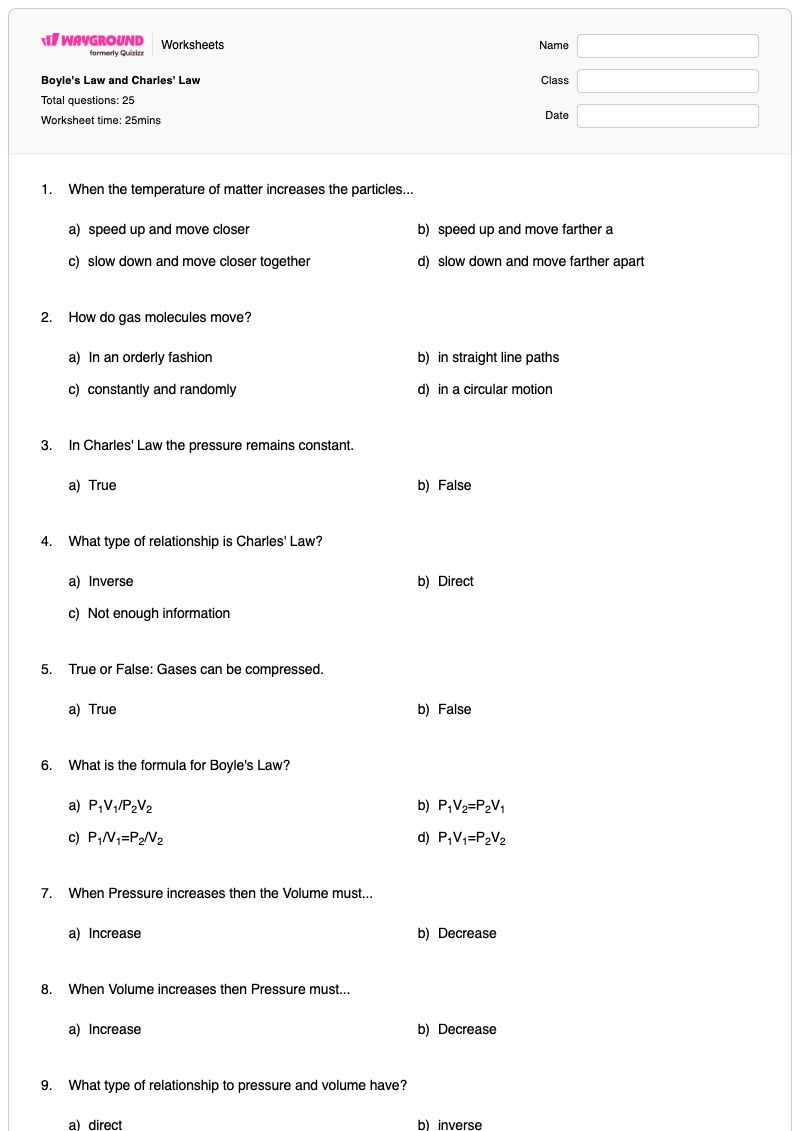
Boyle's Law and Charles' Law

คำถามทั้งหมด: 25

ชื่อ
ระดับ
วันที่
1.

When the temperature of matter increases the particles...

a)

speed up and move closer

b)

speed up and move farther a

c)

slow down and move closer together

d)

slow down and move farther apart

2.

How do gas molecules move? 

a)

In an orderly fashion

b)

in straight line paths

c)

constantly and randomly

d)

in a circular motion

3.

In Charles' Law the pressure remains constant.

a)

True

b)

False

4.

What type of relationship is Charles' Law?

a)

Inverse

b)

Direct

c)

Not enough information

5.

True or False: Gases can be compressed. 

a)

True

b)

False

6.

What is the formula for Boyle's Law?

a)

P1V1/P2V2

b)

P1V2=P2V1

c)

P1/V1=P2/V2

d)

P1V1=P2V2

7.

When Pressure increases then the Volume must...

a)

Increase

b)

Decrease

8.

When Volume increases then Pressure must...

a)

Increase

b)

Decrease

9.

What type of relationship to pressure and volume have?

a)

direct

b)

inverse

c)

no relationship

10.

What does Boyle's law relate to?

a)

Temperature and

b)

Volume and Pressure

c)

Temperature and Pressure

d)

Amount and Volume

11.

What causes pressure?

a)

The walls of the container

b)

The vacuum in the container

c)

The collisions of the particles

d)

Atmospheric pressure acting on the outside walls

12.

 The relationship of which two variables are compared in Boyle's Law?

a)

pressure and volume

b)

volume and temperature

c)

temperature and pressure

d)

amount and volume

13.

What is the formula Charles' Law?

a)

V=T

b)

VT=VT

c)

T1 / V1 = T2 / V2

d)

V1 / T1 = V2 / T2

14.

This variable in an experiment is the one being deliberately changed by the scientist. 

a)

dependent variable

b)

independent variable

c)

data

d)

control group

15.

TRUE/ FALSE: Science is a continually ongoing process.

a)

True

b)

False

16.

Gas Laws involve what three factors?

a)

solid, liquid, gas

b)

speed, velocity, acceleration

c)

elements, compunds, mixtures

d)

pressure, temperature, volume

17.

Directly proportional means that as one value increases ...

a)

the other stays the same

b)

the other increases as well

c)

the other decreases

d)

the other goes to zero

18.

Inversely proportional means as one value increases the other...

a)

increases

b)

decreases

c)

stays the same

d)

does to zero

19.

The word inverse means.......

a)

the same

b)

opposite

20.

Temperature describes  the ______________ of particles.

a)

volume

b)

mass

c)

motion

d)

conductivity

21.

If the temperature of a gas increase, the pressure... (volume is constant)

a)

decreases

b)

increases

c)

does not change

22.

If a balloon is cooled what will happen to the volume?

a)

Volume will increase

b)

Volume will decrease

c)

Volume will not change

23.

A student inflates a balloon with helium then places it in the freezer. The student should expect

a)

The balloon's volume to increase

b)

The balloons volume to decrease

24.

If a hairspray can is heated, what can be expected of the pressure of the gas inside the can?

a)

The pressure will increase

b)

The pressure will decrease

c)

The pressure will remain constant

d)

The pressure will equalize

25.
Which container will have lower pressure?
a)
left
b)
right
c)
they both have the same pressure
แป้นคำตอบ

Boyle's Law and Charles' Law

คำถามทั้งหมด: 25

1.
b)

speed up and move farther a

2.
c)

constantly and randomly

3.
a)

True

4.
b)

Direct

5.
a)

True

6.
d)

P1V1=P2V2

7.
b)

Decrease

8.
b)

Decrease

9.
b)

inverse

10.
b)

Volume and Pressure

11.
c)

The collisions of the particles

12.
a)

pressure and volume

13.
d)

V1 / T1 = V2 / T2

14.
b)

independent variable

15.
a)

True

16.
d)

pressure, temperature, volume

17.
b)

the other increases as well

18.
b)

decreases

19.
b)

opposite

20.
c)

motion

21.
b)

increases

22.
b)

Volume will decrease

23.
b)

The balloons volume to decrease

24.
a)

The pressure will increase

25.
a) left

คำถามที่พบบ่อย

แบบฝึกหัดเรื่องกฎของบอยล์และกฎของชาร์ลส์ครอบคลุมหัวข้ออะไรบ้าง?

แบบฝึกหัดวิทยาศาสตร์สำหรับนักเรียนชั้น ม.1-ม.2 นี้ประกอบด้วยคำถามแบบเลือกตอบ 25 ข้อ เกี่ยวกับพฤติกรรมของแก๊สและความสัมพันธ์ระหว่างความดัน ปริมาตร และอุณหภูมิ นักเรียนจะได้ฝึกฝนการระบุถึงกฎของบอยล์ว่าเป็นความสัมพันธ์ผกผันระหว่างความดันและปริมาตร กฎของชาร์ลส์ว่าเป็นความสัมพันธ์โดยตรงระหว่างปริมาตรและอุณหภูมิ และการเลือกสูตรที่ถูกต้องสำหรับแต่ละกฎ

ฉันจะใช้แบบฝึกหัดนี้ในการสอนกฎของบอยล์และกฎของชาร์ลส์ได้อย่างไร?

แนะนำอนุภาคแก๊ส การอัด และการชนกันของอนุภาคก่อนที่จะให้คำถามแบบเลือกตอบ ให้นักเรียนอธิบายว่าทำไมความดันจึงลดลงเมื่อปริมาตรเพิ่มขึ้นตามกฎของบอยล์ จากนั้นเปรียบเทียบความสัมพันธ์ผกผันนั้นกับกฎของชาร์ลส์ ซึ่งความดันคงที่และปริมาตรเปลี่ยนแปลงโดยตรงกับอุณหภูมิ ใช้คำถามสูตรเป็นตัวตรวจสอบว่านักเรียนสามารถเชื่อมโยงสมการแต่ละสมการกับตัวแปรที่ถูกต้องได้หรือไม่

ฉันควรระวังข้อผิดพลาดอะไรบ้างเมื่อนักเรียนทำแบบฝึกหัดเกี่ยวกับกฎของแก๊สนี้?

นักเรียนอาจสับสนระหว่างความสัมพันธ์ผกผันระหว่างความดันและปริมาตรของบอยล์กับความสัมพันธ์โดยตรงระหว่างปริมาตรและอุณหภูมิของชาร์ลส์ หรือจับคู่กฎกับตัวแปรที่ไม่ถูกต้อง ระวังข้อผิดพลาดในการเลือก P₁V₁ = P₂V₂ และ V₁/T₁ = V₂/T₂ รวมถึงความเข้าใจผิดที่ว่าการเพิ่มความดันจะเพิ่มปริมาตร นักเรียนอาจมองข้ามไปว่าความดันยังคงที่ในกฎของชาร์ลส์ หรืออาจให้เหตุผลว่าความดันเกิดจากสาเหตุอื่นที่ไม่ใช่การชนกันของอนุภาค

ฉันจะมอบหมายและตรวจงานแบบฝึกหัดเรื่องกฎของบอยล์และกฎของชาร์ลส์นี้อย่างไร?

Wayground จัดทำแบบฝึกหัด 25 ข้อนี้ในรูปแบบไฟล์ PDF ที่สามารถพิมพ์ได้ และแบบทดสอบดิจิทัล โดยมีเฉลยคำตอบครบถ้วนสำหรับการตรวจคำตอบแบบเลือกตอบ สำหรับการส่งงานแบบพิมพ์ ให้สแกนงานของนักเรียนด้วยแอป Wayground for Teachers เพื่อให้การตรวจงานง่ายขึ้น ตัวเลือก PDF ยังช่วยสนับสนุนห้องเรียนที่ต้องการลดเวลาการใช้หน้าจออีกด้วย

ฉันจะปรับแบบฝึกหัดเรื่องกฎของแก๊สแบบเลือกตอบนี้ให้เหมาะสมกับนักเรียนของฉันได้อย่างไร?

ใช้การตั้งค่าขั้นสูงของแบบฝึกหัดเพื่อปรับระยะห่างระหว่างตัวอักษรและขนาดตัวอักษร เพื่อให้คำถามแบบเลือกตอบ 25 ข้ออ่านง่ายขึ้น นอกจากนี้ คุณยังสามารถเปิดใช้งานแบบอักษรที่เหมาะสำหรับผู้ที่มีภาวะดิสเล็กเซีย หรือแปลแบบฝึกหัดเป็นภาษาอื่นในขณะที่นักเรียนกำลังเรียนรู้คำศัพท์ ความสัมพันธ์ และสูตรเกี่ยวกับกฎของแก๊ส

ฉันจะหาแบบฝึกหัดแบบนี้เพิ่มเติมได้ที่ไหนบน Wayground?

Wayground นำเสนอชุดแบบฝึกหัดและโจทย์ฝึกหัดฟรีที่ครอบคลุมหลากหลายวิชา พร้อมไฟล์ PDF และเฉลยคำตอบ เพื่อช่วยเสริมสร้างทักษะและความเข้าใจในแนวคิดสำคัญ ดูแหล่งข้อมูลเพิ่มเติมได้ที่ https://wayground.com/en-us/worksheets