

Wayground
Mastering Graduated Cylinder Measurements - Printable ศาสตร์ Worksheets ระดับ 8 - Wayground

Mastering Graduated Cylinder Measurements

Janine Coyle

สร้างโดย Janine Coyle

20 คำถาม

8th ระดับชั้น

ศาสตร์

อัปเดตแล้ว พ.ย. 2568

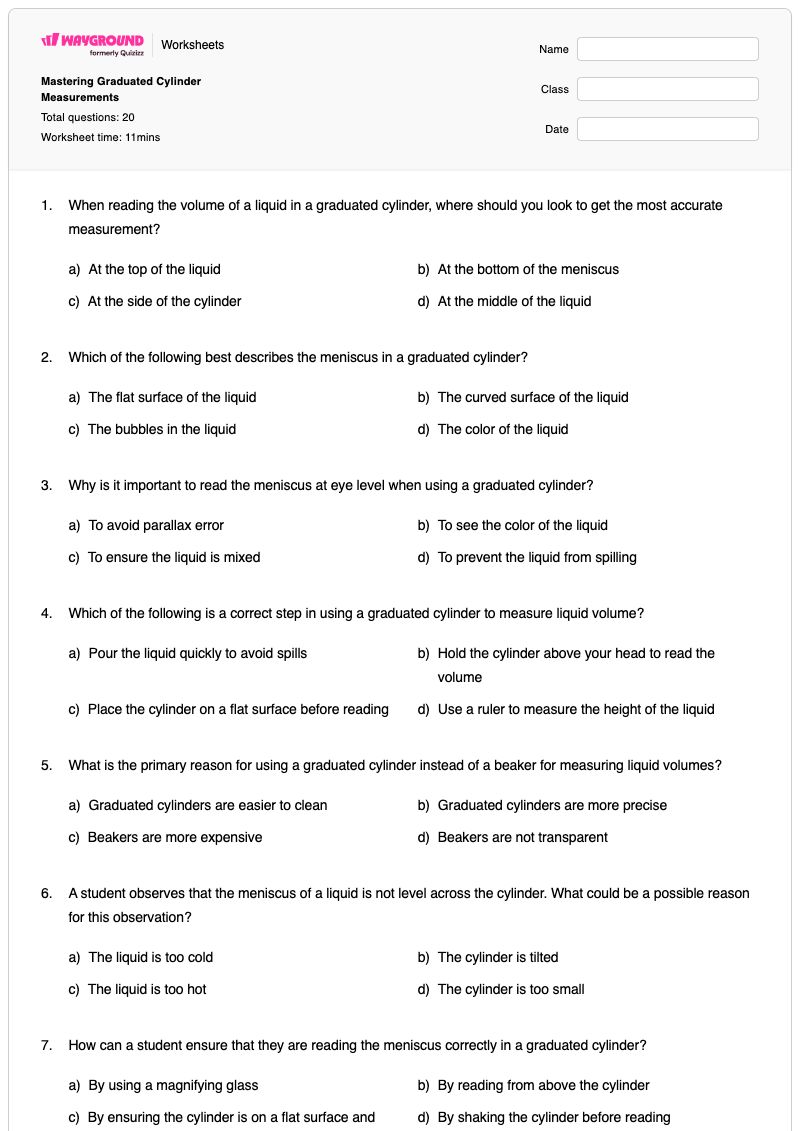
แบบฝึกหัดวิทยาศาสตร์สำหรับนักเรียนชั้น ม.2 เรื่อง "การวัดปริมาตรของเหลวด้วยกระบอกตวง" เป็นแบบฝึกหัดที่สามารถพิมพ์ได้ฟรี ช่วยให้นักเรียนอ่านปริมาตรของเหลวได้อย่างแม่นยำโดยใช้กระบอกตวง แบบฝึกหัดประกอบด้วย 20 ข้อ—19 ข้อเป็นแบบเลือกตอบ และ 1 ข้อเป็นแบบเติมคำ—นักเรียนจะได้เรียนรู้การระบุเมนิสคัส การอ่านค่าที่ก้นเมนิสคัสในระดับสายตา การรู้จักความคลาดเคลื่อนจากมุมมอง การวางกระบอกตวงอย่างถูกต้อง และการหาค่าของขีดแบ่งย่อย แบบฝึกหัดนี้ยังช่วยให้นักเรียนได้ฝึกฝนการตีความค่าปริมาตรที่อ่านได้จากกระบอกตวง รวมถึงการวัดค่าต่างๆ เช่น 21.5 มล. 8.8 มล. และ 11.5 มล. และการเปรียบเทียบความแม่นยำของกระบอกตวงกับบีกเกอร์ เหมาะสำหรับการสอนแบบมีผู้แนะนำ การฝึกฝนด้วยตนเอง หรือการประเมินทบทวนหลังจากการเรียนรู้ขั้นตอนการวัด มีเฉลยคำตอบครบถ้วนเพื่อช่วยในการตรวจสอบและให้ข้อเสนอแนะอย่างมีประสิทธิภาพ

การตั้งค่าแผ่นงาน

ขนาดตัวอักษร

S
M
L
XL
Waygroundแผ่นงาน

Mastering Graduated Cylinder Measurements

คำถามทั้งหมด: 20

ชื่อ
ระดับ
วันที่
1.

When reading the volume of a liquid in a graduated cylinder, where should you look to get the most accurate measurement?

a)

At the top of the liquid

b)

At the bottom of the meniscus

c)

At the side of the cylinder

d)

At the middle of the liquid

2.

Which of the following best describes the meniscus in a graduated cylinder?

a)

The flat surface of the liquid

b)

The curved surface of the liquid

c)

The bubbles in the liquid

d)

The color of the liquid

3.

Why is it important to read the meniscus at eye level when using a graduated cylinder?

a)

To avoid parallax error

b)

To see the color of the liquid

c)

To ensure the liquid is mixed

d)

To prevent the liquid from spilling

4.

Which of the following is a correct step in using a graduated cylinder to measure liquid volume?

a)

Pour the liquid quickly to avoid spills

b)

Hold the cylinder above your head to read the volume

c)

Place the cylinder on a flat surface before reading

d)

Use a ruler to measure the height of the liquid

5.

What is the primary reason for using a graduated cylinder instead of a beaker for measuring liquid volumes?

a)

Graduated cylinders are easier to clean

b)

Graduated cylinders are more precise

c)

Beakers are more expensive

d)

Beakers are not transparent

6.

A student observes that the meniscus of a liquid is not level across the cylinder. What could be a possible reason for this observation?

a)

The liquid is too cold

b)

The cylinder is tilted

c)

The liquid is too hot

d)

The cylinder is too small

7.

How can a student ensure that they are reading the meniscus correctly in a graduated cylinder?

a)

By using a magnifying glass

b)

By reading from above the cylinder

c)

By ensuring the cylinder is on a flat surface and reading at eye level

d)

By shaking the cylinder before reading

8.
Which is NOT a step for reading a graduated cylinder properly?
a)
Make sure the cylinder sits in the stand vertically.
b)
Be sure to hold it up to eye-level when reading.
c)
Read the water's volume by the bottom of the meniscus.
d)
Know the value of the scale for the sub-graduates.
9.
What is the scale of the sub-graduates for this graduated cylinder?
a)
.1 mL per sub-graduate
b)
1 mL per sub-graduate
c)
.2 mL per sub-graduate
d)
.5 mL per sub-graduate
10.
What is the volume of the water in this graduated cylinder?
a)
21 mL
b)
23.5 mL
c)
22 mL
d)
21.5 mL
11.
What is the volume of the water in this graduated cylinder?
a)
8.8 mL
b)
8.6 mL
c)
9.2 mL
d)
9 mL
12.
What is the volume of the water in this graduated cylinder?
a)
11.5 mL
b)
13 mL
c)
10.3 mL
d)
11 mL
13.
What is the volume of the water in this graduated cylinder?
a)
18 mL
b)
20.3 mL
c)
10.7 mL
d)
17 mL
14.
What is the scale of the sub-graduates for this graduated cylinder?

What is the scale of the sub-graduates for this graduated cylinder?

a)

.1 mL per sub-graduate

b)

1 mL per sub-graduate

c)

.2 mL per sub-graduate

d)

.5 mL per sub-graduate

15.
When reading the volume in a graduated cylinder, look at the ___ of the meniscus.

When reading the volume in a graduated cylinder, look at the ___ of the meniscus.

a)

top

b)

bottom

c)

It doesn't matter.

d)

What is a meniscus?

16.
True or False: You should be eye level with the liquid in a graduated cylinder before reading the volume.

True or False: You should be eye level with the liquid in a graduated cylinder before reading the volume.

a)

True

b)

False

17.
True or False: A beaker is more precise than a graduated cylinder when measuring liquid volume.

True or False: A beaker is more precise than a graduated cylinder when measuring liquid volume.

a)

True

b)

False

18.

What is special about graduated cylinders?

a)

They hold large quantities of liquids safely.

b)

They measure small amount of liquids accurately and precisely.

c)

They allow us to examine a liquid carefully.

d)

They are easily heated.

19.
When reading a graduated cylinder, you should read based on the bottom of the _____________ or curve.

When reading a graduated cylinder, you should read based on the bottom of the _____________ or curve.

a)

curve

b)

meniscus

c)

whole number

d)

bubble

20.
This is a(n) .

This is a(n) (a)   .

Waygroundแป้นคำตอบ

Mastering Graduated Cylinder Measurements

คำถามทั้งหมด: 20

1.
b)

At the bottom of the meniscus

2.
b)

The curved surface of the liquid

3.
a)

To avoid parallax error

4.
c)

Place the cylinder on a flat surface before reading

5.
b)

Graduated cylinders are more precise

6.
b)

The cylinder is tilted

7.
c)

By ensuring the cylinder is on a flat surface and reading at eye level

8.
b) Be sure to hold it up to eye-level when reading.
9.
c) .2 mL per sub-graduate
10.
d) 21.5 mL
11.
a) 8.8 mL
12.
a) 11.5 mL
13.
d) 17 mL
14.
b)

1 mL per sub-graduate

15.
b)

bottom

16.
a)

True

17.
b)

False

18.
b)

They measure small amount of liquids accurately and precisely.

19.
b)

meniscus

20.
Erlenmeyer flask

คำถามที่พบบ่อย

แบบฝึกหัด "การวัดปริมาตรด้วยกระบอกตวงอย่างแม่นยำ" ครอบคลุมเนื้อหาอะไรบ้าง?

แบบฝึกหัดวิทยาศาสตร์สำหรับนักเรียนชั้น ม.2 นี้ สอนให้นักเรียนวัดปริมาตรของเหลวโดยการอ่านค่าที่ก้นเมนิสคัสในระดับสายตา และระบุค่าของแต่ละขีดแบ่งย่อย แบบฝึกหัดประกอบด้วย 20 ข้อ รวมถึงคำถามแบบเลือกตอบและคำถามเติมคำในช่องว่าง 1 ข้อ นอกจากนี้ยังช่วยให้นักเรียนรู้จักวิธีการวางกระบอกตวงอย่างถูกต้อง หลีกเลี่ยงข้อผิดพลาดจากมุมมอง และตีความค่าปริมาตรต่างๆ ได้อย่างถูกต้อง

ฉันจะใช้แบบฝึกหัดนี้ในการสอนเรื่องการวัดปริมาตรด้วยกระบอกตวงได้อย่างไร?

เริ่มแบบฝึกหัดโดยสาธิตวิธีการวางกระบอกตวงบนพื้นผิวเรียบ มองดูในระดับสายตา ระบุส่วนโค้งของผิวน้ำ และอ่านค่าที่ก้นกระบอกตวง จากนั้นให้นักเรียนทำตามขั้นตอนและตอบคำถามเกี่ยวกับมาตราส่วนก่อนที่จะแก้โจทย์เกี่ยวกับการอ่านค่าปริมาตร โดยใช้คำตอบที่เลือกมาอภิปรายว่าเหตุใดกระบอกตวงที่เอียง การอ่านค่าที่ส่วนบนของผิวน้ำ หรือค่าที่วัดได้ต่ำกว่าขีดบอกปริมาตรที่ไม่ถูกต้อง จึงทำให้การวัดไม่แม่นยำ

ฉันควรระวังข้อผิดพลาดอะไรบ้างเมื่อนักเรียนทำแบบฝึกหัดเกี่ยวกับกระบอกตวงนี้?

ระวังนักเรียนที่เลือกวัดจากส่วนบนหรือส่วนกลางของของเหลวแทนที่จะเป็นส่วนล่างของเมนิสคัส หรืออ่านค่าจากระดับสายตาที่สูงหรือต่ำกว่า ทำให้เกิดความคลาดเคลื่อนจากมุมมอง (parallax error) นอกจากนี้ นักเรียนอาจสับสนกับมาตราส่วนของขีดบอกปริมาตรย่อย มองข้ามว่ากระบอกตวงต้องตั้งตรงบนพื้นผิวเรียบ หรือเลือกปริมาตรที่ใกล้เคียง เช่น 21 มิลลิลิตร แทนที่จะตีความปริมาตรที่ขีดบอกไว้เพื่อหาค่า 21.5 มิลลิลิตร

ฉันจะมอบหมายและให้คะแนนแบบฝึกหัดเรื่องกระบอกตวงนี้อย่างไร?

คุณสามารถมอบหมายแบบฝึกหัดการวัดปริมาตรกระบอกตวงอย่างชำนาญในรูปแบบไฟล์ PDF ที่พิมพ์ได้ หรือเป็นแบบทดสอบดิจิทัลบน Wayground โดยมีเฉลยคำตอบครบถ้วนสำหรับตรวจสอบทั้ง 20 ข้อ การส่งงานในรูปแบบไฟล์พิมพ์ยังสามารถตรวจได้โดยการสแกนงานของนักเรียนด้วยแอป Wayground for Teachers รูปแบบไฟล์พิมพ์นี้ยังช่วยสนับสนุนโรงเรียนที่ต้องการลดเวลาการใช้หน้าจอได้อีกด้วย

ฉันจะปรับแบบฝึกหัดเรื่องกระบอกตวงนี้ให้เหมาะสมกับนักเรียนของฉันได้อย่างไร?

ในส่วนการตั้งค่าขั้นสูงของแบบฝึกหัด ให้ปรับระยะห่างระหว่างตัวอักษรหรือเลือกขนาดตัวอักษรที่ใหญ่ขึ้น เพื่อให้คำแนะนำในการวัด ตัวเลือกคำตอบ และรายการอ่านค่าปริมาตรอ่านง่ายขึ้น นอกจากนี้ คุณยังสามารถเปิดใช้งานแบบอักษรที่เหมาะสำหรับผู้ที่มีภาวะดิสเล็กเซีย หรือแปลแบบฝึกหัดเป็นภาษาอื่นโดยยังคงรูปแบบการฝึกฝนแบบใช้กระบอกตวงไว้ได้

ฉันจะหาแบบฝึกหัดแบบนี้เพิ่มเติมได้ที่ไหนบน Wayground?

Wayground นำเสนอชุดแบบฝึกหัดและโจทย์ฝึกหัดฟรีที่ครอบคลุมทุกวิชา พร้อมไฟล์ PDF และเฉลยคำตอบ เพื่อช่วยให้นักเรียนเชี่ยวชาญทักษะและแนวคิดที่สำคัญ ดูแหล่งข้อมูลเพิ่มเติมได้ที่ https://wayground.com/en-us/worksheets