

Wayground
Pyramids at Giza and Construction of the Great Pyramid - Printable English Worksheets ระดับ 6 - Wayground

Pyramids at Giza and Construction of the Great Pyramid

11 คำถาม

6th - 6th ระดับชั้น

English

แบบฝึกหัดการอ่านเพื่อความเข้าใจภาษาอังกฤษสำหรับนักเรียนชั้นประถมศึกษาปีที่ 6 เรื่อง "พีระมิดแห่งกิซาและการสร้างมหาพีระมิด" สร้างขึ้นจากบทความสองเรื่องเกี่ยวกับพีระมิดแห่งอียิปต์ นักเรียนจะต้องตอบคำถาม 11 ข้อ—หนึ่งข้อเป็นแบบเลือกตอบ และ 10 ข้อเป็นแบบเลือกตอบ—ซึ่งถามให้ระบุรายละเอียดที่แสดงขนาดของพีระมิด ตีความภาพถ่าย กำหนดความหมายของคำจากบริบทและความหมายในพจนานุกรม และอธิบายว่าประโยคเฉพาะเจาะจงพัฒนาความคิดของผู้เขียนอย่างไร แบบฝึกหัดนี้ยังช่วยพัฒนาทักษะการวิเคราะห์ระดับสูงขึ้น โดยถามนักเรียนให้ระบุความคิดหลัก เลือกหลักฐานที่สนับสนุนข้ออ้างเกี่ยวกับบล็อกคอนกรีตหล่อ เปรียบเทียบความคิดที่เกี่ยวข้องในบทความทั้งสอง และตระหนักถึงจุดประสงค์ร่วมกันของผู้เขียน แบบฝึกหัดนี้สามารถพิมพ์ได้ฟรี พร้อมเฉลยคำตอบครบถ้วน เหมาะสำหรับการฝึกฝนด้วยตนเอง การสอนกลุ่มเล็ก หรือการประเมินการอ่านของนักเรียนชั้นประถมศึกษาปีที่ 6 รูปแบบบทความสองเรื่องช่วยให้ครูมีวิธีที่เน้นเฉพาะเจาะจงในการประเมินว่านักเรียนสามารถเชื่อมโยงรายละเอียด คำศัพท์ หลักฐาน และจุดประสงค์ของผู้เขียนในข้อความเชิงข้อมูลได้หรือไม่

การตั้งค่าแผ่นงาน

ขนาดตัวอักษร

S
M
L
XL
แผ่นงาน

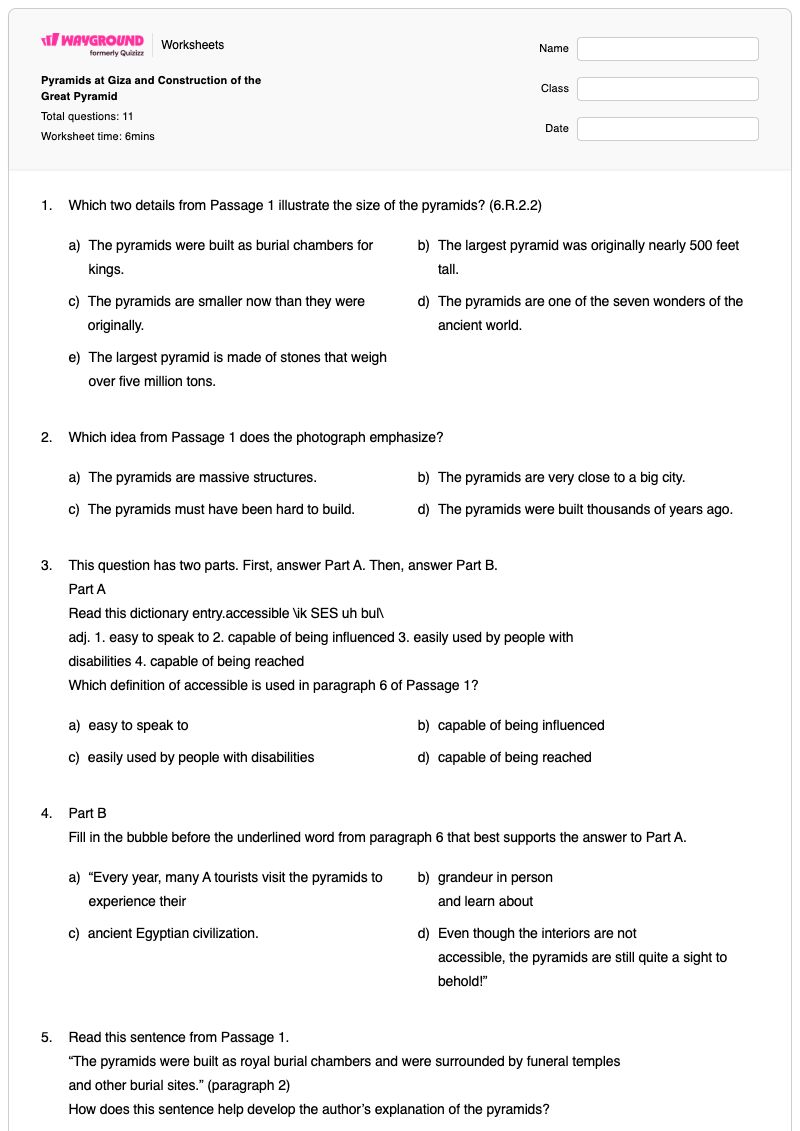
Pyramids at Giza and Construction of the Great Pyramid

คำถามทั้งหมด: 11

ชื่อ
ระดับ
วันที่
1.

Which two details from Passage 1 illustrate the size of the pyramids? (6.R.2.2)

a)

The pyramids were built as burial chambers for kings.

b)

The largest pyramid was originally nearly 500 feet tall.

c)

The pyramids are smaller now than they were originally.

d)

The pyramids are one of the seven wonders of the ancient world.

e)

The largest pyramid is made of stones that weigh over five million tons.

2.

Which idea from Passage 1 does the photograph emphasize?

a)

The pyramids are massive structures.

b)

The pyramids are very close to a big city.

c)

The pyramids must have been hard to build.

d)

The pyramids were built thousands of years ago.

3.

This question has two parts. First, answer Part A. Then, answer Part B.

Part A

Read this dictionary entry.accessible \ik SES uh bul\

adj. 1. easy to speak to 2. capable of being influenced 3. easily used by people with

disabilities 4. capable of being reached

Which definition of accessible is used in paragraph 6 of Passage 1?

a)

easy to speak to

b)

capable of being influenced

c)

easily used by people with disabilities

d)

capable of being reached

4.

Part B

Fill in the bubble before the underlined word from paragraph 6 that best supports the answer to Part A.

a)

“Every year, many A tourists visit the pyramids to experience their

b)

grandeur in person

and learn about

c)

ancient Egyptian civilization.

d)

Even though the interiors are not

accessible, the pyramids are still quite a sight to behold!”

5.

Read this sentence from Passage 1.

“The pyramids were built as royal burial chambers and were surrounded by funeral temples

and other burial sites.” (paragraph 2)

How does this sentence help develop the author’s explanation of the pyramids?

a)

It tells the reason why the pyramids were built.

b)

It introduces the kings who built the pyramids.

c)

It explains why the location of the pyramids was important.

d)

It describes what the ancient Egyptians thought about death.

6.

Which of the following statements illustrates the importance of Michel Barsoum’s work as described in Passage 2?

a)

Barsoum thought it would be simple to analyze the blocks.

b)

Barsoum spent five years analyzing the chemistry of the stones.

c)

Barsoum discovered a substance very close to natural limestone.

d)

Barsoum determined the blocks were made from a type of concrete.

7.

Which sentence from Passage 2 provides a reason that supports the claim that the blocks were made of molded concrete?

a)

“In addition, the pyramids are aligned almost exactly to the cardinal points of north,

south, east, and west.” (paragraph 7)

b)

“Ancient Egyptians had created a material so close to natural limestone that it fooled

everyone for 4,500 years.” (paragraph 11)

c)

“Finally, the stones fit together too perfectly to have been chiseled by hand.”

(paragraph 12)

d)

“Cast stones are no lighter than natural limestone.” (paragraph 13)

8.

What is a central idea of Passage 2?

a)

The pyramids are aligned to the cardinal points.

b)

The ancient Egyptians used advanced building techniques.

c)

The blocks of stone making up the pyramids are nearly identical.

d)

The builders may have moved stones up ramps to get them into place.

9.

Read this sentence from Passage 2.

“Despite the idea that the stones were chiseled, there have been no chisels or other

implements found as archaeological evidence.” (paragraph 12)

How does the word chisels help you determine the meaning of implements?

a)

Chisels and implements are synonyms.

b)

Implements are the products made from using chisels.

c)

Implements are one type of chisel.

d)

Chisels are items in the category of implements.

10.

Read this sentence from Passage 1.

“Given their size and durability, the pyramids must have been extremely challenging to build.” (paragraph 5)

Which sentence from Passage 2 shows the same idea?

a)

“As to the building blocks themselves, up until recently, it was thought that the

cumbersome stone blocks were carved from natural limestone.” (paragraph 9)

b)

“They were then moved by a tremendous amount of physical labor and carefully put

into place.” (paragraph 9)

c)

“Finally, the stones fit together too perfectly to have been chiseled by hand.”

(paragraph 12)

d)

“Cast stones are no lighter than natural limestone.” (paragraph 13)

11.

What purpose is shared by the authors of both passages?

a)

to entertain readers with amusing stories of ancient civilizations

b)

to argue that readers should use concrete for all future building projects

c)

to teach readers about the incredible building feat of the Egyptian pyramids

d)

to tell readers about some of the people involved in analyzing the Egyptian pyramids

แป้นคำตอบ

Pyramids at Giza and Construction of the Great Pyramid

คำถามทั้งหมด: 11

1.
b)

The largest pyramid was originally nearly 500 feet tall.

, e)

The largest pyramid is made of stones that weigh over five million tons.

2.
a)

The pyramids are massive structures.

3.
d)

capable of being reached

4.
d)

Even though the interiors are not

accessible, the pyramids are still quite a sight to behold!”

5.
a)

It tells the reason why the pyramids were built.

6.
d)

Barsoum determined the blocks were made from a type of concrete.

7.
c)

“Finally, the stones fit together too perfectly to have been chiseled by hand.”

(paragraph 12)

8.
b)

The ancient Egyptians used advanced building techniques.

9.
d)

Chisels are items in the category of implements.

10.
b)

“They were then moved by a tremendous amount of physical labor and carefully put

into place.” (paragraph 9)

11.
c)

to teach readers about the incredible building feat of the Egyptian pyramids

คำถามที่พบบ่อย

แบบฝึกหัดเรื่อง พีระมิดแห่งกิซาและการก่อสร้างมหาพีระมิด ครอบคลุมเนื้อหาอะไรบ้าง?

แบบฝึกหัดภาษาอังกฤษสำหรับนักเรียนชั้นประถมศึกษาปีที่ 6 นี้ ใช้บทความให้ข้อมูลเกี่ยวกับพีระมิดอียิปต์สองบทความ เพื่อพัฒนาทักษะการอ่านเพื่อความเข้าใจโดยใช้หลักฐาน แบบฝึกหัดนี้มีทั้งหมด 11 ข้อ โดยให้นักเรียนเลือกรายละเอียดเกี่ยวกับขนาดของพีระมิด ตีความภาพถ่าย กำหนดความหมายของคำศัพท์ในบริบท ระบุใจความสำคัญ เชื่อมโยงข้ออ้างกับหลักฐานสนับสนุน เปรียบเทียบความคิดระหว่างบทความ และระบุจุดประสงค์ร่วมกันของผู้เขียน

ฉันจะใช้แบบฝึกหัดนี้สอนนักเรียนให้วิเคราะห์ข้อความให้ข้อมูลเกี่ยวกับพีระมิดได้อย่างไร?

แนะนำบทความทั้งสองโดยขอให้นักเรียนแยกแยะว่าแต่ละบทความอธิบายอะไร: วัตถุประสงค์และลักษณะของพีระมิดในบทความที่ 1 และวิธีการก่อสร้างที่เสนอในบทความที่ 2 ให้นักเรียนขีดเส้นใต้รายละเอียดที่สนับสนุนความคิดก่อนที่จะตอบคำถามแบบเลือกตอบ จากนั้นอภิปรายว่าประโยคเกี่ยวกับหินที่ประกอบเข้าด้วยกันนั้นสนับสนุนข้ออ้างเกี่ยวกับคอนกรีตหล่ออย่างไร และผู้เขียนทั้งสองอธิบายถึงการก่อสร้างที่น่าทึ่งของพีระมิดอย่างไร

ฉันควรระวังข้อผิดพลาดอะไรบ้างเมื่อนักเรียนทำแบบฝึกหัดการอ่านเรื่องพีระมิดนี้?

นักเรียนอาจเลือกรายละเอียดที่น่าสนใจโดยทั่วไปแทนที่จะเลือกรายละเอียดสองข้อที่แสดงขนาดของพีระมิดโดยเฉพาะในข้อคำถามแบบเลือกหลายข้อ นอกจากนี้ พวกเขายังอาจเลือกคำจำกัดความในพจนานุกรมที่คุ้นเคยสำหรับคำว่า “เข้าถึงได้” โดยไม่ต้องใช้ย่อหน้าที่ 6 หรืออาจสับสนระหว่างแนวคิดหลักกับรายละเอียดสนับสนุนในข้อความที่ 2 หรืออาจเลือกประโยคที่กล่าวถึงการก่อสร้างแทนที่จะเป็นหลักฐานที่สนับสนุนข้ออ้างเรื่องคอนกรีตหล่อ โปรดเตือนนักเรียนให้กลับไปที่ย่อหน้าที่อ้างถึงและจับคู่คำตอบแต่ละข้อกับวัตถุประสงค์ที่เฉพาะเจาะจงของคำถาม

ฉันจะมอบหมายและให้คะแนนแบบฝึกหัดนี้อย่างไร?

คุณสามารถมอบหมายงานเรื่องพีระมิดแห่งกิซาและการสร้างมหาพีระมิดในรูปแบบไฟล์ PDF ที่พิมพ์ได้ หรือเป็นแบบทดสอบดิจิทัลบน Wayground แบบฝึกหัดนี้มีเฉลยคำตอบครบถ้วน และสามารถตรวจให้คะแนนงานที่ส่งในรูปแบบไฟล์พิมพ์ได้โดยการสแกนงานของนักเรียนด้วยแอป Wayground for Teachers รูปแบบไฟล์พิมพ์ยังช่วยสนับสนุนโรงเรียนที่ต้องการลดเวลาการใช้หน้าจอได้อีกด้วย

ฉันจะปรับแบบฝึกหัดพีระมิดสองส่วนนี้ให้เหมาะสมกับนักเรียนของฉันได้อย่างไร?

ใช้การตั้งค่าขั้นสูงของแบบฝึกหัดเพื่อเพิ่มขนาดตัวอักษรหรือระยะห่างระหว่างตัวอักษรเมื่อนักเรียนต้องการพื้นที่มากขึ้นในการติดตามข้อความสองตอนและตัวเลือกคำตอบ นอกจากนี้ คุณยังสามารถเลือกแบบอักษรที่เหมาะสำหรับผู้ที่มีภาวะดิสเล็กเซีย หรือแปลข้อความและคำถามเป็นภาษาอื่นได้ โดยยังคงรักษาส่วนของคำศัพท์ในบริบท หลักฐาน แนวคิดหลัก และจุดประสงค์ของผู้เขียนไว้เหมือนเดิม

ฉันจะหาแบบฝึกหัดแบบนี้เพิ่มเติมได้ที่ไหนบน Wayground?

Wayground นำเสนอชุดแบบฝึกหัดและโจทย์ฝึกหัดฟรีที่ครอบคลุมหลากหลายวิชา พร้อมไฟล์ PDF และเฉลยคำตอบ เพื่อช่วยให้นักเรียนเชี่ยวชาญทักษะและแนวคิดที่สำคัญ ดูแหล่งข้อมูลเพิ่มเติมได้ที่ https://wayground.com/en-us/worksheets