

Wayground
Nouns as Objects - Printable English Worksheets ระดับ 6 - Wayground

Nouns as Objects

20 คำถาม

6th - 6th ระดับชั้น

English

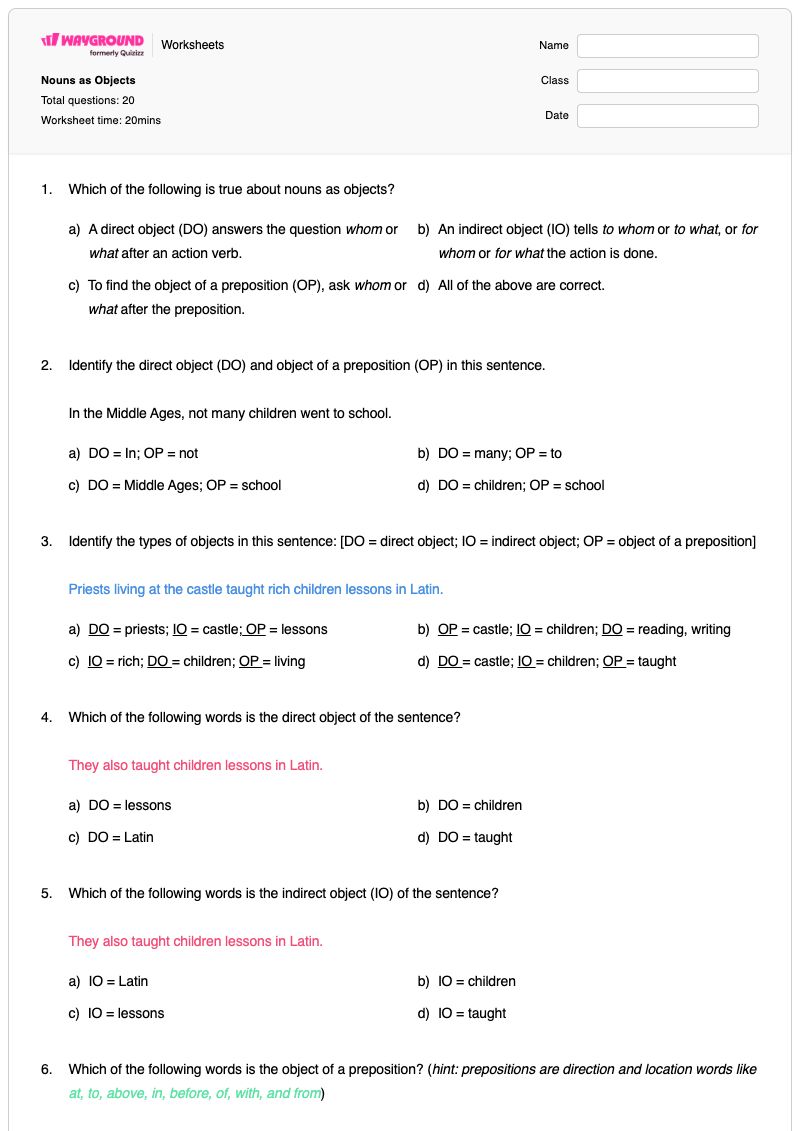
แบบฝึกหัดภาษาอังกฤษสำหรับชั้นประถมศึกษาปีที่ 6 เรื่อง "คำนามในฐานะกรรม" ช่วยให้นักเรียนแยกแยะกรรมตรง กรรมรอง และกรรมของคำบุพบทในประโยคสมบูรณ์ได้ แบบฝึกหัดประกอบด้วย 20 ข้อ นักเรียนจะได้ระบุคำนามหรือวลีคำนามที่ได้รับการกระทำ บุคคลหรือสิ่งของที่ได้รับการกระทำ และคำนามที่ตามหลังคำบุพบท แบบฝึกหัดประกอบด้วยคำถามแบบเลือกตอบ 17 ข้อ คำถามแบบเลือกคำตอบ 2 ข้อ และคำถามเติมคำในช่องว่าง 1 ข้อ ช่วยให้นักเรียนได้ฝึกฝนการวิเคราะห์ในระดับประโยคซ้ำๆ แทนที่จะเป็นการให้คำจำกัดความแบบแยกส่วน ใช้แบบฝึกหัดที่พิมพ์ได้ฟรีนี้เพื่อเสริมความเข้าใจในการระบุกรรมหลังจากการสอนโดยตรง หรือเพื่อตรวจสอบว่านักเรียนสามารถใช้กฎได้อย่างอิสระหรือไม่ คำถามประกอบด้วยประโยคที่มีกรรมมากกว่าหนึ่งประเภท ดังนั้นนักเรียนต้องใช้บทบาทและตำแหน่งของคำนามแต่ละคำ ไม่ใช่เพียงแค่ตำแหน่งที่ตั้ง เพื่อเลือกคำตอบ แบบฝึกหัดนี้เหมาะสำหรับการฝึกฝน ทบทวน หรือประเมินไวยากรณ์สำหรับชั้นประถมศึกษาปีที่ 6 และมีเฉลยคำตอบที่สมบูรณ์เพื่อการตรวจสอบที่มีประสิทธิภาพ

การตั้งค่าแผ่นงาน

ขนาดตัวอักษร

S
M
L
XL
แผ่นงาน

Nouns as Objects

คำถามทั้งหมด: 20

ชื่อ
ระดับ
วันที่
1.

Which of the following is true about nouns as objects?

a)

A direct object (DO) answers the question whom or what after an action verb.

b)

An indirect object (IO) tells to whom or to what, or for whom or for what the action is done.

c)

To find the object of a preposition (OP), ask whom or what after the preposition.

d)

All of the above are correct.

2.

Identify the direct object (DO) and object of a preposition (OP) in this sentence.


In the Middle Ages, not many children went to school.

a)

DO = In; OP = not

b)

DO = many; OP = to

c)

DO = Middle Ages; OP = school

d)

DO = children; OP = school

3.

Identify the types of objects in this sentence: [DO = direct object; IO = indirect object; OP = object of a preposition]


Priests living at the castle taught rich children lessons in Latin.

a)

DO = priests; IO = castle; OP = lessons

b)

OP = castle; IO = children; DO = reading, writing

c)

IO = rich; DO = children; OP = living

d)

DO = castle; IO = children; OP = taught

4.

Which of the following words is the direct object of the sentence?


They also taught children lessons in Latin.

a)

DO = lessons

b)

DO = children

c)

DO = Latin

d)

DO = taught

5.

Which of the following words is the indirect object (IO) of the sentence?


They also taught children lessons in Latin.

a)

IO = Latin

b)

IO = children

c)

IO = lessons

d)

IO = taught

6.

Which of the following words is the object of a preposition? (hint: prepositions are direction and location words like at, to, above, in, before, of, with, and from)


They also taught children lessons in Latin.

a)

OP = children

b)

OP = Latin

c)

OP = lessons

d)

OP = taught

7.

Identify the kinds of objects that are underlined. Which is a direct object, indirect object, or an object of a preposition?


Most people learned history from storytellers.

a)

History is a direct object (DO); Storytellers is an object of a preposition (OP)

b)

History is an indirect object (IO); Storytellers is a direct object (DO)

c)

History is an object of a preposition (OP); storytellers is an indirect object (IO)

d)

History and storyteller are both objects of prepositions (OP)

8.

Identify the direct object (DO), indirect object (IO), and object of a preposition (OP) from the following sentence.


Our teacher showed Sophia a new step at dance class.

a)

DO = teacher; IO = Our; OP = dance

b)

DO = showed; IO = Sophia; OP = class

c)

DO = step; IO = Sophia; OP = class

d)

DO = step; IO = dance; OP = new

9.

Identify the correct types of objects in the following sentence:


The clerk gave the customer two dollars in change.

a)

DO = gave; IO = two; OP = in

b)

DO = dollars; IO = gave; OP = customer

c)

DO = customer; IO = change; OP = dollars

d)

DO = dollars; IO = customer; OP = change

10.

Identify which type of object for the underlined noun.:


The camper watched the antics of the raccoon.

a)

direct object

b)

indirect object

c)

object of a preposition

d)

not an object

11.

Identify which type of object is the underlined noun:


The camper watched the antics of the raccoon.

a)

direct object

b)

indirect object

c)

object of a preposition

d)

not an object

12.

Identify the direct object of the following sentence:


Dan asks his brother questions constantly.

a)

Dan

b)

brother

c)

questions

d)

constantly

13.

Identify the indirect object (IO) of the following sentence:


Dan asks his brother questions constantly.

a)

Dan

b)

brother

c)

questions

d)

constantly

14.

Which of the following is the direct object (DO) of the sentence:


We will build a giant sandwich with plenty of onions.

a)

We

b)

build

c)

giant

d)

sandwich

15.

Identify the two objects of prepositions (OP) in the following sentence:


We will build a giant sandwich with plenty of onions.

a)

We, will

b)

giant, sandwich

c)

with, of

d)

plenty, onions

16.

Identify the correct types of pronouns in the following sentence:


Jacob made his little brother a sandwich for lunch.

a)

sandwich is the direct object (DO); brother is the indirect object (IO); lunch is the object of a preposition (OP)

b)

Jacob is the direct object (DO); made is the indirect object (IO); for is the object of a preposition (OP)

c)

his is the direct object (DO); little is the indirect object (IO); sandwich is the object of a preposition (OP)

d)

none of the above are correct

17.

Identify the preposition and its object noun.


My cat will not eat food in his bowl.

a)

Preposition: My; Object: cat

b)

Preposition: will; Object: eat

c)

Preposition: food; Object: his

d)

Preposition: in; Object: bowl

18.

Which of the words is a preposition? (Hint: a preposition is used to show a relationship between words)

a)

answer

b)

at

c)

because

d)

help

19.

Which of the following are prepositions?

a)

around, by, into, between

b)

house, symphony, child, game

c)

run, play, cry, wait

d)

calmly, fast, colorful, mightily

20.

Fill in the blank with a preposition that makes sense.


The cow jumped (a)   the gate and landed in the field of grass.

แป้นคำตอบ

Nouns as Objects

คำถามทั้งหมด: 20

1.
d)

All of the above are correct.

2.
c)

DO = Middle Ages; OP = school

3.
b)

OP = castle; IO = children; DO = reading, writing

4.
a)

DO = lessons

5.
b)

IO = children

6.
b)

OP = Latin

7.
a)

History is a direct object (DO); Storytellers is an object of a preposition (OP)

8.
c)

DO = step; IO = Sophia; OP = class

9.
d)

DO = dollars; IO = customer; OP = change

10.
a)

direct object

11.
c)

object of a preposition

12.
c)

questions

13.
b)

brother

14.
d)

sandwich

15.
d)

plenty, onions

16.
a)

sandwich is the direct object (DO); brother is the indirect object (IO); lunch is the object of a preposition (OP)

17.
d)

Preposition: in; Object: bowl

18.
b)

at

19.
a)

around, by, into, between

20.
over, through, across, behind, in front of

คำถามที่พบบ่อย

แบบฝึกหัดเรื่อง "คำนามในฐานะกรรม" ครอบคลุมเนื้อหาอะไรบ้าง?

แบบฝึกหัดภาษาอังกฤษสำหรับนักเรียนชั้นประถมศึกษาปีที่ 6 นี้ เน้นการระบุคำนามที่เป็นกรรมตรง กรรมรอง และกรรมของคำบุพบทในประโยคสมบูรณ์ แบบฝึกหัดประกอบด้วย 20 ข้อ—แบบเลือกตอบ 17 ข้อ แบบเลือกคำตอบที่ถูกต้อง 2 ข้อ และแบบเติมคำในช่องว่าง 1 ข้อ—ซึ่งจะช่วยให้นักเรียนจำแนกคำนามแต่ละคำและการรวมกันของกรรมต่างๆ ช่วยให้พวกเขานำความหมายทางไวยากรณ์ไปใช้กับโครงสร้างประโยคได้

ฉันจะใช้แบบฝึกหัดนี้สอนเรื่องกรรมตรง กรรมอ้อม และกรรมตามคำบุพบทได้อย่างไร?

ขั้นแรก ให้ยกตัวอย่างประโยคหนึ่งประโยค โดยระบุคำกริยาที่แสดงการกระทำ ถามว่าใครหรืออะไรสำหรับกรรมตรง ระบุผู้รับสำหรับกรรมรอง และตรวจสอบคำนามที่ตามหลังคำบุพบท จากนั้น ให้นักเรียนอธิบายตัวเลือกของตนในแบบฝึกหัด โดยเฉพาะอย่างยิ่งเมื่อประโยคมีกรรมทั้งสามประเภท ใช้ข้อคำถามแบบเลือกตอบหลายข้อเป็นโอกาสให้นักเรียนอธิบายเหตุผลของแต่ละคำตอบที่เลือก แทนที่จะเดาจากตัวเลือกคำตอบ

ฉันควรระวังข้อผิดพลาดอะไรบ้างเมื่อนักเรียนทำแบบฝึกหัดเรื่องคำนามในฐานะกรรมนี้?

นักเรียนอาจระบุประธานหรือกริยาแสดงการกระทำเป็นกรรม สับสนระหว่างกรรมตรงกับผู้รับกรรมทางอ้อม หรือระบุคำบุพบทเองแทนที่จะเป็นกรรมของมัน นอกจากนี้ พวกเขาอาจมองข้ามกรรมตัวที่สองในประโยคที่มีคำนามหลายคำ หรือเลือกคำตอบเพียงข้อเดียวในข้อสอบแบบเลือกตอบหลายข้อ ทั้งๆ ที่ต้องการการจำแนกประเภทมากกว่าหนึ่งแบบ

ฉันจะมอบหมายและให้คะแนนแบบฝึกหัดเรื่องคำนามในฐานะกรรมนี้ได้อย่างไร?

แบบฝึกหัดนี้มีให้ดาวน์โหลดในรูปแบบ PDF สำหรับพิมพ์ และเป็นแบบทดสอบดิจิทัลบน Wayground โดยมีเฉลยคำตอบครบถ้วน คุณสามารถตรวจงานที่ส่งมาในรูปแบบ PDF ได้โดยการสแกนงานของนักเรียนด้วยแอป Wayground for Teachers หรือใช้แบบทดสอบดิจิทัลเพื่อตรวจสอบคำตอบทางอิเล็กทรอนิกส์

ฉันจะปรับแบบฝึกหัดนี้ให้เหมาะสมกับนักเรียนของฉันได้อย่างไร?

ในการตั้งค่าขั้นสูงของแบบฝึกหัด ให้ปรับระยะห่างระหว่างตัวอักษรหรือเลือกขนาดตัวอักษรที่ใหญ่ขึ้นเพื่อให้แบบฝึกหัดการวิเคราะห์ประโยคมีพื้นที่ในการมองเห็นมากขึ้น นอกจากนี้ คุณยังสามารถใช้แบบอักษรที่เหมาะสำหรับผู้ที่มีภาวะดิสเล็กเซีย หรือแปลแบบฝึกหัดเป็นภาษาอื่นได้ โดยยังคงแบบฝึกหัดเกี่ยวกับกรรมตรง กรรมรอง และกรรมของคำบุพบทไว้เหมือนเดิม

ฉันจะหาแบบฝึกหัดแบบนี้เพิ่มเติมได้ที่ไหนบน Wayground?

Wayground นำเสนอชุดแบบฝึกหัดและโจทย์ฝึกหัดฟรีที่ครอบคลุมทุกวิชา พร้อมไฟล์ PDF และเฉลยคำตอบ เพื่อช่วยให้นักเรียนเชี่ยวชาญทักษะและแนวคิดที่สำคัญ ดูแหล่งข้อมูลเพิ่มเติมได้ที่ https://wayground.com/en-us/worksheets