

Wayground
Historical Thinking Skills - Printable สังคมศึกษา Worksheets ระดับ 6 - Wayground

Historical Thinking Skills

Steven Oliphant

สร้างโดย Steven Oliphant

20 คำถาม

6th ระดับชั้น

สังคมศึกษา

อัปเดตแล้ว ส.ค. 2568

แบบฝึกหัดวิชาสังคมศึกษา ชั้นประถมศึกษาปีที่ 6 นี้ ช่วยเสริมสร้างคำศัพท์เกี่ยวกับการคิดเชิงประวัติศาสตร์ผ่านคำถามแบบเลือกตอบ 20 ข้อ นักเรียนจะได้ระบุความหมายของคำต่างๆ เช่น การเปรียบเทียบ สาเหตุ หลักฐาน การแบ่งยุคสมัย ความต่อเนื่อง การเปลี่ยนแปลง ประวัติศาสตร์ แหล่งข้อมูลปฐมภูมิและทุติยภูมิ ความสัมพันธ์ บริบท ประวัติศาสตร์เทียม อคติ และการเล่าเรื่อง นอกจากนี้ แบบฝึกหัดยังให้นักเรียนเลือกแผนภาพเวนน์เป็นเครื่องมือที่เหมาะสมสำหรับการเปรียบเทียบคุณลักษณะของอารยธรรมโบราณ แบบฝึกหัดนี้เป็นแบบฝึกหัดที่พิมพ์ได้ฟรีพร้อมเฉลย ช่วยให้ครูตรวจสอบว่านักเรียนสามารถแยกแยะคำศัพท์ทางประวัติศาสตร์ที่เกี่ยวข้องกันอย่างใกล้ชิดและเชื่อมโยงการเปรียบเทียบด้วยแผนภาพได้หรือไม่ ใช้เพื่อแนะนำหรือทบทวนภาษาที่นักเรียนต้องการสำหรับการวิเคราะห์อดีต การอภิปรายแหล่งข้อมูล และการอธิบายความสัมพันธ์ระหว่างเหตุการณ์และแนวคิด รูปแบบคำถามแบบเลือกตอบเหมาะสำหรับการฝึกฝนด้วยตนเอง การตรวจสอบคำศัพท์ หรือการทบทวนทั้งชั้นเรียนในบทเรียนสังคมศึกษา ชั้นประถมศึกษาปีที่ 6

การตั้งค่าแผ่นงาน

ขนาดตัวอักษร

S
M
L
XL
Waygroundแผ่นงาน

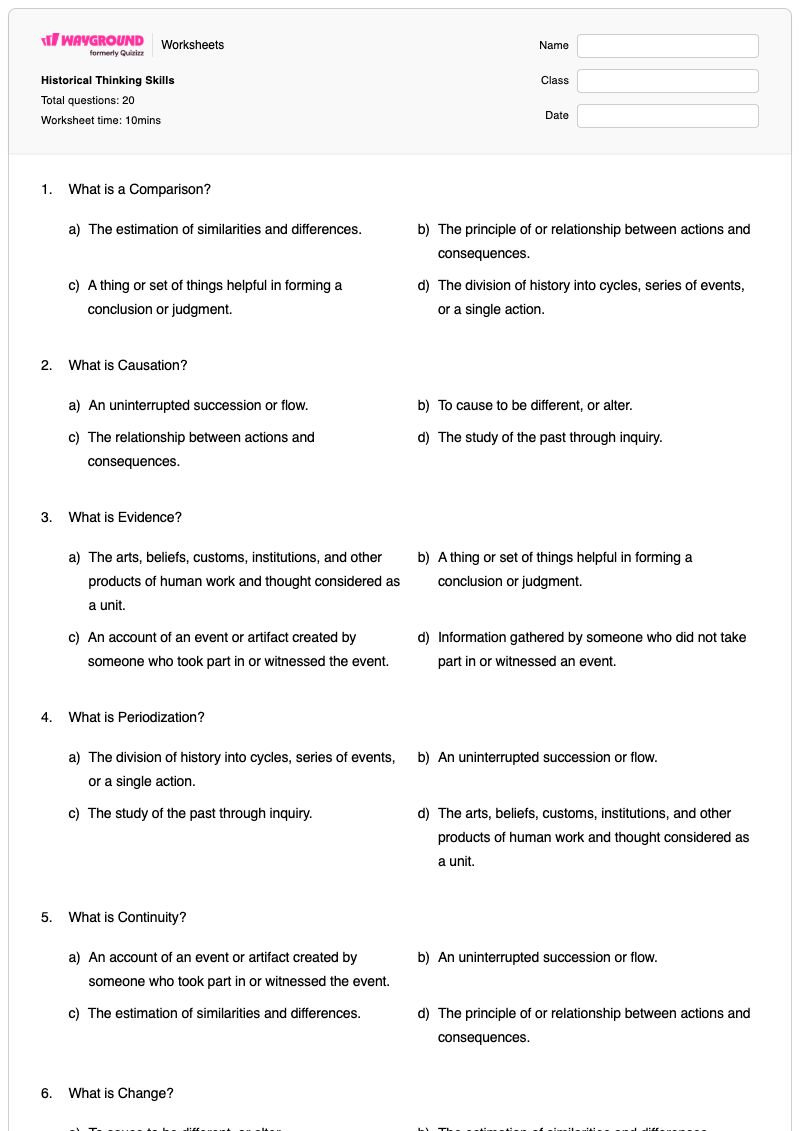
Historical Thinking Skills

คำถามทั้งหมด: 20

ชื่อ
ระดับ
วันที่
1.

What is a Comparison?

a)

The estimation of similarities and differences.

b)

The principle of or relationship between actions and consequences.

c)

A thing or set of things helpful in forming a conclusion or judgment.

d)

The division of history into cycles, series of events, or a single action.

2.

What is Causation?

a)

An uninterrupted succession or flow.

b)

To cause to be different, or alter.

c)

The relationship between actions and consequences.

d)

The study of the past through inquiry.

3.

What is Evidence?

a)

The arts, beliefs, customs, institutions, and other products of human work and thought considered as a unit.

b)

A thing or set of things helpful in forming a conclusion or judgment.

c)

An account of an event or artifact created by someone who took part in or witnessed the event.

d)

Information gathered by someone who did not take part in or witnessed an event.

4.

What is Periodization?

a)

The division of history into cycles, series of events, or a single action.

b)

An uninterrupted succession or flow.

c)

The study of the past through inquiry.

d)

The arts, beliefs, customs, institutions, and other products of human work and thought considered as a unit.

5.

What is Continuity?

a)

An account of an event or artifact created by someone who took part in or witnessed the event.

b)

An uninterrupted succession or flow.

c)

The estimation of similarities and differences.

d)

The principle of or relationship between actions and consequences.

6.

What is Change?

a)

To cause to be different, or alter.

b)

The estimation of similarities and differences.

c)

An uninterrupted succession or flow.

d)

The study of the past through inquiry.

7.

What is History?

a)

The arts, beliefs, customs, institutions, and other products of human work and thought considered as a unit.

b)

An account of an event or artifact created by someone who took part in or witnessed the event.

c)

The study of the past through inquiry.

d)

Information gathered by someone who did not take part in or witnessed an event.

8.

What is a Primary Source?

a)

The estimation of similarities and differences.

b)

An account of an event or artifact created by someone who took part in or witnessed the event.

c)

The estimation of similarities and differences.

d)

Information gathered by someone who did not take part in or witnessed an event.

9.

What is a Secondary Source?

a)

Information gathered by someone who did not take part in or witnessed an event.

b)

The estimation of similarities and differences.

c)

An account of an event or artifact created by someone who took part in or witnessed the event.

d)

To cause to be different, or alter.

10.

What is Correlation?

a)

A thing or set of things helpful in forming a conclusion or judgment.

b)

The division of history into cycles, series of events, or a single action.

c)

A connection between two things based on it happening at the same time.

d)

The circumstances in which an event occurs

11.

What is Context?

a)

The circumstances in which an event occurs

b)

A connection between two things based on it happening at the same time.

c)

An uninterrupted succession or flow.

d)

The principle of or relationship between actions and consequences.

12.

What is Pseudo History?

a)

An account of an event or artifact created by someone who took part in or witnessed the event.

b)

The principle of or relationship between actions and consequences.

c)

The study of the past through inquiry.

d)

False or deceptive study of the past through inquiry

13.

What is Bias?

a)

A preference or an desire, especially one that prevents fair judgment

b)

A connection between two things based on it happening at the same time.

c)

An uninterrupted succession or flow.

d)

The principle of or relationship between actions and consequences.

14.

What is a Narrative?

a)

False or deceptive study of the past through inquiry

b)

An explanation or interpretation of events in accordance with a particular theory, ideology, or point of view

c)

The circumstances in which an event occurs

d)

The study of the past through inquiry.

15.

When comparing two different characteristics of an ancient civilizations, it might be best to use a __________.

a)

Venn Diagram

b)

Timeline

c)

Pyramid chart

d)

Pie chart

16.

A __________ can be used for periodization.

a)

Venn Diagram

b)

Timeline

c)

Pyramid chart

d)

T-chart

17.

A history textbook is an example of a __________.

a)

Primary source

b)

Secondary source

18.

A transcript of Dr. Martin Luther King, Jr.'s 'I Have a Dream' speech is considered a __________.

a)

Primary Source

b)

Secondary Source

19.

What is argumentation?

a)

The action or process of reasoning in order to support an idea, action or theory

b)

the act of being deceptive

c)

the action or process of imagination

d)

the act of fighting, but only with words

20.

TRUE OR FALSE: Historians have no bias.

a)

True

b)

False

Waygroundแป้นคำตอบ

Historical Thinking Skills

คำถามทั้งหมด: 20

1.
a)

The estimation of similarities and differences.

2.
c)

The relationship between actions and consequences.

3.
b)

A thing or set of things helpful in forming a conclusion or judgment.

4.
a)

The division of history into cycles, series of events, or a single action.

5.
b)

An uninterrupted succession or flow.

6.
a)

To cause to be different, or alter.

7.
c)

The study of the past through inquiry.

8.
b)

An account of an event or artifact created by someone who took part in or witnessed the event.

9.
a)

Information gathered by someone who did not take part in or witnessed an event.

10.
c)

A connection between two things based on it happening at the same time.

11.
a)

The circumstances in which an event occurs

12.
d)

False or deceptive study of the past through inquiry

13.
a)

A preference or an desire, especially one that prevents fair judgment

14.
b)

An explanation or interpretation of events in accordance with a particular theory, ideology, or point of view

15.
a)

Venn Diagram

16.
b)

Timeline

17.
b)

Secondary source

18.
a)

Primary Source

19.
a)

The action or process of reasoning in order to support an idea, action or theory

20.
b)

False

คำถามที่พบบ่อย

แบบฝึกหัดทักษะการคิดเชิงประวัติศาสตร์ครอบคลุมหัวข้ออะไรบ้าง?

แบบฝึกหัดสำหรับนักเรียนชั้นประถมศึกษาปีที่ 6 นี้ ประกอบด้วยคำถามแบบเลือกตอบ 20 ข้อ เพื่อตรวจสอบความเข้าใจของนักเรียนเกี่ยวกับคำศัพท์ทางด้านความคิดทางประวัติศาสตร์ ได้แก่ การเปรียบเทียบ สาเหตุ หลักฐาน การแบ่งยุคสมัย ความต่อเนื่อง การเปลี่ยนแปลง แหล่งข้อมูลปฐมภูมิและทุติยภูมิ ความสัมพันธ์ บริบท อคติ การเล่าเรื่อง และประวัติศาสตร์เทียม นักเรียนยังได้ประยุกต์ใช้แนวคิดเรื่องการเปรียบเทียบโดยการเลือกแผนภาพเวนน์เพื่อเปรียบเทียบคุณลักษณะของอารยธรรมโบราณ ซึ่งจะช่วยเสริมสร้างทั้งการจดจำคำศัพท์และการเลือกใช้เครื่องมือ

ฉันจะใช้แบบฝึกหัดนี้ในการสอนทักษะการคิดเชิงประวัติศาสตร์ได้อย่างไร?

แนะนำคำศัพท์ต่างๆ เป็นกลุ่มเล็กๆ เช่น คำศัพท์เกี่ยวกับแหล่งที่มา คำศัพท์เกี่ยวกับเวลาและการเปลี่ยนแปลง และความสัมพันธ์ระหว่างเหตุการณ์ ก่อนที่นักเรียนจะทำแบบทดสอบแบบเลือกตอบ หลังจากแต่ละข้อ ให้ถามนักเรียนว่าทำไมคำจำกัดความที่ถูกต้องจึงเหมาะสม และทำไมตัวเลือกที่เกี่ยวข้องอื่นๆ เช่น ความสัมพันธ์แทนที่จะเป็นสาเหตุ หรือความต่อเนื่องแทนที่จะเป็นการเปลี่ยนแปลง จึงไม่เหมาะสม ใช้คำถามเกี่ยวกับแผนภาพเวนน์เพื่อเชื่อมโยงคำจำกัดความของการเปรียบเทียบกับวิธีการจัดระเบียบความเหมือนและความแตกต่างในทางปฏิบัติ

ฉันควรระวังข้อผิดพลาดอะไรบ้างเมื่อนักเรียนทำแบบฝึกหัดการคิดเชิงประวัติศาสตร์นี้?

นักเรียนอาจสับสนระหว่างการเปรียบเทียบกับสาเหตุ หรือความสัมพันธ์กับสาเหตุ เพราะทั้งสามอย่างเกี่ยวข้องกับความสัมพันธ์ระหว่างความคิดหรือเหตุการณ์ พวกเขายังอาจสลับแหล่งข้อมูลปฐมภูมิและทุติยภูมิ สับสนระหว่างความต่อเนื่องกับการเปลี่ยนแปลง หรือเลือกใช้เส้นเวลาแทนแผนภาพเวนน์ในการเปรียบเทียบคุณลักษณะ ตรวจสอบถ้อยคำที่ใช้จริงของแต่ละคำจำกัดความ และให้นักเรียนระบุเบาะแสสำคัญที่แยกความแตกต่างระหว่างคำที่ใกล้เคียงกัน

ฉันจะมอบหมายและให้คะแนนแบบฝึกหัดทักษะการคิดเชิงประวัติศาสตร์นี้ได้อย่างไร?

แบบฝึกหัดนี้มีให้เลือกทั้งในรูปแบบไฟล์ PDF ที่สามารถพิมพ์ได้ และแบบทดสอบดิจิทัลบน Wayground โดยมีเฉลยคำตอบครบถ้วนสำหรับคำถามแบบเลือกตอบ 20 ข้อ สำหรับการส่งงานแบบพิมพ์ คุณสามารถตรวจงานของนักเรียนได้โดยการสแกนด้วยแอป Wayground for Teachers นอกจากนี้ ตัวเลือก PDF ยังเหมาะสำหรับห้องเรียนหรือโรงเรียนที่ต้องการลดเวลาการใช้หน้าจออีกด้วย

ฉันจะปรับแบบฝึกหัดการคิดเชิงประวัติศาสตร์นี้ให้เหมาะสมกับนักเรียนของฉันได้อย่างไร?

ในการตั้งค่าขั้นสูงของแบบฝึกหัด ให้ปรับระยะห่างระหว่างตัวอักษรหรือเลือกขนาดตัวอักษรที่ใหญ่ขึ้นเพื่อให้คำจำกัดความแบบเลือกตอบอ่านง่ายขึ้น นอกจากนี้ คุณยังสามารถใช้แบบอักษรที่เหมาะสำหรับผู้ที่มีภาวะดิสเล็กเซีย หรือแปลคำถามเกี่ยวกับการคิดเชิงประวัติศาสตร์และตัวเลือกคำตอบเป็นภาษาอื่นเพื่อช่วยให้เข้าถึงคำศัพท์ได้ดียิ่งขึ้น

ฉันจะหาแบบฝึกหัดแบบนี้เพิ่มเติมได้ที่ไหนบน Wayground?

Wayground นำเสนอชุดแบบฝึกหัดและโจทย์ฝึกหัดฟรีที่ครอบคลุมทุกวิชา พร้อมไฟล์ PDF และเฉลยคำตอบ เพื่อช่วยให้นักเรียนเชี่ยวชาญทักษะและแนวคิดที่สำคัญ ดูแหล่งข้อมูลเพิ่มเติมได้ที่ https://wayground.com/en-us/worksheets