

Wayground
Types of Chemical Reactions and Balancing Equations - Printable Science Worksheets - Wayground

Types of Chemical Reactions and Balancing Equations

25 คำถาม

10th - 10th ระดับชั้น

Science

แบบฝึกหัดวิทยาศาสตร์ระดับชั้น ม.4 (เกรด 4) ที่สามารถพิมพ์ได้ฟรีนี้ มีคำถามแบบเลือกตอบ 25 ข้อ เกี่ยวกับการระบุประเภทของปฏิกิริยาเคมีและการดุลสมการเคมี นักเรียนจะได้ทบทวนกฎการอนุรักษ์มวลสาร แยกแยะสารตั้งต้นและผลิตภัณฑ์ รู้จักสัญญาณของการเปลี่ยนแปลงทางเคมี และระบุปฏิกิริยาการสังเคราะห์ การสลายตัว การแทนที่เดี่ยว การแทนที่คู่ และการเผาไหม้จากสมการเชิงสัญลักษณ์ นอกจากนี้ พวกเขายังต้องหาค่าสัมประสิทธิ์ที่ถูกต้องที่จำเป็นในการดุลสมการโดยไม่เปลี่ยนแปลงสูตรเคมี แบบฝึกหัดนี้ออกแบบมาสำหรับการสอนวิชาเคมี การฝึกฝนแบบมีผู้แนะนำ การทบทวนด้วยตนเอง หรือการประเมินทักษะพื้นฐานเกี่ยวกับปฏิกิริยาเคมี คำถามเช่น การดุลสมการเหล็กและคลอรีน หรือลิเธียมและคลอรีน ต้องการให้นักเรียนนับอะตอมทั้งสองข้างและเลือกชุดค่าสัมประสิทธิ์ที่ถูกต้อง แบบฝึกหัดที่สามารถพิมพ์ได้ฟรีนี้มีเฉลยคำตอบครบถ้วน ทำให้ใช้งานได้จริงในห้องเรียนระดับชั้น ม.4 การบ้าน การแก้ไขปัญหา และการเตรียมสอบ

การตั้งค่าแผ่นงาน

ขนาดตัวอักษร

S
M
L
XL
แผ่นงาน

Types of Chemical Reactions and Balancing Equations

คำถามทั้งหมด: 25

ชื่อ
ระดับ
วันที่
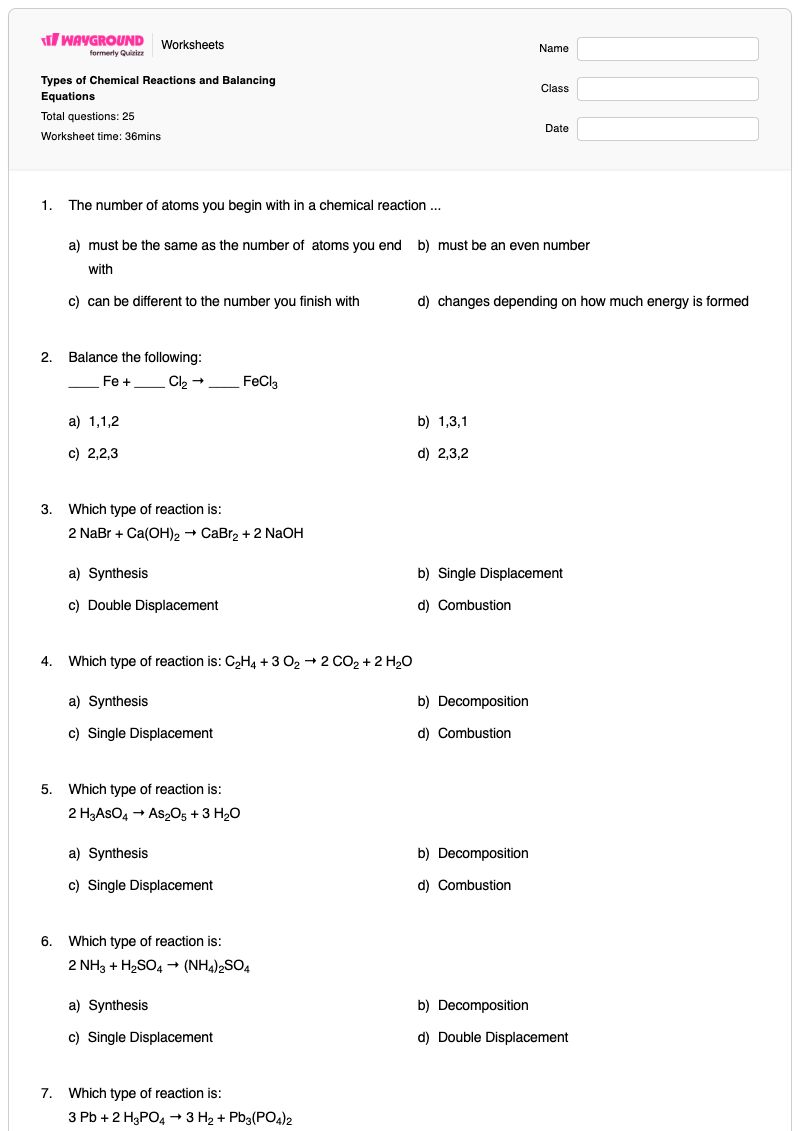
1.
The number of atoms you begin with in a chemical reaction ...
a)
must be the same as the number of  atoms you end with
b)
must be an even number
c)
can be different to the number you finish with
d)
changes depending on how much energy is formed
2.

Balance the following:

____ Fe + ____ Cl2 → ____ FeCl3

a)
1,1,2
b)
1,3,1
c)
2,2,3
d)
2,3,2
3.

Which type of reaction is:

2 NaBr + Ca(OH)2 → CaBr2 + 2 NaOH

a)
Synthesis
b)
Single Displacement
c)
Double Displacement
d)
Combustion
4.
Which type of reaction is: C2H4 + 3 O2 → 2 CO2 + 2 H2O
a)
Synthesis
b)
Decomposition
c)
Single Displacement
d)
Combustion
5.

Which type of reaction is:

2 H3AsO4 → As2O5 + 3 H2O

a)
Synthesis
b)
Decomposition
c)
Single Displacement
d)
Combustion
6.

Which type of reaction is:

2 NH3 + H2SO4 → (NH4)2SO4

a)
Synthesis
b)
Decomposition
c)
Single Displacement
d)
Double Displacement
7.

Which type of reaction is:

3 Pb + 2 H3PO4 → 3 H2 + Pb3(PO4)2

a)
Synthesis
b)
Single Displacement
c)
Double Displacement
d)
Combustion
8.

Which type of reaction is:

C7H16 + 10 O2 → 7 CO2 + 8 H2O

a)
Synthesis
b)
Decomposition
c)
Single Displacement
d)
Combustion
9.
The Law of Conservation of Matter states that the total mass of the reactants should be 
a)
More than the mass of the products
b)
Equal to the mass of the products
c)
Ignored during the reaction
d)
Less than the mass of the products
10.
When balancing equations, the rule is that you can only add, change, and remove
a)
Coefficients
b)
Mass
c)
Subscripts
d)
Elements 
11.

Which of the following is a common sign that a chemical change has occurred?

a)

A chemical has turned a different color, bubbled, and/or changed temperature.

b)

A chemical has changed to a different state of matter, such as a liquid to a solid.

c)

A chemical has changed size.

d)

A chemical has become a different shape.

12.
What are Chemical Reactions?
a)
It's when you mix substances.
b)
a process in which atoms rearrange to form new substances
c)
When something bubbles.
d)
letter and numbers showing the types and number of atoms
13.
the starting materials in a chemical reaction
a)
Products
b)
Reactants
c)
Starters
d)
Enders
14.
a substance that is formed as the result of a chemical reaction
a)
Product 
b)
Reactant
c)
Starters
d)
Enders
15.
Balance this equation:
 2Li + Cl2 -> LiCl
a)
2Li + Cl2 -> 4LiCl2
b)
2Li + Cl2 -> LiCl2
c)
2Li + Cl2 -> 2LiCl
16.
AB + CD →AD + CB
a)
Double Replacement
b)
Single Replacement
c)
Synthesis
d)
Decomposition
17.

What mathematical function do coefficients perform in a balanced equation?

a)

addition

b)

multiplication

c)

subtraction

d)

division

18.

Which of the following is an example of a synthesis reaction?

a)
b)
c)
d)
19.

Which of the following is an example of a decomposition reaction?

a)
b)
c)
d)
20.

Which of the following is an example of a single replacement reaction?

a)
b)
c)
d)
21.

Which of the following is an example of a double replacement reaction?

a)
b)
c)
d)
22.

The red numbers in the image represent

a)

subscripts

b)

coeffiecients

c)

roman numerals

d)

none of the answer options are correct

23.

The blue numbers in the image represent

a)

subscripts

b)

coeffiecients

c)

roman numerals

d)

none of the answer options are correct

24.
Which problem is balanced?
(Check ALL answers)
a)
PbO2 + 2H2
b)
SO2 + H20 --> H2SO4
c)
2Na + 2H2O --> 2NaOH + H2
25.
Is this balanced?
Al + O2 → 2Al2O3
a)
Yes
b)
No
แป้นคำตอบ

Types of Chemical Reactions and Balancing Equations

คำถามทั้งหมด: 25

1.
a) must be the same as the number of  atoms you end with
2.
d) 2,3,2
3.
c) Double Displacement
4.
d) Combustion
5.
b) Decomposition
6.
a) Synthesis
7.
b) Single Displacement
8.
d) Combustion
9.
b) Equal to the mass of the products
10.
a) Coefficients
11.
a)

A chemical has turned a different color, bubbled, and/or changed temperature.

12.
b) a process in which atoms rearrange to form new substances
13.
b) Reactants
14.
a) Product 
15.
c) 2Li + Cl2 -> 2LiCl
16.
a) Double Replacement
17.
b)

multiplication

18.
a)
19.
b)
20.
c)
21.
d)
22.
b)

coeffiecients

23.
a)

subscripts

24.
c) 2Na + 2H2O --> 2NaOH + H2
25.
b) No

คำถามที่พบบ่อย

แบบฝึกหัดนี้ครอบคลุมเนื้อหาอะไรบ้าง และช่วยให้นักเรียนเรียนรู้เกี่ยวกับปฏิกิริยาเคมีได้อย่างไร?

แบบฝึกหัดสำหรับนักเรียนชั้นมัธยมศึกษาปีที่ 4 นี้ ประกอบด้วยคำถามแบบเลือกตอบ 25 ข้อ เพื่อประเมินประเภทของปฏิกิริยาและการดุลสมการ นักเรียนจะต้องจำแนกสมการเป็นปฏิกิริยาการสังเคราะห์ การสลายตัว การแทนที่เดี่ยว การแทนที่คู่ หรือการเผาไหม้ พร้อมทั้งประยุกต์ใช้หลักการอนุรักษ์อะตอมและมวล ระบุสารตั้งต้นและผลิตภัณฑ์ และเลือกสัมประสิทธิ์ที่ทำให้สมการสมดุลโดยไม่เปลี่ยนแปลงตัวเลขห้อย

ฉันจะใช้แบบฝึกหัดนี้สอนเรื่องประเภทของปฏิกิริยาและการดุลสมการได้อย่างไร?

ใช้คำถามเกี่ยวกับการจำแนกประเภทเพื่อแนะนำรูปแบบลักษณะเฉพาะของปฏิกิริยาการสังเคราะห์ การสลายตัว การแทนที่เดี่ยว การแทนที่คู่ และการเผาไหม้ จากนั้นสาธิตวิธีการนับธาตุแต่ละชนิดในสมการ สำหรับคำถามเกี่ยวกับการดุลสมการ ให้นักเรียนอธิบายว่าเหตุใดจึงต้องปรับค่าสัมประสิทธิ์ ไม่ใช่ตัวห้อย โดยใช้ตัวอย่างเช่น Fe + Cl₂ → FeCl₃ และ Li + Cl₂ → LiCl ก่อนที่จะทำแบบฝึกหัดแบบเลือกตอบด้วยตนเอง

ฉันควรระวังข้อผิดพลาดอะไรบ้างเมื่อนักเรียนทำแบบฝึกหัดเรื่องปฏิกิริยาเคมีนี้?

นักเรียนอาจสับสนระหว่างสารตั้งต้นกับผลิตภัณฑ์ มองข้ามว่าอะตอมต้องได้รับการอนุรักษ์ หรือเลือกสมการเพราะดูคุ้นเคยโดยไม่นับจำนวนธาตุทั้งสองข้าง ในโจทย์การดุลสมการ ให้สังเกตนักเรียนที่เปลี่ยนตัวห้อยแทนที่จะเปลี่ยนสัมประสิทธิ์ หรือเลือกชุดสัมประสิทธิ์ที่ทำให้ธาตุหนึ่งสมดุลแต่ทำให้ธาตุอื่นไม่สมดุล นอกจากนี้ พวกเขายังอาจสับสนระหว่างการจำแนกประเภทของปฏิกิริยา โดยเฉพาะอย่างยิ่งปฏิกิริยาการสังเคราะห์กับปฏิกิริยาการแทนที่เดี่ยวหรือปฏิกิริยาการแทนที่คู่ และปฏิกิริยาการเผาไหม้กับปฏิกิริยาประเภทอื่น ๆ

ฉันจะมอบหมายและตรวจงานเรื่องปฏิกิริยาเคมีนี้อย่างไร?

แบบฝึกหัดนี้มีให้ดาวน์โหลดในรูปแบบไฟล์ PDF สำหรับพิมพ์ และเป็นแบบทดสอบดิจิทัลบน Wayground โดยมีเฉลยคำตอบครบถ้วนสำหรับตรวจสอบคำตอบแบบเลือกตอบ 25 ข้อ การส่งงานแบบพิมพ์สามารถตรวจได้โดยการสแกนงานของนักเรียนด้วยแอป Wayground for Teachers ในขณะที่แบบทดสอบดิจิทัลเป็นทางเลือกที่ไม่ต้องใช้กระดาษสำหรับการมอบหมายและทบทวนแบบฝึกหัดเกี่ยวกับปฏิกิริยาและการดุลสมการเคมีแบบเดียวกัน

ฉันจะปรับแบบฝึกหัดเรื่องปฏิกิริยาเคมีนี้ให้เหมาะสมกับนักเรียนของฉันได้อย่างไร?

ใช้การตั้งค่าขั้นสูงของแบบฝึกหัดเพื่อปรับระยะห่างระหว่างตัวอักษรและขนาดตัวอักษร เพื่อให้สูตรเคมี สัมประสิทธิ์ และตัวเลือกแบบปรนัยอ่านง่ายขึ้น นอกจากนี้ คุณยังสามารถใช้แบบอักษรที่เหมาะสำหรับผู้ที่มีภาวะดิสเล็กเซีย หรือแปลแบบฝึกหัดเป็นภาษาอื่นโดยคงรูปแบบการจำแนกประเภทปฏิกิริยาและการดุลสมการเอาไว้ได้

ฉันจะหาแบบฝึกหัดแบบนี้เพิ่มเติมได้ที่ไหนบน Wayground?

Wayground มีแบบฝึกหัดและโจทย์ฝึกหัดมากมายให้ดาวน์โหลดฟรีในหลากหลายวิชา พร้อมไฟล์ PDF และเฉลยคำตอบ เพื่อช่วยเสริมสร้างทักษะและความเข้าใจในเนื้อหาสำคัญ ดูแหล่งข้อมูลเพิ่มเติมได้ที่ https://wayground.com/en-us/worksheets