

Wayground
Unit 3.5 Free Fall - Printable ศาสตร์ Worksheets 9th ระดับชั้น - Wayground

Unit 3.5 Free Fall

Kaitlyn Braatz

สร้างโดย Kaitlyn Braatz

17 คำถาม

9th ระดับชั้น

ศาสตร์

อัปเดตแล้ว ก.ย. 2569

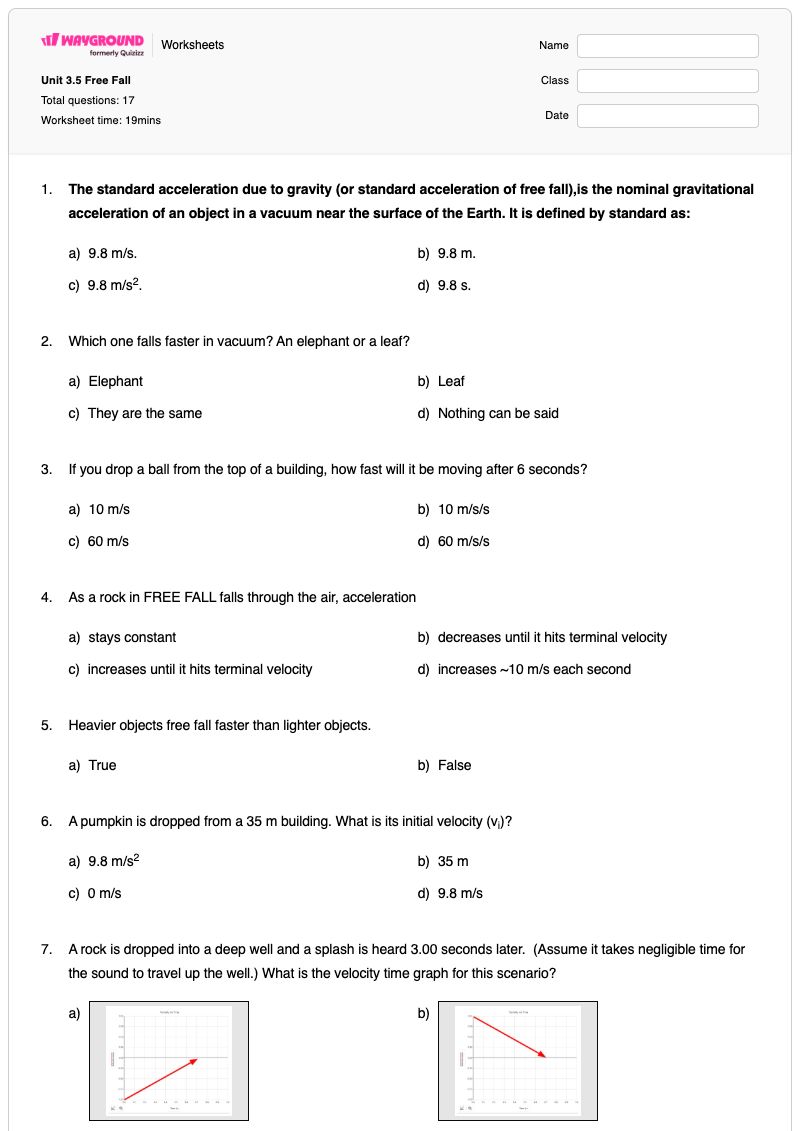
หน่วยที่ 3.5 การตกอย่างอิสระ เป็นแบบฝึกหัดฟิสิกส์ระดับชั้น ม.3 ที่สามารถพิมพ์ได้ฟรี พร้อมเฉลยคำตอบ แบบฝึกหัดนี้มีคำถามแบบเลือกตอบ 17 ข้อ กระตุ้นให้นักเรียนประยุกต์ใช้หลักการตกอย่างอิสระ ระบุค่าความเร่งโน้มถ่วงมาตรฐานและความเร็วเริ่มต้น เปรียบเทียบการตกของวัตถุในสุญญากาศ และแยกแยะความแตกต่างระหว่างความเร็วและความเร่งเมื่อเทียบกับเวลา นอกจากนี้ นักเรียนยังต้องตีความกราฟความเร็ว-เวลาของวัตถุที่ถูกปล่อยลงมา นักกระโดดร่ม และวัตถุที่ถูกโยนขึ้นไป แบบฝึกหัดนี้ช่วยเสริมความเข้าใจว่าแรงโน้มถ่วง แรงต้านอากาศ แรงต้าน และความเร็วปลายมีผลต่อการเคลื่อนที่อย่างไร แบบฝึกหัดนี้มีคำถามที่ต้องการให้นักเรียนเลือกหน่วยที่ถูกต้อง คำนวณความเร็วหลังจากเวลาที่กำหนด ตระหนักว่าความเร่งสามารถคงที่ได้ในขณะที่ความเร็วเปลี่ยนแปลง และเชื่อมโยงพื้นที่ผิวของร่มชูชีพกับแรงต้าน สามารถใช้แบบฝึกหัดนี้สำหรับการฝึกฝนแบบมีผู้แนะนำ การทบทวนด้วยตนเอง หรือการตรวจสอบความเข้าใจของนักเรียนชั้น ม.3 เกี่ยวกับการเคลื่อนที่แบบตกอย่างอิสระและการแสดงภาพกราฟ

การตั้งค่าแผ่นงาน

ขนาดตัวอักษร

S
M
L
XL
Waygroundแผ่นงาน

Unit 3.5 Free Fall

คำถามทั้งหมด: 17

ชื่อ
ระดับ
วันที่
1.

The standard acceleration due to gravity (or standard acceleration of free fall),is the nominal gravitational acceleration of an object in a vacuum near the surface of the Earth. It is defined by standard as:

a)

9.8 m/s.

b)

9.8 m.

c)

9.8 m/s2.

d)

9.8 s.

2.

Which one falls faster in vacuum? An elephant or a leaf?

a)

Elephant

b)

Leaf

c)

They are the same

d)

Nothing can be said

3.
If you drop a ball from the top of a building, how fast will it be moving after 6 seconds?
a)
10 m/s
b)
10 m/s/s
c)
60 m/s
d)
60 m/s/s
4.

As a rock in FREE FALL falls through the air, acceleration

a)

stays constant

b)

decreases until it hits terminal velocity

c)

increases until it hits terminal velocity

d)

increases ~10 m/s each second

5.

Heavier objects free fall faster than lighter objects.

a)

True

b)

False

6.
A pumpkin is dropped from a 35 m building. What is its initial velocity (vi)?
a)
9.8 m/s2
b)
35 m
c)
0 m/s
d)
9.8 m/s
7.

A rock is dropped into a deep well and a splash is heard 3.00 seconds later.  (Assume it takes negligible time for the sound to travel up the well.) What is the velocity time graph for this scenario?

a)
A rock is dropped into a deep well and a splash is heard 3.00 seconds later. (Assume it takes negligible time for the sound…

b)
A rock is dropped into a deep well and a splash is heard 3.00 seconds later. (Assume it takes negligible time for the sound…
c)
A rock is dropped into a deep well and a splash is heard 3.00 seconds later. (Assume it takes negligible time for the sound…
d)
A rock is dropped into a deep well and a splash is heard 3.00 seconds later. (Assume it takes negligible time for the sound…

8.

On a planet that has no atmosphere, a rocket 14.2 m tall is resting on its launch pad. Freefall acceleration on the planet is - 4.45 m/s/s. A ball is dropped from the top of the rocket with zero initial velocity. What is the velocity time graph for this scenario?

a)
On a planet that has no atmosphere, a rocket 14.2 m tall is resting on its launch pad. Freefall acceleration on the planet…
b)
On a planet that has no atmosphere, a rocket 14.2 m tall is resting on its launch pad. Freefall acceleration on the planet…
c)
On a planet that has no atmosphere, a rocket 14.2 m tall is resting on its launch pad. Freefall acceleration on the planet…
d)
On a planet that has no atmosphere, a rocket 14.2 m tall is resting on its launch pad. Freefall acceleration on the planet…
9.

While skydiving, your parachute opens and you slow from 50.0m/s to 8.0m/s is a mere 0.80sec. What is the velocity time graph for this scenario?

a)
While skydiving, your parachute opens and you slow from 50.0m/s to 8.0m/s is a mere 0.80sec. What is the velocity time graph…
b)
While skydiving, your parachute opens and you slow from 50.0m/s to 8.0m/s is a mere 0.80sec. What is the velocity time graph…
c)
While skydiving, your parachute opens and you slow from 50.0m/s to 8.0m/s is a mere 0.80sec. What is the velocity time graph…
d)
While skydiving, your parachute opens and you slow from 50.0m/s to 8.0m/s is a mere 0.80sec. What is the velocity time graph…
10.

After landing safely from your skydiving experience you are so excited that you throw your helmet straight up.  It reaches a height of 5.0m above your hand. What is the velocity time graph for this scenario?

a)
After landing safely from your skydiving experience you are so excited that you throw your helmet straight up. It reaches a…
b)
After landing safely from your skydiving experience you are so excited that you throw your helmet straight up. It reaches a…
c)
After landing safely from your skydiving experience you are so excited that you throw your helmet straight up. It reaches a…
d)
After landing safely from your skydiving experience you are so excited that you throw your helmet straight up. It reaches a…
11.

When a parachute canopy is opened more drag is created because:

a)

It has a large mass

b)

It has a large surface area

c)

It is travelling at terminal speed

d)

The person is now vertical

12.
According to Galileo's observations gravity pulls on all objects equally regardless of _____________

According to Galileo's observations gravity pulls on all objects equally regardless of _____________

a)

size

b)

shape

c)

mass

d)

time of day

13.
When the air resistance or drag is equal and opposite to the weight of the object you would call this

When the air resistance or drag is equal and opposite to the weight of the object you would call this

a)

terminal velocity

b)

gravitational weight

c)

flux capacitor

d)

rotational inertia

14.

What is the acceleration of a ball that is dropped off the side of a cliff after 1,2,3,4,5 seconds? (assume g is rounded to 10 m/s2)

a)

5,10,15, 20, 25 m/s2

b)

10, 20, 30, 40, 50 m/s2

c)

5, 20, 45, 80, 125 m/s2

d)

10,10,10,10,10 m/s2

15.

What is the vertical velocity of a ball that has been dropped off a cliff after 1 , 2, 3, 4, and 5 seconds? (assume g is rounded to 10 m/s2)?.

a)

10, 20, 30, 40, 50 m/s

b)

5, 10, 15, 20, 25 m/s

c)

5, 20, 45, 80,125 m

d)

10,10,10,10,10 m/s

16.

When speed and direction remain the same throughout motion, this is called?

a)

Accelerated motion

b)

Constant motion

c)

Changing motion

d)

Changing velocity

17.
If you throw a baseball straight up, what is its vertical velocity at the highest point?

If you throw a baseball straight up, what is its vertical velocity at the highest point?

a)

9.8 m/s2

b)

9.8 m/s

c)

0 m/s2

d)

0 m/s

Waygroundแป้นคำตอบ

Unit 3.5 Free Fall

คำถามทั้งหมด: 17

1.
c)

9.8 m/s2.

2.
c)

They are the same

3.
c) 60 m/s
4.
c)

increases until it hits terminal velocity

5.
b)

False

6.
c) 0 m/s
7.
c)
8.
d)
9.
a)
10.
b)
11.
b)

It has a large surface area

12.
c)

mass

13.
a)

terminal velocity

14.
d)

10,10,10,10,10 m/s2

15.
a)

10, 20, 30, 40, 50 m/s

16.
b)

Constant motion

17.
d)

0 m/s

คำถามที่พบบ่อย

แบบฝึกหัดหน่วยที่ 3.5 การตกอย่างอิสระ ครอบคลุมเนื้อหาอะไรบ้าง?

แบบฝึกหัดฟิสิกส์ระดับชั้น ม.3 นี้ประกอบด้วยคำถามแบบเลือกตอบ 17 ข้อ เพื่อประเมินการเคลื่อนที่แบบตกอิสระ รวมถึงความเร่งโน้มถ่วง ความเร็วเริ่มต้น ความเร็วหลังจากเวลาที่กำหนด การตกโดยไม่ขึ้นกับมวลในสุญญากาศ แรงต้านอากาศ และความเร็วปลาย นักเรียนยังต้องตีความกราฟความเร็ว-เวลาของก้อนหินที่ถูกปล่อยลงมา นักกระโดดร่ม และลูกบอลที่ถูกโยนขึ้นไปข้างบน ซึ่งเป็นการพัฒนาทั้งทักษะการคำนวณและการอ่านกราฟ

ฉันจะใช้แบบฝึกหัดนี้ในการสอนเรื่องการเคลื่อนที่แบบตกอิสระได้อย่างไร?

เริ่มแบบฝึกหัดโดยทบทวนความแตกต่างระหว่างความเร็วและความเร่ง ค่ามาตรฐานของความเร่งโน้มถ่วง และความหมายของความเร็วเริ่มต้นเป็นศูนย์สำหรับวัตถุที่ถูกปล่อยลงมา จากนั้นให้นักเรียนอธิบายกราฟความเร็ว-เวลาของก้อนหินที่ถูกปล่อยลงมา ร่มชูชีพที่กางออก และหมวกกันน็อคที่ถูกโยนขึ้นไปด้านบน ก่อนที่จะตอบคำถามแบบเลือกตอบด้วยตนเองหรือเป็นคู่

ฉันควรระวังข้อผิดพลาดอะไรบ้างเมื่อนักเรียนทำแบบฝึกหัดเรื่องการตกอย่างอิสระนี้?

สังเกตนักเรียนที่สับสนระหว่างหน่วยความเร่งกับหน่วยความเร็ว เลือกความเร็วเริ่มต้นที่ไม่เป็นศูนย์สำหรับวัตถุที่ถูกปล่อย หรือถือว่าความเร่งคงที่เท่ากับความเร็วคงที่ นักเรียนอาจสับสนระหว่างความชันหรือทิศทางของกราฟความเร็ว-เวลา เข้าใจผิดว่าความเร็วปลายคือความเร่ง หรือคิดว่าวัตถุที่หนักกว่าจะตกลงมาเร็วกว่าในสุญญากาศ

ฉันจะมอบหมายและให้คะแนนแบบฝึกหัดเรื่องการตกอย่างอิสระนี้ได้อย่างไร?

แบบฝึกหัด Unit 3.5 Free Fall มีให้ดาวน์โหลดในรูปแบบ PDF และแบบทดสอบดิจิทัลบน Wayground พร้อมเฉลยคำตอบครบถ้วน แบบฝึกหัดที่พิมพ์ได้สามารถตรวจให้คะแนนได้โดยการสแกนงานของนักเรียนด้วยแอป Wayground for Teachers ส่วนแบบฝึกหัดดิจิทัลสามารถมอบหมายและตรวจให้คะแนนได้ทางออนไลน์

ฉันจะปรับแบบฝึกหัดเรื่องการตกอย่างอิสระนี้ให้เหมาะสมกับนักเรียนของฉันได้อย่างไร?

ในการตั้งค่าขั้นสูงของแบบฝึกหัด ให้ปรับระยะห่างระหว่างตัวอักษรหรือขนาดตัวอักษรเพื่อให้คำถามแบบเลือกตอบ 17 ข้อและกราฟความเร็ว-เวลาอ่านง่ายขึ้น นอกจากนี้ คุณยังสามารถเลือกแบบอักษรที่เหมาะสำหรับผู้ที่มีภาวะดิสเล็กเซีย หรือแปลแบบฝึกหัดการตกอย่างอิสระเป็นภาษาอื่นหากภาษานั้นรองรับการเข้าถึงคำถามได้

ฉันจะหาแบบฝึกหัดแบบนี้เพิ่มเติมได้ที่ไหนบน Wayground?

Wayground มีแบบฝึกหัดและโจทย์ฝึกหัดมากมายให้ดาวน์โหลดฟรีในหลากหลายวิชา พร้อมไฟล์ PDF และเฉลยคำตอบ เพื่อช่วยเสริมสร้างทักษะและความเข้าใจในแนวคิดสำคัญ ดูแหล่งข้อมูลเพิ่มเติมได้ที่ https://wayground.com/en-us/worksheets