

Wayground
Westward Expansion, Immigration & Urbanization Assessment - Printable History Worksheets - Wayground

Westward Expansion, Immigration & Urbanization Assessment

22 คำถาม

11th - 11th ระดับชั้น

History

แบบประเมินการขยายตัวไปทางตะวันตก การอพยพ และการพัฒนาเมือง เป็นแบบฝึกหัดประวัติศาสตร์สำหรับนักเรียนชั้นมัธยมศึกษาปีที่ 4 (เกรด 11) ประกอบด้วยคำถามแบบเลือกตอบ 20 ข้อ และคำถามปลายเปิด 2 ข้อ แบบฝึกหัดนี้ประเมินความเข้าใจของนักเรียนเกี่ยวกับลัทธิแผ่ขยายอำนาจ (Manifest Destiny) การปฏิบัติต่อชนพื้นเมือง ความสำคัญทางวัฒนธรรมของควายป่า ทางรถไฟข้ามทวีป และกฎหมายการจัดสรรที่ดิน (Homestead Act) นอกจากนี้ นักเรียนจะได้ศึกษาเกี่ยวกับการอพยพในศตวรรษที่ 19 รวมถึงการคัดกรองที่เกาะเอลลิส การเดินทางในห้องโดยสารชั้นประหยัด กลุ่มผู้อพยพที่เปลี่ยนแปลงไป แนวคิดการหลอมรวมวัฒนธรรม ลัทธิชาตินิยม กฎหมายกีดกันชาวจีน และข้อกังวลด้านแรงงานเกี่ยวกับแรงงานอพยพ แบบฝึกหัดที่พิมพ์ได้ฟรีพร้อมเฉลยนี้ เหมาะสำหรับใช้เป็นแบบประเมินประจำหน่วย การทบทวน หรือเป็นหลักฐานยืนยันความเข้าใจของนักเรียน คำถามที่หลากหลายในแบบฝึกหัดนี้ต้องการให้นักเรียนระบุคำศัพท์ทางประวัติศาสตร์ ตีความคำพูดและตัวอย่าง ตระหนักถึงความสัมพันธ์ระหว่างเหตุและผล และแยกแยะข้อความที่ถูกต้องออกจากข้อความที่ทำให้เข้าใจผิด คำถามปลายเปิดสองข้อเปิดโอกาสให้นักเรียนอธิบายแนวคิดทางประวัติศาสตร์ด้วยคำพูดของตนเอง แทนที่จะอาศัยเพียงแค่การจดจำ

การตั้งค่าแผ่นงาน

ขนาดตัวอักษร

S
M
L
XL
แผ่นงาน

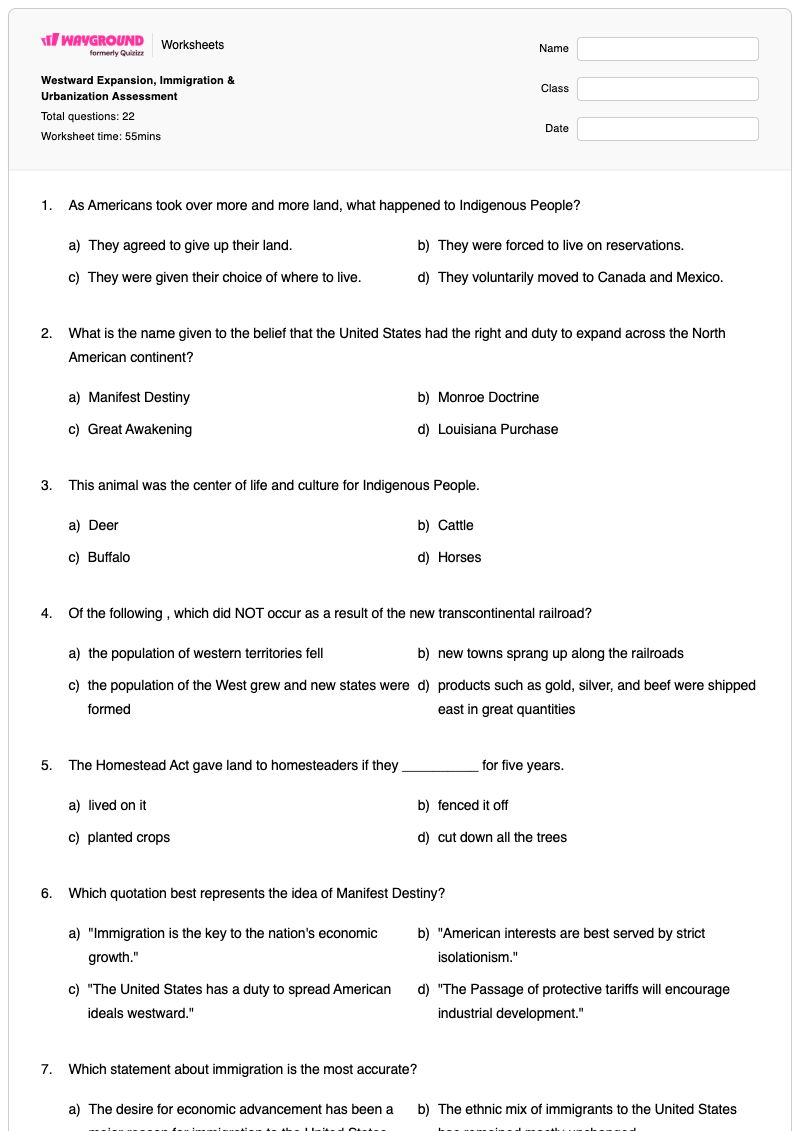
Westward Expansion, Immigration & Urbanization Assessment

คำถามทั้งหมด: 22

ชื่อ
ระดับ
วันที่
1.

As Americans took over more and more land, what happened to Indigenous People?

a)

They agreed to give up their land.

b)

They were forced to live on reservations.

c)

They were given their choice of where to live.

d)

They voluntarily moved to Canada and Mexico.

2.

What is the name given to the belief that the United States had the right and duty to expand across the North American continent?

a)

Manifest Destiny

b)

Monroe Doctrine

c)

Great Awakening

d)

Louisiana Purchase

3.

This animal was the center of life and culture for Indigenous People.

a)

Deer

b)

Cattle

c)

Buffalo

d)

Horses

4.

Of the following , which did NOT occur as a result of the new transcontinental railroad?

a)

the population of western territories fell

b)

new towns sprang up along the railroads

c)

the population of the West grew and new states were formed

d)

products such as gold, silver, and beef were shipped east in great quantities

5.

The Homestead Act gave land to homesteaders if they __________ for five years.

a)

lived on it

b)

fenced it off

c)

planted crops

d)

cut down all the trees

6.

Which quotation best represents the idea of Manifest Destiny?

a)

"Immigration is the key to the nation's economic growth."

b)

"American interests are best served by strict isolationism."

c)

"The United States has a duty to spread American ideals westward."

d)

"The Passage of protective tariffs will encourage industrial development."

7.

Which statement about immigration is the most accurate?

a)

The desire for economic advancement has been a major reason for immigration to the United States.

b)

The ethnic mix of immigrants to the United States has remained mostly unchanged.

c)

The number of immigrants has remained constant in each decade during United States history.

d)

The immigrants have all easily assimilated to the culture in the United States.

8.

Which of the following might an immigrant at Ellis Island NOT experience?

a)

A detailed questionnaire about their background, political beliefs and work experience.

b)

A full physical exam that could end in detainment.

c)

A literacy test.

d)

A voter registration form.

9.

America believed that is was a melting pot because:

a)

Citizens blended together by abandoning their former culture.

b)

Citizens brought and maintained their unique cultures.

c)

Americans wanted Immigrants to add their cultures to the American culture.

d)

Americans cared more about making money than culture.

10.

Which of the following is an example of nativism in the United States?

a)

Allowing all immigrants to enter the United States.

b)

Giving immigrants jobs in factories and on farms.

c)

Giving immigrants the right to vote in political elections.

d)

Issuing the Chinese Exclusion Act.

11.

The "New" immigrant whose migration to the United States increased after 1880, came mainly from:

a)

China

b)

Southeast Asia

c)

Southern and Eastern Europe

d)

Africa, South America and the Caribbean

12.

On the journey to America, most European immigrants faced

a)

a fairly easy journey, like being on a cruise ship

b)

a possibility of not making it through the journey

c)

a rough, crowded ride in the steerage section of the ship

d)

a ship ride with plenty to eat and time to exercise on the ship's deck

13.

Which expression most accurately illustrates the concept of nativism?

a)

"Help Wanted - Irish Need Not Apply"

b)

"Go West, young man"

c)

"America - first in war and peace"

d)

"The only thing we have to fear, is fear itself"

14.

Which statement about immigration to the United States during the 19th century is most valid?

a)

Organized labor supported unrestricted immigration.

b)

Most immigrants to the United States were illegal aliens.

c)

Industrial growth led to a demand for cheap immigrant labor.

d)

Few immigrants came from Western Europe.

15.

In the late 19th century, the major argument used by labor leaders against immigrants was that immigrants

a)

Contributed little to enrich American life

b)

Refused to assimilate into American culture

c)

Took jobs from United States citizens

d)

Placed financial drains on social services

16.

The social geography of the industrial city in America, during the 1880s indicated that:

a)

All classes tended to live together in the same neighborhood.

b)

People separated themselves exclusively by class.

c)

People tended to separate themselves based on race, nationality and economic class.

d)

There is no evidence of segregation or separation in the cities.

17.

Tenement buildings offered a solution to which geographic problem?

a)

Excessive water

b)

Lack of space

c)

Access to waterways

d)

Heating and cooling buildings

18.

Which of the following was NOT an urban problem?

a)

Crime

b)

Fire

c)

Sanitation

d)

Jobs

19.

In the early 1900s, these overcrowding, high crime rate, poor sanitation and fire hazards were most directly a result of

a)

Westward Migration

b)

Rapid Urbanization

c)

Muckrakers’ Influence

d)

Conservation Programs

20.

All of the following characterized America's large cities in the last decades of the 19th century EXCEPT:

a)

crowded tenements

b)

poor treatment of water, sewage, and waste

c)

transportation limited to the rural areas of the country only

d)

outbreaks of deadly diseases such as cholera and tuberculosis

21.

Short Answer - Why are there places in America that are more culturally diverse than others? Explain. This question is worth 5 points.

4 เส้น
22.

Respond to the question using the APE format (Answer, Provide Evidence, Explain). This is question is worth 10 points.


How has America (economy, society, geography, etc) been changed by the immigrants who immigrated in the 19th century? Explain your answer with multiple (3) examples.

4 เส้น
แป้นคำตอบ

Westward Expansion, Immigration & Urbanization Assessment

คำถามทั้งหมด: 22

1.
b)

They were forced to live on reservations.

2.
a)

Manifest Destiny

3.
c)

Buffalo

4.
a)

the population of western territories fell

5.
c)

planted crops

6.
c)

"The United States has a duty to spread American ideals westward."

7.
a)

The desire for economic advancement has been a major reason for immigration to the United States.

8.
b)

A full physical exam that could end in detainment.

9.
a)

Citizens blended together by abandoning their former culture.

10.
d)

Issuing the Chinese Exclusion Act.

11.
c)

Southern and Eastern Europe

12.
c)

a rough, crowded ride in the steerage section of the ship

13.
a)

"Help Wanted - Irish Need Not Apply"

14.
c)

Industrial growth led to a demand for cheap immigrant labor.

15.
c)

Took jobs from United States citizens

16.
c)

People tended to separate themselves based on race, nationality and economic class.

17.
b)

Lack of space

18.
d)

Jobs

19.
b)

Rapid Urbanization

20.
c)

transportation limited to the rural areas of the country only

21.
ไม่มี
22.
ไม่มี

คำถามที่พบบ่อย

การประเมินด้านการขยายตัวไปทางตะวันตก การอพยพ และการพัฒนาเมือง ครอบคลุมเรื่องอะไรบ้าง?

แบบฝึกหัดประวัติศาสตร์ระดับชั้นมัธยมศึกษาปีที่ 4 นี้ประเมินความเข้าใจเกี่ยวกับการขยายตัวไปทางตะวันตกและการอพยพในศตวรรษที่ 19 ผ่านคำถามแบบเลือกตอบ 20 ข้อ และคำถามปลายเปิด 2 ข้อ นักเรียนจะได้ระบุและประยุกต์ใช้แนวคิดต่างๆ เช่น ลัทธิแผ่ขยายอำนาจของชาติ (Manifest Destiny), การขับไล่ชนพื้นเมือง, การเติบโตของทางรถไฟ, กฎหมายการจัดสรรที่ดิน (Homestead Act), กระบวนการที่เกาะเอลลิส (Ellis Island) ลัทธิชาตินิยมดั้งเดิม (Nativism), แนวคิดการหลอมรวมวัฒนธรรม (Melting-pot concept) และรูปแบบแรงงานผู้อพยพ

ฉันจะใช้แบบฝึกหัดนี้ในการสอนเรื่องลัทธิแผ่ขยายอำนาจของอเมริกา (Manifest Destiny) และการอพยพในศตวรรษที่ 19 ได้อย่างไร?

หลังจากแนะนำลำดับเหตุการณ์เหตุและผลแล้ว ให้ใช้ข้อสอบแบบเลือกตอบ: ความเชื่อเรื่องการขยายอำนาจส่งผลต่อการตั้งถิ่นฐานทางตะวันตก ทางรถไฟและนโยบายที่ดินเร่งการเติบโต และการอพยพเข้ามาทำให้เกิดแรงงานและกระตุ้นให้เกิดปฏิกิริยาต่อต้านชาวต่างชาติ ขอให้นักเรียนอธิบายเหตุผลของคำตอบเกี่ยวกับคำกล่าวอ้างเรื่องลัทธิแผ่ขยายอำนาจ (Manifest Destiny) ประสบการณ์ที่เกาะเอลลิส และกฎหมายกีดกันชาวจีน โดยอ้างอิงถึงแนวคิดทางประวัติศาสตร์ที่แต่ละตัวอย่างแสดงถึง จากนั้นให้นักเรียนถามคำถามปลายเปิดสองข้อ เพื่อให้นักเรียนอธิบายความเชื่อมโยงระหว่างนโยบาย การอพยพ แรงงาน และการเปลี่ยนแปลงทางวัฒนธรรม

ฉันควรสังเกตข้อผิดพลาดอะไรบ้างเมื่อนักเรียนทำแบบประเมินนี้?

นักเรียนอาจสับสนระหว่างแนวคิด Manifest Destiny กับหลักการ Monroe Doctrine มองข้ามถ้อยคำเชิงลบในคำถามที่ถามถึงสิ่งที่ไม่ได้เกิดขึ้น หรือเลือกผลกระทบจากทางรถไฟที่ขัดแย้งกับการเติบโตของประชากรในภาคตะวันตก ในส่วนของการอพยพ ให้ระวังความสับสนระหว่างขั้นตอนที่เกาะเอลลิส ประสบการณ์ของผู้อพยพชาวยุโรปในห้องโดยสารชั้นประหยัด และตัวอย่างของลัทธิชาตินิยม เช่น กฎหมายกีดกันชาวจีน นักเรียนอาจมองแนวคิดการหลอมรวมวัฒนธรรมว่าเป็นเพียงการรักษาวัฒนธรรมที่แยกจากกัน แทนที่จะตระหนักถึงการตีความที่นำเสนอโดยการประเมินผล

ฉันจะมอบหมายและตรวจงานใบงานนี้อย่างไร?

Wayground จัดทำแบบประเมินนี้ในรูปแบบไฟล์ PDF ที่สามารถพิมพ์ได้ และในรูปแบบแบบทดสอบดิจิทัล พร้อมเฉลยคำตอบครบถ้วนสำหรับตรวจสอบข้อสอบปรนัย 20 ข้อ และคำถามปลายเปิด 2 ข้อ สำหรับการส่งงานในรูปแบบไฟล์พิมพ์ ให้สแกนงานของนักเรียนด้วยแอป Wayground for Teachers เพื่อช่วยในการให้คะแนนและเก็บรักษาบันทึก นอกจากนี้ รูปแบบไฟล์พิมพ์ยังช่วยให้โรงเรียนลดเวลาการใช้หน้าจอได้เมื่อเหมาะสม

ฉันจะปรับแบบฝึกหัดเรื่องการขยายตัวไปทางตะวันตกและการอพยพนี้ให้เหมาะสมกับนักเรียนของฉันได้อย่างไร?

ในการตั้งค่าขั้นสูงของแบบฝึกหัด ให้ปรับระยะห่างระหว่างตัวอักษรหรือขนาดตัวอักษรเพื่อให้ตัวเลือกแบบปรนัยและช่องคำตอบแบบปลายเปิดอ่านง่ายขึ้น และใช้แบบอักษรที่เป็นมิตรต่อผู้ที่มีภาวะดิสเล็กเซียเมื่อเป็นประโยชน์ นอกจากนี้ คุณยังสามารถแปลแบบประเมินเป็นภาษาอื่นเพื่อช่วยเหลือนักเรียนในการทำงานกับคำศัพท์ทางประวัติศาสตร์ เช่น ลัทธิแผ่ขยายอำนาจของชาติ (Manifest Destiny) ลัทธิชาตินิยม และการกลืนกลายทางวัฒนธรรม

ฉันจะหาแบบฝึกหัดแบบนี้เพิ่มเติมได้ที่ไหนบน Wayground?

Wayground มีแบบฝึกหัดและโจทย์ฝึกหัดมากมายให้ดาวน์โหลดฟรีในหลากหลายวิชา พร้อมไฟล์ PDF และเฉลยคำตอบ เพื่อช่วยให้นักเรียนพัฒนาทักษะและความเข้าใจในแนวคิดที่สำคัญ ดูแหล่งข้อมูลเพิ่มเติมได้ที่ https://wayground.com/en-us/worksheets