

Wayground
Romeo and Juliet Act 1 Review - Printable อีแอลเอ Worksheets ระดับ 9 - Wayground

Romeo and Juliet Act 1 Review

Michele Weston

สร้างโดย Michele Weston

20 คำถาม

9th ระดับชั้น

อีแอลเอ

อัปเดตแล้ว พ.ค. 2569

แบบฝึกหัดทบทวนบทที่ 1 ของเรื่อง Romeo and Juliet สำหรับนักเรียนชั้นมัธยมศึกษาปีที่ 3 (เกรด 3) เป็นแบบฝึกหัดภาษาอังกฤษที่ตรวจสอบความเข้าใจของนักเรียนเกี่ยวกับบทเปิดเรื่องของเช็คสเปียร์ผ่านคำถาม 20 ข้อ: 18 ข้อเป็นแบบเลือกตอบ และ 2 ข้อเป็นแบบเลือกตอบหลายข้อ นักเรียนจะต้องระบุฉากและรูปแบบบทกวีซอนเน็ตในบทนำ ตีความคำศัพท์ต่างๆ เช่น “ศักดิ์ศรี” และ “โชคชะตาเล่นตลก” จดจำกลวิธีการละครต่างๆ เช่น บทพูดคนเดียวและคำขัดแย้ง และจดจำรายละเอียดสำคัญเกี่ยวกับพระราชกฤษฎีกาของเจ้าชาย ความรักที่โรมิโอไม่ได้รับตอบจากโรซาลีน และความสนใจของปารีสที่มีต่อจูเลียต แบบฝึกหัดนี้ยังให้นักเรียนตีความบทสนทนาและคำพูดของตัวละคร แปลภาษาเช็คสเปียร์ของเบนโวลีโอเป็นความหมายสมัยใหม่ วิเคราะห์ว่าความขัดแย้งส่งผลกระทบต่อตัวละครรุ่นเยาว์อย่างไร ตีความความคิดเห็นของลอร์ดคาปูเล็ตเกี่ยวกับวุฒิภาวะและการยินยอมของจูเลียต และระบุว่าไทบอลต์เป็นคนใจร้อน แบบฝึกหัดที่พิมพ์ได้ฟรีนี้มีเฉลยคำตอบครบถ้วน ทำให้มีประโยชน์สำหรับการทบทวนบทที่ 1 การฝึกฝนด้วยตนเอง หรือการตรวจสอบความเข้าใจหลังจากการอ่านในห้องเรียน

การตั้งค่าแผ่นงาน

ขนาดตัวอักษร

S
M
L
XL
Waygroundแผ่นงาน

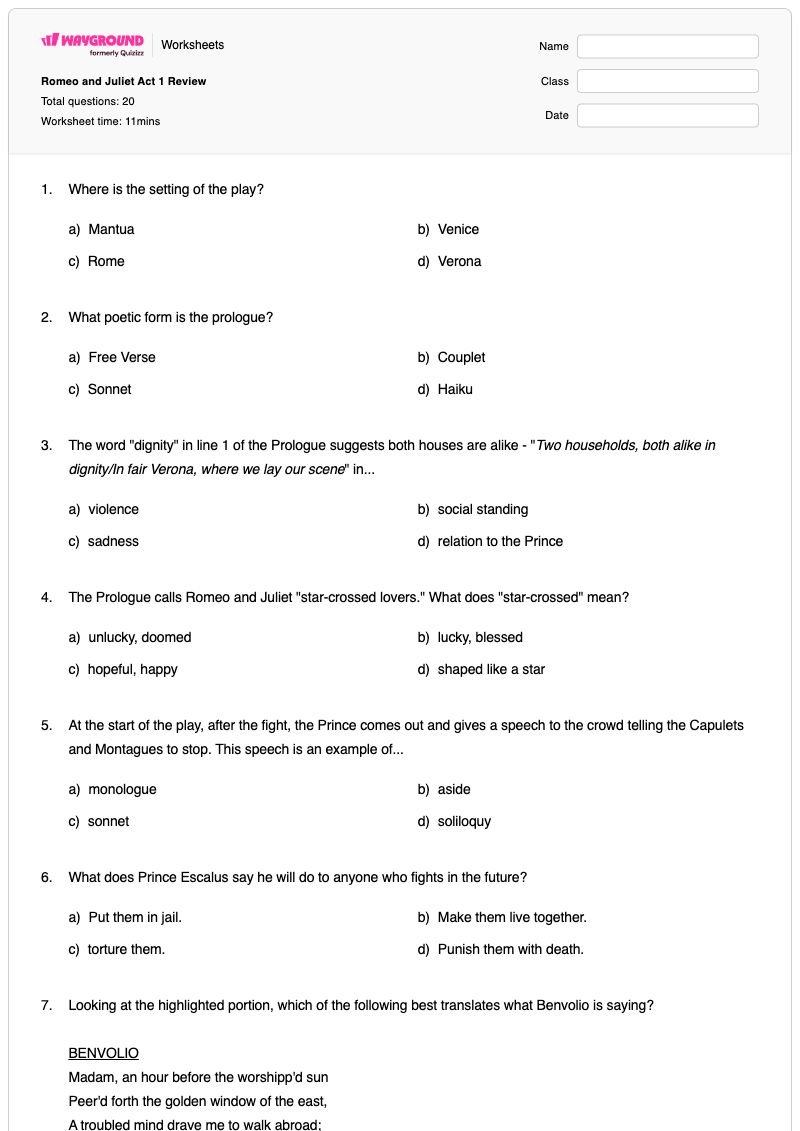
Romeo and Juliet Act 1 Review

คำถามทั้งหมด: 20

ชื่อ
ระดับ
วันที่
1.

Where is the setting of the play?

a)

Mantua

b)

Venice

c)

Rome

d)

Verona

2.

What poetic form is the prologue?

a)

Free Verse

b)

Couplet

c)

Sonnet

d)

Haiku

3.

The word "dignity" in line 1 of the Prologue suggests both houses are alike - "Two households, both alike in dignity/In fair Verona, where we lay our scene" in...

a)

violence

b)

social standing

c)

sadness

d)

relation to the Prince

4.

The Prologue calls Romeo and Juliet "star-crossed lovers." What does "star-crossed" mean?

a)

unlucky, doomed

b)

lucky, blessed

c)

hopeful, happy

d)

shaped like a star

5.

At the start of the play, after the fight, the Prince comes out and gives a speech to the crowd telling the Capulets and Montagues to stop. This speech is an example of...

a)

monologue

b)

aside

c)

sonnet

d)

soliloquy

6.

What does Prince Escalus say he will do to anyone who fights in the future?

a)

Put them in jail.

b)

Make them live together.

c)

torture them.

d)

Punish them with death.

7.

Looking at the highlighted portion, which of the following best translates what Benvolio is saying?


BENVOLIO

Madam, an hour before the worshipp'd sun

Peer'd forth the golden window of the east,

A troubled mind drave me to walk abroad;

Where, underneath the grove of sycamore

That westward rooteth from the city's side,

So early walking did I see your son:

Towards him I made, but he was ware of me

And stole into the covert of the wood:

I, measuring his affections by my own,

That most are busied when they're most alone,

Pursued my humour not pursuing his,

And gladly shunn'd who gladly fled from me.


MONTAGUE

Many a morning hath he there been seen,

With tears augmenting the fresh morning dew.

Adding to clouds more clouds with his deep sighs;

But all so soon as the all-cheering sun

Should in the furthest east begin to draw

The shady curtains from Aurora's bed,

Away from the light steals home my heavy son,

And private in his chamber pens himself,

Shuts up his windows, locks far daylight out

And makes himself an artificial night:

Black and portentous must this humour prove,

Unless good counsel may the cause remove.

a)

I saw Romeo walking, but he saw me and ran into the woods. I thought it best to not chase after him.

b)

Romeo saw me walking restlessly and hid. When I saw him hiding, I laughed, and he ran away.

c)

Romeo was following me in the early morning hours, but every time I turned to look for him, he hid in the woods. It was weird.

d)

I was having a great morning until I saw Romeo looking gloomy outside the city walls. I chose to ignore him.

8.

Why was Romeo is such a sad mood at the beginning of Act 1?

a)

Romeo was in love with Rosaline, but she did not love him back.

b)

Romeo was madly in love with Juliet but could not be with her because she is a Capulet.

c)

Romeo was in love with Juliet, but Juliet did not love him back.

d)

Romeo was in love with Juliet, and he found out she had to marry another suitor.

9.

In Act I, when Romeo is in anguish because Rosalind does not love he says, "O loving hate..O heavy lightness...serious vanity, feather of lead..." These are all examples of

a)

Metaphors

b)

Similes

c)

Oxymorons

d)

Personifications

10.

What is the problem with Capulet's statement? "Montague is bound as well as I,/ In penalty alike; and 'tis not hard, I think,/ For men so old as we to keep the peace."

a)

Montague is only morally, not legally, bound to keep the peace.

b)

Montague has already planned Capulet's demise.

c)

The conflict has spread beyond just Montague and Capulet and affects the younger generations too.

d)

The penalty is not heavy enough to prevent the feud from continuing.

11.

Who wants to marry Juliet?

a)

Paris

b)

Romeo

c)

Capulet

d)

Montague

12.

Which interpretation most accurately reflects the quote?


"My child is yet a stranger in this world; / She hath not seen the change of fourteen years"

a)

Lady Capulet wants to wait for Juliet to get married as she is not yet fourteen.

b)

Lord Capulet is presented as an aging patriarch who is keen for Juliet to marry to secure her future.

c)

Lord Capulet wants Juliet to marry Paris when she is fourteen.

d)

Lord Capulet is presented as being protective of his young, naïve, vulnerable daughter who does not have much experience of the world.

13.

Which quotes show Lord Capulet deferring to Juliet's choice?

a)

“She is the hopeful Lady of my earth”

b)

“My will to her consent is but a part.”

c)

“And she agreed, within her scope of choice /Lies my consent, and fair according voice”

d)

“Like her most, whose merit most shall be”

14.

When denied the opportunity to marry Juliet soon, what does Paris tells Lord Capulet?

a)

Younger women are already married and have children.

b)

Older women are already married and have children.

c)

There are several women already married.

d)

There are several women who already have children.

15.

Which character is described as hot-headed?

a)

Mercutio

b)

Tybalt

c)

Benvolio

d)

Romeo

16.

Why does Capulet allow Romeo to remain at the feast?

a)

Capulet wants to watch Romeo carefully.

b)

Capulet wants to make a deal with Romeo.

c)

Capulet heard that Romeo is well-mannered.

d)

Capulet just wants to show power over Tybalt.

17.

When Tybalt says of Romeo crashing the Capulet's party..."this intrusion shall, now seeming sweet, convert to bitt'rest gall", this is an example of:

a)

foreshadowing

b)

oxymoron

c)

metaphor

d)

monologue

18.

When Romeo first meets Juliet, he refers to her as "this holy shrine." This is an example of:

a)

foreshadowing

b)

simile

c)

oxymoron

d)

metaphor

19.

When Romeo compares Juliet to a shrine and saint, this comparison does which of the following (select all that apply)

a)

This demonstrates that he thinks she is perfect.

b)

This demonstrates that Romeo is confusing Juliet with someone else.

c)

This demonstrates that Juliet should be worshipped

d)

This demonstrates Romeo wants to marry Juliet.

20.

After Juliet learns that Romeo is a Montague at her party, Juliet says "my only love sprung from my only hate." This is an example of... (CHECK ALL THAT APPLY)

a)

allusion

b)

parallelism

c)

a metaphor

d)

a sonnet

Waygroundแป้นคำตอบ

Romeo and Juliet Act 1 Review

คำถามทั้งหมด: 20

1.
d)

Verona

2.
c)

Sonnet

3.
b)

social standing

4.
a)

unlucky, doomed

5.
a)

monologue

6.
d)

Punish them with death.

7.
a)

I saw Romeo walking, but he saw me and ran into the woods. I thought it best to not chase after him.

8.
a)

Romeo was in love with Rosaline, but she did not love him back.

9.
c)

Oxymorons

10.
c)

The conflict has spread beyond just Montague and Capulet and affects the younger generations too.

11.
a)

Paris

12.
d)

Lord Capulet is presented as being protective of his young, naïve, vulnerable daughter who does not have much experience of the world.

13.
c)

“And she agreed, within her scope of choice /Lies my consent, and fair according voice”

14.
a)

Younger women are already married and have children.

15.
b)

Tybalt

16.
c)

Capulet heard that Romeo is well-mannered.

17.
a)

foreshadowing

18.
d)

metaphor

19.
a)

This demonstrates that he thinks she is perfect.

, c)

This demonstrates that Juliet should be worshipped

20.
c)

a metaphor

, b)

parallelism

คำถามที่พบบ่อย

แบบฝึกหัดทบทวนบทที่ 1 ของเรื่อง Romeo and Juliet ครอบคลุมเนื้อหาอะไรบ้าง?

แบบฝึกหัดสำหรับนักเรียนชั้น ม.3 นี้ ประกอบด้วยคำถามแบบเลือกตอบ 18 ข้อ และคำถามแบบเลือกคำตอบ 2 ข้อ เพื่อประเมินความเข้าใจในองก์ที่ 1 นักเรียนจะต้องตีความบทนำ ระบุกลวิธีการเขียนและกลวิธีการละคร เช่น บทกวีโซเน็ต บทพูดคนเดียว และคำขัดแย้ง แปลบทสนทนาของเชกสเปียร์ และวิเคราะห์แรงจูงใจ ความสัมพันธ์ และการตัดสินใจของตัวละคร

ฉันจะใช้แบบฝึกหัดนี้ในการสอนเรื่องโรมิโอและจูเลียต องก์ที่ 1 ได้อย่างไร?

ใช้คำถามหลังจากที่นักเรียนอ่านองก์ที่ 1 เพื่อเปลี่ยนจากการทบทวนความจำไปสู่การตีความ เริ่มต้นด้วยฉาก บทนำ ความขัดแย้ง และพระราชกฤษฎีกาของเจ้าชาย จากนั้นให้นักเรียนอธิบายบทพูดของเบนโวลิโอด้วยภาษาปัจจุบัน และสนับสนุนคำตอบเกี่ยวกับโรมิโอ จูเลียต ปารีส และไทบอลต์ด้วยข้อความอ้างอิงจากบทละคร

ฉันควรสังเกตข้อผิดพลาดอะไรบ้างเมื่อนักเรียนทำแบบฝึกหัดนี้เสร็จ?

นักเรียนอาจสับสนระหว่างบทกวีซอนเน็ตกับบทกวีรูปแบบอื่น เข้าใจผิดว่าบทพูดคนเดียวเป็นบทครุ่นคิดหรือบทพูดข้างหู หรือตีความคำว่า “star-crossed” ว่าโชคดีแทนที่จะเป็นโชคร้าย โปรดระวังข้อผิดพลาดในการแปลภาษาเชกสเปียร์ ความสับสนระหว่างโรซาลีนและจูเลียตว่าเป็นสาเหตุของความเศร้าโศกในช่วงแรกของโรมิโอ และการไม่สามารถแยกแยะความคิดเห็นของลอร์ดคาปูเล็ตออกจากข้อโต้แย้งเรื่องการแต่งงานของปารีสได้

ฉันจะมอบหมายและตรวจงานเรื่องโรมิโอและจูเลียตนี้อย่างไร?

แบบฝึกหัดนี้มีให้ดาวน์โหลดบน Wayground ในรูปแบบไฟล์ PDF ที่สามารถพิมพ์ได้ และในรูปแบบแบบทดสอบดิจิทัล พร้อมเฉลยคำตอบครบถ้วนสำหรับทั้ง 20 ข้อ ตรวจงานที่พิมพ์ออกมาโดยใช้เฉลยคำตอบ หรือสแกนงานของนักเรียนด้วยแอป Wayground for Teachers รูปแบบไฟล์ที่พิมพ์ได้ยังช่วยสนับสนุนโรงเรียนที่ลดเวลาการใช้หน้าจออีกด้วย

แบบฝึกหัดนี้ตรวจสอบความเข้าใจในบทที่ 1 ในด้านใดบ้าง?

แบบฝึกหัดนี้ผสมผสานการท่องจำเนื้อหาเข้ากับการตีความภาษาที่ยกมา โจทย์ในแบบฝึกหัดจะให้นักเรียนเชื่อมโยงถ้อยคำในบทนำกับสถานะทางสังคมและชะตากรรม อธิบายคำบอกเล่าของเบนโวลิโอเกี่ยวกับพฤติกรรมของโรมิโอ ตีความคำกล่าวของคาปูเล็ตเกี่ยวกับทางเลือกของจูเลียต และระบุวิธีการนำเสนอตัวละครผ่านบทสนทนา

ฉันจะหาแบบฝึกหัดแบบนี้เพิ่มเติมได้ที่ไหนบน Wayground?

Wayground นำเสนอชุดแบบฝึกหัดและโจทย์ฝึกหัดฟรีที่ครอบคลุมหลากหลายวิชา พร้อมไฟล์ PDF และเฉลยคำตอบ เพื่อช่วยให้นักเรียนเชี่ยวชาญทักษะและแนวคิดที่สำคัญ ดูแหล่งข้อมูลเพิ่มเติมได้ที่ https://wayground.com/en-us/worksheets