

Wayground
Problem Solving and Decision Making Worksheet - Printable สังคมศึกษา Worksheets ระดับ 6 - Wayground

Problem Solving and Decision Making Worksheet

jacolby thompson

สร้างโดย jacolby thompson

20 คำถาม

6th ระดับชั้น

สังคมศึกษา

อัปเดตแล้ว พ.ค. 2568

แบบฝึกหัดการแก้ปัญหาและการตัดสินใจ เป็นสื่อการเรียนรู้สังคมศึกษาสำหรับนักเรียนชั้นประถมศึกษาปีที่ 6 ที่ใช้คำถามแบบสถานการณ์จำลอง 20 ข้อ เพื่อพัฒนาทักษะการคิดเชิงปฏิบัติ นักเรียนจะต้องตอบคำถามแบบเลือกตอบ 18 ข้อ และแบบเลือกคำตอบหลายข้อ 2 ข้อ เกี่ยวกับการวิเคราะห์ปัญหาที่ซับซ้อน การระบุสาเหตุและขอบเขต การเลือกใช้แหล่งข้อมูลที่เป็นประโยชน์ การวางแผนการดำเนินงาน การแก้ไขข้อขัดแย้ง และการประเมินว่าวิธีการแก้ปัญหาจะได้ผลในระยะสั้นหรือระยะยาวหรือไม่ หลายข้อต้องการให้นักเรียนเชื่อมโยงการตัดสินใจกับหลักฐานสนับสนุน ตระหนักถึงผลกระทบที่ไม่ได้ตั้งใจ หรือใช้ข้อมูลเพื่อทำความเข้าใจปัญหา แบบฝึกหัดนี้ช่วยให้นักเรียนนำกระบวนการตัดสินใจอย่างเป็นระบบไปใช้กับสถานการณ์ในโรงเรียนและชุมชนที่คุ้นเคย เช่น การจัดโครงการรีไซเคิล การเปิดตัวโครงการติวเตอร์เพื่อน การแก้ไขปัญหาการประกาศที่พลาดไป หรือการออกแบบระบบประหยัดน้ำ เหมาะสำหรับใช้ในการสอน การฝึกฝนแบบมีผู้แนะนำ การทบทวน หรือการประเมินผลในวิชาสังคมศึกษาชั้นประถมศึกษาปีที่ 6 แบบฝึกหัดที่พิมพ์ได้ฟรีนี้มีเฉลยคำตอบครบถ้วนเพื่อการตรวจสอบและให้ข้อเสนอแนะอย่างมีประสิทธิภาพ

การตั้งค่าแผ่นงาน

ขนาดตัวอักษร

S
M
L
XL
Waygroundแผ่นงาน

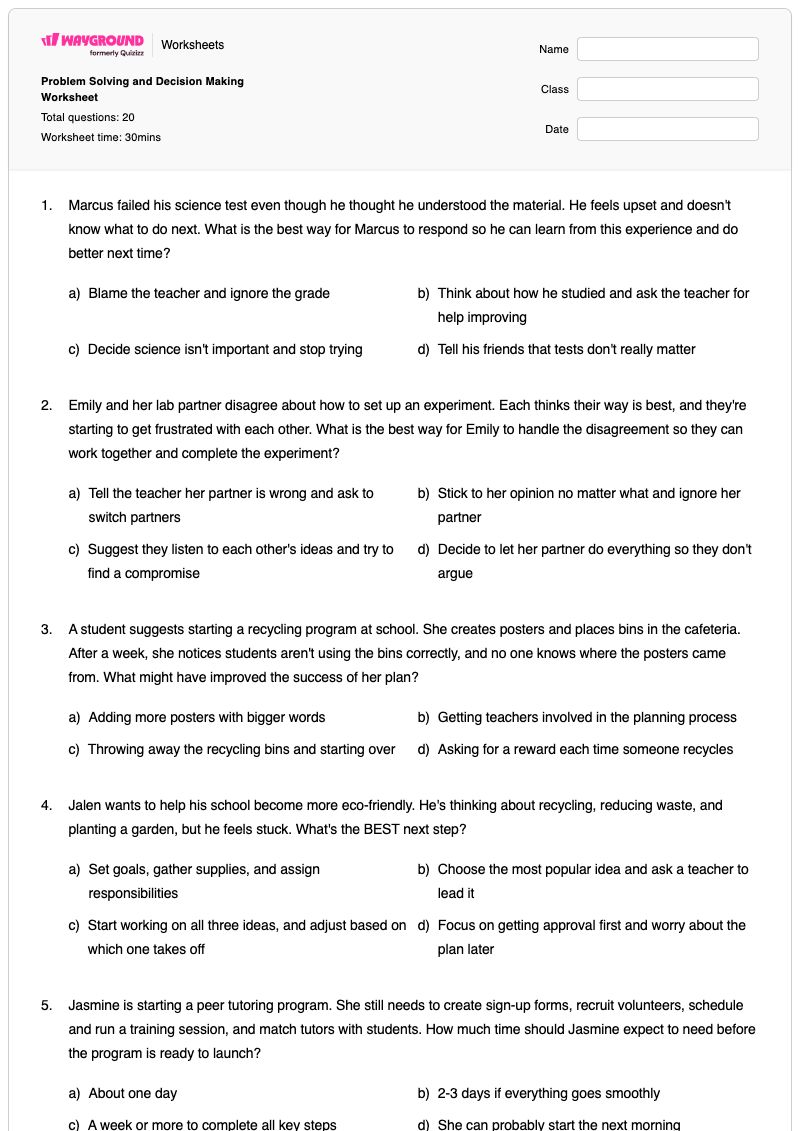
Problem Solving and Decision Making Worksheet

คำถามทั้งหมด: 20

ชื่อ
ระดับ
วันที่
1.

Marcus failed his science test even though he thought he understood the material. He feels upset and doesn't know what to do next. What is the best way for Marcus to respond so he can learn from this experience and do better next time?

a)

Blame the teacher and ignore the grade

b)

Think about how he studied and ask the teacher for help improving

c)

Decide science isn't important and stop trying

d)

Tell his friends that tests don't really matter

2.

Emily and her lab partner disagree about how to set up an experiment. Each thinks their way is best, and they're starting to get frustrated with each other. What is the best way for Emily to handle the disagreement so they can work together and complete the experiment?

a)

Tell the teacher her partner is wrong and ask to switch partners

b)

Stick to her opinion no matter what and ignore her partner

c)

Suggest they listen to each other's ideas and try to find a compromise

d)

Decide to let her partner do everything so they don't argue

3.

A student suggests starting a recycling program at school. She creates posters and places bins in the cafeteria. After a week, she notices students aren't using the bins correctly, and no one knows where the posters came from. What might have improved the success of her plan?

a)

Adding more posters with bigger words

b)

Getting teachers involved in the planning process

c)

Throwing away the recycling bins and starting over

d)

Asking for a reward each time someone recycles

4.

Jalen wants to help his school become more eco-friendly. He's thinking about recycling, reducing waste, and planting a garden, but he feels stuck. What's the BEST next step?

a)

Set goals, gather supplies, and assign responsibilities

b)

Choose the most popular idea and ask a teacher to lead it

c)

Start working on all three ideas, and adjust based on which one takes off

d)

Focus on getting approval first and worry about the plan later

5.

Jasmine is starting a peer tutoring program. She still needs to create sign-up forms, recruit volunteers, schedule and run a training session, and match tutors with students. How much time should Jasmine expect to need before the program is ready to launch?

a)

About one day

b)

2-3 days if everything goes smoothly

c)

A week or more to complete all key steps

d)

She can probably start the next morning

6.

Read the following excerpt and determine if the solution works in the short term or long term. To solve the problem of students not having enough time to eat lunch, a school allows them to bring their food to the next class and eat during the first five minutes. Right away, students stop rushing through their meals and feel more satisfied. However, teachers begin to notice that students are distracted and take longer to focus once instruction begins. What is the best answer?

a)

The solution worked well only in the short term.

b)

The solution had only long-term benefits.

c)

The solution worked equally well in the short and long term.

d)

The solution was never effective.

7.

What evidence supports your choice for part A?

a)

Students ate more comfortably and felt less rushed.

b)

Teachers said students stayed focused throughout class.

c)

Students were distracted and learning time decreased.

d)

Lunch lines were shorter, so everyone was happy.

8.

A class wants to start a student-run school store to raise money for field trips. Which resources would be MOST important for getting started? Select TWO correct answers.

a)

Inventory of school supplies or snacks to sell

b)

A location or space to set up the store

c)

A list of everyone's favorite snacks

d)

A new school mascot costume

e)

A timer for classroom games

9.

A class notices that students often miss important announcements and due dates. What is the BEST solution to address this problem and plan for implementation?

a)

Post weekly updates in the classroom and online.

b)

Tell students to listen better.

c)

Assign one student to share all announcements.

d)

Remove due dates so there's nothing to forget.

10.

Students design a water-saving system for their school garden, but they don't have the tools or materials to build it. What is the MAIN challenge in this situation?

a)

The idea is not allowed during school hours.

b)

They lack the resources to test the solution.

c)

The garden doesn't need any water.

d)

Saving water is not a real-world problem.

11.

Students start a kindness wall where people can leave encouraging notes. It makes students feel more supported, but later some students start leaving off-topic or silly messages. What is the unintended consequence of this solution?

a)

The wall became a helpful way to spread kindness.

b)

Everyone began writing more notes.

c)

Not all messages were used appropriately.

d)

Students became better at spelling.

12.

Why is it important to carefully analyze a complex situation before identifying the core problem?

a)

Because solving any issue quickly is always more important than understanding it fully.

b)

Because a problem may have multiple causes or interpretations depending on different perspectives.

c)

Because problems always have a single, clear solution that applies to everyone.

d)

Because defining a problem is not necessary as long as a solution is chosen.

13.

A company notices a drop in customer satisfaction. Which of the following is the best way to use data to understand the issue?

a)

Adjust pricing strategies immediately without reviewing sales data or customer concerns in depth.

b)

Collect and analyze customer feedback, purchases, and complaints to identify key patterns.

c)

Conduct a review of recent purchases because trends will remain the same over time.

d)

Survey a selected group of customers and focus on positive responses.

14.

A school is trying to determine if students are struggling with math. What is the most effective way to assess the problem's size and scope?

a)

Conduct interviews with 3rd grade students and teachers to gather qualitative insights on learning difficulties.

b)

Compare the school's math performance to national math performance to gain a broader perspective.

c)

Evaluate past lesson changes and teacher strategies to see if previous adjustments have addressed student challenges.

d)

Analyze all test scores and survey all students and teachers to gather multiple sources of data.

15.

A local government wants to reduce traffic. What is the best way to narrow the problem's scope?

a)

Analyze traffic data to identify the busiest roads and busiest times before developing targeted solutions.

b)

Examine how road design, public transportation, and driving behavior contribute to congestion.

c)

Review the impact of recent road construction projects to determine their effectiveness in improving traffic flow.

d)

Compare traffic strategies used in other cities to explore possible solutions.

16.

What is the purpose of generating alternative solutions before choosing one?

a)

To choose an option that appears reasonable without spending time on others.

b)

To ensure that only one solution is considered.

c)

To explore different possibilities and select the most effective solution.

d)

To avoid making any decision at all.

17.

A business wants to reduce customer wait times at checkout. What are the best ways to generate alternate solutions? Select TWO correct answers.

a)

Explore options such as self-checkout stations, express lanes, and mobile payment options.

b)

Implement suggestions from employees before reviewing other possibilities.

c)

Research strategies, gather customer feedback, and test checkout options.

d)

Apply a solution used by a business with the shortest checkout times.

e)

Hire more cashiers with at least three years of retail experience.

18.

A government bans plastic grocery bags to reduce pollution. However, after the ban, studies show that people are buying more plastic trash bags, leading to continued plastic waste. This is an example of a(n) ______.

a)

Informed decision

b)

Unintended consequence

c)

Alternative solution

d)

Planned outcome

19.

Why is it important to assess the outcomes of a chosen solution?

a)

To determine if adjustments to the answer are needed.

b)

To generate an alternative solution before selecting one.

c)

To clearly define the problem before considering possible solutions.

d)

To brainstorm different approaches and evaluate their data.

20.

Leo's soccer team is voting for a new team captain. He strongly believes that Alex, one of his teammates, is the best choice because Alex is hardworking, supportive, and experienced. However, some of his teammates are considering other candidates. Leo wants to explain why Alex would be the best captain while being fair and respectful in the discussion. Which metacognitive question would best help Leo support his perspective in a discussion about who should be team captain?

a)

How can I convince my teammates that no one else is a better leader?

b)

Why should I ignore the opinions of others in making my decision?

c)

What can I do to make sure my team chooses the person I support?

d)

What qualities make my candidate the best choice for captain?

Waygroundแป้นคำตอบ

Problem Solving and Decision Making Worksheet

คำถามทั้งหมด: 20

1.
b)

Think about how he studied and ask the teacher for help improving

2.
c)

Suggest they listen to each other's ideas and try to find a compromise

3.
b)

Getting teachers involved in the planning process

4.
a)

Set goals, gather supplies, and assign responsibilities

5.
c)

A week or more to complete all key steps

6.
a)

The solution worked well only in the short term.

7.
c)

Students were distracted and learning time decreased.

8.
a)

Inventory of school supplies or snacks to sell

, b)

A location or space to set up the store

9.
a)

Post weekly updates in the classroom and online.

10.
b)

They lack the resources to test the solution.

11.
c)

Not all messages were used appropriately.

12.
b)

Because a problem may have multiple causes or interpretations depending on different perspectives.

13.
b)

Collect and analyze customer feedback, purchases, and complaints to identify key patterns.

14.
d)

Analyze all test scores and survey all students and teachers to gather multiple sources of data.

15.
a)

Analyze traffic data to identify the busiest roads and busiest times before developing targeted solutions.

16.
c)

To explore different possibilities and select the most effective solution.

17.
a)

Explore options such as self-checkout stations, express lanes, and mobile payment options.

, c)

Research strategies, gather customer feedback, and test checkout options.

18.
b)

Unintended consequence

19.
a)

To determine if adjustments to the answer are needed.

20.
d)

What qualities make my candidate the best choice for captain?

คำถามที่พบบ่อย

แบบฝึกหัดการแก้ปัญหาและการตัดสินใจนี้ครอบคลุมหัวข้ออะไรบ้าง?

แบบฝึกหัดวิชาสังคมศึกษา ชั้นประถมศึกษาปีที่ 6 นี้ ประกอบด้วยคำถามแบบสถานการณ์จำลอง 20 ข้อ—แบบเลือกตอบ 18 ข้อ และแบบเลือกคำตอบที่ถูกต้อง 2 ข้อ—เพื่อฝึกฝนทักษะการวิเคราะห์ปัญหา การวางแผนวิธีแก้ปัญหา การระบุทรัพยากรที่จำเป็น และการประเมินผลลัพธ์ นักเรียนจะได้ตีความสถานการณ์ต่างๆ เช่น การรีไซเคิลในโรงเรียน การสอนพิเศษเพื่อน การจราจร และการอนุรักษ์น้ำ จากนั้นเลือกคำตอบที่ได้รับการสนับสนุนจากหลักฐาน ขั้นตอนการดำเนินการที่สมจริง หรือความเข้าใจเกี่ยวกับผลกระทบในระยะสั้นและระยะยาว

ฉันจะใช้แบบฝึกหัดนี้ในการสอนทักษะการแก้ปัญหาและการตัดสินใจได้อย่างไร?

แนะนำลำดับขั้นตอนง่ายๆ คือ ทำความเข้าใจปัญหา ระบุขอบเขตและสาเหตุ วางแผนการดำเนินการ และประเมินผลลัพธ์ จากนั้นให้นักเรียนนำลำดับขั้นตอนนั้นไปใช้กับสถานการณ์ในแบบฝึกหัด ขอให้นักเรียนอธิบายเหตุผลในการเลือกวิธีการต่างๆ เช่น การให้ครูมีส่วนร่วมในแผนการรีไซเคิล การมอบหมายความรับผิดชอบ หรือการใช้แหล่งข้อมูลหลายแหล่ง และอภิปรายว่าเหตุใดวิธีแก้ปัญหาที่ได้ผลในทันทีอาจก่อให้เกิดปัญหาในภายหลัง

ฉันควรสังเกตข้อผิดพลาดอะไรบ้างเมื่อนักเรียนทำแบบฝึกหัดนี้เสร็จ?

นักเรียนอาจเลือกแนวคิดที่น่าสนใจโดยไม่ได้ตรวจสอบว่าแนวคิดนั้นมีทรัพยากร ความรับผิดชอบ หรือข้อมูลที่จำเป็นสำหรับการนำไปปฏิบัติหรือไม่ ควรระวังความสับสนระหว่างผลประโยชน์ระยะสั้นและประสิทธิผลในระยะยาว การไม่เลือกทรัพยากรที่ถูกต้องในข้อสอบแบบเลือกหลายข้อ และคำตอบที่ระบุเพียงวิธีการแก้ปัญหา แทนที่จะระบุหลักฐาน ผลกระทบที่ไม่ได้ตั้งใจ ปัญหาหลัก หรือขอบเขตที่อธิบายไว้ในสถานการณ์จำลอง

ฉันจะมอบหมายและให้คะแนนแบบฝึกหัดการแก้ปัญหานี้ได้อย่างไร?

บน Wayground คุณสามารถกำหนดแบบฝึกหัดเป็นไฟล์ PDF ที่พิมพ์ได้ หรือเป็นแบบทดสอบดิจิทัล โดยใช้เฉลยคำตอบทั้งหมดเพื่อตรวจสอบคำตอบแบบเลือกตอบ 18 ข้อ และแบบเลือกหลายคำตอบ 2 ข้อ นอกจากนี้ ยังสามารถตรวจงานของนักเรียนที่ส่งมาในรูปแบบไฟล์พิมพ์ได้โดยการสแกนงานของนักเรียนด้วยแอป Wayground for Teachers

ฉันจะปรับแบบฝึกหัดนี้ให้เหมาะสมกับนักเรียนของฉันได้อย่างไร?

ใช้การตั้งค่าขั้นสูงของแบบฝึกหัดเพื่อปรับระยะห่างระหว่างตัวอักษรและขนาดตัวอักษร เพื่อให้คำถามและตัวเลือกคำตอบตามสถานการณ์อ่านง่ายขึ้น นอกจากนี้ คุณยังสามารถเปิดใช้งานแบบอักษรที่เหมาะสำหรับผู้ที่มีภาวะดิสเล็กเซีย หรือแปลแบบฝึกหัดเป็นภาษาอื่นเพื่อช่วยให้เข้าถึงสถานการณ์การแก้ปัญหาและคำแนะนำแบบเลือกหลายข้อได้ดียิ่งขึ้น

ฉันจะหาแบบฝึกหัดแบบนี้เพิ่มเติมได้ที่ไหนบน Wayground?

Wayground นำเสนอชุดแบบฝึกหัดและโจทย์ฝึกหัดฟรีที่ครอบคลุมหลากหลายวิชา พร้อมไฟล์ PDF และเฉลยคำตอบ เพื่อช่วยให้นักเรียนเชี่ยวชาญทักษะและแนวคิดที่สำคัญ ดูแหล่งข้อมูลเพิ่มเติมได้ที่ https://wayground.com/en-us/worksheets