
Wayground
Ch. 4-2: Covalent Bonds - Printable ศาสตร์ Worksheets ระดับ 8 - Wayground

Ch. 4-2: Covalent Bonds

Stacey Glanz

สร้างโดย Stacey Glanz

20 คำถาม

8th ระดับชั้น

ศาสตร์

อัปเดตแล้ว เม.ย. 2569

บทที่ 4-2: พันธะโคเวเลนต์ เป็นแบบฝึกหัดวิทยาศาสตร์สำหรับนักเรียนชั้น ม.2 ที่มีคำถาม 20 ข้อ—19 ข้อเป็นแบบเลือกตอบ และ 1 ข้อเป็นการเลือกคำตอบ—เพื่อสร้างความเข้าใจเกี่ยวกับวิธีการเกิดพันธะโคเวเลนต์และวิธีการแสดงพันธะเหล่านี้ นักเรียนจะได้เรียนรู้การระบุพันธะโคเวเลนต์ว่าเป็นอิเล็กตรอนวาเลนซ์ที่ใช้ร่วมกันระหว่างอโลหะ การตีความแผนภาพจุดอิเล็กตรอนสำหรับพันธะเดี่ยว พันธะคู่ และพันธะสาม การคำนวณจำนวนอิเล็กตรอนที่ใช้ร่วมกันใน N₂ และการแยกแยะความแตกต่างระหว่างพันธะโคเวเลนต์แบบมีขั้วและแบบไม่มีขั้ว แบบฝึกหัดนี้ยังถามนักเรียนเกี่ยวกับการจำแนกสารว่าเป็นไอออนิกหรือโคเวเลนต์ การรู้จักธาตุและโมเลกุลไดอะตอมิก การระบุไฮโดรเจนว่าเป็นอโลหะ และการเชื่อมโยงพฤติกรรมของอิเล็กตรอนวาเลนซ์กับการสูญเสียหรือการได้รับอิเล็กตรอนที่อาจเกิดขึ้น คำถามเปรียบเทียบจะกล่าวถึงความแตกต่างทั่วไประหว่างสารประกอบโมเลกุลและไอออนิก รวมถึงการนำไฟฟ้า ความหนาแน่น และจุดเดือด แบบฝึกหัดที่พิมพ์ได้ฟรีนี้มีเฉลยคำตอบที่สมบูรณ์เพื่อตรวจสอบความเข้าใจของนักเรียนเกี่ยวกับแนวคิดพื้นฐานของพันธะโคเวเลนต์

การตั้งค่าแผ่นงาน

ขนาดตัวอักษร

S
M
L
XL
Waygroundแผ่นงาน

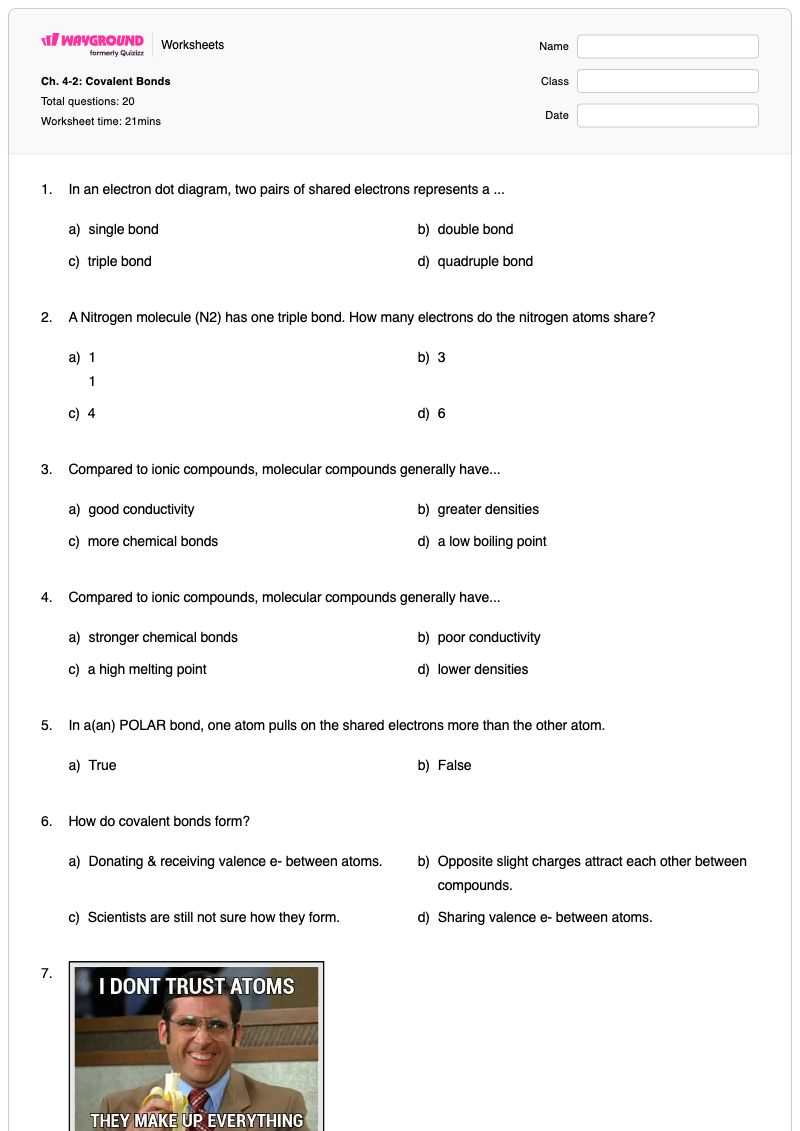
Ch. 4-2: Covalent Bonds

คำถามทั้งหมด: 20

ชื่อ
ระดับ
วันที่

1.
In an electron dot diagram, two pairs of shared electrons represents a ...
a)
single bond
b)
double bond
c)
triple bond
d)
quadruple bond
2.
A Nitrogen molecule (N2) has one triple bond. How many electrons do the nitrogen atoms share?
a)
1
1
b)
3
c)
4
d)
6
3.
Compared to ionic compounds, molecular compounds generally have...
a)
good conductivity
b)
greater densities
c)
more chemical bonds
d)
a low boiling point
4.
Compared to ionic compounds, molecular compounds generally have...
a)
stronger chemical bonds
b)
poor conductivity
c)
a high melting point
d)
lower densities
5.
In a(an) POLAR bond, one atom pulls on the shared electrons more than the other atom. 
a)
True
b)
False
6.
How do covalent bonds form?
a)
Donating & receiving valence e- between atoms.
b)
Opposite slight charges attract each other between compounds.
c)
Scientists are still not sure how they form.
d)
Sharing valence e- between atoms.
7.
What two types of atoms make a covalent bond?
a)
2 Nonmetals
b)
1 Nonmetal and 1 Metal
c)
2 Metals
d)
2 Noble Gases
8.
Which of the following is NOT formed by a covalent bond?
a)
K2S
b)
H2O
c)
I2
d)
CO2
9.
What do we call a covalent bond where electrons are shared UNEVENLY or UNEQUALLY?
a)
Ionic
b)
Polar Covalent
c)
Nonpolar Covalent
d)
Van der Waals Force
10.
Which of the following is NOT considered a diatomic element?
a)
Carbon
b)
Nitrogen
c)
Chlorine
d)
Iodine
11.
Diatomic elements are defined as IDENTICAL elements that bond with each other (i.e. Oxygen with Oxygen). What do we call it…
Diatomic elements are defined as IDENTICAL elements that bond with each other (i.e. Oxygen with Oxygen).  What do we call it when this forms?
a)
Compound
b)
Molecule
c)
Atom
d)
None of the above
12.
Is hydrogen considered a metal or a non-metal?
a)
A metal
b)
Nonmetal
c)
Metalloid
13.
Ionic or covalent?
H2O
a)
Ionic
b)
Covalent
14.
What type of bond is the strongest?

What type of bond is the strongest?

a)

single

b)

Double

c)

James

d)

triple

15.

An atom with 3 valence electrons "wants" a full shell, so it can either gain 5 or lose 3. Which is more likely to occur?

a)

Gain 5

b)

Lose 3

c)

Nothing

16.

Covalent compounds can have (select all that apply)

a)

Single Bonds

b)

Double Bonds

c)

Triple Bonds

d)

Quadruple Bonds

17.
What is a molecule?
a)
The structure that results when atoms are joined together by covalent bonds 
b)
when atoms share a pair of ele
c)
positively and negatively charged atoms
18.
Hydrogen gains stability as the H 2 molecule by forming the noble-gas configuration of ________.
Hydrogen gains stability as the H2 molecule by forming the noble-gas configuration of ________.
a)
oxygen
b)
helium
c)
neon
d)
xenon
19.

Which of the following is a pure substance that contains two or more elements? (Sodium chloride is an example of this.)

a)

compound

b)

ion

c)

molecule

d)

solution

20.
Ionic or covalent?
NaBr
a)
Ionic
b)
Covalent
Waygroundแป้นคำตอบ

Ch. 4-2: Covalent Bonds

คำถามทั้งหมด: 20

1.
b) double bond
2.
d) 6
3.
d) a low boiling point
4.
b) poor conductivity
5.
a) True
6.
d) Sharing valence e- between atoms.
7.
a) 2 Nonmetals
8.
a) K2S
9.
b) Polar Covalent
10.
a) Carbon
11.
b) Molecule
12.
b) Nonmetal
13.
b) Covalent
14.
d)

triple

15.
b)

Lose 3

16.
c)

Triple Bonds

, b)

Double Bonds

, a)

Single Bonds

17.
a) The structure that results when atoms are joined together by covalent bonds 
18.
b) helium
19.
a)

compound

20.
a) Ionic

คำถามที่พบบ่อย

แบบฝึกหัดเรื่องพันธะโคเวเลนต์นี้ครอบคลุมเนื้อหาอะไรบ้าง และช่วยให้นักเรียนเข้าใจแนวคิดนี้ได้อย่างไร?

แบบฝึกหัดสำหรับนักเรียนชั้น ม.2 นี้ ประกอบด้วยคำถามแบบเลือกตอบ 19 ข้อ และคำถามแบบเลือกคำตอบ 1 ข้อ เพื่อประเมินความเข้าใจเกี่ยวกับพันธะโคเวเลนต์ นักเรียนจะได้ตีความแผนภาพจุดอิเล็กตรอน กำหนดว่าพันธะเป็นพันธะเดี่ยว พันธะคู่ หรือพันธะสาม นับอิเล็กตรอนที่ใช้ร่วมกันใน N₂ แยกแยะพันธะโคเวเลนต์แบบมีขั้วออกจากพันธะประเภทอื่น และจัดประเภทสูตรเคมี เช่น H₂O และ K₂S ว่าเป็นพันธะโคเวเลนต์หรือพันธะไอออนิก

ฉันจะใช้แบบฝึกหัดนี้ในการสอนเรื่องพันธะโคเวเลนต์ได้อย่างไร?

แนะนำพันธะโคเวเลนต์โดยการจำลองวิธีการที่อะตอมของอโลหะสองอะตอมแบ่งปันอิเล็กตรอนวาเลนซ์ จากนั้นใช้แผนภาพจุดอิเล็กตรอนเพื่อแสดงพันธะเดี่ยว พันธะคู่ และพันธะสาม ให้นักเรียนอธิบายว่าทำไม N₂ จึงมีอิเล็กตรอนที่ใช้ร่วมกันหกตัว และอภิปรายว่าคำถามเกี่ยวกับพันธะขั้วและพันธะไอออนิกเทียบกับพันธะโคเวเลนต์ในแบบฝึกหัดนำแนวคิดเดียวกันไปใช้กับตัวอย่างโมเลกุลได้อย่างไร จบด้วยแบบฝึกหัดเกี่ยวกับธาตุไดอะตอมิกและอิเล็กตรอนวาเลนซ์เพื่อตรวจสอบการถ่ายทอดความรู้

ฉันควรระวังข้อผิดพลาดอะไรบ้างเมื่อนักเรียนทำแบบฝึกหัดเรื่องพันธะโคเวเลนต์นี้?

นักเรียนอาจสับสนระหว่างจำนวนคู่ของอิเล็กตรอนที่ใช้ร่วมกันกับจำนวนอิเล็กตรอนที่ใช้ร่วมกันทั้งหมด เช่น ตอบว่าสามแทนที่จะเป็นหกสำหรับพันธะสามใน N₂ ควรระวังความสับสนระหว่างพันธะโคเวเลนต์แบบมีขั้วและพันธะไอออนิก การจัดประเภท K₂S ผิดว่าเป็นโคเวเลนต์เพราะเขียนเป็นสูตร และการไม่เข้าใจว่าโมเลกุลไดอะตอมิกประกอบด้วยอะตอมที่เหมือนกันสองอะตอม นอกจากนี้ นักเรียนอาจสลับการเปรียบเทียบทั่วไประหว่างโมเลกุลและสารประกอบที่เกี่ยวข้องกับค่าการนำไฟฟ้า ความหนาแน่น และจุดเดือด

ฉันจะมอบหมายและตรวจงานเรื่องพันธะโคเวเลนต์นี้อย่างไร?

แบบฝึกหัดนี้มีให้ดาวน์โหลดบน Wayground ในรูปแบบไฟล์ PDF ที่สามารถพิมพ์ได้ และในรูปแบบแบบทดสอบดิจิทัล โดยมีเฉลยคำตอบครบถ้วนสำหรับทั้ง 20 ข้อ คุณสามารถตรวจงานที่ส่งมาในรูปแบบไฟล์ PDF ได้โดยการสแกนงานของนักเรียนด้วยแอป Wayground for Teachers ในขณะที่แบบทดสอบดิจิทัลรองรับการมอบหมายงานและการทบทวนออนไลน์

ฉันจะปรับแบบฝึกหัดเรื่องพันธะโคเวเลนต์นี้ให้เหมาะสมกับนักเรียนของฉันได้อย่างไร?

ใช้การตั้งค่าขั้นสูงของแบบฝึกหัดเพื่อเพิ่มขนาดตัวอักษรหรือระยะห่างเมื่อนักเรียนต้องการพื้นที่มากขึ้นในการอ่านแผนภาพพันธะ สูตร และตัวเลือกคำตอบ นอกจากนี้ คุณยังสามารถเลือกแบบอักษรที่เหมาะสำหรับผู้ที่มีภาวะดิสเล็กเซีย หรือแปลคำถามเกี่ยวกับพันธะโคเวเลนต์เป็นภาษาอื่นเพื่อให้เข้าใจเนื้อหาเกี่ยวกับการแบ่งปันอิเล็กตรอนและพันธะไอออนิกเทียบกับพันธะโคเวเลนต์ได้ง่ายขึ้น

ฉันจะหาแบบฝึกหัดแบบนี้เพิ่มเติมได้ที่ไหนบน Wayground?

Wayground นำเสนอชุดแบบฝึกหัดและโจทย์ฝึกหัดฟรีที่ครอบคลุมหลากหลายวิชา พร้อมไฟล์ PDF และเฉลยคำตอบ เพื่อช่วยให้นักเรียนเชี่ยวชาญทักษะและแนวคิดที่สำคัญ ดูแหล่งข้อมูลเพิ่มเติมได้ที่ https://wayground.com/en-us/worksheets