

Wayground
Throwback Thursday! 9/26 - Review of Experiments and Forces - Printable ศาสตร์ Worksheets 8th ระดับชั้น - Wayground

Throwback Thursday! 9/26 - Review of Experiments and Forces

Lindsay Sereika

สร้างโดย Lindsay Sereika

20 คำถาม

8th ระดับชั้น

ศาสตร์

อัปเดตแล้ว พ.ค. 2568

ย้อนวันพฤหัส! 26/9 – แบบฝึกหัดวิทยาศาสตร์ชั้น ม.2 เรื่อง การทบทวนการทดลองและแรง เป็นแบบฝึกหัดที่ทบทวนทักษะหลักจากการออกแบบการทดลองและการสำรวจแรง นักเรียนจะได้เลือกหน่วยวัดที่เหมาะสม ระบุตัวแปรอิสระและตัวแปรตาม รู้จักกลุ่มควบคุมและตัวแปรที่ถูกควบคุม แยกแยะข้ออ้างออกจากหลักฐาน และเรียงลำดับขั้นตอนทั่วไปของการทดลอง แบบฝึกหัด 20 ข้อนี้ใช้รูปแบบคำถามแบบเลือกตอบ เลือกหลายข้อ ลากและวาง จุดสนใจ การจำแนกประเภท การเรียงลำดับ และการสร้างกราฟ นอกจากนี้ นักเรียนยังจะได้ตีความชุดข้อมูลมวลและแรงโดยการสร้างแผนภาพกระจาย ระบุแรงเสียดทานและแรงว่าเป็นแรงผลักหรือแรงดึง แยกแยะแรงสมดุลออกจากแรงไม่สมดุล เปรียบเทียบแผนภาพแรง และคำนวณแรงลัพธ์ รูปแบบที่หลากหลายเหล่านี้ช่วยให้ครูสามารถทบทวนอย่างเจาะจงว่านักเรียนวางแผนการสำรวจ ตีความผลลัพธ์ และเชื่อมโยงแนวคิดเรื่องแรงกับหลักฐานอย่างไร แบบฝึกหัดที่พิมพ์ได้ฟรีนี้ออกแบบมาสำหรับการสอน การทบทวน หรือการประเมินวิทยาศาสตร์ชั้น ม.2 และมีเฉลยคำตอบครบถ้วน

การตั้งค่าแผ่นงาน

ขนาดตัวอักษร

S
M
L
XL
Waygroundแผ่นงาน

Throwback Thursday! 9/26 - Review of Experiments and Forces

คำถามทั้งหมด: 20

ชื่อ
ระดับ
วันที่
1.
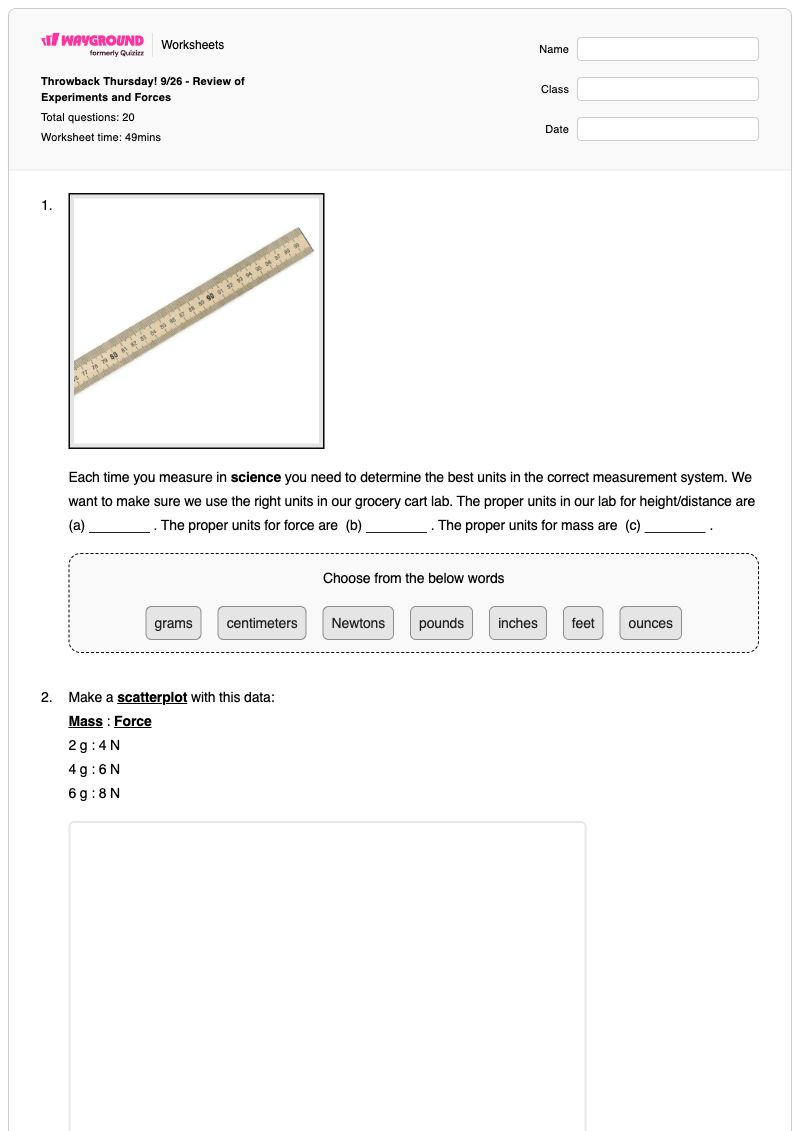
Each time you measure in science you need to determine the best units in the correct measurement system. We want to make…

Each time you measure in science you need to determine the best units in the correct measurement system. We want to make sure we use the right units in our grocery cart lab. The proper units in our lab for height/distance are (a)   . The proper units for force are ​ (b)   . The proper units for mass are ​ (c)   .

เลือกจากคำด้านล่าง
grams
centimeters
Newtons
pounds
inches
feet
ounces
2.

Make a scatterplot with this data:

Mass : Force

2 g : 4 N

4 g : 6 N

6 g : 8 N

3.
Which apply to the IV? (hint: 3 apply!)

Which apply to the IV?

(hint: 3 apply!)

a)

the independent variable

b)

what you change

c)

what stays the same

d)

what is being tested in the experiment

4.
Remember the chant Ms. Sereika made you do?.....The IV is _________________,...
a)
the result
b)
the same
c)
what you change
d)
what you keep the same
5.
...The DV is _________________!
a)
the result
b)
the same
c)
what you change
d)
what you keep the same
6.

What part of the experiment gives you something to compare your results to, so that you know that the changes really affected the outcomes and not something else?

7.
Think about our bad first attempt at an experiment and planning for a good experiment. How do you know if your experiment…

Think about our bad first attempt at an experiment and planning for a good experiment. How do you know if your experiment was one that you can trust the results of?

จัดหมวดหมู่ดังต่อไปนี้

has a control group

lots of different answers

lots of constants (controlled variables)

lots of variables

data is consistent

use of different units

only one variable (the IV) is changed

no common procedure used

the research question is testable

results cannot be repeated

Good experiment
Can't trust it!
8.

What is a claim in an experiment?

a)

A way to cancel data

b)

A summary of the problems in the experiment.

c)

A statement/summary of what you discovered

d)

An average of the data

9.

In an experiment, what is the evidence that you use to support the claim?

a)

Data

b)

Guesses

c)

Hypotheses

d)

Questions

10.

In an experiment, you usually follow some basic steps. Think back to our grocery cart lab. Based on that, what is the order of how we should conduct experiments?

a)

Design the experiment (IV, DV, constants, etc.)

b)

Gather data through observations/
measurement

c)

Analyze the data (averages, graphs, etc.)

d)

Interpret the data (What I See - WIS) to look for patterns

e)

Make a claim (What it Means - WIM) to answer the testable research question + hypothesis

1)
2)
3)
4)
5)
11.

What is a force?

a)

the PUSH or PULL on an object

b)

The MOTION an object creates

c)

The objects HITTING one another

d)

Going REALLY FAST

12.
Which side has more force?

Which side has more force?

a)

left

b)

right

13.

What force is it when you try to push a box and it doesn't move easily on the carpet?

a)

gravity

b)

friction

c)

air

14.
Is this a balanced or unbalance force?
a)
Balanced
b)
Unbalanced
c)
Neither one
d)
Both
15.
Calculate the net force of the object in the image shown.
a)
20N
b)
35N
c)
5N
d)
25N
16.
Which direction will the object move?
a)
Up
b)
Down
c)
Right
d)
Left
17.
Is this a balanced or unbalanced force?
a)
Balanced
b)
Unbalanced
c)
Neither
d)
Both
18.
Which direction will the object move?
a)
Right
b)
Left
c)
Up
d)
Down
19.
Calculate the net force shown in the diagram.

Calculate the net force shown in the  diagram.

a)
6 N
b)
0 N
c)
3 N
d)
9N
20.
Which apply to the DV? (hint: 3 apply!)

Which apply to the DV?

(hint: 3 apply!)

a)

the result

b)

the dependent variable

c)

what stays the same

d)

what is measured or counted at the end

Waygroundแป้นคำตอบ

Throwback Thursday! 9/26 - Review of Experiments and Forces

คำถามทั้งหมด: 20

1.
centimeters, Newtons, grams
2.
3.
a)

the independent variable

, b)

what you change

, d)

what is being tested in the experiment

4.
c) what you change
5.
a) the result
6.
7.
Good experiment

has a control group

lots of constants (controlled variables)

data is consistent

only one variable (the IV) is changed

the research question is testable

Can't trust it!

lots of different answers

lots of variables

use of different units

no common procedure used

results cannot be repeated

8.
c)

A statement/summary of what you discovered

9.
a)

Data

10.
a, b, c, d, e
11.
a)

the PUSH or PULL on an object

12.
a)

left

13.
b)

friction

14.
b) Unbalanced
15.
c) 5N
16.
d) Left
17.
b) Unbalanced
18.
b) Left
19.
a) 6 N
20.
a)

the result

, b)

the dependent variable

, d)

what is measured or counted at the end

คำถามที่พบบ่อย

แบบฝึกหัดสำหรับนักเรียนชั้น ม.2 นี้ครอบคลุมเนื้อหาอะไรบ้าง?

แบบฝึกหัดนี้ทบทวนการออกแบบการทดลองและการวิเคราะห์แรงผ่านคำถามแบบผสม 20 ข้อ นักเรียนจะต้องระบุหน่วยวัด ตัวแปรอิสระและตัวแปรตาม ตัวควบคุม ข้ออ้างและหลักฐาน และขั้นตอนการทดลอง สร้างแผนภาพกระจายมวลและแรง และวิเคราะห์แรงเสียดทาน แรงสมดุลหรือไม่สมดุล และแรงลัพธ์

ฉันจะใช้แบบฝึกหัดนี้ในการสอนเรื่องการออกแบบการทดลองและแรงได้อย่างไร?

ใช้รายการออกแบบการทดลองเพื่อแนะนำหรือทบทวนการทดลองรถเข็นในซูเปอร์มาร์เก็ต: ให้นักเรียนระบุสิ่งที่เปลี่ยนแปลง วัด และควบคุม ก่อนที่จะเรียงลำดับขั้นตอนการตรวจสอบ จากนั้นใช้แผนภูมิกระจายและคำถามเกี่ยวกับแรงเพื่อเชื่อมโยงข้อมูลที่บันทึกไว้กับข้อสรุป แรงเสียดทาน แรงสมดุล และการคำนวณแรงลัพธ์ โดยขอให้นักเรียนอธิบายว่าคำตอบแต่ละข้อได้รับการสนับสนุนจากการสังเกตหรือการวัดอย่างไร

ฉันควรสังเกตข้อผิดพลาดอะไรบ้างเมื่อนักเรียนทำแบบฝึกหัดนี้เสร็จ?

สังเกตนักเรียนที่สับสนระหว่างตัวแปรอิสระกับตัวแปรตาม หรือเลือก “สิ่งที่คงที่” แทนที่จะเป็น “สิ่งที่คุณเปลี่ยนแปลง” สำหรับตัวแปรอิสระ ในข้อสอบเกี่ยวกับการทดลอง นักเรียนอาจสับสนระหว่างข้ออ้างกับข้อมูลสนับสนุน ละเว้นกลุ่มควบคุมเมื่อพิจารณาว่าผลลัพธ์น่าเชื่อถือหรือไม่ หรือสลับลำดับการรวบรวม การวิเคราะห์ การตีความ และการรายงานผลลัพธ์ สำหรับคำถามเกี่ยวกับแรง ตรวจสอบว่านักเรียนใช้หน่วยที่กำหนดไว้ ตระหนักถึงแรงเสียดทานเมื่อวัตถุต้านทานการเคลื่อนที่บนพรม และคำนวณแรงลัพธ์แทนที่จะเลือกแรงแต่ละแรงที่มากที่สุด

ฉันจะมอบหมายและให้คะแนนแบบฝึกหัดเรื่องการทดลองและแรงนี้ได้อย่างไร?

แบบฝึกหัดนี้มีให้ดาวน์โหลดบน Wayground ในรูปแบบไฟล์ PDF ที่สามารถพิมพ์ได้ และในรูปแบบแบบทดสอบดิจิทัล โดยมีเฉลยคำตอบครบถ้วนสำหรับทั้ง 20 ข้อ การส่งงานแบบพิมพ์สามารถตรวจได้โดยการสแกนงานของนักเรียนด้วยแอป Wayground for Teachers ในขณะที่แบบทดสอบดิจิทัลรองรับการส่งงานและการตรวจให้คะแนนทางออนไลน์

ฉันจะปรับแบบฝึกหัดนี้ให้เหมาะสมกับนักเรียนของฉันได้อย่างไร?

ใช้การตั้งค่าขั้นสูงของแบบฝึกหัดเพื่อปรับระยะห่างระหว่างตัวอักษรเป็นปกติ ปานกลาง หรือกว้าง และเปลี่ยนขนาดตัวอักษรจาก S ถึง XL สำหรับรายการเกี่ยวกับการสร้างกราฟ การจำแนกประเภท และการวิเคราะห์แรง นอกจากนี้ คุณยังสามารถเปิดใช้งานแบบอักษรที่เหมาะสำหรับผู้ที่มีภาวะดิสเล็กเซีย หรือแปลแบบฝึกหัดเป็นภาษาอื่น ซึ่งอาจช่วยให้นักเรียนอ่านคำศัพท์และคำแนะนำเกี่ยวกับการออกแบบการทดลองได้อย่างสะดวกสบายยิ่งขึ้น

ฉันจะหาแบบฝึกหัดฟรีแบบนี้เพิ่มเติมได้ที่ไหนบน Wayground?

Wayground นำเสนอชุดแบบฝึกหัดและโจทย์ฝึกหัดฟรีที่ครอบคลุมทุกวิชา พร้อมไฟล์ PDF และเฉลยคำตอบ เพื่อช่วยเสริมสร้างทักษะและความเข้าใจในแนวคิดสำคัญ ดูแบบฝึกหัดเพิ่มเติมได้ที่ https://wayground.com/en-us/worksheets