

Wayground
History of Atomic Theory Quiz - Printable ศาสตร์ Worksheets ระดับ 10 - Wayground

History of Atomic Theory Quiz

Travis Curry

สร้างโดย Travis Curry

15 คำถาม

10th ระดับชั้น

ศาสตร์

อัปเดตแล้ว ก.ย. 2569

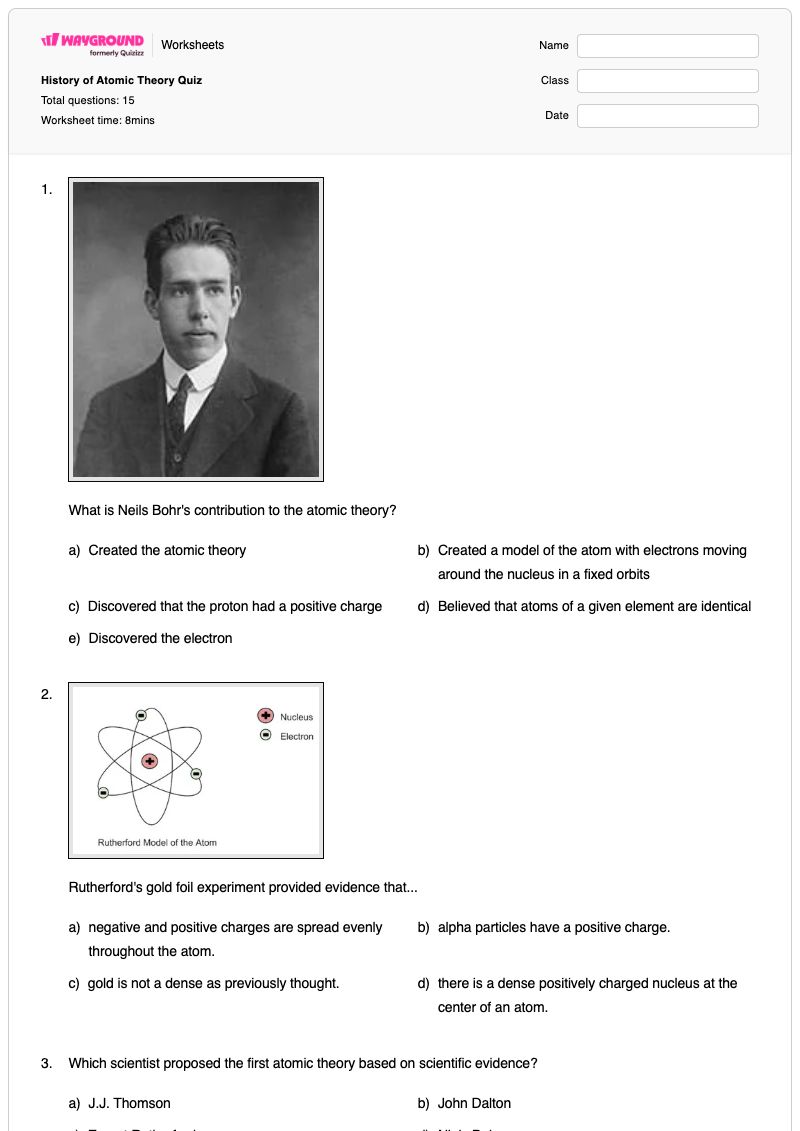
แบบทดสอบประวัติศาสตร์ทฤษฎีอะตอม เป็นแบบฝึกหัดวิทยาศาสตร์สำหรับนักเรียนชั้น ม.4 ที่ทบทวนวิวัฒนาการของแบบจำลองอะตอม ตั้งแต่แนวคิดแรกเริ่มเกี่ยวกับอนุภาคที่แบ่งแยกไม่ได้ ไปจนถึงทฤษฎีอะตอมของดาลตัน แบบจำลองอิเล็กตรอนและแบบจำลองพลัมพุดดิ้งของทอมสัน นิวเคลียสของรัทเทอร์ฟอร์ด วงโคจรอิเล็กตรอนคงที่ของโบร์ และแบบจำลองกลศาสตร์ควอนตัม นักเรียนจะต้องเชื่อมโยงนักวิทยาศาสตร์แต่ละคนกับผลงาน การทดลอง แบบจำลอง หรือข้อสรุป รวมถึงหลักฐานจากการทดลองแผ่นทองคำของรัทเทอร์ฟอร์ด และความหมายของวงโคจรและการกระจายความน่าจะเป็น แบบฝึกหัดที่พิมพ์ได้ฟรีนี้ประกอบด้วย 15 ข้อ: 14 ข้อเป็นแบบเลือกตอบ และ 1 ข้อเป็นแบบเลือกตอบหลายตัวเลือก ช่วยให้นักเรียนแยกแยะได้ว่าแบบจำลองแต่ละแบบเปลี่ยนแปลงความเข้าใจเกี่ยวกับโครงสร้างอะตอมอย่างไร จดจำนักวิทยาศาสตร์และการทดลองที่สำคัญ และระบุข้ออ้างเฉพาะในทฤษฎีของดาลตัน เช่น อะตอมรวมตัวกันในอัตราส่วนจำนวนเต็มอย่างง่าย มีเฉลยคำตอบให้ด้วย ทำให้แบบฝึกหัดนี้มีประโยชน์สำหรับการทบทวนวิทยาศาสตร์ชั้น ม.4 การประเมินผลระหว่างเรียน หรือการเตรียมตัวสำหรับการสอบประจำหน่วย

การตั้งค่าแผ่นงาน

ขนาดตัวอักษร

S
M
L
XL
Waygroundแผ่นงาน

History of Atomic Theory Quiz

คำถามทั้งหมด: 15

ชื่อ
ระดับ
วันที่
1.
What is Neils Bohr's contribution to the atomic theory?

What is Neils Bohr's contribution to the atomic theory?

a)

Created the atomic theory

b)

Created a model of the atom with electrons moving around the nucleus in a fixed orbits

c)

Discovered that the proton had a positive charge

d)

Believed that atoms of a given element are identical

e)

Discovered the electron

2.
Rutherford's gold foil experiment provided evidence that...

Rutherford's gold foil experiment provided evidence that...

a)

negative and positive charges are spread evenly throughout the atom.

b)

alpha particles have a positive charge.

c)

gold is not a dense as previously thought.

d)

there is a dense positively charged nucleus at the center of an atom.

3.

Which scientist proposed the first atomic theory based on scientific evidence?

a)

J.J. Thomson

b)

John Dalton

c)

Ernest Rutherford

d)

Niels Bohr

4.

According to Dalton's Atomic Theory, atoms of the same element are:

a)

Different in mass and properties

b)

Indivisible and indestructible

c)

Identical in mass and properties

d)

Made up of protons, neutrons, and electrons

5.

J.J. Thomson's Plum Pudding Model suggested that:

a)

Electrons orbit the nucleus in fixed paths

b)

Atoms are indivisible

c)

Atoms consist of a positively charged 'pudding' with negatively charged 'plums' (electrons) embedded in it

d)

Atoms have a dense, positively charged nucleus

6.

What was the main conclusion of Rutherford's Gold Foil Experiment?

a)

Atoms are indivisible

b)

Electrons are embedded in a positively charged sphere

c)

Atoms have a small, dense, positively charged nucleus

d)

Electrons orbit the nucleus in fixed paths

7.

In Bohr's Model of the Atom, electrons:

a)

Are embedded in a positively charged sphere

b)

Move in fixed orbits around the nucleus

c)

Are scattered randomly around the nucleus

d)

Are part of a 'cloud' around the nucleus

8.

Which model of the atom introduced the concept of quantized energy levels?

a)

Dalton's Atomic Theory

b)

Thomson's Plum Pudding Model

c)

Rutherford's Model

d)

Bohr's Model

9.

The Quantum Mechanical Model of the atom describes electrons as:

a)

Particles in fixed orbits

b)

Waves with a probability distribution

c)

Particles embedded in a positively charged sphere

d)

Particles in a dense nucleus

10.

Who is credited with the discovery of the electron?

a)

John Dalton

b)

J.J. Thomson

c)

Ernest Rutherford

d)

Niels Bohr

11.

Which experiment led to the discovery of the nucleus?

a)

Thomson's Cathode Ray Experiment

b)

Rutherford's Gold Foil Experiment

c)

Bohr's Hydrogen Spectrum Experiment

d)

Millikan's Oil Drop Experiment

12.

In the Quantum Mechanical Model, the region where an electron is likely to be found is called:

a)

Orbit

b)

Orbital

c)

Nucleus

d)

Shell

13.

Who first described matter as being made of small, indivisible, particles?

a)

Ancient Greeks

b)

Ancient Romans

c)

Niels Bohr

d)

John Dalton

14.

Fun (not on the test): These two were research assistants and students of J.J. Thompson

a)

Niels Bohr

b)

Ernst Rutherford

c)

Democritus

d)

John Dalton

15.

Which of the following statements is true about Dalton's Atomic Theory?

a)

Atoms can be created or destroyed in chemical reactions

b)

Atoms of different elements can combine in simple whole-number ratios to form compounds

c)

Atoms are made up of protons, neutrons, and electrons

d)

Atoms of the same element can have different masses

Waygroundแป้นคำตอบ

History of Atomic Theory Quiz

คำถามทั้งหมด: 15

1.
b)

Created a model of the atom with electrons moving around the nucleus in a fixed orbits

2.
d)

there is a dense positively charged nucleus at the center of an atom.

3.
b)

John Dalton

4.
c)

Identical in mass and properties

5.
c)

Atoms consist of a positively charged 'pudding' with negatively charged 'plums' (electrons) embedded in it

6.
c)

Atoms have a small, dense, positively charged nucleus

7.
b)

Move in fixed orbits around the nucleus

8.
d)

Bohr's Model

9.
b)

Waves with a probability distribution

10.
b)

J.J. Thomson

11.
b)

Rutherford's Gold Foil Experiment

12.
b)

Orbital

13.
a)

Ancient Greeks

14.
a)

Niels Bohr

, b)

Ernst Rutherford

15.
b)

Atoms of different elements can combine in simple whole-number ratios to form compounds

คำถามที่พบบ่อย

แบบทดสอบประวัติศาสตร์ทฤษฎีอะตอมช่วยให้นักเรียนเรียนรู้อะไรบ้าง?

แบบฝึกหัดวิทยาศาสตร์สำหรับนักเรียนชั้นมัธยมศึกษาปีที่ 4 นี้ ช่วยให้นักเรียนติดตามพัฒนาการของแบบจำลองอะตอม ตั้งแต่แนวคิดของชาวกรีกในยุคแรก ผ่านดาลตัน ทอมสัน รัทเทอร์ฟอร์ด โบห์ร และแบบจำลองกลศาสตร์ควอนตัม แบบฝึกหัดนี้ประกอบด้วยคำถามแบบเลือกตอบ 14 ข้อ และคำถามแบบเลือกคำตอบ 1 ข้อ ซึ่งจะทดสอบความสามารถของนักเรียนในการจับคู่ชื่อนักวิทยาศาสตร์กับผลงาน เชื่อมโยงการทดลองกับหลักฐาน และแยกแยะความแตกต่างระหว่างแนวคิดต่างๆ เช่น วงโคจรคงที่ของโบห์ร กับวงโคจรในกลศาสตร์ควอนตัม

ฉันจะใช้แบบฝึกหัดนี้ในการสอนประวัติศาสตร์ของทฤษฎีอะตอมได้อย่างไร?

หลังจากที่นักเรียนได้ทบทวนแบบจำลองตามลำดับเวลาแล้ว ให้แนะนำแบบฝึกหัด จากนั้นขอให้นักเรียนอธิบายว่าแบบจำลองใหม่แต่ละแบบได้กล่าวถึงหลักฐานจากงานวิจัยก่อนหน้านี้อย่างไร ใช้หัวข้อเกี่ยวกับแบบจำลองพุดดิ้งลูกพลัมของทอมสัน การทดลองแผ่นทองคำของรัทเทอร์ฟอร์ด และระดับพลังงานของโบร์ เป็นช่วงพักการสนทนา โดยถามนักเรียนว่าอะไรเปลี่ยนแปลงไปในแบบจำลองและเพราะเหตุใด ปิดท้ายด้วยคำถามเกี่ยวกับแบบจำลองกลศาสตร์ควอนตัม เพื่อเน้นย้ำว่าออร์บิทัลเป็นบริเวณความน่าจะเป็น ไม่ใช่เส้นทางอิเล็กตรอนที่ตายตัว

ฉันควรระวังข้อผิดพลาดอะไรบ้างเมื่อนักเรียนทำแบบทดสอบทฤษฎีอะตอมนี้?

นักเรียนอาจสับสนเกี่ยวกับผลงานของนักวิทยาศาสตร์แต่ละคน เช่น อาจระบุว่าการค้นพบอิเล็กตรอนเป็นผลงานของรัทเทอร์ฟอร์ด หรือนิวเคลียสเป็นผลงานของทอมสัน นอกจากนี้ พวกเขาอาจเลือกแบบจำลองของรัทเทอร์ฟอร์ดเมื่อคำถามถามเกี่ยวกับวงโคจรคงที่หรือระดับพลังงานควอนตัม หรืออาจสับสนระหว่างวงโคจรควอนตัมกับวงโคจรของบอร์ โปรดตรวจสอบข้อสอบแบบเลือกหลายข้ออย่างละเอียดด้วย เนื่องจากนักเรียนต้องระบุชื่อผู้ช่วยวิจัยทั้งสองคน ไม่ใช่เลือกเพียงชื่อเดียว

ฉันจะมอบหมายและให้คะแนนแบบทดสอบประวัติศาสตร์ทฤษฎีอะตอมนี้อย่างไร?

แบบฝึกหัดนี้มีให้ดาวน์โหลดในรูปแบบไฟล์ PDF สำหรับพิมพ์ และเป็นแบบทดสอบดิจิทัลบน Wayground โดยมีเฉลยคำตอบครบถ้วนสำหรับทั้ง 15 ข้อ คุณสามารถตรวจงานที่ส่งในรูปแบบไฟล์ PDF ได้โดยการสแกนงานของนักเรียนด้วยแอป Wayground for Teachers ในขณะที่เวอร์ชันดิจิทัลรองรับการทำและตรวจงานออนไลน์

ฉันจะปรับแบบฝึกหัดทฤษฎีอะตอมนี้ให้เหมาะสมกับนักเรียนของฉันได้อย่างไร?

ใช้การตั้งค่าขั้นสูงของแบบฝึกหัดเพื่อปรับระยะห่างระหว่างตัวอักษรหรือขนาดตัวอักษร เพื่อให้คำถามเกี่ยวกับนักวิทยาศาสตร์และแบบจำลองอ่านง่ายขึ้น นอกจากนี้ คุณยังสามารถใช้แบบอักษรที่เหมาะสำหรับผู้ที่มีภาวะดิสเล็กเซีย หรือแปลแบบทดสอบเป็นภาษาอื่นได้ โดยยังคงรูปแบบคำถามแบบปรนัยและเลือกหลายข้อไว้เหมือนเดิม

ฉันจะหาแบบฝึกหัดแบบนี้เพิ่มเติมได้ที่ไหนบน Wayground?

Wayground นำเสนอชุดแบบฝึกหัดและโจทย์ฝึกหัดฟรีที่ครอบคลุมหลากหลายวิชา พร้อมไฟล์ PDF และเฉลยคำตอบ เพื่อช่วยให้นักเรียนเชี่ยวชาญทักษะและแนวคิดที่สำคัญ ดูแหล่งข้อมูลเพิ่มเติมได้ที่ https://wayground.com/en-us/worksheets