

Wayground
SOL 4.3 Ecosystems Review - Printable ศาสตร์ Worksheets ระดับ 4 - Wayground

SOL 4.3 Ecosystems Review

Jeannine Vuillemot

สร้างโดย Jeannine Vuillemot

20 คำถาม

3rd - 5th ระดับชั้น

ศาสตร์

อัปเดตแล้ว ก.ย. 2569

แบบฝึกหัดวิทยาศาสตร์ SOL 4.3 เรื่องระบบนิเวศ สำหรับนักเรียนชั้นประถมศึกษาปีที่ 3-5 สามารถพิมพ์ได้ฟรี เพื่อตรวจสอบความเข้าใจของนักเรียนเกี่ยวกับโครงสร้างของระบบนิเวศและการไหลเวียนของพลังงาน แบบฝึกหัดประกอบด้วย 20 ข้อ—13 ข้อเป็นแบบเลือกตอบ 5 ข้อเป็นแบบเลือกคำตอบ และ 2 ข้อเป็นแบบเติมคำในช่องว่าง—นักเรียนจะได้ระบุประชากร ชุมชน องค์ประกอบของระบบนิเวศทั้งที่มีชีวิตและไม่มีชีวิต ผู้ผลิต ผู้บริโภค ผู้ย่อยสลาย และแหล่งพลังงาน นอกจากนี้ นักเรียนยังได้ตีความห่วงโซ่อาหารและใยอาหารเพื่อติดตามความสัมพันธ์ของพลังงาน ระบุการแข่งขัน ทำนายว่าการเปลี่ยนแปลงของประชากรส่งผลกระทบต่อสิ่งมีชีวิตอื่นอย่างไร และรู้จักนิเวศวิทยาของสิ่งมีชีวิต แบบฝึกหัดนี้มีรูปแบบคำถามที่หลากหลาย ทำให้นักเรียนต้องเลือกองค์ประกอบที่ถูกต้องทั้งหมด ระบุคำศัพท์สำคัญ เช่น ดวงอาทิตย์และผู้ย่อยสลาย และประยุกต์ใช้ความสัมพันธ์ของระบบนิเวศกับสถานการณ์ที่เกี่ยวข้องกับรูปแบบการกินอาหารและการเปลี่ยนแปลงของประชากร แบบฝึกหัดนี้มีเฉลยคำตอบครบถ้วน เหมาะสำหรับการทบทวน การฝึกฝนด้วยตนเอง หรือการประเมินผลวิชาวิทยาศาสตร์

การตั้งค่าแผ่นงาน

ขนาดตัวอักษร

S
M
L
XL
Waygroundแผ่นงาน

SOL 4.3 Ecosystems Review

คำถามทั้งหมด: 20

ชื่อ
ระดับ
วันที่
1.

What makes up the cardinal population in Prince William Forest Park?

a)

all the birds in Virginia

b)

all the cardinals living in Prince William Forest Park

c)

all the living and nonliving components at the edge of the forest

d)

only the living things at the edge of the forest

2.

Which of the following would be a part of the community in which the cardinals live? Select ALL possible answers.

a)

rocks

b)

trees

c)

water

d)

other birds

3.

Which three components of an ecosystem are nonliving? Select all three.

a)

Air

b)

Nutrients

c)

Decomposer

d)

Sunlight

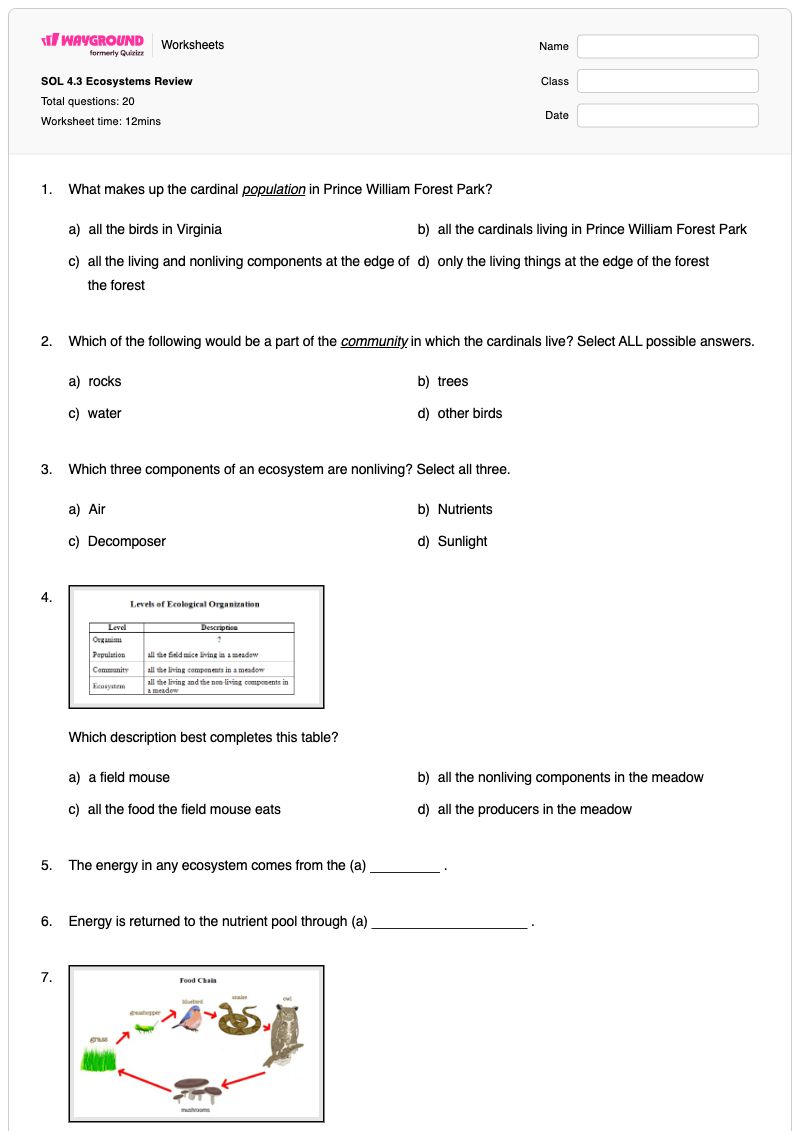
4.
Which description best completes this table?

Which description best completes this table?

a)

a field mouse

b)

all the nonliving components in the meadow

c)

all the food the field mouse eats

d)

all the producers in the meadow

5.

The energy in any ecosystem comes from the (a)   .

6.

Energy is returned to the nutrient pool through (a)   .

7.
Study this food chain. What is the producer?

Study this food chain. What is the producer?

a)

grasshopper

b)

mushroom

c)

snake

d)

grass

8.
Study this food chain. What is a consumer?

Study this food chain. What is a consumer?

a)

grass

b)

mushroom

c)

sun

d)

owl

9.
Study this food chain. What is the decomposer?

Study this food chain. What is the decomposer?

a)

grass

b)

owl

c)

grasshopper

d)

mushroom

10.
Which component of this ecosystem has the most amount of energy?

Which component of this ecosystem has the most amount of energy?

a)

producers

b)

consumers

c)

decomposers

d)

insects

11.
Study this food web. Which organisms provide energy for more than one organism in this food web? Select ALL that apply.

Study this food web. Which organisms provide energy for more than one organism in this food web? Select ALL that apply.

a)

fox

b)

frog

c)

grasshopper

d)

owl

12.
If a group of raccoons was introduced to this ecosystem and began eating frogs, what would most likely happen?

If a group of raccoons was introduced to this ecosystem and began eating frogs, what would most likely happen?

a)

There will be less grasshoppers in the area

b)

Snakes will begin eating grasshoppers

c)

Frogs will begin eating plants

d)

There will be less snakes in the area

13.
Study the food web. Which two organisms are in direct competition for food?

Study the food web. Which two organisms are in direct competition for food?

a)

frog and mouse

b)

fox and rabbit

c)

owl and bird

d)

frog and bird

14.

Study this food web. What would most likely happen to the organisms if the population of grasshoppers greatly decreased?

a)

Competition between frogs and birds for food would increase

b)

Competition between hawks and snakes for food would increase

c)

The number of mice would decrease

d)

Foxes would start eating extra frogs

15.

The great horned owl has a sharp beak and claws used for catching prey and tearing meat. It has good eyesight to see in low light. Which of these is part of the niche of the great horned owl?

a)

grazes on grass during the day

b)

comes out at dawn and gets worms from the ground

c)

comes out as dusk to sweep the sky for insects

d)

hunts small animals at night

16.

All species of plants & animals require four things in their habitat. Select the four requirements from the list below.

a)

food

b)

shelter

c)

ecosystem

d)

water

e)

space

17.
Yara is taking notes on niches. Which of the following should be added to her notes?

Yara is taking notes on niches. Which of the following should be added to her notes?

a)

plants do not have niches

b)

an organism may have different niches during its life

c)

all farm animals have the same niche

d)

a bird's niche is the sky

18.

Which of the following describes an organism whose niche has changed?

a)

A frog is a carnivore and a tadpole is an herbivore

b)

A cow is an herbivore and a calf is an herbivore

c)

A trout eats small fish and a goldfish eats plants and insects

d)

A bunny eats grass and a rabbit eats grass

19.

Which of the following things can be used to classify different organisms? Select ALL that apply.

a)

need for water

b)

need for shelter

c)

energy source

d)

skin covering

20.
A zoo hatched 100 eggs from three different types of butterflies. They watched the population of each type of butterfly and…

A zoo hatched 100 eggs from three different types of butterflies. They watched the population of each type of butterfly and recorded the number of butterflies for five months. Which of the following is true?

a)

The painted lady population died out

b)

The monarch butterfly population decreased from June to July

c)

The painted lady population stayed constant

d)

The zebra swallowtails decreased greatly over time

Waygroundแป้นคำตอบ

SOL 4.3 Ecosystems Review

คำถามทั้งหมด: 20

1.
b)

all the cardinals living in Prince William Forest Park

2.
b)

trees

, d)

other birds

3.
a)

Air

, b)

Nutrients

, d)

Sunlight

4.
a)

a field mouse

5.
sun
6.
decomposers
7.
d)

grass

8.
d)

owl

9.
d)

mushroom

10.
a)

producers

11.
b)

frog

, c)

grasshopper

12.
d)

There will be less snakes in the area

13.
d)

frog and bird

14.
a)

Competition between frogs and birds for food would increase

15.
d)

hunts small animals at night

16.
a)

food

, b)

shelter

, d)

water

, e)

space

17.
b)

an organism may have different niches during its life

18.
a)

A frog is a carnivore and a tadpole is an herbivore

19.
c)

energy source

, d)

skin covering

20.
d)

The zebra swallowtails decreased greatly over time

คำถามที่พบบ่อย

แบบฝึกหัดทบทวนระบบนิเวศตามมาตรฐาน SOL 4.3 ครอบคลุมเนื้อหาอะไรบ้าง?

แบบฝึกหัดวิทยาศาสตร์สำหรับนักเรียนชั้นประถมศึกษาปีที่ 3-5 นี้ครอบคลุมหัวข้อประชากร ชุมชน องค์ประกอบของระบบนิเวศทั้งทางชีวภาพและอชีวภาพ การไหลของพลังงาน ห่วงโซ่อาหาร เครือข่ายอาหาร การแข่งขัน และนิเวศวิทยาเฉพาะถิ่น แบบฝึกหัดประกอบด้วย 20 ข้อ โดยใช้รูปแบบคำถามแบบเลือกตอบ เลือกคำตอบที่ถูกต้อง และเติมคำในช่องว่าง เพื่อให้นักเรียนจำแนกส่วนประกอบของระบบนิเวศ ระบุผู้ผลิต ผู้บริโภค และผู้ย่อยสลาย และคาดการณ์ว่าการเปลี่ยนแปลงในประชากรกลุ่มหนึ่งจะส่งผลกระทบต่อกลุ่มอื่นอย่างไร

ฉันจะใช้แบบฝึกหัดระบบนิเวศนี้ในการสอนเรื่องการไหลเวียนของพลังงานและห่วงโซ่อาหารได้อย่างไร?

เริ่มแบบฝึกหัดโดยให้นักเรียนแยกแยะความแตกต่างระหว่างประชากรกับชุมชน และแยกส่วนประกอบที่มีชีวิตออกจากส่วนประกอบที่ไม่มีชีวิต จากนั้นใช้สิ่งของในห่วงโซ่อาหารและใยอาหารเพื่อติดตามพลังงานจากดวงอาทิตย์ผ่านผู้ผลิตไปยังผู้บริโภค อธิบายว่าผู้ย่อยสลายคืนพลังงานกลับสู่แหล่งสารอาหารได้อย่างไร และขอให้นักเรียนอธิบายผลกระทบที่คาดการณ์ได้จากการเปลี่ยนแปลง เช่น จำนวนตั๊กแตนหรือแรคคูนที่กินกบลดลง

ฉันควรระวังข้อผิดพลาดอะไรบ้างเมื่อนักเรียนทำแบบประเมินระบบนิเวศนี้?

ระวังนักเรียนอาจสับสนระหว่างประชากรกับชุมชนหรือระบบนิเวศ โดยเฉพาะอย่างยิ่งเมื่อเลือกสิ่งมีชีวิตเทียบกับองค์ประกอบทั้งหมดทั้งที่มีชีวิตและไม่มีชีวิต นักเรียนอาจระบุว่าดวงอาทิตย์เป็นผู้ผลิตแทนที่จะเป็นแหล่งพลังงาน เข้าใจผิดว่าผู้บริโภคหรือผู้ย่อยสลายเป็นผู้ผลิต เลือกคำตอบเพียงข้อเดียวในข้อสอบแบบเลือกตอบ หรือมองข้ามผลกระทบทางอ้อมเมื่อวิเคราะห์การแข่งขันและการเปลี่ยนแปลงของประชากรในห่วงโซ่อาหาร

ฉันจะมอบหมายและให้คะแนนแบบฝึกหัดทบทวนระบบนิเวศ SOL 4.3 ได้อย่างไร?

แบบฝึกหัดนี้มีให้ดาวน์โหลดในรูปแบบ PDF สำหรับพิมพ์ และเป็นแบบทดสอบดิจิทัลบน Wayground โดยมีเฉลยคำตอบครบถ้วนสำหรับคำถามแบบเลือกตอบ 13 ข้อ คำถามแบบเลือกคำตอบหลายข้อ 5 ข้อ และคำถามแบบเติมคำในช่องว่าง 2 ข้อ สำหรับการส่งงานแบบพิมพ์ คุณสามารถตรวจงานของนักเรียนได้โดยการสแกนด้วยแอป Wayground for Teachers

ฉันจะปรับแบบฝึกหัดเรื่องระบบนิเวศนี้ให้เหมาะสมกับนักเรียนของฉันได้อย่างไร?

สำหรับคำถามเกี่ยวกับห่วงโซ่อาหาร เครือข่ายอาหาร และช่องว่าง ให้ใช้การตั้งค่าขั้นสูงของแบบฝึกหัดเพื่อปรับระยะห่างระหว่างตัวอักษร หรือเลือกขนาดตัวอักษรที่ใหญ่ขึ้นเพื่อให้ติดตามได้ง่ายขึ้น นอกจากนี้ คุณยังสามารถใช้แบบอักษรที่เหมาะสำหรับผู้ที่มีภาวะดิสเล็กเซีย หรือแปลแบบฝึกหัดเป็นภาษาอื่นโดยคงรูปแบบคำถามเกี่ยวกับระบบนิเวศเอาไว้ได้

ฉันจะหาแบบฝึกหัดแบบนี้เพิ่มเติมได้ที่ไหนบน Wayground?

Wayground นำเสนอชุดแบบฝึกหัดและโจทย์ฝึกหัดที่สามารถพิมพ์ได้ฟรีอย่างครอบคลุมในทุกวิชา ครูสามารถเข้าไปดูที่ https://wayground.com/en-us/worksheets เพื่อดาวน์โหลดไฟล์ PDF และเฉลยคำตอบ ซึ่งจะช่วยส่งเสริมการเรียนรู้ทักษะและแนวคิดที่สำคัญ