

Wayground
Color Addition and Subtraction and Basics of Light - Printable Physics Worksheets - Wayground

Color Addition and Subtraction and Basics of Light

21 คำถาม

9th - 12th ระดับชั้น

Physics

แบบฝึกหัดฟิสิกส์เรื่องการบวกและการลบสี และพื้นฐานของแสง สำหรับนักเรียนระดับชั้น ม.3-ม.6 ประกอบด้วยคำถามแบบเลือกตอบ 13 ข้อ คำถามเติมคำในช่องว่าง 3 ข้อ และคำถามเลือกคำตอบ 5 ข้อ นักเรียนจะได้เรียนรู้การระบุส่วนต่างๆ ของสเปกตรัมแสงที่มองเห็นได้และสเปกตรัมแม่เหล็กไฟฟ้า เปรียบเทียบความถี่ ความยาวคลื่น และพลังงานของแสง รู้จักการบวกสี และหาผลลัพธ์ของการรวมแสงสีต่างๆ แบบฝึกหัดนี้ยังนำแนวคิดเหล่านี้ไปประยุกต์ใช้กับสถานการณ์การใช้ตัวกรองสีในทางปฏิบัติ นักเรียนจะวิเคราะห์ว่าตัวกรองสีม่วง สีน้ำเงิน และสีฟ้าอมเขียวปิดกั้นความยาวคลื่นใดบ้าง ทำนายสีที่เกิดจากตัวกรองแบบหลายชั้น และใช้การบวกแสง RGB เพื่ออธิบายผลลัพธ์ เช่น แสงสีขาวและแสงสีม่วงแดง แบบฝึกหัดที่พิมพ์ได้ฟรีนี้มีเฉลยคำตอบครบถ้วน และสามารถใช้ประกอบการสอนโดยตรง การฝึกฝนด้วยตนเอง หรือการตรวจสอบความเข้าใจของนักเรียนเกี่ยวกับพฤติกรรมของแสงได้

การตั้งค่าแผ่นงาน

ขนาดตัวอักษร

S
M
L
XL
แผ่นงาน

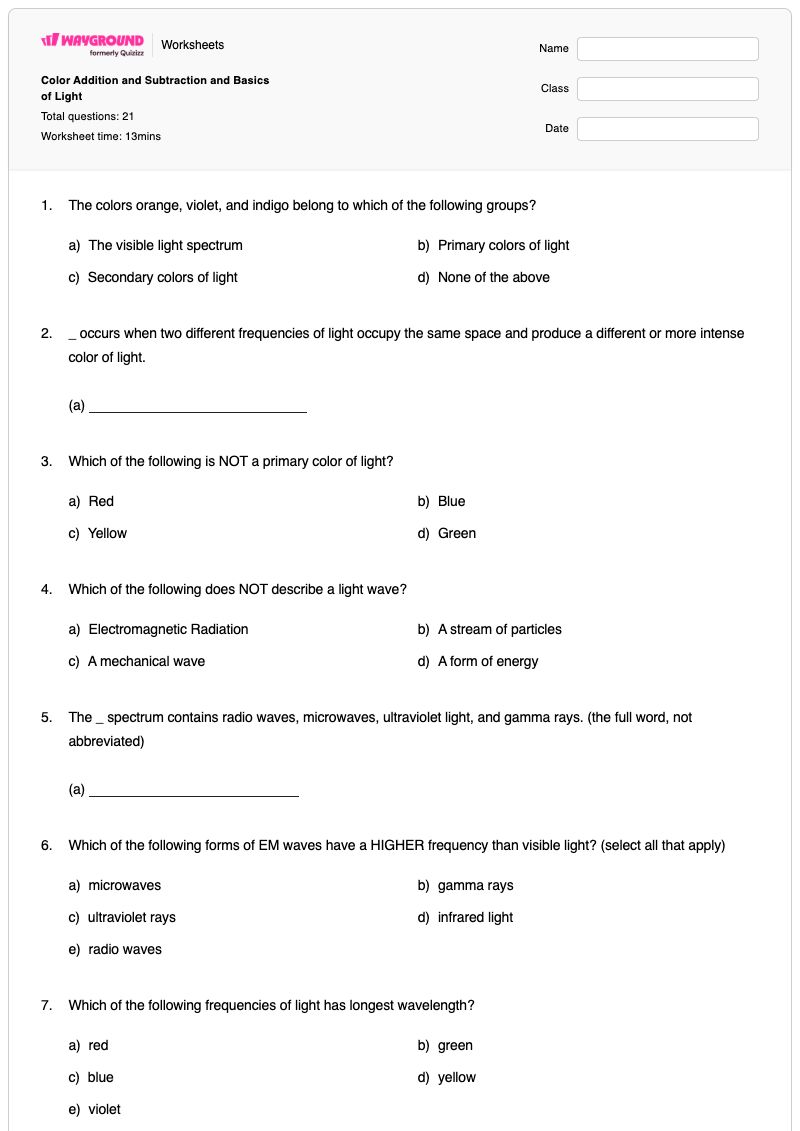
Color Addition and Subtraction and Basics of Light

คำถามทั้งหมด: 21

ชื่อ
ระดับ
วันที่
1.

The colors orange, violet, and indigo belong to which of the following groups?

a)

The visible light spectrum

b)

Primary colors of light

c)

Secondary colors of light

d)

None of the above

2.

_ occurs when two different frequencies of light occupy the same space and produce a different or more intense color of light.

(a)  

3.

Which of the following is NOT a primary color of light?

a)

Red

b)

Blue

c)

Yellow

d)

Green

4.

Which of the following does NOT describe a light wave?

a)

Electromagnetic Radiation

b)

A stream of particles

c)

A mechanical wave

d)

A form of energy

5.

The _ spectrum contains radio waves, microwaves, ultraviolet light, and gamma rays. (the full word, not abbreviated)

(a)  

6.

Which of the following forms of EM waves have a HIGHER frequency than visible light? (select all that apply)

a)

microwaves

b)

gamma rays

c)

ultraviolet rays

d)

infrared light

e)

radio waves

7.

Which of the following frequencies of light has longest wavelength?

a)

red

b)

green

c)

blue

d)

yellow

e)

violet

8.

Which of the following carries the highest amount of energy?

a)

X-rays

b)

UV-rays

c)

radio waves

d)

microwaves

e)

blue light

9.

_ light is the result of blue, red, and green light being added together.

(a)  

10.

When a blue and red spotlight are shined on actor wearing white ghost costume, what color does the audience see?

a)

cyan

b)

magenta

c)

yellow

d)

violet

e)

green

11.

White light is shined through a magenta filter. Which of the following will be BLOCKED by the filter? (choose all that apply)

a)

Red

b)

Blue

c)

Green

d)

Magenta

12.

White light is shined through a blue filter. Which of the following will be BLOCKED by the filter? (choose all that apply)

a)

Red

b)

Blue

c)

Green

d)

Cyan

e)

Magenta

13.

A white light is shined through a cyan filter, and then a magenta filter. What color will appear?

a)

blue

b)

green

c)

red

d)

black

14.

A white light is shined through a cyan filter, and then a yellow filter. What color will appear?

a)

blue

b)

green

c)

red

d)

black

15.

A white light is shined through a blue filter, and then a yellow filter. What color will appear?

a)

blue

b)

green

c)

red

d)

black

16.

A magenta light and a green light are shined in the same space. What color will they form?

a)

Red

b)

Cyan

c)

Yellow

d)

Blue

e)

White

17.

Which of the following filters could be used together to block out all light?

a)

Blue

b)

Magenta

c)

Red

18.

A white light shined through a red filter is shined toward a blank space. If a green light is also shined on that space, what color will result?

a)

yellow

b)

magenta

c)

cyan

d)

red

e)

green

19.

Which two filters could be combined to make a white light appear red?

a)

blue

b)

cyan

c)

magenta

d)

yellow

e)

green

20.

A white light is shined through magenta and green filters on a spot, and then a blue light is also shined on the spot. What color will appear at the spot?

a)

blue

b)

red

c)

green

d)

cyan

e)

magenta

21.

Which of the following describes how we see an object outdoors?

a)

Light goes from our eyes, then bounces off an object, and reaches the sun

b)

Light goes from the sun, into our eyes, and then onto an object

c)

Light comes from the sun, bounces off an object, and then into our eyes

d)

Light travels from an object to the sun, and then into our eyes

แป้นคำตอบ

Color Addition and Subtraction and Basics of Light

คำถามทั้งหมด: 21

1.
a)

The visible light spectrum

2.
Color Addition, Addition, Addition of Light, Interference, Light Addition
3.
c)

Yellow

4.
c)

A mechanical wave

5.
electromagnetic, electro magnetic
6.
c)

ultraviolet rays

, b)

gamma rays

7.
a)

red

8.
a)

X-rays

9.
White, White light
10.
b)

magenta

11.
c)

Green

12.
c)

Green

, a)

Red

13.
a)

blue

14.
b)

green

15.
d)

black

16.
e)

White

17.
a)

Blue

, c)

Red

18.
a)

yellow

19.
c)

magenta

, d)

yellow

20.
a)

blue

21.
c)

Light comes from the sun, bounces off an object, and then into our eyes

คำถามที่พบบ่อย

แบบฝึกหัดนี้ครอบคลุมเนื้อหาอะไรบ้างเกี่ยวกับการบวกสีและแสง?

แบบฝึกหัดฟิสิกส์สำหรับนักเรียนระดับชั้น ม.3-ม.6 นี้ ใช้คำถามแบบเลือกตอบ เติมคำในช่องว่าง และเลือกคำตอบที่ถูกต้อง เพื่อประเมินความเข้าใจเกี่ยวกับการบวกสี สเปกตรัมแม่เหล็กไฟฟ้า และความสัมพันธ์ระหว่างความถี่แสง ความยาวคลื่น และพลังงาน นอกจากนี้ นักเรียนยังจะได้ทำนายสีที่เกิดขึ้นเมื่อแสงสีแดง สีน้ำเงิน และสีเขียวรวมกัน และเมื่อแสงสีขาวผ่านตัวกรองสีม่วงแดง สีน้ำเงิน สีฟ้า และสีเหลือง

ฉันจะใช้แบบฝึกหัดนี้สอนเรื่องการบวกสีและตัวกรองแสงได้อย่างไร?

แนะนำสเปกตรัมแม่เหล็กไฟฟ้าและช่วงแสงที่มองเห็นได้ก่อนที่นักเรียนจะทำแบบฝึกหัดเปรียบเทียบความถี่ ความยาวคลื่น และพลังงาน จากนั้นสาธิตการบวกสี RGB และให้นักเรียนอธิบายสถานการณ์ตัวกรองแต่ละแบบโดยระบุว่าสีใดถูกปิดกั้น ใช้ตัวกรองแบบหลายชั้นเป็นหัวข้อในการสนทนาก่อนที่จะมอบหมายแบบฝึกหัดให้นักเรียนทำด้วยตนเอง

ฉันควรสังเกตข้อผิดพลาดอะไรบ้างเมื่อนักเรียนทำแบบฝึกหัดเรื่องง่ายๆ นี้เสร็จ?

ระวังนักเรียนที่สับสนระหว่างสเปกตรัมแสงที่มองเห็นได้กับสเปกตรัมแม่เหล็กไฟฟ้าทั้งหมด หรือสลับความสัมพันธ์ระหว่างความยาวคลื่น ความถี่ และพลังงาน ในคำถามเกี่ยวกับตัวกรองแบบเลือกหลายตัวเลือก นักเรียนอาจเลือกสีที่ผ่านตัวกรองแทนที่จะเลือกสีที่ถูกตัวกรองปิดกั้น และในข้อสอบแบบใช้ตัวกรองหลายชั้น นักเรียนอาจหยุดที่ตัวกรองชั้นแรกแทนที่จะพิจารณาตัวกรองทั้งสองชั้น

ฉันจะมอบหมายและให้คะแนนแบบฝึกหัดการบวกสีและแสงนี้อย่างไร?

แบบฝึกหัดนี้มีให้ดาวน์โหลดในรูปแบบ PDF สำหรับพิมพ์ และเป็นแบบทดสอบดิจิทัลบน Wayground โดยมีเฉลยคำตอบครบถ้วนสำหรับตรวจสอบคำตอบแบบเลือกตอบ เติมคำในช่องว่าง และเลือกหลายข้อ นอกจากนี้ ยังสามารถตรวจงานของนักเรียนได้โดยการสแกนงานของนักเรียนด้วยแอป Wayground for Teachers

ฉันจะปรับแบบฝึกหัดนี้ให้เหมาะสมกับนักเรียนของฉันได้อย่างไร?

ใช้การตั้งค่าขั้นสูงของแบบฝึกหัดเพื่อปรับระยะห่างระหว่างตัวอักษรและขนาดตัวอักษร ซึ่งจะทำให้คำถามเกี่ยวกับสเปกตรัมและตัวกรองอ่านง่ายขึ้น นอกจากนี้ คุณยังสามารถใช้แบบอักษรที่เหมาะสำหรับผู้ที่มีภาวะดิสเล็กเซีย หรือแปลแบบฝึกหัดเป็นภาษาอื่นเมื่อเหมาะสมกับผู้เรียนของคุณได้

ฉันจะหาแบบฝึกหัดแบบนี้เพิ่มเติมได้ที่ไหนบน Wayground?

Wayground นำเสนอชุดแบบฝึกหัดและโจทย์ฝึกหัดฟรีที่ครอบคลุมทุกวิชา พร้อมไฟล์ PDF และเฉลยคำตอบ เพื่อช่วยให้นักเรียนเชี่ยวชาญทักษะและแนวคิดที่สำคัญ ดูแหล่งข้อมูลเพิ่มเติมได้ที่ https://wayground.com/en-us/worksheets