

Wayground
Causes of World War 1 - Printable สังคมศึกษา Worksheets 10th ระดับชั้น - Wayground

Causes of World War 1

Adam Villeneuve

สร้างโดย Adam Villeneuve

22 คำถาม

10th ระดับชั้น

สังคมศึกษา

อัปเดตแล้ว พ.ค. 2569

สาเหตุของสงครามโลกครั้งที่ 1 เป็นแบบฝึกหัดวิชาสังคมศึกษาสำหรับนักเรียนชั้นมัธยมศึกษาปีที่ 4 ที่ช่วยให้นักเรียนระบุและอธิบายปัจจัยสำคัญที่อยู่เบื้องหลังความขัดแย้ง นักเรียนจะได้ทบทวนเรื่องลัทธิทหารนิยม พันธมิตร จักรวรรดินิยม และชาตินิยม เชื่อมโยงการลอบสังหารอาร์ชดยุคเฟอร์ดินานด์กับการประกาศสงครามของออสเตรีย-ฮังการีต่อเซอร์เบีย และแยกแยะคำศัพท์ที่เกี่ยวข้อง เช่น ความเป็นกลางและพันธมิตร แบบฝึกหัดนี้มี 22 ข้อ: 19 ข้อเป็นแบบเลือกตอบ และ 3 ข้อเป็นแบบเลือกตอบหลายข้อ นักเรียนจะได้ระบุสมาชิกของกลุ่มพันธมิตรสามฝ่ายและกลุ่มพันธมิตรสามฝ่าย ตระหนักถึงวิธีการที่ระบบพันธมิตรขยายความขัดแย้ง และนำคำศัพท์ไปใช้กับตัวอย่าง เช่น การแข่งขันเพื่อแย่งชิงอาณานิคม แบบฝึกหัดที่พิมพ์ได้ฟรีนี้มีเฉลยคำตอบครบถ้วนสำหรับการทบทวน การฝึกฝนด้วยตนเอง หรือการประเมินผลอย่างมีประสิทธิภาพ

การตั้งค่าแผ่นงาน

ขนาดตัวอักษร

S
M
L
XL
Waygroundแผ่นงาน

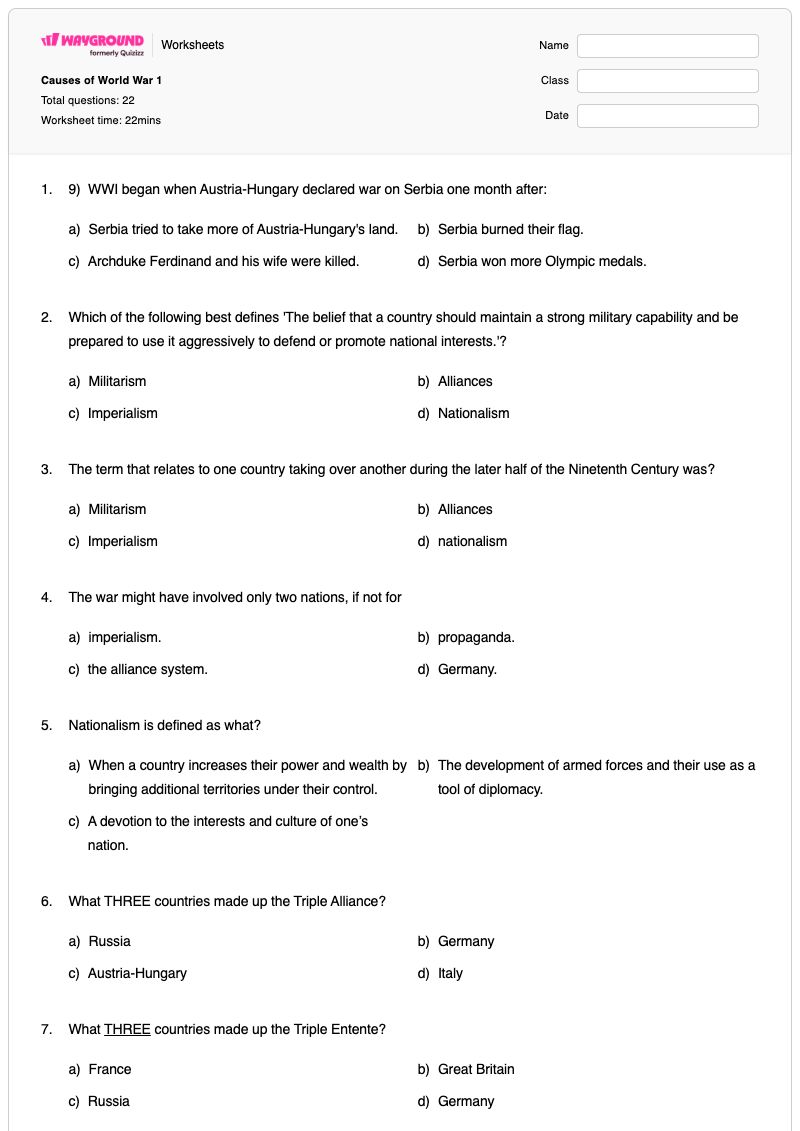
Causes of World War 1

คำถามทั้งหมด: 22

ชื่อ
ระดับ
วันที่
1.
9)  WWI began when Austria-Hungary declared war on Serbia one month after:
a)
Serbia tried to take more of Austria-Hungary's land.
b)
Serbia burned their flag.
c)
Archduke Ferdinand and his wife were killed.
d)
Serbia won more Olympic medals.
2.

Which of the following best defines 'The belief that a country should maintain a strong military capability and be prepared to use it aggressively to defend or promote national interests.'?

a)

Militarism

b)

Alliances

c)

Imperialism

d)

Nationalism

3.

The term that relates to one country taking over another during the later half of the Ninetenth Century was?

a)

Militarism

b)

Alliances

c)

Imperialism

d)

nationalism

4.
The war might have involved only two nations, if not for
a)
imperialism.
b)
propaganda.
c)
the alliance system.
d)
Germany.
5.

Nationalism is defined as what?

a)

When a country increases their power and wealth by bringing additional territories under their control.

b)

The development of armed forces and their use as a tool of diplomacy.

c)

A devotion to the interests and culture of one’s nation.

6.

What THREE countries made up the Triple Alliance?

a)

Russia

b)

Germany

c)

Austria-Hungary

d)

Italy

7.

What THREE countries made up the Triple Entente?

a)

France

b)

Great Britain

c)

Russia

d)

Germany

8.

Select all that apply: Which of the following are causes of World War I?

a)

Militarism

b)

Alliances

c)

Nationalism

d)

Imperialism

e)

Religion

9.
A union of two or more groups

A union of two or more groups

a)

Militarism

b)

Alliance

c)

Imperialism

d)

Nationalism

10.
A position of not taking sides in a conflict

A position of not taking sides in a conflict

a)

Neutrality

b)

Propaganda

c)

Rationing

d)

Trench Warfare

11.

Which of the following is the best example of imperialism?

a)

France building a powerful navy

b)

England's alliance with France

c)

German schools teaching English

d)

England and Germany competing for colonies

12.

Another name for the Allied Powers was the ________________________.

a)

Quadruple Alliance

b)

Triple Alliance

c)

Triple Entente

d)

Democratic Alliance

13.

Great Britain, France, Russia and eventually the U.S. made up which alliance?

a)

Axis Powers

b)

Central Powers

c)

Western Powers

d)

Allied Powers

14.

A feeling of intense loyalty to a country or group

a)

Nationalism

b)

Militarism

c)

Propaganda

d)

Autocracy

15.
A policy in which a strong nation seeks to dominate other countries politically, economically, or socially.
a)
Armistice
b)
Militarism
c)
Nationalism
d)
Imperialism
16.

Why was Franz Ferdinand killed?

a)

Serbian nationalists hoped to provoke Russia into supporting Serbs in the Austro-Hungarian Empire.

b)

The Emperor of the Austro-Hungarian Empire disliked him and wanted him dead.

c)

The Ottoman Empire wanted revenge for Serbia achieving independence.

d)

Russians hoped that they could take over Austro-Hungarian territory through war.

17.

Which response best describes how imperialism helped expand and accelerate the war?

a)

Many of the warring countries wanted to gain economic and strategic advantages.

b)

Countries wanted to expand by taking territory from each other in different parts of Europe.

c)

The Alliance wanted to seize the territories and resources of the Entente.

d)

The Entente wanted to seize the territories and resources of the Alliance.

18.

How did industrialization affect the war?

a)

New industrial technologies improved diplomatic relations.

b)

New industrial technologies made it easier for people to flee the violence.

c)

New industrial technologies made war harder to reverse.

d)

New industrial technologies vastly improved healthcare for war victims.

19.

How did European powers’ experience with imperialism influence their attitude toward the war?

a)

It made them anxious.

b)

It made them apologetic.

c)

It intimidated them.

d)

It emboldened them.

20.

Why was the choice Austria gave Serbia so important?

a)

The many demands of Austria’s ultimatum were so harsh that war was really the only option.

b)

The Austro-Hungarian Empire set a realistic choice for Serbia.

c)

The choice was a lenient way to punish Serbia for Franz Ferdinand’s death.

d)

The choice meant Serbia would seek Germany’s help in a potential war.

21.

Why did Austria wait a month to issue the ultimatum?

a)

They wanted to make sure Germany could support them if a war started.

b)

The Emperor did not like Franz Ferdinand, so he did not care if he died.

c)

They wanted Russia to mobilize before issuing the ultimatum.

d)

They did not know how to react to Franz Ferdinand’s death.

22.

How might the First World War have happened by accident?

a)

The Russian and Austro-Hungarian Empires started the war over a misunderstanding.

b)

Franz Ferdinand was killed by mistake and the diplomatic escalation led to war.

c)

Countries were quick to adopt new communications technologies, making diplomacy more vulnerable to misinformation.

d)

Governments could not keep up diplomatic relations and communications at the pass the conflict was moving.

Waygroundแป้นคำตอบ

Causes of World War 1

คำถามทั้งหมด: 22

1.
c) Archduke Ferdinand and his wife were killed.
2.
a)

Militarism

3.
c)

Imperialism

4.
c) the alliance system.
5.
c)

A devotion to the interests and culture of one’s nation.

6.
b)

Germany

, c)

Austria-Hungary

, d)

Italy

7.
a)

France

, b)

Great Britain

, c)

Russia

8.
a)

Militarism

, b)

Alliances

, c)

Nationalism

, d)

Imperialism

9.
b)

Alliance

10.
a)

Neutrality

11.
d)

England and Germany competing for colonies

12.
c)

Triple Entente

13.
d)

Allied Powers

14.
a)

Nationalism

15.
d) Imperialism
16.
a)

Serbian nationalists hoped to provoke Russia into supporting Serbs in the Austro-Hungarian Empire.

17.
a)

Many of the warring countries wanted to gain economic and strategic advantages.

18.
c)

New industrial technologies made war harder to reverse.

19.
d)

It emboldened them.

20.
a)

The many demands of Austria’s ultimatum were so harsh that war was really the only option.

21.
a)

They wanted to make sure Germany could support them if a war started.

22.
d)

Governments could not keep up diplomatic relations and communications at the pass the conflict was moving.

คำถามที่พบบ่อย

แบบฝึกหัดเรื่องสาเหตุของสงครามโลกครั้งที่ 1 ครอบคลุมเนื้อหาอะไรบ้าง?

แบบฝึกหัดวิชาสังคมศึกษาสำหรับนักเรียนชั้นมัธยมศึกษาปีที่ 4 นี้ ประกอบด้วยคำถามแบบเลือกตอบ 19 ข้อ และคำถามแบบเลือกคำตอบ 3 ข้อ เพื่อประเมินความเข้าใจของนักเรียนเกี่ยวกับลัทธิทหาร พันธมิตร จักรวรรดินิยม และชาตินิยม ในฐานะสาเหตุของสงครามโลกครั้งที่ 1 นอกจากนี้ยังให้นักเรียนระบุกลุ่มพันธมิตรสามฝ่าย (Triple Alliance) และกลุ่มพันธมิตรสามฝ่าย (Triple Entente) เชื่อมโยงการลอบสังหารอาร์ชดยุคเฟอร์ดินานด์กับการปะทุของสงคราม และแยกแยะความแตกต่างระหว่างคำต่างๆ เช่น ความเป็นกลางและพันธมิตร

ฉันจะใช้แบบฝึกหัดนี้ในการสอนเรื่องสาเหตุของสงครามโลกครั้งที่หนึ่งได้อย่างไร?

แนะนำสาเหตุหลักสี่ประการ ได้แก่ ลัทธิทหารนิยม พันธมิตร จักรวรรดินิยม และชาตินิยม ก่อนที่นักเรียนจะทำแบบฝึกหัดคำศัพท์และคำจำกัดความ จากนั้นใช้สื่อเกี่ยวกับพันธมิตรสามฝ่ายและกลุ่มพันธมิตรสามฝ่ายเพื่อให้นักเรียนวาดแผนผังกลุ่มพันธมิตรและอภิปรายว่าระบบพันธมิตรสามารถขยายความขัดแย้งได้อย่างไรหลังจากที่ออสเตรีย-ฮังการีประกาศสงครามกับเซอร์เบีย

ฉันควรระวังข้อผิดพลาดอะไรบ้างเมื่อนักเรียนทำแบบฝึกหัดเกี่ยวกับสงครามโลกครั้งที่หนึ่งนี้?

นักเรียนอาจสับสนระหว่างลัทธิทหารนิยม ลัทธิจักรวรรดินิยม ลัทธิชาตินิยม และพันธมิตร เพราะคำศัพท์เหล่านี้อธิบายถึงแนวคิดที่เกี่ยวข้องกันแต่แตกต่างกัน ในข้อสอบแบบเลือกตอบหลายข้อ ให้ระวังการเลือกสมาชิกภาพในพันธมิตรสามฝ่ายและกลุ่มพันธมิตรสามฝ่ายที่ไม่ครบถ้วนหรือไม่ถูกต้อง และการเลือกศาสนาเป็นสาเหตุเมื่อแบบฝึกหัดระบุถึงลัทธิทหารนิยม พันธมิตร ลัทธิชาตินิยม และลัทธิจักรวรรดินิยม นอกจากนี้ นักเรียนอาจมองข้ามไปว่าการลอบสังหารอาร์ชดยุคเฟอร์ดินานด์เกิดขึ้นก่อนที่ออสเตรีย-ฮังการีจะประกาศสงครามกับเซอร์เบีย

ฉันจะมอบหมายและตรวจงานแบบฝึกหัดเรื่องสาเหตุของสงครามโลกครั้งที่ 1 นี้อย่างไร?

Wayground จัดเตรียมแบบฝึกหัดนี้ในรูปแบบไฟล์ PDF ที่สามารถพิมพ์ได้ และในรูปแบบแบบทดสอบดิจิทัล พร้อมเฉลยคำตอบครบถ้วนสำหรับคำถามทั้ง 22 ข้อ คุณสามารถตรวจสอบคำตอบแบบเลือกตอบหลายข้อและแบบเลือกคำตอบที่ถูกต้องได้โดยใช้เฉลย และสามารถตรวจงานส่งของนักเรียนที่พิมพ์ออกมาได้โดยการสแกนงานของนักเรียนด้วยแอป Wayground for Teachers

ฉันจะปรับแบบฝึกหัดเรื่องสาเหตุของสงครามโลกครั้งที่ 1 นี้ให้เหมาะสมกับนักเรียนของฉันได้อย่างไร?

ใช้การตั้งค่าขั้นสูงของแบบฝึกหัดเพื่อปรับระยะห่างระหว่างตัวอักษรและขนาดตัวอักษรสำหรับคำจำกัดความ คำถามเกี่ยวกับพันธมิตร และรายการแบบเลือกหลายข้อ นอกจากนี้ คุณยังสามารถเปิดใช้งานแบบอักษรที่เหมาะสำหรับผู้ที่มีภาวะดิสเล็กเซีย หรือแปลแบบฝึกหัดเป็นภาษาอื่นเมื่อนักเรียนต้องการแบบฝึกหัดเกี่ยวกับสงครามโลกครั้งที่ 1 ที่เข้าถึงได้ง่ายกว่า

ฉันจะหาแบบฝึกหัดแบบนี้เพิ่มเติมได้ที่ไหนบน Wayground?

Wayground นำเสนอชุดแบบฝึกหัดและโจทย์ฝึกหัดฟรีที่ครอบคลุมทุกวิชา พร้อมไฟล์ PDF และเฉลยคำตอบ เพื่อช่วยให้นักเรียนเชี่ยวชาญทักษะและแนวคิดที่สำคัญ ดูแหล่งข้อมูลเพิ่มเติมได้ที่ https://wayground.com/en-us/worksheets