

Wayground
7th Grade Summative #5 History of Earth Review - Printable ศาสตร์ Worksheets ระดับ 7 - Wayground

7th Grade Summative #5 History of Earth Review

Julie Hladky

สร้างโดย Julie Hladky

21 คำถาม

7th ระดับชั้น

ศาสตร์

อัปเดตแล้ว ก.ย. 2568

แบบฝึกหัดทบทวนวิชาประวัติศาสตร์โลก ชั้นมัธยมศึกษาปีที่ 7 ชุดที่ 5 นี้ ครอบคลุมทักษะวิทยาศาสตร์โลก 3 หัวข้อที่เชื่อมโยงกัน ได้แก่ การระบุขั้นตอนและวัสดุในวัฏจักรหิน การอธิบายการกัดเซาะและสาเหตุ และการอธิบายการเคลื่อนตัวของทวีปโดยใช้หลักฐานจากฟอสซิลและหิน นักเรียนจะต้องตีความส่วนประกอบของวัฏจักรหินที่ระบุไว้ แยกแยะแมกมาออกจากลาวา อธิบายว่าทำไมวัฏจักรหินจึงทำให้เกิดการเปลี่ยนแปลงหลายอย่าง ระบุตัวการกัดเซาะ และประเมินว่าลมมีผลต่อหินอย่างไร แบบฝึกหัดนี้ประกอบด้วยคำถาม 21 ข้อ: คำถามแบบเลือกตอบ 12 ข้อ คำถามแบบเลือกคำตอบหลายข้อ 1 ข้อ และคำถามปลายเปิด 8 ข้อ ส่วนคำถามแบบเขียนตอบนั้น นักเรียนจะต้องอธิบายการเคลื่อนตัวของทวีป อธิบายว่าทวีปต่างๆ เคยอยู่ในตำแหน่งใดก่อนที่จะเคลื่อนไปยังตำแหน่งปัจจุบัน และใช้ฟอสซิลและหินเป็นหลักฐาน แบบฝึกหัดนี้สามารถพิมพ์ได้ฟรี พร้อมเฉลย เหมาะสำหรับการทบทวน การประเมินผลระหว่างเรียน หรือการตรวจสอบความเข้าใจในชั้นมัธยมศึกษาปีที่ 7

การตั้งค่าแผ่นงาน

ขนาดตัวอักษร

S
M
L
XL
Waygroundแผ่นงาน

7th Grade Summative #5 History of Earth Review

คำถามทั้งหมด: 21

ชื่อ
ระดับ
วันที่
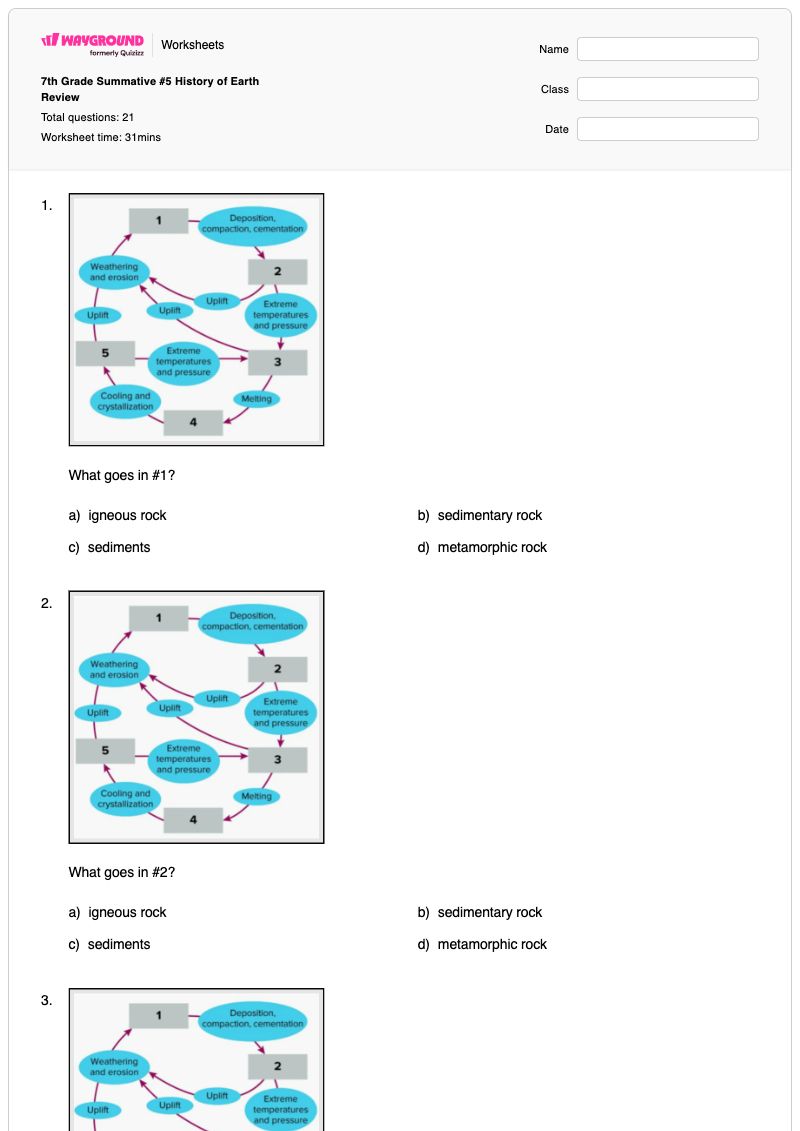
1.
What goes in #1?

What goes in #1?

a)

igneous rock

b)

sedimentary rock

c)

sediments

d)

metamorphic rock

2.
What goes in #2?

What goes in #2?

a)

igneous rock

b)

sedimentary rock

c)

sediments

d)

metamorphic rock

3.
What goes in #3?

What goes in #3?

a)

igneous rock

b)

sedimentary rock

c)

sediments

d)

metamorphic rock

4.
What goes in #4?

What goes in #4?

a)

igneous rock

b)

sedimentary rock

c)

magma

d)

metamorphic rock

5.
What goes in #5?

What goes in #5?

a)

igneous rock

b)

sedimentary rock

c)

magma

d)

metamorphic rock

6.

Why is the rock cycle not just a circle?

a)

Each rock type can only turn into 1other type of rock.

b)

The different types of rock can turn into each other.

c)

It looks better not just being a circle.

7.

What is the molten material deep inside Earth from which igneous rocks form?

a)

magma

b)

lava

c)

sediments

d)

water

8.

What is the molten material that flows on Earth's surface?

a)

magma

b)

lava

c)

sediments

d)

water

9.

What are the major causes of erosion? (choose multiple answers)

a)

wind

b)

water

c)

ice/glaciers

d)

humans

e)

plants

10.

How does wind cause erosion?

a)

The wind swirls and picks up other rocks.

b)

The wind moves over the rocks and causes erosion.

c)

The small particles that are carried by wind hit against other rocks and break piece off.

11.

Harder rocks will erode faster than softer rocks.

a)

true

b)

false

12.

Explain the theory of continental drift.

4 เส้น
13.

How were the continents once positioned before they moved to their current locations?

4 เส้น
14.

Explain how fossils can be used as evidence of the Theory of Continental Drift.

4 เส้น
15.

Explain how rocks can be used as evidence of the Theory of Continental Drift.

4 เส้น
16.

Explain how glaciers can be used as evidence of the Theory of Continental Drift.

4 เส้น
17.

Explain how seafloor spreading can be used as evidence of the Theory of Continental Drift.

4 เส้น
18.

What timescale would be appropriate to use to describe the movements of the continents.

a)

catastrophic global change over a small time scale

b)

local change over a very large time scale

c)

planetary scale change over a very large time scale

d)

regional change over a small time scale

19.

What is the pattern of the age of the sea floor compared to the boundaries of the plates?

a)

the oldest seafloor is at the boundaries of the plates

b)

the newest seafloor is at the boundaries of the plates

c)

the newest seafloor is in the middle of the plates

20.

How does seafloor spreading cause the tectonic plates to move around the Earth?

4 เส้น
21.
Use the map for evidence. Why do events such as earthquakes and volcanoes usually occur on the west coast of the United…

Use the map for evidence. Why do events such as earthquakes and volcanoes usually occur on the west coast of the United States rather than the ease coast of the United States?

4 เส้น
Waygroundแป้นคำตอบ

7th Grade Summative #5 History of Earth Review

คำถามทั้งหมด: 21

1.
c)

sediments

2.
b)

sedimentary rock

3.
d)

metamorphic rock

4.
c)

magma

5.
a)

igneous rock

6.
b)

The different types of rock can turn into each other.

7.
a)

magma

8.
b)

lava

9.
a)

wind

, b)

water

, c)

ice/glaciers

, d)

humans

10.
c)

The small particles that are carried by wind hit against other rocks and break piece off.

11.
b)

false

12.
ไม่มี
13.
ไม่มี
14.
ไม่มี
15.
ไม่มี
16.
ไม่มี
17.
ไม่มี
18.
c)

planetary scale change over a very large time scale

19.
b)

the newest seafloor is at the boundaries of the plates

20.
ไม่มี
21.
ไม่มี

คำถามที่พบบ่อย

แบบฝึกหัดทบทวนประวัติศาสตร์โลกสำหรับนักเรียนชั้นมัธยมศึกษาปีที่ 7 ครอบคลุมเนื้อหาอะไรบ้าง?

แบบฝึกหัดวิทยาศาสตร์สำหรับนักเรียนชั้น ม.1 นี้ครอบคลุมเรื่องการเปลี่ยนแปลงของวัฏจักรหิน การกัดเซาะ และการเคลื่อนตัวของทวีป แบบฝึกหัด 21 ข้อประกอบด้วยคำถามแบบเลือกตอบเกี่ยวกับวัฏจักรหิน คำถามแบบเลือกตอบเกี่ยวกับสาเหตุของการกัดเซาะ และคำถามปลายเปิดที่ต้องการให้นักเรียนอธิบายการเคลื่อนตัวของทวีปและประเมินฟอสซิลและหินในฐานะหลักฐาน

ฉันจะใช้แบบฝึกหัดนี้ในการสอนเรื่องวัฏจักรของหินและการเคลื่อนตัวของทวีปได้อย่างไร?

เริ่มจากการให้นักเรียนระบุตะกอน หินตะกอน หินแปร หินหนืด และหินอัคนี จากนั้นอภิปรายว่าทำไมหินจึงสามารถเปลี่ยนเป็นหินประเภทต่างๆ ได้ แทนที่จะเปลี่ยนแปลงไปตามเส้นทางเดียวเท่านั้น ต่อด้วยคำถามเกี่ยวกับการกัดเซาะ และคำถามปลายเปิดเกี่ยวกับการเคลื่อนตัวของทวีป โดยขอให้นักเรียนสนับสนุนคำอธิบายของตนเองด้วยหลักฐานจากฟอสซิลและหิน

ฉันควรระวังข้อผิดพลาดอะไรบ้างในแบบฝึกหัดทบทวนประวัติศาสตร์โลกนี้?

ระวังนักเรียนอาจสับสนระหว่างแมกมา ซึ่งเป็นวัสดุหลอมเหลวภายในโลก กับลาวา ซึ่งไหลอยู่บนพื้นผิวโลก หรือมองวัฏจักรของหินเป็นลำดับเหตุการณ์แบบทิศทางเดียว ในส่วนของการกัดเซาะ นักเรียนอาจเลือกสาเหตุน้อยเกินไป หรือมองข้ามไปว่าการกัดเซาะโดยลมเกี่ยวข้องกับอนุภาคที่พุ่งชนและทำให้หินแตกเป็นชิ้นๆ ในส่วนคำถามปลายเปิด ตรวจสอบว่าคำตอบอธิบายว่าฟอสซิลและหินสนับสนุนการเคลื่อนตัวของทวีปอย่างไร แทนที่จะเพียงแค่เอ่ยชื่อพวกมัน

ฉันจะมอบหมายและให้คะแนนแบบฝึกหัดประวัติศาสตร์โลกนี้อย่างไร?

บน Wayground คุณสามารถมอบหมายแบบฝึกหัดนี้ในรูปแบบไฟล์ PDF ที่พิมพ์ได้ หรือเป็นแบบทดสอบดิจิทัล และใช้เฉลยคำตอบทั้งหมดเพื่อตรวจสอบคำตอบแบบเลือกตอบ เลือกหลายข้อ และคำตอบแบบปลายเปิด สำหรับแบบฝึกหัดที่พิมพ์ได้ สามารถตรวจให้คะแนนได้โดยการสแกนงานของนักเรียนด้วยแอป Wayground for Teachers

ฉันจะปรับแบบฝึกหัดนี้ให้เหมาะสมกับนักเรียนของฉันได้อย่างไร?

สำหรับตัวเลือกเกี่ยวกับวัฏจักรหินที่มีป้ายกำกับ และคำตอบแบบปลายเปิดเกี่ยวกับการเคลื่อนตัวของทวีป ให้ใช้การตั้งค่าขั้นสูงของแบบฝึกหัดเพื่อปรับระยะห่างระหว่างตัวอักษรและขนาดตัวอักษรเพื่อให้ง่ายต่อการอ่าน นอกจากนี้ คุณยังสามารถเปิดใช้งานแบบอักษรที่เป็นมิตรกับผู้ที่มีภาวะดิสเล็กเซีย หรือแปลแบบฝึกหัดเป็นภาษาอื่นได้ หากนั่นช่วยเหลือนักเรียนที่กำลังเรียนรู้คำศัพท์ทางวิทยาศาสตร์เกี่ยวกับโลกได้ดียิ่งขึ้น

ฉันจะหาแบบฝึกหัดแบบนี้เพิ่มเติมได้ที่ไหนบน Wayground?

Wayground มีแบบฝึกหัดและโจทย์ฝึกหัดมากมายให้ดาวน์โหลดฟรีในหลากหลายวิชา พร้อมไฟล์ PDF และเฉลยคำตอบ เพื่อช่วยเสริมสร้างทักษะและความเข้าใจในเนื้อหาสำคัญ ดูแหล่งข้อมูลเพิ่มเติมได้ที่ https://wayground.com/en-us/worksheets