

Wayground
The Role of the Media CE.5c/10a - Printable สังคมศึกษา Worksheets ระดับ 6 - Wayground

The Role of the Media CE.5c/10a

Sharon Kitchin

สร้างโดย Sharon Kitchin

20 คำถาม

6th - 8th ระดับชั้น

สังคมศึกษา

อัปเดตแล้ว มี.ค. 2569

บทบาทของสื่อ CE.5c/10a เป็นแบบฝึกหัดฟรีสำหรับวิชาสังคมศึกษา ระดับชั้น ป.6-ม.2 ที่ศึกษาว่าสื่อมวลชนมีอิทธิพลต่อการเลือกตั้ง ความคิดเห็นสาธารณะ และความรับผิดชอบของรัฐบาลอย่างไร นักเรียนจะได้ระบุรูปแบบของสื่อมวลชน จับคู่ประเภทของสื่อกับตัวอย่าง นิยามอคติและการโฆษณาชวนเชื่อ และอธิบายวัตถุประสงค์ของบทความแสดงความคิดเห็น บทบรรณาธิการ การ์ตูนการเมือง โพสต์ในโซเชียลมีเดีย และข้อความสื่ออื่นๆ นอกจากนี้ พวกเขายังจะได้ประเมินว่าผู้มีสิทธิเลือกตั้งสามารถประเมินสุนทรพจน์หาเสียง เอกสาร และโฆษณาต่างๆ ได้อย่างไร โดยการแยกข้อเท็จจริงออกจากความคิดเห็น ตรวจสอบแหล่งที่มา และตระหนักถึงอคติและการโฆษณาชวนเชื่อ แบบฝึกหัด 20 ข้อนี้ผสมผสานการลากและวาง การจับคู่ และคำถามแบบเลือกตอบ ทำให้ผู้เรียนได้ฝึกฝนการเชื่อมโยงการกระทำของสื่อกับผลกระทบต่อกระบวนการทางการเมือง แบบฝึกหัดนี้มีประโยชน์สำหรับการแนะนำหรือทบทวนความรู้ด้านสื่อและการมีส่วนร่วมของพลเมืองในระดับมัธยมต้น แบบฝึกหัดนี้มีเฉลยคำตอบครบถ้วนและสามารถดาวน์โหลดเป็นไฟล์ PDF ฟรีเพื่อใช้ในการฝึกฝนในห้องเรียน การทำงานอิสระ หรือการประเมินผล

การตั้งค่าแผ่นงาน

ขนาดตัวอักษร

S
M
L
XL
Waygroundแผ่นงาน

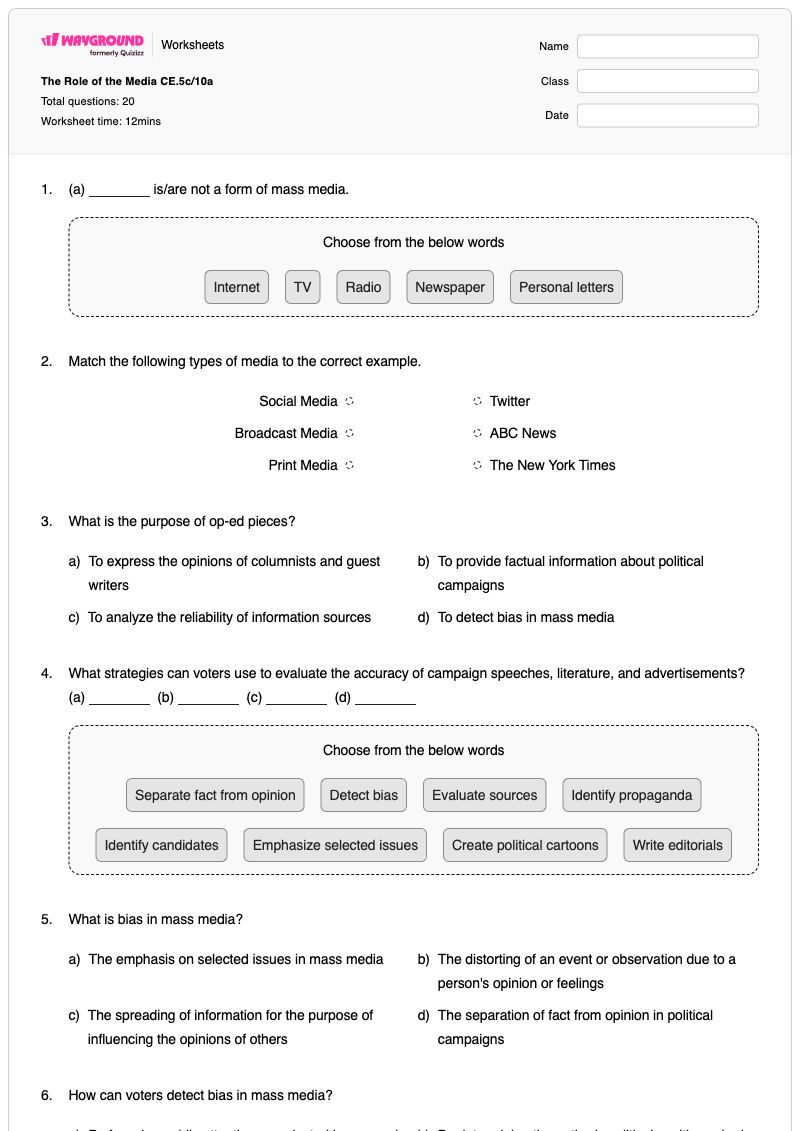
The Role of the Media CE.5c/10a

คำถามทั้งหมด: 20

ชื่อ
ระดับ
วันที่
1.

(a)   is/are not a form of mass media.

เลือกจากคำด้านล่าง
Internet
TV
Radio
Newspaper
Personal letters
2.

Match the following types of media to the correct example.

Social Media

Twitter

Broadcast Media

ABC News

Print Media

The New York Times

3.

What is the purpose of op-ed pieces?

a)

To express the opinions of columnists and guest writers

b)

To provide factual information about political campaigns

c)

To analyze the reliability of information sources

d)

To detect bias in mass media

4.

What strategies can voters use to evaluate the accuracy of campaign speeches, literature, and advertisements?​ (a)   ​ (b)   ​ (c)   ​ (d)  

เลือกจากคำด้านล่าง
Separate fact from opinion
Detect bias
Evaluate sources
Identify propaganda
Identify candidates
Emphasize selected issues
Create political cartoons
Write editorials
5.

What is bias in mass media?

a)

The emphasis on selected issues in mass media

b)

The distorting of an event or observation due to a person's opinion or feelings

c)

The spreading of information for the purpose of influencing the opinions of others

d)

The separation of fact from opinion in political campaigns

6.

How can voters detect bias in mass media?

a)

By focusing public attention on selected issues and offering a forum for opposing viewpoints

b)

By determining the author's political position, who is paying for the message, what sources were used, and whether different viewpoints were shared

c)

By separating fact from opinion, evaluating the reliability of information sources, and identifying propaganda

d)

By identifying candidates, emphasizing selected issues, and broadcasting different points of view

7.

What is propaganda?

a)

The spreading of information for the purpose of influencing the opinions of others

b)

The emphasis on selected issues in mass media

c)

The distorting of an event or observation due to a person's opinion or feelings

d)

The separation of fact from opinion in political campaigns

8.

Why is it important for citizens to recognize propaganda?

a)

Because mass media enables propaganda to be spread quickly to huge audiences

b)

Because mass media plays an important role in setting the public agenda

c)

Because citizens need to evaluate the accuracy of campaign speeches, literature, and advertisements

d)

Because citizens need to detect bias in mass media

9.

Which is not a role mass media plays in setting the public agenda?

a)

They write editorials, create political cartoons, and post to social media and blogs

b)

They identify candidates and emphasize selected issues

c)

They hold government officials accountable to the public

d)

They focus public attention on selected issues and offer a forum for opposing viewpoints

e)

They detect bias and identify propaganda for voters

10.

How do government officials use the media?

a)

To communicate with the public

b)

To identify candidates and emphasize selected issues

c)

To evaluate the accuracy of campaign speeches, literature, and advertisements

d)

To detect bias in mass media

11.

What is the main role of mass media in the political process?

a)

To detect bias in mass media

b)

To evaluate the accuracy of campaign speeches, literature, and advertisements

c)

To express the opinions of columnists and guest writers

d)

To reach large audiences and play different roles in elections

12.

What is the purpose of writing editorials, creating political cartoons, and posting to social media and blogs?

a)

To detect bias in mass media

b)

To provide factual information about political campaigns

c)

To influence public opinion and communicate different viewpoints

d)

To analyze the reliability of information sources

13.

What is the purpose of identifying candidates and emphasizing selected issues in mass media?

a)

To inform voters about the choices they have and the important issues at stake

b)

To express the opinions of columnists and guest writers

c)

To evaluate the accuracy of campaign speeches, literature, and advertisements

d)

To detect bias in mass media

14.

What is the purpose of focusing public attention on selected issues and offering a forum for opposing viewpoints?

a)

To ensure a balanced and informed public discourse

b)

To identify candidates and emphasize selected issues

c)

To evaluate the accuracy of campaign speeches, literature, and advertisements

d)

To detect bias in mass media

15.

What is the purpose of holding government officials accountable to the public?

a)

To ensure transparency and responsiveness in government

b)

To evaluate the accuracy of campaign speeches, literature, and advertisements

c)

To detect bias in mass media

d)

To express the opinions of columnists and guest writers

16.

Which of the following is not a "Strategy to evaluate the Media"?

a)

Identify propaganda

b)

Making fun of candidates

c)

Separating fact from opinion

d)

Evaluating sources

17.

Which of the following is a role of the media during elections?

a)

Broadcasting different points of view.

b)

To identify the candidates that they like

c)

To show important sports events over election coverage.

d)

To persuade the electorate to only vote for specific candidates

18.

Which of the following statements is fact?

a)

Ice cream is too expensive

b)

A greater percentage of people buy vanilla ice cream than any other flavor.

c)

The best kind of ice cream is Rocky Road.

d)

You should only eat ice cream on hot, summer days

19.

The 2020 Presidential debates were televised nationwide as well as streamed online by most news agencies. These debates demonstrate which role of the media?

a)

Emphasizing selected issues

b)

Producing editorials and op-ed pieces

c)

Detecting bias

d)

Telling voters who to pick

20.

CNN broadcasts a story that describes a Democratic candidate in only positive ways, leaving out any details that are negative or unflattering. Voters should carefully evaluate a story such as this one, that is a clear example of _______.

a)

propaganda

b)

an editorial

c)

social media

d)

bias

Waygroundแป้นคำตอบ

The Role of the Media CE.5c/10a

คำถามทั้งหมด: 20

1.
Personal letters
2.

Social Media

 - 

Twitter

, 

Broadcast Media

 - 

ABC News

, 

Print Media

 - 

The New York Times

3.
a)

To express the opinions of columnists and guest writers

4.
Separate fact from opinion, Detect bias, Evaluate sources, Identify propaganda
5.
b)

The distorting of an event or observation due to a person's opinion or feelings

6.
b)

By determining the author's political position, who is paying for the message, what sources were used, and whether different viewpoints were shared

7.
a)

The spreading of information for the purpose of influencing the opinions of others

8.
a)

Because mass media enables propaganda to be spread quickly to huge audiences

9.
e)

They detect bias and identify propaganda for voters

10.
a)

To communicate with the public

11.
d)

To reach large audiences and play different roles in elections

12.
c)

To influence public opinion and communicate different viewpoints

13.
a)

To inform voters about the choices they have and the important issues at stake

14.
a)

To ensure a balanced and informed public discourse

15.
a)

To ensure transparency and responsiveness in government

16.
b)

Making fun of candidates

17.
a)

Broadcasting different points of view.

18.
b)

A greater percentage of people buy vanilla ice cream than any other flavor.

19.
a)

Emphasizing selected issues

20.
d)

bias

คำถามที่พบบ่อย

แบบฝึกหัดนี้ครอบคลุมเนื้อหาอะไรบ้างเกี่ยวกับบทบาทของสื่อ?

แบบฝึกหัด 20 ข้อนี้ให้นักเรียนระบุรูปแบบสื่อ จับคู่สื่อสังคม สื่อกระจายเสียง และสื่อสิ่งพิมพ์กับตัวอย่าง และอธิบายว่าสื่อมวลชนมีอิทธิพลต่อการเลือกตั้งและวาระสาธารณะอย่างไร ผ่านการลากและวาง การจับคู่ และคำถามแบบเลือกตอบ นักเรียนจะสามารถแยกแยะความลำเอียงออกจากโฆษณาชวนเชื่อ และระบุกลยุทธ์ที่ผู้มีสิทธิเลือกตั้งสามารถใช้ในการประเมินแหล่งที่มา ข้อความในการหาเสียง และมุมมองที่แตกต่างกันได้

ฉันจะใช้แบบฝึกหัดนี้สอนนักเรียนเกี่ยวกับอคติของสื่อและการโฆษณาชวนเชื่อได้อย่างไร?

เริ่มต้นด้วยการแนะนำความแตกต่างที่สำคัญในแบบฝึกหัดนี้: อคติคือการบิดเบือนที่เกิดจากความคิดเห็นหรือความรู้สึก ในขณะที่โฆษณาชวนเชื่อคือการเผยแพร่ข้อมูลเพื่อโน้มน้าวความคิดเห็น จากนั้นให้นักเรียนทำแบบฝึกหัดจับคู่และลากวาง ก่อนที่จะอภิปรายสถานการณ์แบบเลือกตอบเกี่ยวกับข้อความในการหาเสียง ประเด็นที่เลือก แหล่งข้อมูล และมุมมองที่แตกต่างกัน ใช้คำตอบของพวกเขาเพื่อถามว่าสื่อสามารถให้ข้อมูลแก่ผู้มีสิทธิเลือกตั้ง มีอิทธิพลต่อความคิดเห็นสาธารณะ และตรวจสอบความรับผิดชอบของเจ้าหน้าที่ได้อย่างไร

ฉันควรระวังข้อผิดพลาดอะไรบ้างเมื่อนักเรียนทำแบบฝึกหัดเกี่ยวกับสื่อนี้?

นักเรียนอาจสับสนระหว่างอคติกับการโฆษณาชวนเชื่อ โดยเลือกความหมายของการโน้มน้าวใจเมื่อคำถามถามถึงการบิดเบือนที่เกิดจากความคิดเห็นหรือความรู้สึก พวกเขายังอาจสับสนระหว่างจุดประสงค์ของบทความแสดงความคิดเห็นกับการรายงานข่าวหาเสียงตามข้อเท็จจริง หรือสับสนระหว่างบทบาทของสื่อ เช่น การให้ข้อมูลแก่ผู้มีสิทธิเลือกตั้งเกี่ยวกับผู้สมัคร กับกลยุทธ์ของผู้มีสิทธิเลือกตั้งในการตรวจสอบความถูกต้อง ในส่วนของแบบฝึกหัดแบบลากและวาง ให้ตรวจสอบว่านักเรียนแยกจดหมายส่วนตัวออกจากสื่อมวลชน และเลือกกลยุทธ์การประเมินผลแทนที่จะเลือกผลิตภัณฑ์สื่อหรือกิจกรรมทางการเมือง

ฉันจะมอบหมายและให้คะแนนแบบฝึกหัดนี้อย่างไร?

บทบาทของสื่อ CE.5c/10a มีให้บริการบน Wayground ในรูปแบบไฟล์ PDF ที่สามารถพิมพ์ได้ และในรูปแบบแบบทดสอบดิจิทัล พร้อมเฉลยคำตอบครบถ้วนสำหรับข้อสอบแบบลากและวาง จับคู่ และแบบเลือกตอบ สามารถตรวจงานที่พิมพ์ออกมาได้ด้วยตนเอง หรือสแกนงานของนักเรียนด้วยแอป Wayground for Teachers รูปแบบที่สามารถพิมพ์ได้ยังช่วยสนับสนุนโรงเรียนที่ต้องการลดเวลาการใช้หน้าจอในขณะที่ยังคงรักษาการฝึกฝนความรู้ด้านสื่อเอาไว้

ฉันจะปรับแบบฝึกหัดนี้ให้เหมาะสมกับนักเรียนของฉันได้อย่างไร?

ใช้การตั้งค่าขั้นสูงของแบบฝึกหัดเพื่อปรับระยะห่างระหว่างตัวอักษรหรือเพิ่มขนาดตัวอักษรสำหรับคำถามแบบเลือกตอบที่มีคำจำกัดความจำนวนมากและคำแนะนำแบบลากและวาง นอกจากนี้ คุณยังสามารถเปิดใช้งานแบบอักษรที่เป็นมิตรกับผู้ที่มีภาวะดิสเล็กเซีย หรือแปลแบบฝึกหัดเป็นภาษาอื่น เพื่อช่วยให้นักเรียนเข้าถึงคำศัพท์ต่างๆ เช่น อคติ การโฆษณาชวนเชื่อ และวาระสาธารณะ ในขณะที่ทำภารกิจวิเคราะห์สื่อเดียวกัน

ฉันจะหาแบบฝึกหัดฟรีแบบนี้เพิ่มเติมได้ที่ไหนบน Wayground?

Wayground นำเสนอชุดแบบฝึกหัดและโจทย์ฝึกหัดที่สามารถพิมพ์ได้ฟรีอย่างครอบคลุมในทุกวิชา รวมถึงไฟล์ PDF ที่ดาวน์โหลดได้และเฉลยคำตอบ เพื่อสนับสนุนการเรียนรู้ทักษะและแนวคิดที่สำคัญ ดูแหล่งข้อมูลเพิ่มเติมได้ที่ https://wayground.com/en-us/worksheets