

Wayground
Self-Advocacy - Printable Other Worksheets - Wayground

Self-Advocacy

16 คำถาม

9th - 12th ระดับชั้น

Other

แบบฝึกหัดเรื่อง "การเรียกร้องสิทธิของตนเอง" เป็นแบบฝึกหัดที่สามารถดาวน์โหลดได้ฟรี สำหรับนักเรียนชั้นมัธยมศึกษาปีที่ 3-6 ที่ช่วยสร้างทักษะเชิงปฏิบัติในการรู้จักว่าเมื่อใดและอย่างไรควรพูดเพื่อเรียกร้องความต้องการของตนเอง แบบฝึกหัดนี้ประกอบด้วยคำถามแบบเลือกตอบ 15 ข้อ และคำถามแบบเลือกตอบหลายข้ออีก 1 ข้อ นักเรียนจะได้เรียนรู้เกี่ยวกับการเรียกร้องสิทธิของตนเองในสถานการณ์ต่างๆ ในโรงเรียน แยกแยะคำขอที่สร้างสรรค์ออกจากคำตอบที่ไม่เป็นประโยชน์ และพิจารณาว่าทำไมการสื่อสารที่ชัดเจนและเฉพาะเจาะจงจึงมีความสำคัญ แบบฝึกหัดนี้ยังให้นักเรียนได้ไตร่ตรองถึงนิสัยการเรียกร้องสิทธิของตนเอง รวมถึงเมื่อใดที่พวกเขาแสวงหาคำตอบ พวกเขาขอความช่วยเหลือจากใคร และการสนับสนุนที่ได้รับจากเพื่อนและครอบครัว แบบฝึกหัดนี้เน้นย้ำว่าการเรียกร้องสิทธิของตนเองเป็นทักษะที่เรียนรู้ได้และนำไปใช้ได้ในระดับมัธยมศึกษาและในอนาคต เชื่อมโยงทางเลือกของนักเรียนกับความสำเร็จทางด้านวิชาการและการศึกษาต่อในระดับอุดมศึกษา แบบฝึกหัดที่สามารถดาวน์โหลดได้ฟรีนี้มีเฉลยคำตอบครบถ้วนเพื่อให้ตรวจสอบและให้คะแนนได้ง่าย

การตั้งค่าแผ่นงาน

ขนาดตัวอักษร

S
M
L
XL
แผ่นงาน

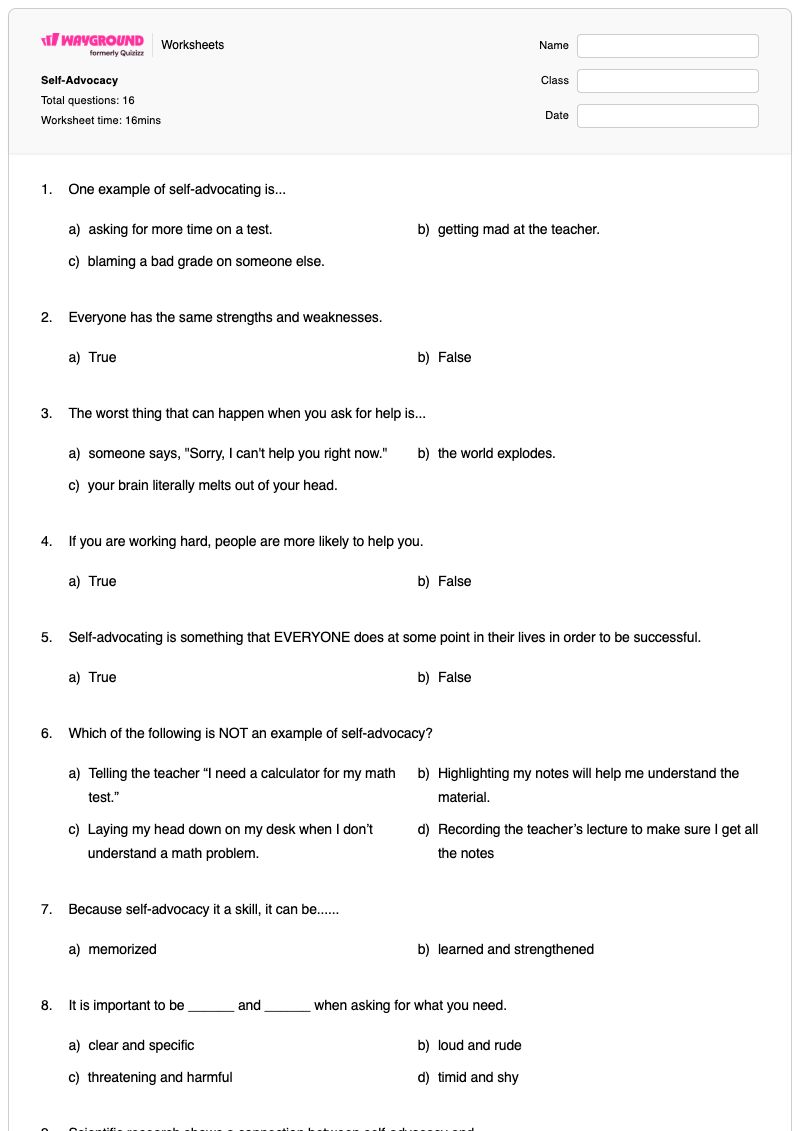
Self-Advocacy

คำถามทั้งหมด: 16

ชื่อ
ระดับ
วันที่
1.

One example of self-advocating is...

a)

asking for more time on a test.

b)

getting mad at the teacher.

c)

blaming a bad grade on someone else.

2.

Everyone has the same strengths and weaknesses.

a)

True

b)

False

3.

The worst thing that can happen when you ask for help is...

a)

someone says, "Sorry, I can't help you right now."

b)

the world explodes.

c)

your brain literally melts out of your head.

4.

If you are working hard, people are more likely to help you.

a)

True

b)

False

5.

Self-advocating is something that EVERYONE does at some point in their lives in order to be successful.

a)

True

b)

False

6.

Which of the following is NOT an example of self-advocacy?

a)

Telling the teacher “I need a calculator for my math test.”

b)

Highlighting my notes will help me understand the material.

c)

Laying my head down on my desk when I don’t understand a math problem.

d)

Recording the teacher’s lecture to make sure I get all the notes

7.

Because self-advocacy it a skill, it can be......

a)

memorized

b)

learned and strengthened

8.

It is important to be ______ and ______ when asking for what you need.

a)

clear and specific

b)

loud and rude

c)

threatening and harmful

d)

timid and shy

9.

Scientific research shows a connection between self-advocacy and ______

a)

academic failure

b)

academic and post secondary success

c)

high anxiety

d)

poor attendance

10.

Which of the following is an example of self advocacy?

a)

Completing all your work on your own.

b)

Going to class.

c)

Setting an alarm to remind you to go to class.

d)

Reaching out to teachers/school counselor with questions.

11.

Why is self advocacy important

a)

It is important because it empowers you to speak up for yourself and make decisions about your life.

b)

Self advocacy isn't important

c)

Self advocacy is important because you can stand up for other people when they are being mistreated.

12.

Self-advocacy is an important skill in high school, but will not be used after graduation.

a)

True

b)

False

13.

I am a self advocate...

a)

All of the time

b)

Most of the time

c)

Some of the time

d)

On rare occassions

e)

Very rarely, almost never

14.

When confronted with something I don't know...

a)

I look for answers on my own first, then ask if I still don't know.

b)

I ask a question right away.

c)

I'll ask someone I feel comfortable with later

d)

I'll ask later if I remember.

e)

I won't ask a question.

15.

Fill in the blank with the choices below:

I have ______ friends and family who support me through thick and thin

a)

lots

b)

some

c)

a few

d)

hardly any

e)

none

16.

I would like to improve in the following areas (check all that apply).

a)

Staying informed and knowing how to get information.

b)

Knowing my rights and responsibilities

c)

I want to find people who will support me.

d)

I want to be more of a problem solver.

e)

I want to take control of my own life.

แป้นคำตอบ

Self-Advocacy

คำถามทั้งหมด: 16

1.
a)

asking for more time on a test.

2.
b)

False

3.
a)

someone says, "Sorry, I can't help you right now."

4.
a)

True

5.
a)

True

6.
c)

Laying my head down on my desk when I don’t understand a math problem.

7.
b)

learned and strengthened

8.
a)

clear and specific

9.
b)

academic and post secondary success

10.
d)

Reaching out to teachers/school counselor with questions.

11.
a)

It is important because it empowers you to speak up for yourself and make decisions about your life.

12.
b)

False

13.
ไม่มี
14.
ไม่มี
15.
ไม่มี
16.
ไม่มี

คำถามที่พบบ่อย

แบบฝึกหัดการเรียกร้องสิทธิของตนเองนี้ช่วยให้นักเรียนมัธยมปลายเรียนรู้อะไรบ้าง?

แบบฝึกหัดสำหรับนักเรียนระดับชั้น ม.3-ม.6 นี้ ช่วยให้นักเรียนตระหนักถึงการเรียกร้องสิทธิ์ของตนเองในสถานการณ์จริงในโรงเรียน เช่น การขอเวลาสอบเพิ่ม การถามคำถามครูหรือที่ปรึกษา และการอธิบายว่าตนเองต้องการเครื่องคิดเลข แบบฝึกหัดนี้ประกอบด้วยคำถามแบบเลือกตอบ 15 ข้อ และคำถามแบบเลือกตอบอีก 1 ข้อ ซึ่งช่วยเน้นย้ำว่าการเรียกร้องสิทธิ์ของตนเองอย่างมีประสิทธิภาพนั้น ต้องมีความชัดเจนและเฉพาะเจาะจง สามารถเรียนรู้และพัฒนาได้ และสนับสนุนความสำเร็จทั้งในและนอกโรงเรียนมัธยมปลาย

ฉันจะใช้แบบฝึกหัดนี้ในการสอนเรื่องการเรียกร้องสิทธิของตนเองได้อย่างไร?

แนะนำเรื่องการเรียกร้องสิทธิของตนเองโดยการอธิบายความแตกต่างระหว่างการแสดงความต้องการอย่างชัดเจนกับการตอบสนองอย่างเฉยเมย หยาบคาย หรือไม่ลงมือทำอะไรเลย ในขณะที่นักเรียนทำแบบฝึกหัดสถานการณ์ในโรงเรียน ให้หยุดและถามพวกเขาว่าพวกเขาสามารถพูดอะไรได้บ้าง พวกเขาสามารถเข้าหาใครได้บ้าง และการสนับสนุนแบบใดที่จะทำให้คำขอมีความเฉพาะเจาะจงมากขึ้น ใช้หัวข้อการสะท้อนความคิดสุดท้ายเกี่ยวกับการถามคำถามและการได้รับการสนับสนุนที่น่าเชื่อถือเพื่อเชื่อมโยงแนวคิดนี้เข้ากับประสบการณ์ของนักเรียนเอง

ฉันควรระวังข้อผิดพลาดอะไรบ้างเมื่อนักเรียนทำแบบฝึกหัดการเรียกร้องสิทธิของตนเองนี้?

นักเรียนอาจสับสนระหว่างการทำงานให้เสร็จโดยอิสระกับการเรียกร้องสิทธิของตนเอง หรือเลือกที่จะหลีกเลี่ยงปัญหา เช่น การก้มหน้าก้มตา แทนที่จะสื่อสารความต้องการของตนเอง พวกเขาอาจเลือกที่จะขอร้องอย่างคลุมเครือหรือก้าวร้าว แทนที่จะทำตามที่แบบฝึกหัดเน้นความชัดเจนและเฉพาะเจาะจง ควรสังเกตนักเรียนที่มองว่าการเรียกร้องสิทธิของตนเองเป็นคุณลักษณะส่วนบุคคลที่ตายตัว แทนที่จะเป็นทักษะที่สามารถเรียนรู้และพัฒนาได้

ฉันจะมอบหมายและให้คะแนนแบบฝึกหัดการเรียกร้องสิทธิของตนเองนี้อย่างไร?

แบบฝึกหัดนี้มีให้ดาวน์โหลดบน Wayground ในรูปแบบไฟล์ PDF ที่สามารถพิมพ์ได้ และในรูปแบบแบบทดสอบดิจิทัล พร้อมเฉลยคำตอบครบถ้วนสำหรับคำถามแบบเลือกตอบและแบบเลือกหลายข้อ คุณสามารถตรวจสอบคำตอบของนักเรียนเกี่ยวกับสถานการณ์การสนับสนุนตนเองและคำถามสะท้อนความคิด และให้คะแนนงานที่ส่งมาในรูปแบบไฟล์พิมพ์ได้โดยการสแกนงานของนักเรียนด้วยแอป Wayground for Teachers ตัวเลือกแบบพิมพ์ยังสามารถช่วยสนับสนุนโรงเรียนที่กำลังลดเวลาการใช้หน้าจอได้อีกด้วย

ฉันจะปรับแบบฝึกหัดการเรียกร้องสิทธิของตนเองนี้ให้เหมาะสมกับนักเรียนของฉันได้อย่างไร?

ใช้การตั้งค่าขั้นสูงของแบบฝึกหัดเพื่อปรับระยะห่างระหว่างตัวอักษรหรือขนาดตัวอักษร เพื่อให้คำถามเกี่ยวกับการสนับสนุนตนเองทั้ง 16 ข้ออ่านและเข้าใจง่ายขึ้น นอกจากนี้ คุณยังสามารถใช้แบบอักษรที่เหมาะสำหรับผู้ที่มีภาวะดิสเล็กเซีย หรือแปลแบบฝึกหัดเป็นภาษาอื่นได้ หากตัวเลือกเหล่านั้นช่วยให้ผู้เรียนเข้าถึงสถานการณ์ในโรงเรียนและหัวข้อการสะท้อนความคิดส่วนตัวได้ดียิ่งขึ้น

ฉันจะหาแบบฝึกหัดแบบนี้เพิ่มเติมได้ที่ไหนบน Wayground?

Wayground มีแบบฝึกหัดและโจทย์ฝึกหัดมากมายให้ดาวน์โหลดฟรีในหลากหลายวิชา พร้อมไฟล์ PDF และเฉลยคำตอบ เพื่อช่วยให้นักเรียนพัฒนาทักษะและความเข้าใจในแนวคิดที่สำคัญ ดูแหล่งข้อมูลเพิ่มเติมได้ที่ https://wayground.com/en-us/worksheets