
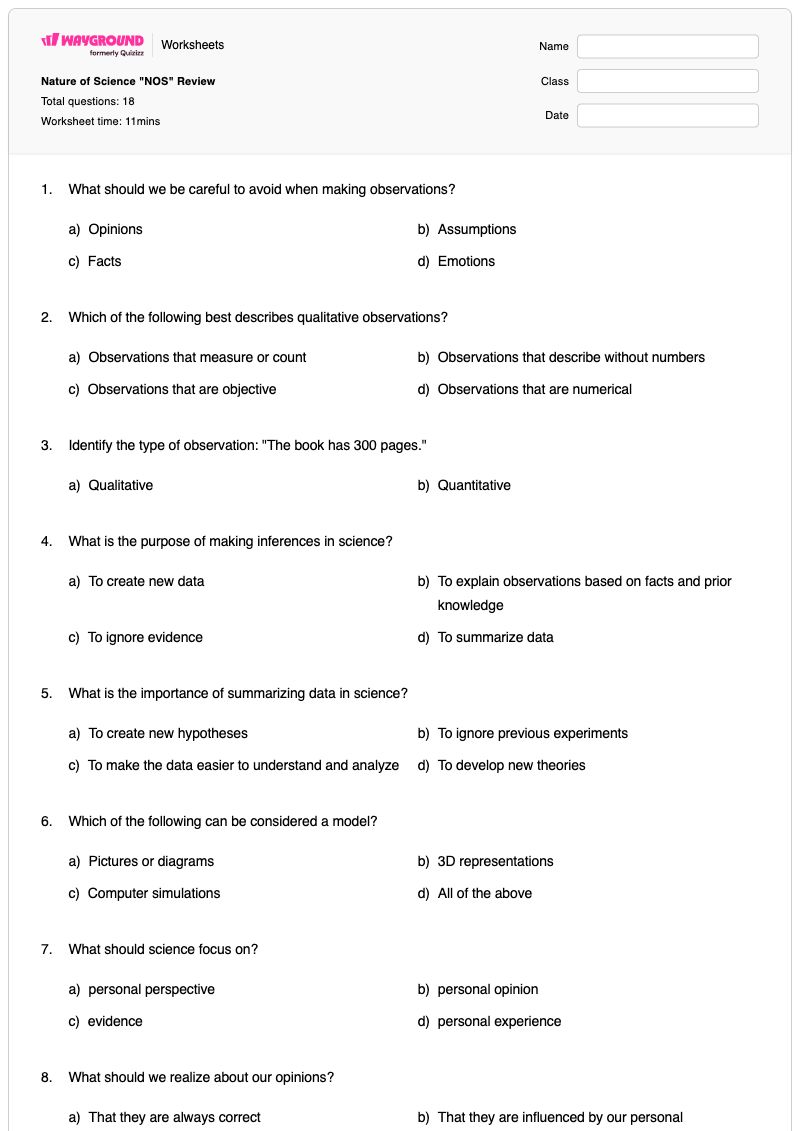

What should we be careful to avoid when making observations?
a)
Opinions
b)
Assumptions
c)
Facts
d)
Emotions
2.
Which of the following best describes qualitative observations?
a)
Observations that measure or count
b)
Observations that describe without numbers
c)
Observations that are objective
d)
Observations that are numerical
3.
Identify the type of observation: "The book has 300 pages."
a)
Qualitative
b)
Quantitative
4.
What is the purpose of making inferences in science?
a)
To create new data
b)
To explain observations based on facts and prior knowledge
c)
To ignore evidence
d)
To summarize data
5.
What is the importance of summarizing data in science?
a)
To create new hypotheses
b)
To ignore previous experiments
c)
To make the data easier to understand and analyze
d)
To develop new theories
6.
Which of the following can be considered a model?
a)
Pictures or diagrams
b)
3D representations
c)
Computer simulations
d)
All of the above
7.
What should science focus on?
a)
personal perspective
b)
personal opinion
c)
evidence
d)
personal experience
8.
What should we realize about our opinions?
a)
That they are always correct
b)
That they are influenced by our personal experiences
c)
That they do not change
d)
That they do not influence science
9.
What does the image of the glass half full and half empty demonstrate?
a)
That perspective changes
b)
That evidence changes
c)
That science changes
d)
That sculpture changes
10.
What does "speaking the same language" mean in science?
a)
Using different languages
b)
Using the same units and scientific tools
c)
Using only graphs
d)
Using only data tables
11.
Which term is a description of evidence that we collect around us?
a)
observation
b)
inference
c)
model
d)
bias
12.
Which term is an explanation based on facts or prior knowledge combined with observations?
a)
observation
b)
inference
c)
model
d)
bias
13.
Which term helps us explain our ideas that match the evidence.
They allow us to make predictions?
a)
observation
b)
inference
c)
model
d)
bias
14.
Which term is a prejudice in favor of or against one thing, person, or group compared with another, usually in a way considered to be unfair?
a)
observation
b)
inference
c)
model
d)
bias
15.
In science we avoid using the word (a) . If you prove it, you know that it is absolutely true. We are usually missing information and must do the best we can with available evidence.
16.
In science we avoid using the word prove or proven. If you prove it, you know that it is absolutely true. We are usually missing (a) and must do the best we can with available evidence.
17.
Science can only (try to) answer questions about the (a) world. Meaning, it can't answer questions about the supernatural or spiritual world.
18.
Which is NOT an explanation of "what is science"?
a)
Science is testable and based on evidence
b)
Science is creative
c)
Science never changes
d)
Science reduces bias and involves communication
แป้นคำตอบ
Nature of Science "NOS" Review
คำถามทั้งหมด: 18
1.
a)
Opinions
, b)
Assumptions
, d)
Emotions
2.
b)
Observations that describe without numbers
3.
b)
Quantitative
4.
b)
To explain observations based on facts and prior knowledge
5.
c)
To make the data easier to understand and analyze
6.
d)
All of the above
7.
c)
evidence
8.
b)
That they are influenced by our personal experiences
คุณสามารถมอบหมายแบบฝึกหัดทบทวนเรื่องธรรมชาติของวิทยาศาสตร์ (NOS) ในรูปแบบไฟล์ PDF ที่พิมพ์ได้ หรือเป็นแบบทดสอบดิจิทัลบน Wayground แบบฝึกหัดนี้มีเฉลยคำตอบครบถ้วนสำหรับคำถามแบบเลือกตอบหลายข้อ คำถามแบบเลือกคำตอบหลายข้อ และคำถามแบบเติมคำในช่องว่าง และสามารถตรวจให้คะแนนงานที่ส่งมาในรูปแบบไฟล์ PDF ได้โดยการสแกนงานของนักเรียนด้วยแอป Wayground for Teachers ตัวเลือกไฟล์ PDF ยังช่วยสนับสนุนโรงเรียนที่ต้องการลดเวลาการใช้หน้าจอในขณะที่ยังคงรักษารูปแบบการเรียนรู้ทางวิทยาศาสตร์ที่เป็นระบบเอาไว้