

Wayground
4.18.23 - Topic 3 - Bioenergetics -  Keystone Review - Printable ศาสตร์ Worksheets 9th ระดับชั้น - Wayground

4.18.23 - Topic 3 - Bioenergetics - Keystone Review

Pamela Lynch

สร้างโดย Pamela Lynch

13 คำถาม

9th ระดับชั้น

ศาสตร์

อัปเดตแล้ว มี.ค. 2569

แบบฝึกหัดชีววิทยา ม.3 “4.18.23 - หัวข้อที่ 3 - ชีวพลังงาน - แบบฝึกหัดทบทวนหลัก” นี้ ทบทวนกระบวนการที่เซลล์ดักจับ ถ่ายโอน และใช้พลังงานผ่านกระบวนการสังเคราะห์แสง การหายใจระดับเซลล์ ATP ไกลโคไลซิส คลอโรพลาสต์ และไมโทคอนเดรีย นักเรียนจะต้องตอบคำถามแบบเลือกตอบ 12 ข้อ ซึ่งอธิบายความสัมพันธ์ของกระบวนการ การเปลี่ยนแปลงพลังงาน บทบาทของออร์แกเนลล์ การใช้ ATP และการได้รับ ATP สุทธิจากไกลโคไลซิส นอกจากนี้ยังมีคำถามแบบเปิดโดยใช้แผนภาพเวนน์ ถามนักเรียนให้เปรียบเทียบการสังเคราะห์แสงและการหายใจระดับเซลล์ และอธิบายว่าทำไมสิ่งมีชีวิตบางชนิดจึงทำทั้งสองกระบวนการนี้ แบบฝึกหัดนี้ออกแบบมาเพื่อทบทวนชีววิทยา การประเมินผลระหว่างเรียน หรือการเตรียมสอบ โดยจะตรวจสอบว่านักเรียนสามารถเชื่อมโยงการสังเคราะห์แสงกับการหายใจระดับเซลล์ได้หรือไม่ แทนที่จะมองว่าเป็นกระบวนการที่แยกจากกัน คำถามแบบเปิดเพิ่มโอกาสในการอธิบายความเหมือน ความแตกต่าง และความสัมพันธ์ระหว่างกันในรูปแบบการเขียน แบบฝึกหัดนี้สามารถพิมพ์ได้ฟรี พร้อมเฉลยคำตอบครบถ้วน ช่วยให้ครูสามารถระบุความเข้าใจผิดเกี่ยวกับกระแสพลังงานและกระบวนการระดับเซลล์ได้อย่างสะดวก

การตั้งค่าแผ่นงาน

ขนาดตัวอักษร

S
M
L
XL
Waygroundแผ่นงาน

4.18.23 - Topic 3 - Bioenergetics - Keystone Review

คำถามทั้งหมด: 13

ชื่อ
ระดับ
วันที่
1.

Which statement best describes the role of ATP in a living system?

a)

ATP senses and adjusts the pH in the cellular environment.

b)

ATP identifies and repairs weak components of cells and tissues.

c)

ATP measures and provides heat to increase reaction rates in cells.

d)

ATP captures and transfers energy released by the breakdown of glucose.

2.

Which statement best explains why cellular respiration in plants and other organisms is dependent on photosynthesis?

a)

Photosynthesis is one of the final steps in cellular respiration.

b)

Photosynthesis provides the materials that fuel cellular respiration.

c)

Photosynthesis absorbs excess energy produced by cellular respiration.

d)

Photosynthesis absorbs materials that are catalyzed during cellular respiration.

3.

A scientist observed that during the course of a chemical reaction the number of ATP molecules was reduced. What did the scientist most likely learn from the observation?

a)

The reaction produced water.

b)

The reaction consumed water.

c)

The reaction caused an output of energy.

d)

The reaction required an input of energy.

4.

Which process uses the products of photosynthesis as reactants?

a)

active transport

b)

cellular respiration

c)

DNA replication

d)

protein synthesis

5.

Plant cells use sunlight to make their own food. Which structure allows plant cells to perform this function?

a)

nucleus

b)

vacuole

c)

chloroplast

d)

mitochondrion

6.
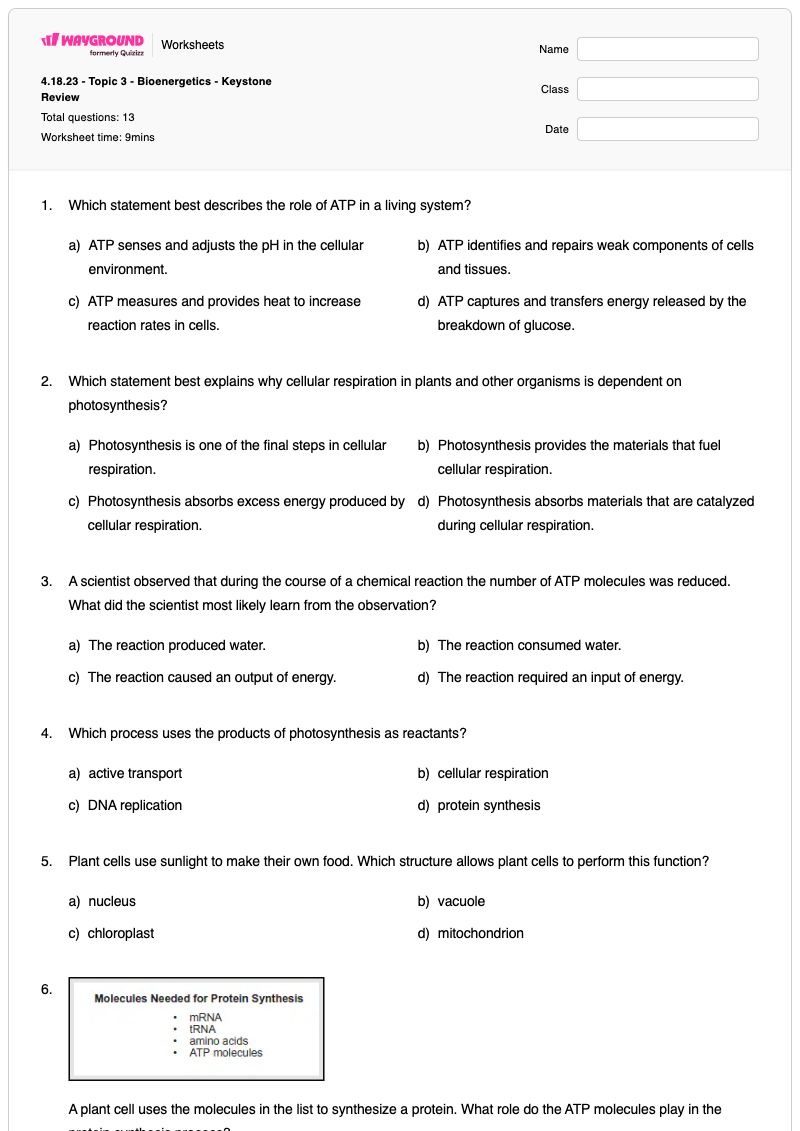
A plant cell uses the molecules in the list to synthesize a protein. What role do the ATP molecules play in the protein…

A plant cell uses the molecules in the list to synthesize a protein. What role do the ATP molecules play in the protein synthesis process?

a)

They provide energy.

b)

They increase activation energy.

c)

They convert energy into hereditary information.

d)

They absorb excess energy to prevent overheating.

7.
The diagram shows an energy transformation that typically occurs in plant cell plastids. Which statement best describes this…

The diagram shows an energy transformation that typically occurs in plant cell plastids. Which statement best describes this role of plastids in the plant cell?

a)

Chloroplasts transform light energy into chemical energy.

b)

Mitochondria transform light energy into chemical energy.

c)

Chloroplasts transform chemical energy into electromagnetic energy.

d)

Mitochondria transform chemical energy into electromagnetic energy.

8.
Which two statements correctly describe one similarity and one difference between cellular respiration and photosynthesis?

Which two statements correctly describe one similarity and one difference between cellular respiration and photosynthesis?

a)

statements 1 and 2

b)

statements 1 and 4

c)

statements 2 and 3

d)

statements 3 and 4

9.

A cell in the leaf of a green plant performs both photosynthesis and cellular respiration, often at the same time. Which statement best describes how these processes are related to each other?

a)

Both processes produce carbon dioxide.

b)

Both processes require energy directly from the Sun.

c)

Products of one process are used as some of the reactants for the other process.

d)

Thermal energy from one process is used as the energy source for the other process.

10.

An organism carries out both photosynthesis and cellular respiration. Which statement- describes a difference between these two processes?

a)

Only cellular respiration creates chemical energy.

b)

Only photosynthesis changes light energy into chemical energy.

c)

The processes occur in different types of animal cells.

d)

The processes occur at different times during the animal’s life cycle.

11.

In glycolysis, the first stage of cellular respiration, ATP molecules are produced.

What is the net gain of ATP molecules (per molecule of glucose) from glycolysis?

a)

2 ATP

b)

4 ATP

c)

1 ATP

d)

36 ATP

12.
A student made lists of structures observed in cells from two different organisms. Which statement describes the most likely…

A student made lists of structures observed in cells from two different organisms. Which statement describes the most likely difference in the way that organism 1 and organism 2 obtain energy?

a)

Only organism 1 uses solar energy to make energy-rich compounds.

b)

Only organism 1 stores solar energy until it is needed for its life processes.

c)

Only organism 2 produces molecules for long-term energy storage.

d)

Only organism 2 transforms food energy into ATP during cellular respiration.

13.
Part A: Select two areas from the Venn diagram and describe a characteristic that could be placed into each of the areas.…

Part A: Select two areas from the Venn diagram and describe a characteristic that could be placed into each of the areas.

Part B: Explain why some organisms would need to perform both cellular respiration and photosynthesis.

4 เส้น
Waygroundแป้นคำตอบ

4.18.23 - Topic 3 - Bioenergetics - Keystone Review

คำถามทั้งหมด: 13

1.
d)

ATP captures and transfers energy released by the breakdown of glucose.

2.
b)

Photosynthesis provides the materials that fuel cellular respiration.

3.
d)

The reaction required an input of energy.

4.
b)

cellular respiration

5.
c)

chloroplast

6.
a)

They provide energy.

7.
a)

Chloroplasts transform light energy into chemical energy.

8.
a)

statements 1 and 2

9.
c)

Products of one process are used as some of the reactants for the other process.

10.
b)

Only photosynthesis changes light energy into chemical energy.

11.
a)

2 ATP

12.
a)

Only organism 1 uses solar energy to make energy-rich compounds.

13.
ไม่มี

คำถามที่พบบ่อย

แบบฝึกหัดด้านชีวพลังงานนี้ครอบคลุมหัวข้ออะไรบ้าง?

แบบฝึกหัดชีววิทยาสำหรับนักเรียนชั้น ม.3 นี้ ประกอบด้วยคำถามแบบเลือกตอบ 12 ข้อ และคำตอบแบบเปิดโดยใช้แผนภาพเวนน์ 1 ข้อ เพื่อประเมินหน้าที่ของ ATP กระบวนการสังเคราะห์แสง การหายใจระดับเซลล์ ไกลโคไลซิส การเปลี่ยนแปลงพลังงาน และบทบาทของคลอโรพลาสต์และไมโทคอนเดรีย นักเรียนจะสร้างความเข้าใจโดยการเชื่อมโยงผลิตภัณฑ์จากการสังเคราะห์แสงกับสารตั้งต้นของการหายใจระดับเซลล์ ระบุวิธีที่ ATP ถ่ายโอนพลังงาน และอธิบายว่าทำไมสิ่งมีชีวิตบางชนิดจึงทำทั้งสองกระบวนการนี้ได้

ฉันจะใช้แบบฝึกหัดนี้สอนความสัมพันธ์ระหว่างการสังเคราะห์แสงและการหายใจระดับเซลล์ได้อย่างไร?

เริ่มแบบฝึกหัดโดยให้นักเรียนลากเส้นตามขั้นตอนการสังเคราะห์แสงที่ให้วัตถุดิบสำหรับการหายใจระดับเซลล์ จากนั้นอภิปรายว่าทั้งสองกระบวนการใช้สารตั้งต้นและผลิตภัณฑ์ที่เกี่ยวข้องกันอย่างไร ขณะที่นักเรียนตอบคำถามแบบเลือกตอบ ให้ถามพวกเขาถึงเหตุผลของความแตกต่าง เช่น คลอโรพลาสต์เปลี่ยนพลังงานแสงเป็นพลังงานเคมี และไกลโคไลซิสสร้าง ATP สุทธิ 2 โมเลกุล ปิดท้ายด้วยการให้นักเรียนเขียนแผนภาพเวนน์เพื่ออธิบายความสัมพันธ์ในแบบของตนเอง

ฉันควรระวังข้อผิดพลาดอะไรบ้างเมื่อนักเรียนทำแบบฝึกหัดทบทวนเรื่องชีวพลังงานนี้?

นักเรียนอาจสับสนระหว่าง ATP กับโครงสร้างที่ควบคุมค่า pH หรือความร้อน แทนที่จะตระหนักว่ามันดักจับและถ่ายโอนพลังงาน หรืออาจเลือก ATP 4 หรือ 36 โมเลกุล แทนที่จะเลือก ATP 2 โมเลกุลที่ได้จากกระบวนการไกลโคไลซิส ระวังความสับสนระหว่างคลอโรพลาสต์และไมโทคอนเดรีย และการมองว่าการสังเคราะห์แสงและการหายใจระดับเซลล์เป็นกระบวนการที่ไม่เกี่ยวข้องกัน แทนที่จะตระหนักว่าผลิตภัณฑ์จากกระบวนการหนึ่งสามารถใช้เป็นสารตั้งต้นสำหรับอีกกระบวนการหนึ่งได้ ในแผนภาพเวนน์ ให้ตรวจสอบว่านักเรียนอธิบายทั้งลักษณะเฉพาะและเหตุผลว่าทำไมสิ่งมีชีวิตบางชนิดจึงต้องการทั้งสองกระบวนการ

ฉันจะมอบหมายและตรวจงานใบงานนี้อย่างไร?

แบบทดสอบทบทวนเรื่องชีวพลังงานมีให้ดาวน์โหลดในรูปแบบไฟล์ PDF ที่สามารถพิมพ์ได้ และในรูปแบบแบบทดสอบดิจิทัลบน Wayground โดยมีเฉลยคำตอบครบถ้วนสำหรับคำถามแบบเลือกตอบทั้ง 12 ข้อ และคำถามแบบปลายเปิด การส่งงานในรูปแบบไฟล์ PDF สามารถตรวจได้โดยการสแกนงานของนักเรียนด้วยแอป Wayground for Teachers ในขณะที่เวอร์ชันดิจิทัลรองรับการมอบหมายงานและการทบทวนออนไลน์

คำถามปลายเปิดในแบบฝึกหัดนี้ประเมินอะไร?

ข้อสอบปลายเปิดข้อสุดท้ายขอให้นักเรียนเลือกสองส่วนจากแผนภาพเวนน์ อธิบายลักษณะเฉพาะของแต่ละส่วน และอธิบายว่าทำไมสิ่งมีชีวิตบางชนิดจึงจำเป็นต้องสังเคราะห์แสงและหายใจระดับเซลล์พร้อมกัน ข้อสอบนี้ประเมินว่านักเรียนสามารถเปรียบเทียบกระบวนการทั้งสองและสื่อสารความสัมพันธ์ระหว่างกันได้หรือไม่ นอกเหนือจากการเลือกคำตอบจากตัวเลือกแบบปรนัย

ฉันจะหาแบบฝึกหัดแบบนี้เพิ่มเติมได้ที่ไหนบน Wayground?

Wayground นำเสนอชุดแบบฝึกหัดและโจทย์ฝึกหัดฟรีที่ครอบคลุมหลากหลายวิชา พร้อมไฟล์ PDF และเฉลยคำตอบ เพื่อช่วยให้นักเรียนเชี่ยวชาญทักษะและแนวคิดที่สำคัญ ดูแหล่งข้อมูลเพิ่มเติมได้ที่ https://wayground.com/en-us/worksheets