


Wayground
Cellular Respiration and Photosynthesis Review  - Printable ศาสตร์ Worksheets 8th ระดับชั้น - Wayground

Cellular Respiration and Photosynthesis Review

Martha Babiarz

สร้างโดย Martha Babiarz

38 คำถาม

8th ระดับชั้น

ศาสตร์

อัปเดตแล้ว ต.ค. 2569

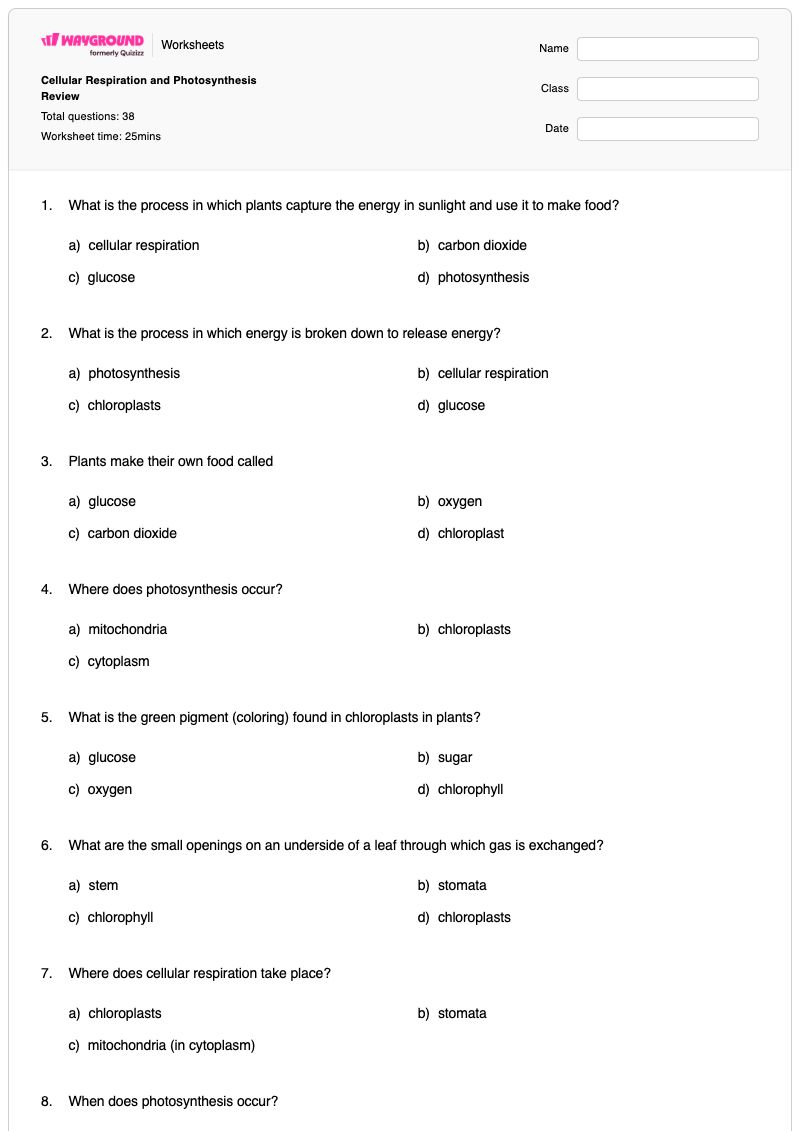
แบบฝึกหัดทบทวนเรื่องการหายใจระดับเซลล์และการสังเคราะห์แสง สำหรับนักเรียนชั้น ม.2 ช่วยให้นักเรียนแยกแยะความแตกต่างระหว่างสองกระบวนการที่พืชใช้ในการสร้างและปลดปล่อยพลังงาน แบบฝึกหัดนี้ประกอบด้วยคำถาม 38 ข้อ—แบบเลือกตอบ 33 ข้อ และแบบเลือกคำตอบที่ถูกต้อง 5 ข้อ—นักเรียนจะได้ระบุคำศัพท์สำคัญ ตำแหน่ง เวลา สารตั้งต้น ผลิตภัณฑ์ และสมการที่เกี่ยวข้องกับการสังเคราะห์แสงและการหายใจระดับเซลล์ นอกจากนี้ยังช่วยให้นักเรียนเชื่อมโยงโครงสร้างต่างๆ เช่น คลอโรพลาสต์ ไมโตคอนเดรีย ปากใบ และคลอโรฟิลล์ กับบทบาทของโครงสร้างเหล่านั้นในกระบวนการของพืช แบบฝึกหัดที่พิมพ์ได้ฟรีนี้มีประโยชน์สำหรับการทบทวน การฝึกฝนด้วยตนเอง หรือการประเมินผลหลังการเรียนการสอน คำถามแบบเลือกคำตอบที่ถูกต้องต้องการให้นักเรียนระบุปัจจัยนำเข้าและผลิตภัณฑ์ที่เกี่ยวข้องทั้งหมด แทนที่จะเลือกคำตอบเดียว ในขณะที่คำถามเกี่ยวกับการระบุสมการจะช่วยเสริมสร้างการจดจำแต่ละกระบวนการ มีเฉลยคำตอบให้ครูสามารถตรวจสอบความเข้าใจและแก้ไขความสับสนระหว่างสองกระบวนการ ออร์แกเนลล์ และสารตั้งต้นและผลิตภัณฑ์ได้อย่างรวดเร็ว

การตั้งค่าแผ่นงาน

ขนาดตัวอักษร

S
M
L
XL
Waygroundแผ่นงาน

Cellular Respiration and Photosynthesis Review

คำถามทั้งหมด: 38

ชื่อ
ระดับ
วันที่
1.

What is the process in which plants capture the energy in sunlight and use it to make food?

a)

cellular respiration

b)

carbon dioxide

c)

glucose

d)

photosynthesis

2.

What is the process in which energy is broken down to release energy?

a)

photosynthesis

b)

cellular respiration

c)

chloroplasts

d)

glucose

3.

Plants make their own food called

a)

glucose

b)

oxygen

c)

carbon dioxide

d)

chloroplast

4.

Where does photosynthesis occur?

a)

mitochondria

b)

chloroplasts

c)

cytoplasm

5.

What is the green pigment (coloring) found in chloroplasts in plants?

a)

glucose

b)

sugar

c)

oxygen

d)

chlorophyll

6.

What are the small openings on an underside of a leaf through which gas is exchanged?

a)

stem

b)

stomata

c)

chlorophyll

d)

chloroplasts

7.

Where does cellular respiration take place?

a)

chloroplasts

b)

stomata

c)

mitochondria (in cytoplasm)

8.

When does photosynthesis occur?

a)

With sunlight

b)

At night

c)

All the time

9.

When does cellular respiration occur?

a)

With sunlight

b)

At night

c)

All the time

10.

In photosynthesis, what are the reactants (the input, what the plant takes in)?

a)

water

b)

oxygen

c)

glucose

d)

carbon dioxide

e)

milk

11.

In photosynthesis, what are the products (output, what is released or made)?

a)

oxygen

b)

water

c)

glucose

d)

carbon dioxide

12.

In cellular respiration, what are the reactants (input)?

a)

oxygen

b)

water

c)

glucose

d)

carbon dioxide

13.

In cellular respiration, what are the products (the output)?

a)

water

b)

carbon dioxide

c)

energy

d)

glucose

14.
What equation is this?

What equation is this?

a)

Photosynthesis

b)

Cellular Respiration

15.
What equation is this?

What equation is this?

a)

Photosynthesis

b)

Cellular Respiration

16.

Photosynthesis and cellular respiration can be thought of as _________ processes

a)

similar

b)

opposite

17.

Photosynthesis occurs in what type of cells?

a)

Plants

b)

All

c)

Algae

18.

Cellular respiration occurs in mostly all cells/organisms

a)

True

b)

False

19.

Photosynthesis is a biological process that occurs in autotrophs. Which of the following is produced as a result of photosynthesis?

a)

Water and light

b)

Glucose and chlorophyll

c)

Glucose and oxygen

d)

Carbon dioxide and water

20.

The organic molecule that is the cell's primary form of energy?

a)

Glucose

b)

ATP

c)

ADP

d)

GMP

21.

Where do the reactions of photosynthesis take place in autotrophs?

a)

Chloroplast

b)

Mitochondria

c)

Cell Walls

d)

Cytoplasm

22.

Where does the energy for plants to perform photosynthesis come from?

a)

Breaking down ATP

b)

sunlight

c)

glucose metabolism

d)

None of the Above

23.

What is the chemical equation for photosynthesis? Choose the BEST answer

a)

C6H12O6 + O2 -> CO2 + H2O

b)

CO2 + H2O --> C6H12O6 + O2

c)

6 CO2 + 6 H2O --> C6H12O6 + 6 O2

d)

C6H12O6 + 6 O2 -> 6 CO2 + 6 H2O

24.

What is the pigment responsible for absorbing light energy in chloroplasts during photosynthesis?

a)

None of the Above

b)

Carotenoids

c)

Xenophylls

d)

Chlorophyll

25.

Cellular Respiration involves the chemical breakdown of _____ to form ATP Energy

a)

Fats

b)

Fructose

c)

Glucose

d)

Proteins

26.

Which of the following chemical equations properly demonstrates Cellular Respiration? Choose the BEST answer.

a)

C6H12O6 + O2 --> H2O + CO2

b)

H2O + CO2 -> C6H12O6 + O2

c)

C6H12O6 + 6 O2 -> 6 H2O + 6 CO2

d)

6 H2O + 6 CO2 -> C6H12O6 + 6 O2

27.

Where do the reactions of Aerobic respiration take place? (Krebs Cycle & Electron Transport Chain)

a)

Cytoplasm

b)

Mitochondria

c)

Chloroplasts

d)

Cell Wall

28.

True of False, Plants can perform Cellular Respiration and Photosynthesis

a)

False

b)

True

29.
What are the two products that are formed in photosynthesis?
a)
Oxygen and carbon dioxide
b)
Water and oxygen
c)
Oxygen and glucose
d)
Water and glucose
30.

Photosynthesis is ...

a)

The process in which organisms convert/transfer energy from glucose to ATP.

b)

The process in which organisms exchange carbon dioxide and oxygen in their lungs.

c)

The process of taking a picture.

d)

The process of plants converting/transferring solar energy to chemical energy to make their food.

31.
What are the reactants (what's needed) for photosynthesis?
a)
glucose and oxygen
b)
light, water, and carbon dioxide
c)

oxygen and carbon dioxide

d)

light and water

32.

Which process does heterotrophs and autotrophs undergo in order to convert glucose into ATP?

a)

cellular respiration

b)

osmosis

c)

photosynthesis

d)

transcription

33.

In what organelle does cellular respiration take place?

a)

mitochondria

b)

chromosomes

c)

lysosomes

d)

nucleus

34.

Cellular respiration is a chemical reaction that converts chemical energy stored in glucose into which large molecule?

a)

carbohydrate

b)

citric acid

c)

pyruvate

d)

ATP

35.
What is one of the reactants (raw materials) going into cellular respiration?

What is one of the reactants (raw materials) going into cellular respiration?

a)

Energy

b)

Sugar (Glucose)

c)

Carbon dioxide

d)

Water

36.
Which statement about photosynthesis is correct?

Which statement about photosynthesis is correct?

a)

Plants get the energy they need for photosynthesis from water.

b)

Plants get the energy they need for photosynthesis from soil.

c)

Plants get the energy they need for photosynthesis from sunlight.

d)

Plants do not require energy to perform photosynthesis.

37.

Which organism(s) go through cellular respiration?

a)

animals only

b)

plants only

c)

both animals and plants

d)

decomposers

38.

What is the main purpose of photosynthesis?

a)

To make food

b)

To create energy

c)

To release oxygen

d)

To absorb sunlight

Waygroundแป้นคำตอบ

Cellular Respiration and Photosynthesis Review

คำถามทั้งหมด: 38

1.
d)

photosynthesis

2.
b)

cellular respiration

3.
a)

glucose

4.
b)

chloroplasts

5.
d)

chlorophyll

6.
b)

stomata

7.
c)

mitochondria (in cytoplasm)

8.
a)

With sunlight

9.
c)

All the time

10.
a)

water

, d)

carbon dioxide

11.
a)

oxygen

, c)

glucose

12.
a)

oxygen

, b)

water

13.
a)

water

, b)

carbon dioxide

, c)

energy

14.
a)

Photosynthesis

15.
b)

Cellular Respiration

16.
b)

opposite

17.
a)

Plants

, c)

Algae

18.
a)

True

19.
c)

Glucose and oxygen

20.
b)

ATP

21.
a)

Chloroplast

22.
b)

sunlight

23.
c)

6 CO2 + 6 H2O --> C6H12O6 + 6 O2

24.
d)

Chlorophyll

25.
c)

Glucose

26.
c)

C6H12O6 + 6 O2 -> 6 H2O + 6 CO2

27.
b)

Mitochondria

28.
b)

True

29.
c) Oxygen and glucose
30.
d)

The process of plants converting/transferring solar energy to chemical energy to make their food.

31.
b) light, water, and carbon dioxide
32.
a)

cellular respiration

33.
a)

mitochondria

34.
d)

ATP

35.
b)

Sugar (Glucose)

36.
c)

Plants get the energy they need for photosynthesis from sunlight.

37.
c)

both animals and plants

38.
a)

To make food

คำถามที่พบบ่อย

แบบฝึกหัดทบทวนเรื่องการหายใจระดับเซลล์และการสังเคราะห์แสงครอบคลุมเนื้อหาอะไรบ้าง?

แบบฝึกหัดวิทยาศาสตร์สำหรับนักเรียนชั้น ม.2 นี้ ประกอบด้วยคำถามแบบเลือกตอบ 33 ข้อ และคำถามแบบเลือกคำตอบ 5 ข้อ เพื่อเปรียบเทียบกระบวนการสังเคราะห์แสงกับกระบวนการหายใจระดับเซลล์ นักเรียนจะต้องระบุว่าแต่ละกระบวนการเกิดขึ้นที่ใด เกิดขึ้นเมื่อใด บทบาทของคลอโรพลาสต์ ไมโทคอนเดรีย ปากใบ และคลอโรฟิลล์ รวมถึงสารตั้งต้นและผลิตภัณฑ์ที่เกี่ยวข้อง แบบฝึกหัดการระบุสมการจะช่วยเสริมความเข้าใจในการแยกแยะความแตกต่างระหว่างสองกระบวนการนี้ให้ดียิ่งขึ้น

ฉันจะใช้แบบฝึกหัดนี้ในการสอนเรื่องการสังเคราะห์แสงและการหายใจระดับเซลล์ได้อย่างไร?

ใช้แบบฝึกหัดหลังจากแนะนำกระบวนการทั้งสองเพื่อจัดระเบียบการทบทวนแบบเปรียบเทียบและเปรียบต่าง ขอให้นักเรียนอธิบายว่าทำไมน้ำและคาร์บอนไดออกไซด์จึงอยู่ในหัวข้อสารตั้งต้นของการสังเคราะห์แสง จากนั้นให้พวกเขาใช้คำถามเกี่ยวกับผลิตภัณฑ์และสมการเพื่ออธิบายเหตุผลในการเลือกของพวกเขา อภิปรายคำถามแบบเลือกตอบหลายข้อร่วมกันในชั้นเรียน เพื่อให้นักเรียนอธิบายทุกตัวเลือกที่พวกเขาเลือก แทนที่จะเดาจากคำตอบเดียว

ฉันควรสังเกตข้อผิดพลาดอะไรบ้างเมื่อนักเรียนทำแบบฝึกหัดนี้เสร็จ?

นักเรียนอาจสับสนระหว่างกระบวนการสังเคราะห์แสงและการหายใจระดับเซลล์ สับสนระหว่างคลอโรพลาสต์กับไมโทคอนเดรีย หรือเข้าใจผิดว่าคลอโรฟิลล์เป็นออร์แกเนลล์ที่เกิดกระบวนการสังเคราะห์แสง ควรระวังนักเรียนที่เลือกคำตอบเพียงข้อเดียวในคำถามแบบเลือกตอบ โดยเฉพาะอย่างยิ่งเมื่อต้องระบุสารตั้งต้นหรือผลิตภัณฑ์หลายชนิด นอกจากนี้ นักเรียนอาจสับสนระหว่างการสังเคราะห์แสงที่เกิดขึ้นด้วยแสงแดดกับการหายใจระดับเซลล์ที่เกิดขึ้นตลอดเวลา หรือระบุสมการผิดพลาด

ฉันจะมอบหมายและให้คะแนนแบบฝึกหัดนี้อย่างไร?

แบบฝึกหัดนี้มีให้ดาวน์โหลดในรูปแบบไฟล์ PDF ที่สามารถพิมพ์ได้ และเป็นแบบทดสอบดิจิทัลบน Wayground โดยมีเฉลยคำตอบครบถ้วน สำหรับการส่งงานแบบพิมพ์ คุณสามารถตรวจงานของนักเรียนได้โดยการสแกนด้วยแอป Wayground for Teachers นอกจากนี้ ตัวเลือกไฟล์ PDF ยังเหมาะสำหรับห้องเรียนหรือโรงเรียนที่ต้องการลดเวลาการใช้หน้าจออีกด้วย

ฉันจะปรับแบบฝึกหัดเรื่องการสังเคราะห์แสงและการหายใจระดับเซลล์ให้เหมาะสมกับนักเรียนของฉันได้อย่างไร?

ในการตั้งค่าขั้นสูงของแบบฝึกหัด ให้ปรับระยะห่างระหว่างตัวอักษรหรือขนาดตัวอักษรเพื่อให้ข้อสอบแบบเลือกตอบและเลือกหลายข้อจำนวน 38 ข้ออ่านง่ายขึ้น นอกจากนี้ คุณยังสามารถใช้แบบอักษรที่เหมาะสำหรับผู้ที่มีภาวะดิสเล็กเซีย หรือแปลแบบฝึกหัดเป็นภาษาอื่น เพื่อช่วยให้นักเรียนเข้าถึงการเปรียบเทียบกระบวนการ คำถามเกี่ยวกับสารตั้งต้นและผลิตภัณฑ์ และข้อสอบเกี่ยวกับสมการได้ง่ายขึ้น

ฉันจะหาแบบฝึกหัดแบบนี้เพิ่มเติมได้ที่ไหนบน Wayground?

Wayground นำเสนอชุดแบบฝึกหัดและโจทย์ฝึกหัดฟรีที่ครอบคลุมทุกวิชา พร้อมไฟล์ PDF และเฉลยคำตอบ เพื่อช่วยให้นักเรียนเชี่ยวชาญทักษะและแนวคิดที่สำคัญ ดูแหล่งข้อมูลเพิ่มเติมได้ที่ https://wayground.com/en-us/worksheets