

Wayground
EOC Review Photosynthesis & Cellular Respiration - Printable ศาสตร์ Worksheets 9th ระดับชั้น - Wayground

EOC Review Photosynthesis & Cellular Respiration

Ciara Marquis

สร้างโดย Ciara Marquis

20 คำถาม

9th ระดับชั้น

ศาสตร์

อัปเดตแล้ว ต.ค. 2569

แบบฝึกหัดชีววิทยาสำหรับนักเรียนชั้น ม.3 เรื่อง การสังเคราะห์แสงและการหายใจระดับเซลล์ ออกแบบมาเพื่อทบทวนการทำงานร่วมกันของการสังเคราะห์แสงและการหายใจระดับเซลล์ในเซลล์ แบบฝึกหัดประกอบด้วยคำถามแบบเลือกตอบ 20 ข้อ นักเรียนจะต้องระบุสารตั้งต้นและผลิตภัณฑ์ของแต่ละกระบวนการ จับคู่แต่ละกระบวนการกับออร์แกเนลล์ที่เกี่ยวข้อง รู้จักบทบาทของแสงแดด คลอโรฟิลล์ กลูโคส ออกซิเจน และ ATP และตีความสมการเคมีของการหายใจระดับเซลล์ แบบฝึกหัดนี้ช่วยให้นักเรียนแยกแยะได้ว่าพืชดักจับพลังงานแสงเพื่อผลิตกลูโคสและออกซิเจน ในขณะที่เซลล์สลายกลูโคสด้วยออกซิเจนเพื่อปล่อย ATP คาร์บอนไดออกไซด์ และน้ำ คำถามยังเชื่อมโยงการหายใจระดับเซลล์กับเซลล์พืชและสัตว์ รวมถึงคาร์โบไฮเดรตในฐานะแหล่งพลังงานทั่วไป ใช้แบบฝึกหัดนี้สำหรับการเตรียมสอบ EOC การทบทวนด้วยตนเอง หรือการตรวจสอบความเข้าใจของนักเรียน เป็นแบบฝึกหัดที่พิมพ์ได้ฟรีพร้อมเฉลยคำตอบครบถ้วน

การตั้งค่าแผ่นงาน

ขนาดตัวอักษร

S
M
L
XL
Waygroundแผ่นงาน

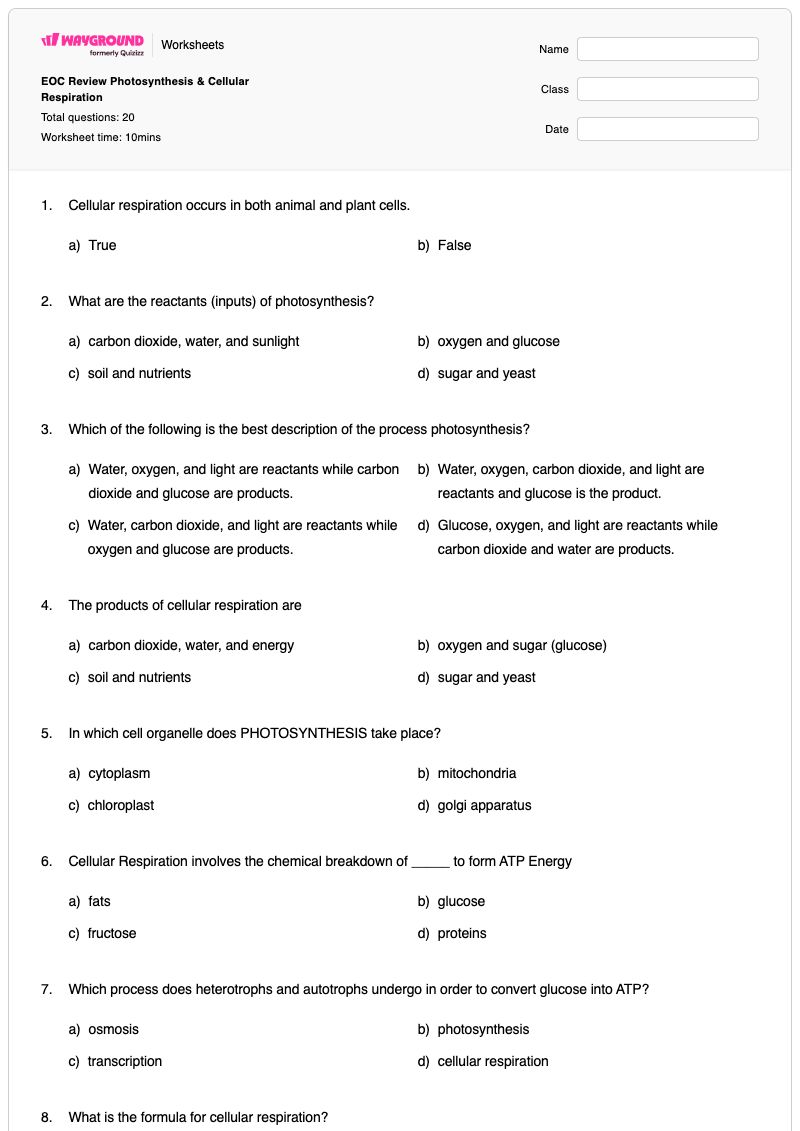
EOC Review Photosynthesis & Cellular Respiration

คำถามทั้งหมด: 20

ชื่อ
ระดับ
วันที่
1.

Cellular respiration occurs in both animal and plant cells.

a)

True

b)

False

2.

What are the reactants (inputs) of photosynthesis?

a)

carbon dioxide, water, and sunlight

b)

oxygen and glucose

c)

soil and nutrients

d)

sugar and yeast

3.

Which of the following is the best description of the process photosynthesis?

a)

Water, oxygen, and light are reactants while carbon dioxide and glucose are products.

b)

Water, oxygen, carbon dioxide, and light are reactants and glucose is the product.

c)

Water, carbon dioxide, and light are reactants while oxygen and glucose are products.

d)

Glucose, oxygen, and light are reactants while carbon dioxide and water are products.

4.

The products of cellular respiration are

a)

carbon dioxide, water, and energy

b)

oxygen and sugar (glucose)

c)

soil and nutrients

d)

sugar and yeast

5.

In which cell organelle does PHOTOSYNTHESIS take place?

a)

cytoplasm

b)

mitochondria

c)

chloroplast

d)

golgi apparatus

6.

Cellular Respiration involves the chemical breakdown of _____ to form ATP Energy

a)

fats

b)

glucose

c)

fructose

d)

proteins

7.

Which process does heterotrophs and autotrophs undergo in order to convert glucose into ATP?

a)

osmosis

b)

photosynthesis

c)

transcription

d)

cellular respiration

8.

What is the formula for cellular respiration?

a)

6CO2+6H2O+Light Energy-->C6H12O6+6O2

b)

C6H12O6+6O2-->6CO2+6H2O+ATP

c)

C6H12O6+6O2-->6CO2+6H2O+Light Energy

d)

6CO2+6H2O+ATP-->C6H12O6+6O2

9.

Which organelle does cellular respiration happen in?

a)

nucleus

b)

mitochondria

c)

chlorophyll

d)

chloroplast

10.

During cellular respiration, what do animals/people need to use in ADDITION to glucose to make ATP?

a)

sunlight

b)

water

c)

oxygen

d)

glucose

11.

During photosynthesis, what gas do plants release into the air?

a)

oxygen

b)

carbon dioxide

c)

nitrogen

d)

hydrogen

12.

The energy that starts the process of photosynthesis comes from....

a)

transpiration

b)

cellular respiration

c)

sunlight

d)

germination

13.

Which of the following is ONE of the products during cellular respiration?

a)

protein

b)

oxygen

c)

carbon dioxide

d)

glucose

14.

Which of the following macromolecules found in the food we eat is most commonly broken down to make ATP?

a)

carbohydrates

b)

lipids

c)

proteins

d)

nucleic acid

15.

Plants gather the sun's energy with light-absorbing molecules called __________

a)

chlorophyll

b)

thylakoids

c)

chloroplasts

d)

glucose

16.

The Calvin Cycle is another name for ________.

a)

light-independent reactions

b)

light-dependent reactions

c)

photosynthesis

d)

all answers are correct

17.

What is the product of the Calvin Cycle?

a)

oxygen gas

b)

ATP

c)

glucose

d)

carbon dioxide gas

18.

Cellular respiration and photosynthesis are related because....

a)

they both make glucose

b)

they both require oxygen

c)

the products of one reaction are the reactants of the other reaction

d)

the reactants of one reactions are the reactants of the other reactions

19.
Main products of the Calvin Cycle

Main products of the Calvin Cycle

a)

Oxygen, NADP+, ADP

b)

Glucose, CO2, ADP

c)

ADP, NADP+, Glucose

d)

ATP, NADPH, Oxygen

20.

The Calvin Cycle occurs in the

a)

thylakoid

b)

grana

c)

inner member of the chloroplast

d)

stroma

Waygroundแป้นคำตอบ

EOC Review Photosynthesis & Cellular Respiration

คำถามทั้งหมด: 20

1.
a)

True

2.
a)

carbon dioxide, water, and sunlight

3.
c)

Water, carbon dioxide, and light are reactants while oxygen and glucose are products.

4.
a)

carbon dioxide, water, and energy

5.
c)

chloroplast

6.
b)

glucose

7.
d)

cellular respiration

8.
b)

C6H12O6+6O2-->6CO2+6H2O+ATP

9.
b)

mitochondria

10.
c)

oxygen

11.
a)

oxygen

12.
c)

sunlight

13.
c)

carbon dioxide

14.
a)

carbohydrates

15.
a)

chlorophyll

16.
a)

light-independent reactions

17.
c)

glucose

18.
c)

the products of one reaction are the reactants of the other reaction

19.
c)

ADP, NADP+, Glucose

20.
d)

stroma

คำถามที่พบบ่อย

แบบฝึกหัดทบทวน EOC เรื่องกระบวนการสังเคราะห์แสงและการหายใจระดับเซลล์ครอบคลุมเนื้อหาอะไรบ้าง?

แบบฝึกหัดชีววิทยาสำหรับนักเรียนชั้น ม.3 นี้ ประกอบด้วยคำถามแบบเลือกตอบ 20 ข้อ เพื่อทบทวนสารตั้งต้น ผลิตภัณฑ์ ออร์แกเนลล์ แหล่งพลังงาน และสมการที่เกี่ยวข้องกับการสังเคราะห์แสงและการหายใจระดับเซลล์ นักเรียนจะได้พัฒนาทักษะโดยการแยกแยะสารตั้งต้นในการสังเคราะห์แสง เช่น คาร์บอนไดออกไซด์ น้ำ และแสงแดด ออกจากผลิตภัณฑ์ และโดยการระบุว่ากลูโคสและออกซิเจนถูกนำไปใช้ในการผลิต ATP คาร์บอนไดออกไซด์ และน้ำได้อย่างไรในระหว่างการหายใจระดับเซลล์

ฉันจะใช้แบบฝึกหัดนี้ในการสอนเรื่องการสังเคราะห์แสงและการหายใจระดับเซลล์ได้อย่างไร?

แนะนำกระบวนการทั้งสองโดยใช้แผนภูมิแสดงปัจจัยนำเข้า ผลผลิต ออร์แกเนลล์ และการเปลี่ยนแปลงพลังงานควบคู่กันไป จากนั้นให้นักเรียนทำแบบฝึกหัดแบบเลือกตอบ ขอให้นักเรียนอธิบายเหตุผลในการเลือกคำตอบที่เกี่ยวข้องกับสมการการสังเคราะห์แสงและการหายใจระดับเซลล์ โดยเฉพาะอย่างยิ่งว่าทำไมกลูโคสและออกซิเจนจึงปรากฏเป็นสารตั้งต้นในการหายใจระดับเซลล์ และทำไมคาร์บอนไดออกไซด์และน้ำจึงปรากฏเป็นผลิตภัณฑ์ ใช้คำอธิบายของพวกเขาเพื่อแก้ไขความเข้าใจผิดก่อนที่จะมอบหมายคำถามที่เหลือให้ทำด้วยตนเอง

ฉันควรสังเกตข้อผิดพลาดอะไรบ้างเมื่อนักเรียนทำแบบฝึกหัดนี้เสร็จ?

สังเกตดูว่านักเรียนสลับสารตั้งต้นและผลิตภัณฑ์หรือไม่ โดยเฉพาะอย่างยิ่งเมื่ออ่านสมการการสังเคราะห์แสงและการหายใจระดับเซลล์ พวกเขาอาจสับสนระหว่างคลอโรพลาสต์กับไมโทคอนเดรีย ระบุแสงแดดแทนออกซิเจนว่าเป็นสารตั้งต้นสำหรับการหายใจระดับเซลล์ หรือเลือกกลูโคสเป็นผลิตภัณฑ์ของการหายใจระดับเซลล์แทนที่จะเป็นโมเลกุลที่ถูกย่อยสลายเพื่อสร้าง ATP รูปแบบคำถามแบบเลือกตอบสามารถช่วยให้เห็นว่าข้อผิดพลาดนั้นเกิดจากความสับสนเกี่ยวกับคำศัพท์ ออร์แกเนลล์ หรือทิศทางของแต่ละกระบวนการหรือไม่

ฉันจะมอบหมายและตรวจงานแบบฝึกหัดเรื่องการสังเคราะห์แสงและการหายใจระดับเซลล์นี้อย่างไร?

แบบฝึกหัดนี้มีให้ดาวน์โหลดในรูปแบบ PDF สำหรับพิมพ์ และเป็นแบบทดสอบดิจิทัลบน Wayground โดยมีเฉลยคำตอบครบถ้วนสำหรับคำถามแบบเลือกตอบ 20 ข้อ สามารถใช้ไฟล์ PDF สำหรับการตรวจสอบเป็นลายลักษณ์อักษร หรือใช้แบบทดสอบดิจิทัลสำหรับการตอบคำถามและดูผลทางออนไลน์ นอกจากนี้ยังสามารถตรวจงานของนักเรียนได้โดยการสแกนงานของนักเรียนด้วยแอป Wayground for Teachers ตัวเลือกแบบพิมพ์สามารถช่วยสนับสนุนโรงเรียนที่กำลังลดเวลาการใช้หน้าจอได้

ฉันจะปรับแบบฝึกหัดเรื่องการสังเคราะห์แสงและการหายใจระดับเซลล์ให้เหมาะสมกับนักเรียนของฉันได้อย่างไร?

ใช้การตั้งค่าขั้นสูงของแบบฝึกหัดเพื่อปรับระยะห่างระหว่างตัวอักษรและขนาดตัวอักษร เพื่อให้โจทย์แบบเลือกตอบ สมการ และตัวเลือกคำตอบอ่านง่ายขึ้น นอกจากนี้ คุณยังสามารถเปิดใช้งานแบบอักษรที่เหมาะสำหรับผู้ที่มีภาวะดิสเล็กเซีย หรือแปลแบบฝึกหัดเป็นภาษาอื่น เพื่อช่วยให้นักเรียนเข้าถึงเนื้อหาการทบทวนเรื่องสารตั้งต้น ผลิตภัณฑ์ ออร์แกเนลล์ และความสัมพันธ์ด้านพลังงานได้เช่นเดียวกัน

ฉันจะหาแบบฝึกหัดฟรีแบบนี้เพิ่มเติมได้ที่ไหนบน Wayground?

Wayground นำเสนอชุดแบบฝึกหัดและโจทย์ฝึกหัดฟรีที่ครอบคลุมหลากหลายวิชา พร้อมไฟล์ PDF และเฉลยคำตอบ เพื่อช่วยให้นักเรียนเชี่ยวชาญทักษะและแนวคิดที่สำคัญ ดูแหล่งข้อมูลเพิ่มเติมได้ที่ https://wayground.com/en-us/worksheets