

Wayground
KE REVIEW ~ UNIT 3 - Printable ศาสตร์ Worksheets 9th - 12th ระดับชั้น - Wayground

KE REVIEW ~ UNIT 3

Stephanie Leonard

สร้างโดย Stephanie Leonard

20 คำถาม

9th - 12th ระดับชั้น

ศาสตร์

อัปเดตแล้ว มี.ค. 2569

แบบฝึกหัดชีววิทยา KE REVIEW ~ UNIT 3 สำหรับนักเรียนระดับชั้น ม.3-ม.6 ทบทวนกระบวนการจัดการและเปลี่ยนแปลงพลังงานในเซลล์โดย ATP การสังเคราะห์แสง และการหายใจระดับเซลล์ นักเรียนจะต้องตอบคำถามแบบเลือกตอบเกี่ยวกับ ATP และ ADP ซึ่งเป็นแหล่งเก็บพลังงาน สารตั้งต้นและผลิตภัณฑ์ของการสังเคราะห์แสงและการหายใจ ความสัมพันธ์ระหว่างสองกระบวนการนี้ และบทบาทของคลอโรพลาสต์และไมโทคอนเดรีย แบบฝึกหัดนี้ยังเชื่อมโยง ATP กับการทำงานของเซลล์ รวมถึงการเคลื่อนที่ของซีเลียและการขนส่งแบบแอคทีฟต้านความเข้มข้นของสาร แบบฝึกหัดที่พิมพ์ได้ฟรีนี้ประกอบด้วยคำถามแบบเลือกตอบ 20 ข้อ ออกแบบมาเพื่อตรวจสอบความเข้าใจและช่วยให้นักเรียนแยกแยะกระบวนการทางชีววิทยา การแปลงพลังงาน หน้าที่ของออร์แกเนลล์ และผลกระทบจากสิ่งแวดล้อม เช่น การเปลี่ยนแปลงของออกซิเจนและคาร์บอนไดออกไซด์ แบบฝึกหัดนี้ใช้ได้ดีสำหรับการทบทวนบทเรียน การประเมินผลระหว่างเรียน การฝึกฝนด้วยตนเอง หรือการเตรียมสอบสำหรับนักเรียนชีววิทยาระดับมัธยมศึกษา มีเฉลยคำตอบครบถ้วนเพื่อให้ครูสามารถตรวจสอบคำตอบและระบุแนวคิดที่ต้องการการสอนเพิ่มเติมได้อย่างรวดเร็ว

การตั้งค่าแผ่นงาน

ขนาดตัวอักษร

S
M
L
XL
Waygroundแผ่นงาน

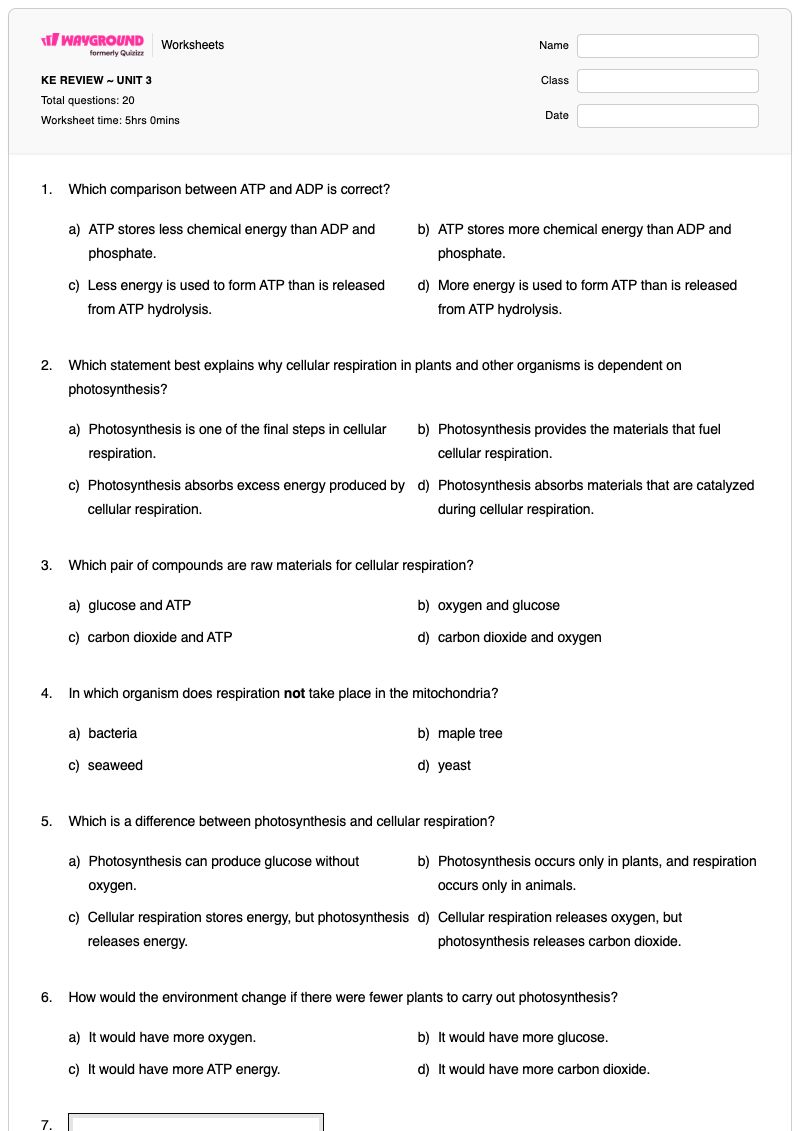
KE REVIEW ~ UNIT 3

คำถามทั้งหมด: 20

ชื่อ
ระดับ
วันที่
1.

Which comparison between ATP and ADP is correct?

a)

ATP stores less chemical energy than ADP and phosphate.

b)

ATP stores more chemical energy than ADP and phosphate.

c)

Less energy is used to form ATP than is released from ATP hydrolysis.

d)

More energy is used to form ATP than is released from ATP hydrolysis.

2.

Which statement best explains why cellular respiration in plants and other organisms is dependent on photosynthesis?

a)

Photosynthesis is one of the final steps in cellular respiration.

b)

Photosynthesis provides the materials that fuel cellular respiration.

c)

Photosynthesis absorbs excess energy produced by cellular respiration.

d)

Photosynthesis absorbs materials that are catalyzed during cellular respiration.

3.

Which pair of compounds are raw materials for cellular respiration?

a)

glucose and ATP

b)

oxygen and glucose

c)

carbon dioxide and ATP

d)

carbon dioxide and oxygen

4.

In which organism does respiration not take place in the mitochondria?

a)

bacteria

b)

maple tree

c)

seaweed

d)

yeast

5.

Which is a difference between photosynthesis and cellular respiration?

a)

Photosynthesis can produce glucose without oxygen.

b)

Photosynthesis occurs only in plants, and respiration occurs only in animals.

c)

Cellular respiration stores energy, but photosynthesis releases energy.

d)

Cellular respiration releases oxygen, but photosynthesis releases carbon dioxide.

6.

How would the environment change if there were fewer plants to carry out photosynthesis?

a)

It would have more oxygen.

b)

It would have more glucose.

c)

It would have more ATP energy.

d)

It would have more carbon dioxide.

7.
Which statement best describes a direct role of ATP in a paramecium?

Which statement best describes a direct role of ATP in a paramecium?

a)

ATP provides the energy to move cilia.

b)

ATP stores the genetic code for replication.

c)

ATP signals the presence of other nearby organisms.

d)

ATP senses changes in the surrounding aquatic environment.

8.

Which process uses the products of photosynthesis as reactants?

a)

active transport

b)

cellular respiration

c)

DNA replication

d)

protein synthesis

9.

Which of the following are the reactants in photosynthesis?

a)

oxygen (O2) and water (H2O)

b)

water (H2O) and glucose (C6H12O6)

c)

carbon dioxide (CO2) and water (H2O)

d)

glucose (C6H12O6) and carbon dioxide (CO2)

10.

A scientist observed that during the course of a chemical reaction the number of ATP molecules was reduced. What did the scientist most likely learn from the observation?

a)

The reaction produced water

b)

The reaction consumed water.

c)

The reaction caused an output of energy.

d)

The reaction required an input of energy.

11.
Four students classified the main energy conversions that occur during photosynthesis and cellular respiration. Which…

Four students classified the main energy conversions that occur during photosynthesis and cellular respiration. Which student best classified the energy conversions that occur in the two processes?

a)

student 1

b)

student 2

c)

student 3

d)

student 4

12.

Which statement best compares the energy transformations of photosynthesis and cellular respiration?

a)

Only photosynthesis uses oxygen to create energy.

b)

Only photosynthesis causes an increase in kinetic energy.

c)

Photosynthesis and cellular respiration both store energy in chemical bonds.

d)

Photosynthesis and cellular respiration both require chemical energy to make food.

13.
Use the diagram to answer the question. The diagram shows the movement of ions against a concentration gradient to an area…

Use the diagram to answer the question. The diagram shows the movement of ions against a concentration gradient to an area of higher concentration. Which molecule provides the energy needed for this movement to occur in a cell?

a)

ATP

b)

mRNA

c)

protein

d)

lipid

14.
Use the diagram to answer the question. The diagram shows an energy transformation that typically occurs in plant cell…

Use the diagram to answer the question. The diagram shows an energy transformation that typically occurs in plant cell plastids. Which statement best describes this role of plastids in the plant cell?

a)

Chloroplasts transform light energy into chemical energy.

b)

Mitochondria transform light energy into chemical energy.

c)

Chloroplasts transform chemical energy into electromagnetic energy.

d)

Mitochondria transform chemical energy into electromagnetic energy.

15.
Use the list to answer the question. Which two statements correctly describe one similarity and one difference between…

Use the list to answer the question. Which two statements correctly describe one similarity and one difference between cellular respiration and photosynthesis?

a)

statements 1 and 2

b)

statements 1 and 4

c)

statements 2 and 3

d)

statements 3 and 4

16.

Plant cells use sunlight to make their own food. Which structure allows plant cells to perform this function?

a)

nucleus

b)

vacuole

c)

chloroplast

d)

mitochondrion

17.
Use the list to answer the question. A plant cell uses the molecules in the list to synthesize a protein. What role do the…

Use the list to answer the question. A plant cell uses the molecules in the list to synthesize a protein. What role do the ATP molecules play in the protein synthesis process?

a)

They provide energy.

b)

They increase activation energy.

c)

They convert energy into hereditary information.

d)

They absorb excess energy to prevent overheating.

18.

Which statement best describes a relationship between mitochondria and chloroplasts?

a)

Mitochondria release chemical energy from molecules and store it in chloroplasts.

b)

Chloroplasts release chemical energy from molecules and store it in mitochondria.

c)

Mitochondria convert chemical energy into light energy that can be used by chloroplasts.

d)

Chloroplasts convert light energy into chemical energy that can be used by mitochondria.

19.
Use the lists below to answer the question. A student made lists of structures observed in cells from two different…

Use the lists below to answer the question. A student made lists of structures observed in cells from two different organisms. Which statement describes the most likely difference in the way that organism 1 and organism 2 obtain energy?

a)

Only organism 1 uses solar energy to make energy-rich compounds.

b)

Only organism 1 stores solar energy until it is needed for its life processes.

c)

Only organism 2 produces molecules for long-term energy storage.

d)

Only organism 2 transforms food energy into ATP during cellular respiration.

20.

A cell in the leaf of a green plant performs both photosynthesis and cellular respiration, often at the same time. Which statement best describes how these processes are related to each other?

a)

Both processes produce carbon dioxide.

b)

Both processes require energy directly from the Sun.

c)

Products of one process are used as some of the reactants for the other process.

d)

Thermal energy from one process is used as the energy source for the other process.

Waygroundแป้นคำตอบ

KE REVIEW ~ UNIT 3

คำถามทั้งหมด: 20

1.
b)

ATP stores more chemical energy than ADP and phosphate.

2.
b)

Photosynthesis provides the materials that fuel cellular respiration.

3.
b)

oxygen and glucose

4.
a)

bacteria

5.
a)

Photosynthesis can produce glucose without oxygen.

6.
d)

It would have more carbon dioxide.

7.
a)

ATP provides the energy to move cilia.

8.
b)

cellular respiration

9.
c)

carbon dioxide (CO2) and water (H2O)

10.
d)

The reaction required an input of energy.

11.
d)

student 4

12.
c)

Photosynthesis and cellular respiration both store energy in chemical bonds.

13.
a)

ATP

14.
a)

Chloroplasts transform light energy into chemical energy.

15.
a)

statements 1 and 2

16.
c)

chloroplast

17.
a)

They provide energy.

18.
d)

Chloroplasts convert light energy into chemical energy that can be used by mitochondria.

19.
a)

Only organism 1 uses solar energy to make energy-rich compounds.

20.
c)

Products of one process are used as some of the reactants for the other process.

คำถามที่พบบ่อย

แบบฝึกหัด KE REVIEW ~ UNIT 3 ครอบคลุมเนื้อหาอะไรบ้าง?

แบบทดสอบชีววิทยาแบบเลือกตอบ 20 ข้อนี้ ครอบคลุมหัวข้อต่างๆ เช่น ความสัมพันธ์ระหว่าง ATP และ ADP กับพลังงานในเซลล์ การใช้และการผลิตสารในกระบวนการสังเคราะห์แสงและการหายใจระดับเซลล์ และการเคลื่อนที่ของพลังงานในกระบวนการเหล่านี้ นอกจากนี้ นักเรียนยังได้ประยุกต์ใช้แนวคิดเหล่านี้กับออร์แกเนลล์ การเคลื่อนที่ของซีเลียที่ขับเคลื่อนด้วย ATP และการขนส่งแบบแอคทีฟ การทำงานของคลอโรพลาสต์ และการเปลี่ยนแปลงของออกซิเจนและคาร์บอนไดออกไซด์ในสิ่งแวดล้อม

ฉันจะใช้แบบฝึกหัดนี้ในการสอนเรื่อง ATP, การสังเคราะห์แสง และการหายใจระดับเซลล์ได้อย่างไร?

เริ่มการทบทวนโดยให้นักเรียนเปรียบเทียบสารตั้งต้น ผลิตภัณฑ์ และการเปลี่ยนแปลงพลังงานของการสังเคราะห์แสงและการหายใจระดับเซลล์ จากนั้นใช้ข้อสอบแบบเลือกตอบเพื่อกระตุ้นคำอธิบาย เช่น ถามนักเรียนว่าทำไม ATP จึงจำเป็นสำหรับการขนส่งแบบแอคทีฟหรือการเคลื่อนที่ของซีเลีย ทำไมแบคทีเรียจึงไม่ใช้ไมโทคอนเดรียในการหายใจ และจำนวนพืชที่ลดลงจะส่งผลกระทบต่อก๊าซในชั้นบรรยากาศอย่างไร หลังจากนั้นให้ทบทวนตัวเลือกคำตอบเพื่อตรวจสอบเหตุผล ไม่ใช่แค่การเลือกตัวอักษร

ฉันควรสังเกตข้อผิดพลาดอะไรบ้างเมื่อนักเรียนทำแบบฝึกหัดนี้เสร็จ?

นักเรียนอาจสับสนระหว่างสารตั้งต้นและผลิตภัณฑ์ของการสังเคราะห์แสงและการหายใจระดับเซลล์ โดยเฉพาะอย่างยิ่งคาร์บอนไดออกไซด์ ออกซิเจน น้ำ และกลูโคส พวกเขาอาจสลับความสัมพันธ์ทางพลังงานระหว่าง ATP และ ADP มองว่าไมโทคอนเดรียเป็นแหล่งหายใจในแบคทีเรีย หรือสับสนระหว่างคลอโรพลาสต์กับไมโทคอนเดรียเมื่อระบุการเปลี่ยนแปลงพลังงาน ในคำถามที่ใช้แผนภาพ ให้ตรวจสอบว่านักเรียนเข้าใจว่า ATP เป็นแหล่งพลังงานสำหรับการเคลื่อนที่สวนทางกับความเข้มข้นของสาร

ฉันจะมอบหมายและให้คะแนนแบบฝึกหัดนี้อย่างไร?

แบบฝึกหัด KE REVIEW ~ UNIT 3 มีให้ดาวน์โหลดในรูปแบบ PDF สำหรับพิมพ์ และแบบทดสอบดิจิทัลบน Wayground พร้อมเฉลยคำตอบครบถ้วน คุณสามารถตรวจงานที่ส่งมาในรูปแบบไฟล์พิมพ์ได้โดยการสแกนงานของนักเรียนด้วยแอป Wayground for Teachers หรือตรวจสอบคำตอบจากแบบทดสอบดิจิทัล รูปแบบไฟล์พิมพ์ยังช่วยสนับสนุนโรงเรียนที่ต้องการลดเวลาการใช้หน้าจอได้อีกด้วย

ฉันจะแยกแยะความแตกต่างระหว่างแบบฝึกหัดทบทวนเรื่อง ATP และการหายใจระดับเซลล์นี้ได้อย่างไร?

ใช้การตั้งค่าขั้นสูงของแบบฝึกหัดเพื่อปรับระยะห่างระหว่างตัวอักษรและขนาดตัวอักษร เพื่อให้คำถามแบบเลือกตอบ 20 ข้ออ่านง่ายขึ้น นอกจากนี้ คุณยังสามารถใช้แบบอักษรที่เหมาะสำหรับผู้ที่มีภาวะดิสเล็กเซีย หรือแปลแบบฝึกหัดเป็นภาษาอื่นได้ โดยยังคงเนื้อหาเกี่ยวกับ ATP การสังเคราะห์แสง การหายใจระดับเซลล์ และการเปลี่ยนแปลงพลังงานไว้เหมือนเดิม

ฉันจะหาแบบฝึกหัดแบบนี้เพิ่มเติมได้ที่ไหนบน Wayground?

Wayground มีแบบฝึกหัดและโจทย์ฝึกหัดมากมายให้ดาวน์โหลดฟรีในหลากหลายวิชา พร้อมไฟล์ PDF และเฉลยคำตอบ เพื่อช่วยให้นักเรียนพัฒนาทักษะและความเข้าใจในแนวคิดที่สำคัญ ดูแหล่งข้อมูลเพิ่มเติมได้ที่ https://wayground.com/en-us/worksheets