

Wayground
Photosynthesis - Printable ศาสตร์ Worksheets 6th ระดับชั้น - Wayground

Photosynthesis

Autumn Burgess

สร้างโดย Autumn Burgess

20 คำถาม

6th ระดับชั้น

ศาสตร์

อัปเดตแล้ว ต.ค. 2569

แบบฝึกหัดวิทยาศาสตร์ชั้นประถมศึกษาปีที่ 6 นี้ช่วยให้นักเรียนสร้างแบบจำลองที่ชัดเจนของกระบวนการสังเคราะห์แสงผ่านคำถามแบบเลือกตอบ 20 ข้อ ครอบคลุมถึงวัตถุดิบและผลิตภัณฑ์ของกระบวนการ ได้แก่ คาร์บอนไดออกไซด์ น้ำ ออกซิเจน และกลูโคส บทบาทของแสงแดดและคลอโรฟิลล์ และตำแหน่งของการสังเคราะห์แสงในคลอโรพลาสต์ คำถามยังกล่าวถึงวิธีการที่น้ำเคลื่อนที่ผ่านไซเลม วิธีการที่ก๊าซเข้าและออกจากปากใบ และวิธีการที่พลังงานรังสีเปลี่ยนเป็นพลังงานเคมี แบบฝึกหัดนี้ช่วยให้นักเรียนได้ฝึกฝนอย่างมุ่งเน้นในการเชื่อมโยงคำศัพท์เกี่ยวกับการสังเคราะห์แสงกับโครงสร้างและหน้าที่ของพืช นักเรียนสามารถระบุได้ว่าทำไมพืชจึงสร้างกลูโคส วิธีการเก็บพลังงาน ทำไมพืชจึงค้ำจุนสิ่งมีชีวิตบนโลก และความเข้มของแสงที่เพิ่มขึ้นส่งผลต่ออัตราการสังเคราะห์แสงอย่างไร แบบฝึกหัดนี้สามารถพิมพ์ได้ฟรีสำหรับใช้ในการสอน ทบทวน หรือประเมินผลวิชาวิทยาศาสตร์ชั้นประถมศึกษาปีที่ 6 และมีเฉลยคำตอบครบถ้วนเพื่อการตรวจสอบที่มีประสิทธิภาพ

การตั้งค่าแผ่นงาน

ขนาดตัวอักษร

S
M
L
XL
Waygroundแผ่นงาน

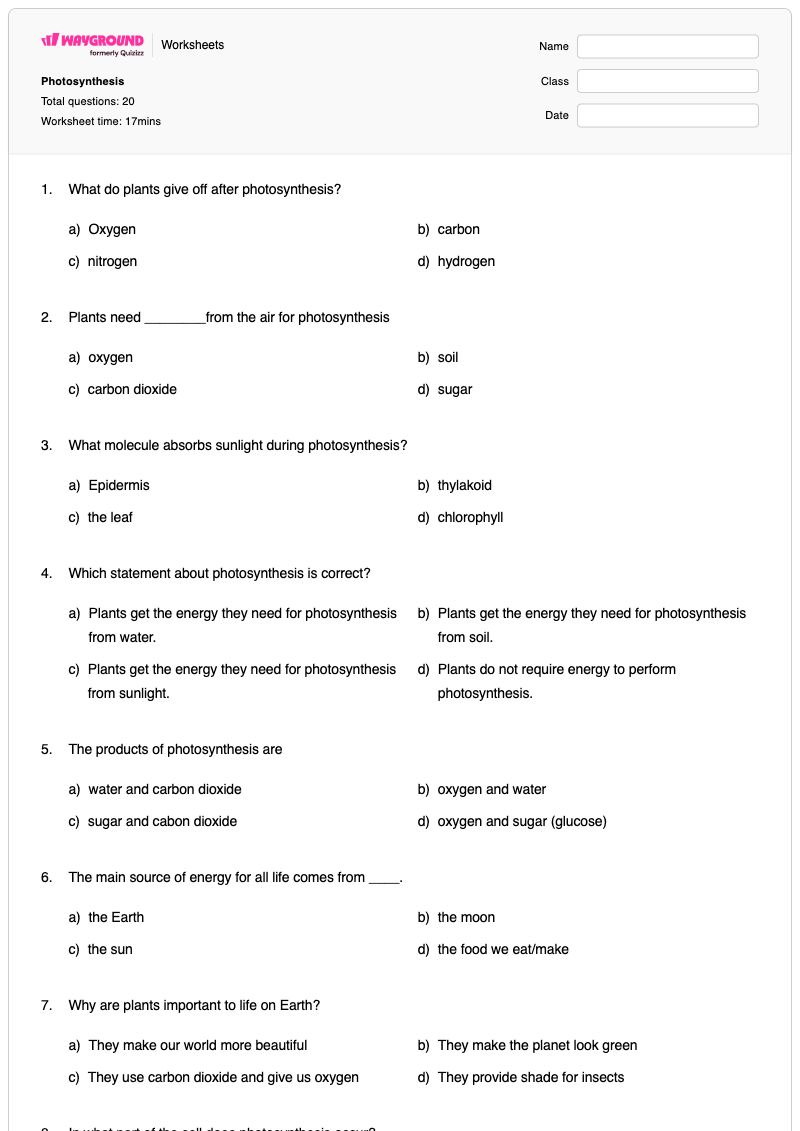
Photosynthesis

คำถามทั้งหมด: 20

ชื่อ
ระดับ
วันที่
1.
What do plants give off after photosynthesis?
a)
Oxygen
b)
carbon
c)
nitrogen
d)
hydrogen
2.
Plants need ________from the air for photosynthesis
a)
oxygen
b)
soil
c)
carbon dioxide
d)
sugar
3.
What molecule absorbs sunlight during photosynthesis?
a)
Epidermis
b)
thylakoid
c)
the leaf
d)
chlorophyll
4.
Which statement about photosynthesis is correct?
a)
Plants get the energy they need for photosynthesis from water.
b)
Plants get the energy they need for photosynthesis from soil.
c)
Plants get the energy they need for photosynthesis from sunlight.
d)
Plants do not require energy to perform photosynthesis.
5.
The products of photosynthesis are
a)
water and carbon dioxide
b)
oxygen and water
c)
sugar and cabon dioxide
d)
oxygen and sugar (glucose)
6.
The main source of energy for all life comes from ____.
a)
the Earth
b)
the moon
c)
the sun
d)
the food we eat/make
7.
Why are plants important to life on Earth?
a)
They make our world more beautiful
b)
They make the planet look green
c)
They use carbon dioxide and give us oxygen
d)
They provide shade for insects
8.
In what part of the cell does photosynthesis occur?
a)
Nucleus
b)
Chloroplast
c)
Epidermis
d)
Vacuole
9.
After photosynthesis, plants store their energy as _________ .
a)
chlorophyll
b)
pigment
c)
glucose (sugar)
d)
Oxygen
10.

How does most of the water needed by the plant get into its leaves?

a)

It enters through the stomata

b)

The roots absorb it and then it travels up the xylem

c)

It's made during a chemical reaction in the stem

d)

The flowers capture water and deliver it to the leaves

11.
Why do plants conduct photosynthesis?
a)
To make light
b)
To make mitochondria
c)
To make glucose
d)
To release carbon dioxide
12.
What major energy transformation occurs during photosynthesis?
a)
Thermal --> Chemical
b)
Kinetic --> Radiant
c)
Chemical --> Radiant
d)
Radiant --> Chemical
13.
How does carbon dioxide get into the leaves of a plant?
a)
It's absorbed by the roots
b)
It's made in a chemical reaction in the stem
c)
It enters through the stomata
d)
It goes through the flowers
14.
Which choice correctly shows the gases that enter and exit plants during photosynthesis?
a)
Enter: Oxygen
Exit: Carbon dioxide
b)
Enter: Water vapor
Exit: Glucose
c)
Enter: Carbon dioxide
Exit: Oxygen
d)
Enter: Light
Exit: Water vapor
15.

When light intensity goes up, the rate of photosynthesis goes _______.

a)

up

b)

down

c)

at the same rate. It does not change.

16.
__________ energy from the sun is changed intto __________ energy during photosynthesis
a)
Chemical energy to light energy
b)
Light energy to chemical energy
c)
Thermal energy to light energy
d)
Electrical energy to chemical enerfy
17.
What are the 3 key ingredients needed for photosynthesis
a)
glucose, oxygen, carbon dioxide
b)
carbon dioxide, water, glucose
c)
water, soil, sunlight
d)
sunlight, water, carbon dioxide
18.
Which of the following statement is true regarding photosynthesis
a)
creates oxygen for animals to breath
b)
creates energy for consumers to use
c)
creates food for plants to use
d)
all of these are correct
19.
Which of the following examples go through the process of photosynthesis?
a)
bees
b)
algae
c)
humans
d)
mushrooms
20.
A student is collecting the gas given off from a plant in bright sunlight at a temperature of 27°C. The gas being collected is probably ________.
a)
oxygen
b)
carbon dioxide
c)
ATP
d)
glucose
Waygroundแป้นคำตอบ

Photosynthesis

คำถามทั้งหมด: 20

1.
a) Oxygen
2.
c) carbon dioxide
3.
d) chlorophyll
4.
c) Plants get the energy they need for photosynthesis from sunlight.
5.
d) oxygen and sugar (glucose)
6.
c) the sun
7.
c) They use carbon dioxide and give us oxygen
8.
b) Chloroplast
9.
c) glucose (sugar)
10.
b)

The roots absorb it and then it travels up the xylem

11.
c) To make glucose
12.
d) Radiant --> Chemical
13.
c) It enters through the stomata
14.
c) Enter: Carbon dioxide
Exit: Oxygen
15.
a)

up

16.
b) Light energy to chemical energy
17.
d) sunlight, water, carbon dioxide
18.
d) all of these are correct
19.
b) algae
20.
a) oxygen

คำถามที่พบบ่อย

แบบฝึกหัดเรื่องการสังเคราะห์แสงสำหรับนักเรียนชั้นประถมศึกษาปีที่ 6 นี้ครอบคลุมเนื้อหาอะไรบ้าง?

แบบฝึกหัดนี้ประกอบด้วยคำถามแบบเลือกตอบ 20 ข้อ เพื่อประเมินว่านักเรียนเชื่อมโยงข้อมูลนำเข้า ผลผลิต โครงสร้าง และการเปลี่ยนแปลงพลังงานของการสังเคราะห์แสงได้อย่างไร นักเรียนจะระบุคาร์บอนไดออกไซด์และน้ำว่าเป็นวัสดุที่จำเป็น ออกซิเจนและกลูโคสเป็นผลผลิต คลอโรฟิลล์และคลอโรพลาสต์เป็นส่วนประกอบสำคัญ และบทบาทของปากใบ ท่อน้ำ แสงแดด และการเปลี่ยนพลังงานจากรังสีเป็นพลังงานเคมี

ฉันจะใช้แบบฝึกหัดนี้ในการสอนเรื่องการสังเคราะห์แสงได้อย่างไร?

เริ่มต้นด้วยการให้นักเรียนสังเกตการเข้าสู่ของก๊าซคาร์บอนไดออกไซด์ผ่านทางปากใบ และการเคลื่อนที่ของน้ำจากรากผ่านท่อลำเลียงน้ำไปยังใบ จากนั้นใช้คำถามแบบเลือกตอบเพื่ออธิบายว่าคลอโรฟิลล์ดักจับแสงแดดในคลอโรพลาสต์ได้อย่างไร และพลังงานรังสีนั้นเปลี่ยนเป็นพลังงานเคมีที่เก็บสะสมไว้ในกลูโคสได้อย่างไร ทบทวนแต่ละตัวเลือกหลังจากที่นักเรียนตอบแล้ว เพื่อให้พวกเขาอธิบายว่าเหตุใดข้อมูลนำเข้า ข้อมูลส่งออก โครงสร้าง หรือการเปลี่ยนแปลงพลังงานที่ถูกต้องจึงเหมาะสม

ฉันควรระวังข้อผิดพลาดอะไรบ้างเมื่อนักเรียนทำแบบฝึกหัดเรื่องการสังเคราะห์แสงนี้?

ระวังนักเรียนที่สับสนระหว่างออกซิเจนและคาร์บอนไดออกไซด์ โดยเฉพาะอย่างยิ่งเมื่อระบุว่าก๊าซใดเข้าสู่ใบและก๊าซใดถูกปล่อยออกมา พวกเขาอาจเลือกใบหรือชั้นผิวใบแทนคลอโรพลาสต์ หรือเลือกปากใบแทนไซเล็มเมื่อตอบคำถามเกี่ยวกับตำแหน่งและการลำเลียง นอกจากนี้ ข้อผิดพลาดทั่วไปอื่นๆ ได้แก่ การระบุว่ากลูโคสเป็นสารตั้งต้นแทนที่จะเป็นผลิตภัณฑ์ที่เก็บสะสม และการสลับลำดับการเปลี่ยนจากพลังงานรังสีเป็นพลังงานเคมี

ฉันจะมอบหมายและให้คะแนนแบบฝึกหัดเรื่องการสังเคราะห์แสงนี้ได้อย่างไร?

มอบหมายแบบฝึกหัดเรื่องการสังเคราะห์แสงในรูปแบบไฟล์ PDF ที่สามารถพิมพ์ได้ หรือเป็นแบบทดสอบดิจิทัลบน Wayground แบบฝึกหัดนี้มีเฉลยคำตอบครบถ้วน และสามารถตรวจให้คะแนนได้โดยการสแกนงานของนักเรียนด้วยแอป Wayground for Teachers รูปแบบไฟล์ที่พิมพ์ได้ยังช่วยให้โรงเรียนสามารถลดเวลาการใช้หน้าจอขณะประเมินความเข้าใจเรื่องการสังเคราะห์แสงของนักเรียนได้อีกด้วย

ฉันจะปรับแบบฝึกหัดเรื่องการสังเคราะห์แสงนี้ให้เหมาะสมกับนักเรียนของฉันได้อย่างไร?

ใช้การตั้งค่าขั้นสูงของแบบฝึกหัดเพื่อปรับระยะห่างระหว่างตัวอักษรและขนาดตัวอักษร เพื่อให้คำถามแบบเลือกตอบ 20 ข้ออ่านง่ายขึ้น นอกจากนี้ คุณยังสามารถใช้แบบอักษรที่เหมาะสำหรับผู้ที่มีภาวะดิสเล็กเซีย หรือแปลแบบฝึกหัดเป็นภาษาอื่นได้ หากตัวเลือกเหล่านั้นช่วยให้เข้าถึงคำศัพท์และตัวเลือกคำตอบเกี่ยวกับกระบวนการสังเคราะห์แสงได้ง่ายขึ้น

ฉันจะหาแบบฝึกหัดแบบนี้เพิ่มเติมได้ที่ไหนบน Wayground?

Wayground มีแบบฝึกหัดและโจทย์ฝึกหัดมากมายให้ดาวน์โหลดฟรีในหลากหลายวิชา พร้อมไฟล์ PDF และเฉลยคำตอบ เพื่อช่วยเสริมสร้างทักษะและความเข้าใจในแนวคิดสำคัญ ดูแหล่งข้อมูลเพิ่มเติมได้ที่ https://wayground.com/en-us/worksheets