

Wayground
Paragraph Writing Review - Printable อีแอลเอ Worksheets 7th ระดับชั้น - Wayground

Paragraph Writing Review

Amanda Wright

สร้างโดย Amanda Wright

20 คำถาม

7th ระดับชั้น

อีแอลเอ

อัปเดตแล้ว ต.ค. 2569

แบบฝึกหัดการเขียนย่อหน้า (Paragraph Writing Review) เป็นแบบฝึกหัดภาษาอังกฤษสำหรับนักเรียนชั้น ม.1 ที่สามารถพิมพ์ได้ฟรี เพื่อเรียนรู้วิธีการสร้างและจัดรูปแบบย่อหน้าวิเคราะห์วรรณกรรม แบบฝึกหัดนี้มีคำถามแบบเลือกตอบ 20 ข้อ ครอบคลุมบทบาทของประโยคหัวเรื่อง ประโยคสนับสนุน และประโยคสรุป ลำดับของส่วนต่างๆ ในย่อหน้า คำเชื่อม ความยาวของย่อหน้า และความแตกต่างระหว่างการวิเคราะห์ การสรุป และการแสดงความคิดเห็น แบบฝึกหัดนี้ยังตรวจสอบทักษะการเตรียมและการจัดรูปแบบที่สำคัญ รวมถึงการระดมความคิด การเว้นวรรค หลักการเขียนแบบ MLA ประโยค TAG การจัดรูปแบบชื่อเรื่อง และการหลีกเลี่ยงการใช้สรรพนามส่วนตัวในการวิเคราะห์วรรณกรรม นักเรียนใช้คำจำกัดความ การเรียงลำดับ ประโยคถูกหรือผิด และตัวเลือกคำตอบเพื่อระบุโครงสร้างย่อหน้าที่มีประสิทธิภาพและแนวทางการเขียนเชิงวิชาการ มีเฉลยคำตอบครบถ้วน ทำให้แบบฝึกหัดที่พิมพ์ได้ฟรีนี้มีประโยชน์สำหรับการทบทวน การฝึกฝนด้วยตนเอง การบ้าน หรือการประเมินความรู้ด้านการเขียนภาษาอังกฤษของนักเรียนชั้น ม.1 อย่างรวดเร็ว

การตั้งค่าแผ่นงาน

ขนาดตัวอักษร

S
M
L
XL
Waygroundแผ่นงาน

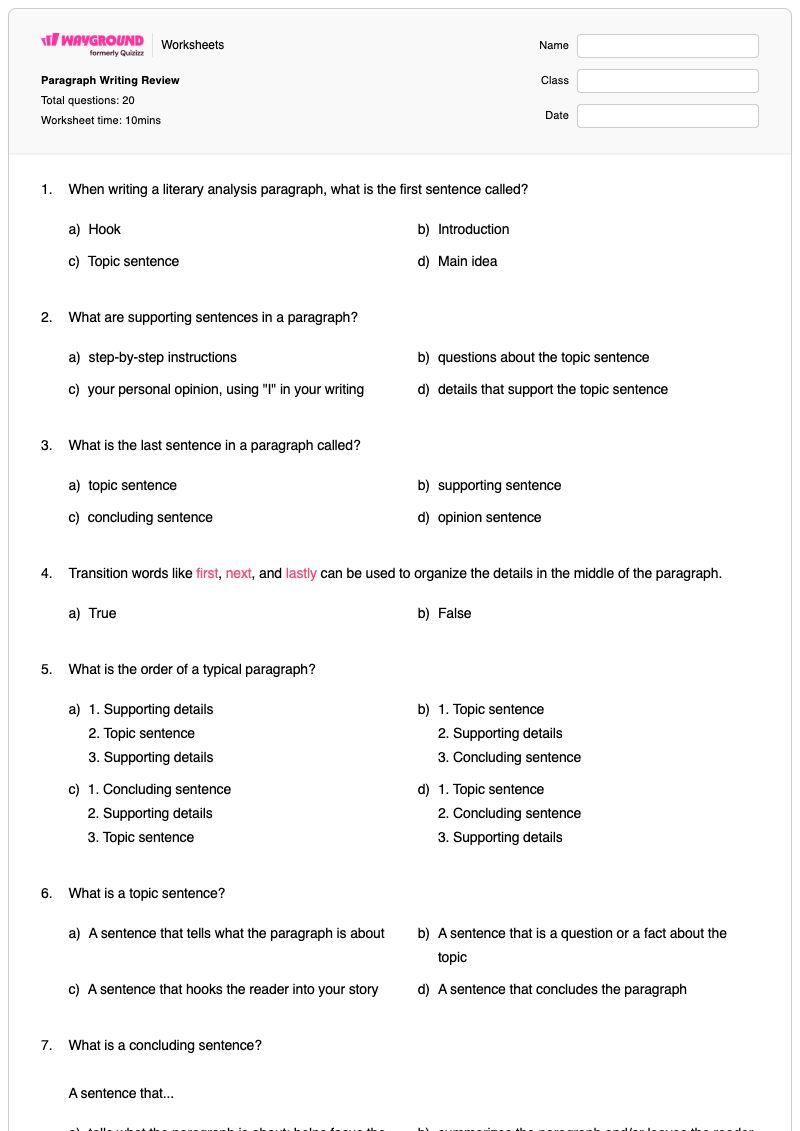
Paragraph Writing Review

คำถามทั้งหมด: 20

ชื่อ
ระดับ
วันที่
1.

When writing a literary analysis paragraph, what is the first sentence called?

a)

Hook

b)

Introduction

c)

Topic sentence

d)

Main idea

2.

What are supporting sentences in a paragraph?

a)

step-by-step instructions

b)

questions about the topic sentence

c)

your personal opinion, using "I" in your writing

d)

details that support the topic sentence

3.
What is the last sentence in a paragraph called?
a)
topic sentence
b)
supporting sentence
c)
concluding sentence
d)
opinion sentence
4.

Transition words like first, next, and lastly can be used to organize the details in the middle of the paragraph.

a)

True

b)

False

5.

What is the order of a typical paragraph?

a)

1. Supporting details

2. Topic sentence

3. Supporting details

b)

1. Topic sentence

2. Supporting details

3. Concluding sentence

c)

1. Concluding sentence

2. Supporting details

3. Topic sentence

d)

1. Topic sentence

2. Concluding sentence

3. Supporting details

6.

What is a topic sentence?

a)

A sentence that tells what the paragraph is about

b)

A sentence that is a question or a fact about the topic

c)

A sentence that hooks the reader into your story

d)

A sentence that concludes the paragraph

7.

What is a concluding sentence?


A sentence that...

a)

tells what the paragraph is about; helps focus the paragraph

b)

summarizes the paragraph and/or leaves the reader with a strong impression

c)

supports or gives more detailed information about the topic sentence

d)

introduces new information

8.

Before writing the first word of your paragraph, you should...

a)

indent one inch from the left margin

b)

brainstorm what you are going to write about

c)

set up your document with the right MLA formatting

d)

All of the above!

9.
Good paragraphs are like good _________.
a)
pizzas
b)
burgers
c)
french fries
d)
tomatoes
10.

Using personal pronouns, like "I think" or "My opinion," in a literary analysis paragraph makes your writing sound stronger.

a)

True!

b)

False!

11.

A standard paragraph, without text evidence/quotes, is about how long?

a)

3-5 sentences

b)

5-7 sentences

c)

1-2 sentences

d)

8-10 sentences

12.

A literary analysis is...

a)

a writing piece that analyzes a piece of literature

b)

an opinion-based writing piece, like a book review

c)

a summary of what you have read

d)

a creative writing piece inspired by the text

13.

What is standard MLA format?

a)

Times New Roman font

b)

Size 12 font

c)

Double-spaced

d)

All of the above

14.

The TAG statement includes

a)

Title, Author, Genre

b)

Topic and Genre

c)

Thesis Statement

d)

None of these

15.

When writing the title of a novel, it should be

a)

Italicized or Underlined

b)

In quotation marks

c)

In bold font

d)

In a bigger font

16.

If you are writing about an article or a poem, you should use what type of formatting for the title?

a)

Italics

b)

Quotation Marks

c)

Underline

d)

None of these

17.

Which acronym can help you write an organized paragraph?

a)

TAG

b)

ACES

c)

YMCA

d)

SOS

18.

In short, ACES stands for...

a)

Answer Correctly Each Sentence

b)

Answer, Cite, Explain, Sum it Up

c)

All Children Eat Sandwiches

d)

Ask, Cite, Explain, Say it again

19.

When formatting a quote in the middle of your paragraph, you don't need to include which of the following?

a)

Signal Phrase

b)

Author

c)

Page Number

d)

Title

20.

Which quote below from The Hunger Games has NOT been cited properly? Look carefully!

a)

On page 21, Katniss exclaims, "I volunteer as tribute!" (Collins).

b)

Katniss exclaims on page 21, "I volunteer as tribute!" (Collins).

c)

The text states, "I volunteer as tribute!" (Collins 21).

d)

"I volunteer as tribute!" the text states on page 21 of The Hunger Games (Collins).

Waygroundแป้นคำตอบ

Paragraph Writing Review

คำถามทั้งหมด: 20

1.
c)

Topic sentence

2.
d)

details that support the topic sentence

3.
c) concluding sentence
4.
a)

True

5.
b)

1. Topic sentence

2. Supporting details

3. Concluding sentence

6.
a)

A sentence that tells what the paragraph is about

7.
b)

summarizes the paragraph and/or leaves the reader with a strong impression

8.
d)

All of the above!

9.
b) burgers
10.
b)

False!

11.
b)

5-7 sentences

12.
a)

a writing piece that analyzes a piece of literature

13.
d)

All of the above

14.
a)

Title, Author, Genre

15.
a)

Italicized or Underlined

16.
b)

Quotation Marks

17.
b)

ACES

18.
b)

Answer, Cite, Explain, Sum it Up

19.
d)

Title

20.
d)

"I volunteer as tribute!" the text states on page 21 of The Hunger Games (Collins).

คำถามที่พบบ่อย

แบบฝึกหัดทบทวนการเขียนย่อหน้าครอบคลุมเนื้อหาอะไรบ้าง?

แบบฝึกหัดภาษาอังกฤษสำหรับนักเรียนชั้น ม.1 นี้ ประกอบด้วยคำถามแบบเลือกตอบ 20 ข้อ เพื่อทบทวนวิธีการเรียบเรียงย่อหน้าวิเคราะห์วรรณกรรม ได้แก่ ประโยคหัวเรื่อง รายละเอียดสนับสนุน คำเชื่อม และประโยคสรุป นอกจากนี้ยังตรวจสอบหลักการเขียนที่เกี่ยวข้อง เช่น การระดมความคิด การจัดรูปแบบ MLA ประโยค TAG การจัดรูปแบบชื่อนวนิยาย ความยาวของย่อหน้า และการหลีกเลี่ยงการใช้สรรพนามบุรุษที่สามในการเขียนวิเคราะห์

ฉันจะใช้แบบฝึกหัดนี้ในการสอนโครงสร้างย่อหน้าวิเคราะห์วรรณกรรมได้อย่างไร?

แนะนำลำดับของย่อหน้า—ประโยคหัวเรื่อง รายละเอียดสนับสนุน และประโยคสรุป—ก่อนที่นักเรียนจะทำแบบทดสอบแบบเลือกตอบ หลังจากนั้น ขอให้นักเรียนอธิบายว่าเหตุใดประโยคที่เลือกจึงสนับสนุนประโยคหัวเรื่อง หรือประโยคสรุปสรุปย่อหน้าอย่างไร จากนั้นใช้รูปแบบการจัดเรียงแบบ MLA, TAG และรูปแบบหัวเรื่อง เพื่อเชื่อมโยงการจัดระเบียบกับความคาดหวังของการวิเคราะห์วรรณกรรม

ฉันควรระวังข้อผิดพลาดอะไรบ้างเมื่อนักเรียนทำแบบฝึกหัดการเขียนย่อหน้านี้?

นักเรียนอาจสับสนระหว่างประโยคหัวเรื่องกับประโยคเกริ่นนำหรือประโยคสรุป หรือวางรายละเอียดสนับสนุนไว้ก่อนประโยคหัวเรื่องเมื่อตอบคำถามเกี่ยวกับการเรียงลำดับเหตุการณ์ โปรดระวังความสับสนระหว่างการวิเคราะห์และการสรุป ความเชื่อที่ว่าวลีส่วนตัว เช่น “ฉันคิดว่า” ช่วยเสริมความแข็งแกร่งให้กับการวิเคราะห์วรรณกรรม และข้อผิดพลาดที่เกี่ยวข้องกับ TAG, ข้อกำหนดของ MLA หรือการใช้ตัวเอียงและขีดเส้นใต้ชื่อนวนิยาย

ฉันจะมอบหมายและให้คะแนนแบบฝึกหัดการเขียนย่อหน้านี้อย่างไร?

แบบฝึกหัดนี้มีให้ดาวน์โหลดในรูปแบบไฟล์ PDF สำหรับพิมพ์ และเป็นแบบทดสอบดิจิทัลบน Wayground โดยมีเฉลยคำตอบครบถ้วนสำหรับคำถามแบบเลือกตอบ 20 ข้อ คุณสามารถตรวจงานส่งแบบพิมพ์ได้โดยการสแกนงานของนักเรียนด้วยแอป Wayground for Teachers ในขณะที่แบบทดสอบดิจิทัลสามารถมอบหมายผ่าน Wayground เพื่อให้นักเรียนทำและตรวจให้คะแนนทางออนไลน์ได้

ฉันจะปรับแบบฝึกหัดการวิเคราะห์วรรณกรรมนี้ให้เหมาะสมกับนักเรียนของฉันได้อย่างไร?

ใช้การตั้งค่าขั้นสูงของแบบฝึกหัดเพื่อปรับระยะห่างระหว่างตัวอักษรและขนาดตัวอักษรสำหรับคำถามแบบเลือกตอบและคำศัพท์การจัดรูปแบบย่อหน้า นอกจากนี้ คุณยังสามารถเลือกแบบอักษรที่เหมาะสำหรับผู้ที่มีภาวะดิสเล็กเซีย หรือแปลแบบฝึกหัดเป็นภาษาอื่นเพื่อให้การทบทวนเข้าถึงได้ง่ายยิ่งขึ้น

ฉันจะหาแบบฝึกหัดแบบนี้เพิ่มเติมได้ที่ไหนบน Wayground?

Wayground นำเสนอชุดแบบฝึกหัดและโจทย์ฝึกหัดฟรีที่ครอบคลุมทุกวิชา พร้อมไฟล์ PDF และเฉลยคำตอบ เพื่อสนับสนุนทักษะและแนวคิดที่สำคัญ ดูแหล่งข้อมูลเพิ่มเติมได้ที่ https://wayground.com/en-us/worksheets