

Wayground
Introduction to Programming Vocabulary - Printable คณิตศาสตร์ Worksheets 9th - 12th ระดับชั้น - Wayground

Introduction to Programming Vocabulary

LaToya James

สร้างโดย LaToya James

16 คำถาม

9th - 12th ระดับชั้น

คณิตศาสตร์

อัปเดตแล้ว พ.ค. 2569

แบบฝึกหัดคำศัพท์การเขียนโปรแกรมเบื้องต้นนี้เป็นแบบฝึกหัดที่พิมพ์ได้ฟรีสำหรับนักเรียนวิชาวิทยาการคอมพิวเตอร์ระดับชั้นมัธยมศึกษาตอนปลาย (เกรด 9-12) แบบฝึกหัดนี้มีคำถามแบบเลือกตอบ 16 ข้อ เพื่อตรวจสอบความเข้าใจของนักเรียนเกี่ยวกับคำศัพท์พื้นฐานในการเขียนโปรแกรม ได้แก่ อัลกอริทึม การจัดลำดับ การเลือก การวนซ้ำ นามธรรม ฟังก์ชัน API ไลบรารี พารามิเตอร์ เอกสารประกอบ เลขฐานสิบหก และลูป for นักเรียนเลือกคำจำกัดความที่ตรงกับคำศัพท์แต่ละคำ โดยแยกแยะแนวคิดที่เกี่ยวข้อง เช่น ภาษาการเขียนโปรแกรมระดับสูงและระดับต่ำ ฟังก์ชัน และไลบรารี แบบฝึกหัดนี้ช่วยพัฒนาคำศัพท์ก่อนที่นักเรียนจะได้อ่าน เขียน หรืออภิปรายโปรแกรมที่ใช้แนวคิดเหล่านี้ ช่วยให้ครูระบุได้ว่านักเรียนสามารถจดจำคำจำกัดความที่แม่นยำสำหรับแนวคิดหลักของการเขียนโปรแกรมได้หรือไม่ เช่น การออกแบบทีละขั้นตอน คำสั่งที่ใช้ซ้ำได้ การดำเนินการระดับเครื่อง การเลือกแบบบูลีน และโครงสร้างลูปที่กำหนดไว้ล่วงหน้า ใช้เป็นแบบฝึกหัดแนะนำ ทบทวน หรือตรวจสอบความเข้าใจในวิชาวิทยาการคอมพิวเตอร์ระดับมัธยมปลาย แบบฝึกหัดนี้มีให้ดาวน์โหลดเป็นไฟล์ PDF ที่พิมพ์ได้ฟรี และมีเฉลยคำตอบครบถ้วนเพื่อการตรวจสอบและให้ข้อเสนอแนะที่มีประสิทธิภาพ

การตั้งค่าแผ่นงาน

ขนาดตัวอักษร

S
M
L
XL
Waygroundแผ่นงาน

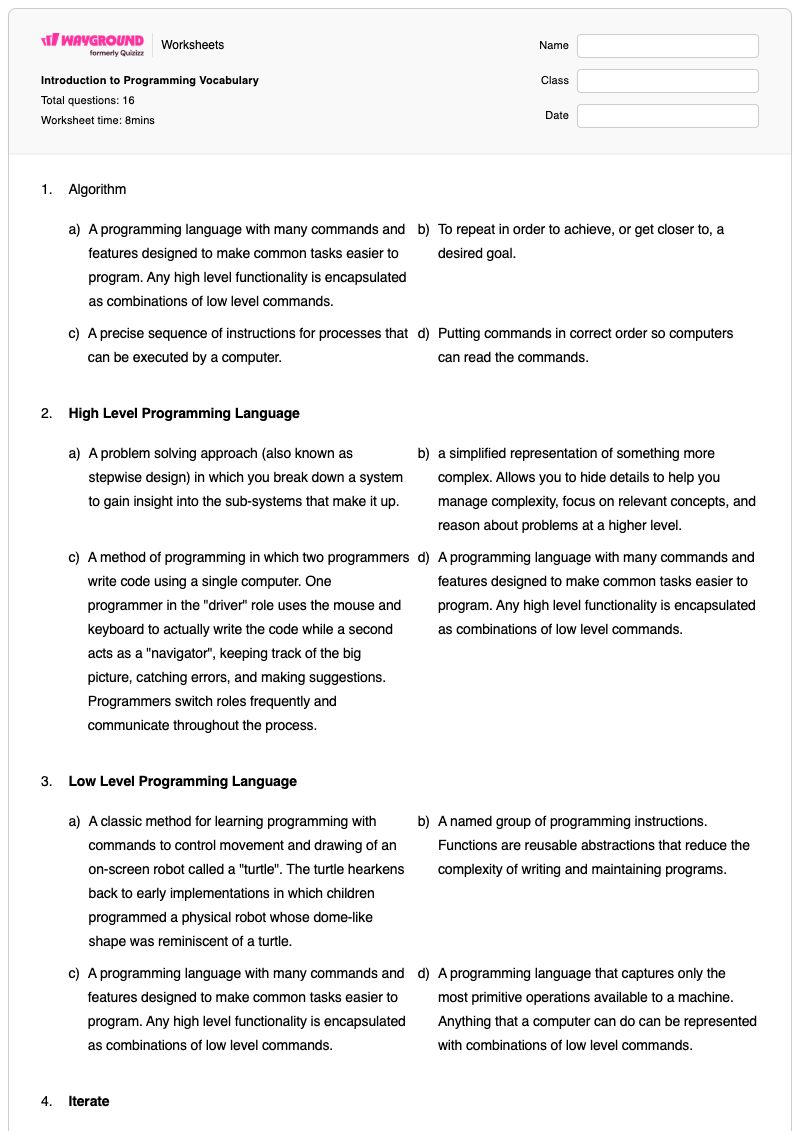
Introduction to Programming Vocabulary

คำถามทั้งหมด: 16

ชื่อ
ระดับ
วันที่
1.

Algorithm

a)

A programming language with many commands and features designed to make common tasks easier to program. Any high level functionality is encapsulated as combinations of low level commands.

b)

To repeat in order to achieve, or get closer to, a desired goal.

c)

A precise sequence of instructions for processes that can be executed by a computer.

d)

Putting commands in correct order so computers can read the commands.

2.

High Level Programming Language

a)

A problem solving approach (also known as stepwise design) in which you break down a system to gain insight into the sub-systems that make it up.

b)

a simplified representation of something more complex. Allows you to hide details to help you manage complexity, focus on relevant concepts, and reason about problems at a higher level.

c)

A method of programming in which two programmers write code using a single computer. One programmer in the "driver" role uses the mouse and keyboard to actually write the code while a second acts as a "navigator", keeping track of the big picture, catching errors, and making suggestions. Programmers switch roles frequently and communicate throughout the process.

d)

A programming language with many commands and features designed to make common tasks easier to program. Any high level functionality is encapsulated as combinations of low level commands.

3.

Low Level Programming Language

a)

A classic method for learning programming with commands to control movement and drawing of an on-screen robot called a "turtle". The turtle hearkens back to early implementations in which children programmed a physical robot whose dome-like shape was reminiscent of a turtle.

b)

A named group of programming instructions. Functions are reusable abstractions that reduce the complexity of writing and maintaining programs.

c)

A programming language with many commands and features designed to make common tasks easier to program. Any high level functionality is encapsulated as combinations of low level commands.

d)

A programming language that captures only the most primitive operations available to a machine. Anything that a computer can do can be represented with combinations of low level commands.

4.

Iterate

a)

To repeat in order to achieve, or get closer to, a desired goal.

b)

A generic term for a type of programming statement (usually an if-statement) that uses a Boolean condition to determine, or select, whether or not to run a certain block of statements.

c)

A collection of commands made available to a programmer.

d)

Putting commands in correct order so computers can read the commands.

5.

Selection

a)

A generic term for a type of programming statement (usually an if-statement) that uses a Boolean condition to determine, or select, whether or not to run a certain block of statements.

b)

Putting commands in correct order so computers can read the commands.

c)

To repeat in order to achieve, or get closer to, a desired goal.

d)

A named group of programming instructions. Functions are reusable abstractions that reduce the complexity of writing and maintaining programs.

6.

Sequencing

a)

A generic term for a type of programming statement (usually an if-statement) that uses a Boolean condition to determine, or select, whether or not to run a certain block of statements.

b)

To repeat in order to achieve, or get closer to, a desired goal.

c)

Putting commands in correct order so computers can read the commands.

d)

A description of the behavior of a command, function, library, API, etc.

7.

Abstraction

a)

·A generic term for a type of programming statement (usually an if-statement) that uses a Boolean condition to determine, or select, whether or not to run a certain block of statements.

b)

A named group of programming instructions. Reusable abstractions that reduce the complexity of writing and maintaining programs.

c)

A simplified representation of something more complex. Allows you to hide details to help you manage complexity, focus on relevant concepts, and reason about problems at a higher level.

d)

A collection of commands / functions, typically with a shared purpose.

8.

Function

a)

A base-16 number system that uses sixteen distinct symbols 0-9 and A-F to represent numbers from 0 to 15.

b)

A problem solving approach (also known as stepwise design) in which you break down a system to gain insight into the sub-systems that make it up.

c)

A generic term for a type of programming statement (usually an if-statement) that uses a Boolean condition to determine, or select, whether or not to run a certain block of statements.

d)

A named group of programming instructions. Reusable abstractions that reduce the complexity of writing and maintaining programs.

9.

Top Down Design

a)

A classic method for learning programming with commands to control movement and drawing of an on-screen robot called a "turtle". The turtle hearkens back to early implementations in which children programmed a physical robot whose dome-like shape was reminiscent of a turtle.

b)

A problem solving approach (also known as stepwise design) in which you break down a system to gain insight into the sub-systems that make it up.

c)

A method of programming in which two programmers write code using a single computer. One programmer in the "driver" role uses the mouse and keyboard to actually write the code while a second acts as a "navigator", keeping track of the big picture, catching errors, and making suggestions. Programmers switch roles frequently and communicate throughout the process.

d)

· : A programming language that captures only the most primitive operations available to a machine. Anything that a computer can do can be represented with combinations of low level commands.

10.

API

a)

A collection of commands made available to a programmer. A set of functions and procedures allowing the creation of applications that access the features or data of an operating system, application, or other service.

b)

A generic term for a type of programming statement (usually an if-statement) that uses a Boolean condition to determine, or select, whether or not to run a certain block of statements.

c)

A named group of programming instructions.

d)

A collection of commands / functions, typically with a shared purpose.

11.

Documentation

a)

A precise sequence of instructions for processes that can be executed by a computer.

b)

A named group of programming instructions.

c)

A simplified representation of something more complex.

d)

A description of the behavior of a command, function, library, API, etc.

12.

Hexadecimal

a)

An extra piece of information passed to a function to customize it for a specific need

b)

A collection of commands / functions, typically with a shared purpose.

c)

A base-16 number system that uses sixteen distinct symbols 0-9 and A-F to represent numbers from 0 to 15.

d)

The action of doing something over and over again.

13.

Library

a)

An extra piece of information passed to a function to customize it for a specific need.

b)

A collection of commands / functions, typically with a shared purpose.

c)

The action of doing something over and over again.

d)

A named group of programming instructions.

14.

Parameter

a)

An extra piece of information passed to a function to customize it for a specific need.

b)

Loops that have a predetermined beginning, end, and increment (step interval).

c)

The action of doing something over and over again.

d)

A collection of commands / functions, typically with a shared purpose.

15.

For Loop

a)

The action of doing something over and over again.

b)

· To repeat in order to achieve, or get closer to, a desired goal.

c)

Loops that have a predetermined beginning, end, and increment (step interval).

d)

· Putting commands in correct order so computers can read the commands.

16.

Loop

a)

Loops that have a predetermined beginning, end, and increment (step interval).

b)

The action of doing something over and over again.

c)

A description of the behavior of a command, function, library, API, etc.

d)

To repeat in order to achieve, or get closer to, a desired goal.

Waygroundแป้นคำตอบ

Introduction to Programming Vocabulary

คำถามทั้งหมด: 16

1.
c)

A precise sequence of instructions for processes that can be executed by a computer.

2.
d)

A programming language with many commands and features designed to make common tasks easier to program. Any high level functionality is encapsulated as combinations of low level commands.

3.
d)

A programming language that captures only the most primitive operations available to a machine. Anything that a computer can do can be represented with combinations of low level commands.

4.
a)

To repeat in order to achieve, or get closer to, a desired goal.

5.
a)

A generic term for a type of programming statement (usually an if-statement) that uses a Boolean condition to determine, or select, whether or not to run a certain block of statements.

6.
c)

Putting commands in correct order so computers can read the commands.

7.
c)

A simplified representation of something more complex. Allows you to hide details to help you manage complexity, focus on relevant concepts, and reason about problems at a higher level.

8.
d)

A named group of programming instructions. Reusable abstractions that reduce the complexity of writing and maintaining programs.

9.
b)

A problem solving approach (also known as stepwise design) in which you break down a system to gain insight into the sub-systems that make it up.

10.
a)

A collection of commands made available to a programmer. A set of functions and procedures allowing the creation of applications that access the features or data of an operating system, application, or other service.

11.
d)

A description of the behavior of a command, function, library, API, etc.

12.
c)

A base-16 number system that uses sixteen distinct symbols 0-9 and A-F to represent numbers from 0 to 15.

13.
b)

A collection of commands / functions, typically with a shared purpose.

14.
a)

An extra piece of information passed to a function to customize it for a specific need.

15.
c)

Loops that have a predetermined beginning, end, and increment (step interval).

16.
b)

The action of doing something over and over again.

คำถามที่พบบ่อย

แบบฝึกหัดคำศัพท์เบื้องต้นเกี่ยวกับการเขียนโปรแกรมครอบคลุมเนื้อหาอะไรบ้าง?

แบบฝึกหัดนี้ครอบคลุมคำศัพท์พื้นฐานทางวิทยาศาสตร์คอมพิวเตอร์ 16 คำ ผ่านคำถามแบบเลือกตอบ นักเรียนจับคู่คำศัพท์ เช่น อัลกอริทึม การจัดลำดับ การเลือก นามธรรม ฟังก์ชัน API พารามิเตอร์ ไลบรารี และลูป for กับความหมายที่ถูกต้อง เพื่อสร้างคำศัพท์ที่จำเป็นในการอธิบายวิธีการออกแบบและจัดระเบียบโปรแกรม

ฉันจะใช้แบบฝึกหัดนี้ในการสอนคำศัพท์พื้นฐานเกี่ยวกับการเขียนโปรแกรมได้อย่างไร?

เริ่มด้วยการแนะนำคำศัพท์พื้นฐานกลุ่มเล็กๆ ก่อน เช่น อัลกอริทึม การจัดลำดับ การเลือก และการวนซ้ำ จากนั้นให้นักเรียนทำข้อสอบแบบเลือกตอบด้วยตนเองหรือเป็นคู่ ขอให้นักเรียนอธิบายว่าทำไมคำจำกัดความที่เลือกจึงเหมาะสม และทำไมตัวเลือกอื่นที่เกี่ยวข้องจึงไม่เหมาะสม เช่น พารามิเตอร์แตกต่างจากฟังก์ชันอย่างไร หรือลูป for แตกต่างจากการวนซ้ำอย่างไร

ฉันควรระวังข้อผิดพลาดอะไรบ้างในแบบฝึกหัดคำศัพท์การเขียนโปรแกรมนี้?

นักเรียนอาจสับสนระหว่างคำศัพท์กว้างๆ กับคำศัพท์เฉพาะ เช่น การวนซ้ำ (iteration) กับลูป for หรือฟังก์ชัน (function) กับไลบรารี (library) และ API ควรระวังนักเรียนที่เลือกใช้คำจำกัดความจากคำที่คุ้นเคยมากกว่าความหมายที่แท้จริง โดยเฉพาะอย่างยิ่งเมื่อแยกแยะความแตกต่างระหว่างการจัดลำดับ (sequencing) กับการเลือก (selection) นามธรรม (abstraction) กับการออกแบบจากบนลงล่าง (top-down design) และภาษาโปรแกรมระดับสูงกับระดับต่ำ

ฉันจะมอบหมายและให้คะแนนแบบฝึกหัดคำศัพท์การเขียนโปรแกรมนี้ได้อย่างไร?

บน Wayground คุณสามารถมอบหมายแบบฝึกหัดนี้เป็นไฟล์ PDF ที่พิมพ์ได้ หรือเป็นแบบทดสอบดิจิทัล และมีเฉลยคำตอบครบถ้วนสำหรับคำถามแบบเลือกตอบทั้ง 16 ข้อ การส่งงานแบบพิมพ์สามารถตรวจได้โดยการสแกนงานของนักเรียนด้วยแอป Wayground for Teachers

ฉันจะปรับแบบฝึกหัดคำศัพท์การเขียนโปรแกรมนี้ให้เหมาะสมกับนักเรียนของฉันได้อย่างไร?

ใช้การตั้งค่าขั้นสูงของแบบฝึกหัดเพื่อปรับระยะห่างระหว่างตัวอักษรหรือขนาดตัวอักษร เพื่อให้ตัวเลือกคำจำกัดความทั้ง 16 ข้ออ่านง่ายขึ้น นอกจากนี้ คุณยังสามารถเลือกแบบอักษรที่เหมาะสำหรับผู้ที่มีภาวะดิสเล็กเซีย หรือแปลแบบฝึกหัดคำศัพท์การเขียนโปรแกรมเป็นภาษาอื่นเพื่อช่วยให้เข้าถึงคำศัพท์และคำจำกัดความได้ดียิ่งขึ้น

ฉันจะหาแบบฝึกหัดฟรีแบบนี้เพิ่มเติมได้ที่ไหนบน Wayground?

Wayground นำเสนอชุดแบบฝึกหัดและโจทย์ฝึกหัดฟรีที่ครอบคลุมหลากหลายวิชา พร้อมไฟล์ PDF และเฉลยคำตอบ เพื่อช่วยให้นักเรียนเชี่ยวชาญทักษะและแนวคิดที่สำคัญ ดูแหล่งข้อมูลเพิ่มเติมได้ที่ https://wayground.com/en-us/worksheets