
Wayground
3.5 Lesson Check - Continental Drift & Seafloor Spreading - Printable ศาสตร์ Worksheets ระดับ 6 - Wayground

3.5 Lesson Check - Continental Drift & Seafloor Spreading

M Abel

สร้างโดย M Abel

12 คำถาม

6th ระดับชั้น

ศาสตร์

อัปเดตแล้ว พ.ค. 2568

3.5 แบบฝึกหัดตรวจสอบความเข้าใจ - การเคลื่อนตัวของทวีปและการขยายตัวของพื้นทะเล เป็นแบบฝึกหัดวิทยาศาสตร์สำหรับนักเรียนชั้นประถมศึกษาปีที่ 6 ที่ใช้ตรวจสอบความเข้าใจของนักเรียนเกี่ยวกับแนวคิดการเคลื่อนตัวของทวีปของอัลเฟรด เวเกเนอร์ และหลักฐานที่สนับสนุนแนวคิดนั้น รวมถึงการจับคู่ฟอสซิล รอยแผลจากธารน้ำแข็ง ลักษณะภูมิประเทศ และเบาะแสเกี่ยวกับสภาพภูมิอากาศ นักเรียนยังต้องระบุแพนเจีย รู้จักหลักฐานที่เวเกเนอร์ไม่ได้ใช้ และเรียงลำดับภาพที่แสดงการแตกตัวของมหาทวีป จากนั้นแบบฝึกหัดจะเชื่อมโยงการเคลื่อนที่ของทวีปกับการขยายตัวของพื้นทะเล ในแบบฝึกหัด 12 ข้อ—คำถามแบบเลือกตอบ 10 ข้อ งานเรียงลำดับ 1 ข้อ และคำถามแบบดรอปดาวน์ 1 ข้อ—นักเรียนจะต้องระบุถึงกระบวนการที่ก่อให้เกิดเปลือกโลกใต้ทะเลใหม่ กำหนดว่าอายุของหินเปลี่ยนแปลงอย่างไรตามระยะทางจากสันกลางมหาสมุทร ระบุตำแหน่งพื้นทะเลแอตแลนติกที่อายุน้อยที่สุด และระบุตัวตนของมารี ธาร์ป แบบฝึกหัดที่พิมพ์ได้ฟรีนี้มีเฉลยคำตอบครบถ้วนและสามารถใช้สนับสนุนการตรวจสอบความเข้าใจ การทบทวน หรือการประเมินผลระหว่างเรียนได้

การตั้งค่าแผ่นงาน

ขนาดตัวอักษร

S
M
L
XL
Waygroundแผ่นงาน

3.5 Lesson Check - Continental Drift & Seafloor Spreading

คำถามทั้งหมด: 12

ชื่อ
ระดับ
วันที่
1.

What was Wegener’s continental drift idea?

a)

The continents have moved slowly apart to their current locations.

b)

The continents have always been located at their current locations.

c)

The continents are moving slowly together from their current locations.

d)

None of these

2.
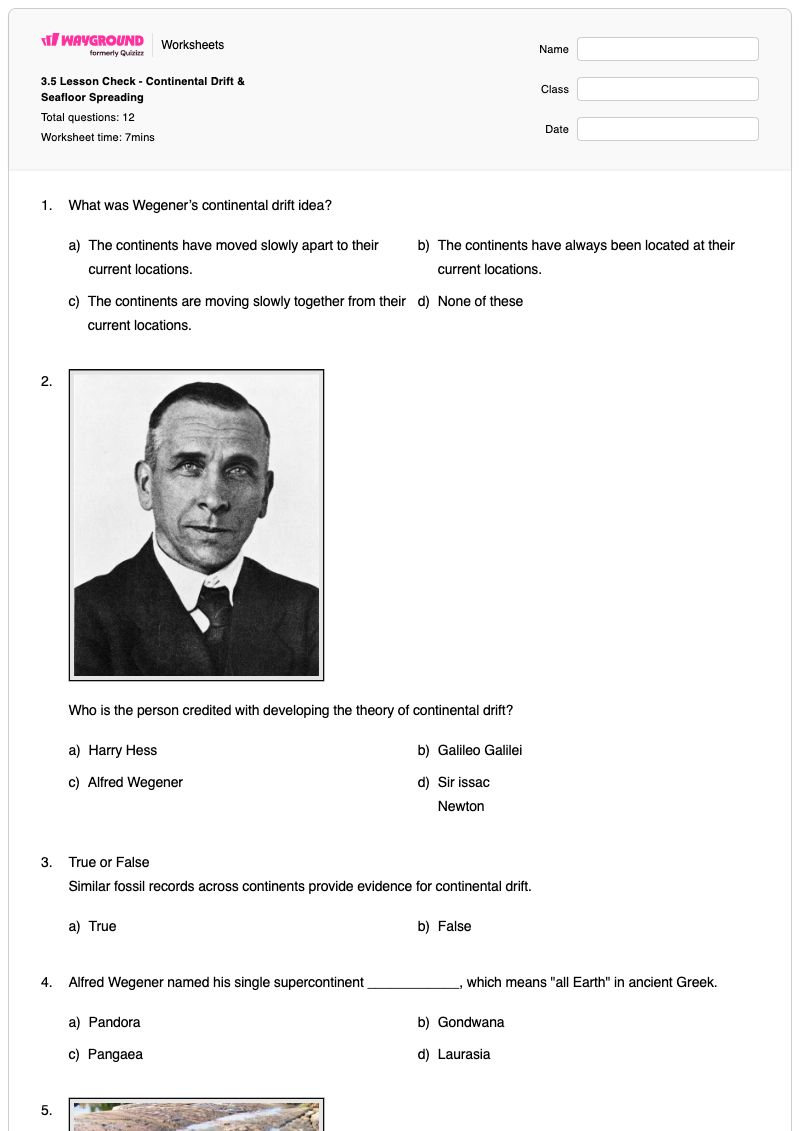
Who is the person credited with developing the theory of continental drift?
a)
Harry Hess
b)

Galileo Galilei

c)
Alfred Wegener
d)

Sir issac

Newton

3.

True or False

Similar fossil records across continents provide evidence for continental drift.

a)

True

b)

False

4.

Alfred Wegener named his single supercontinent ____________, which means "all Earth" in ancient Greek.

a)

Pandora

b)

Gondwana

c)

Pangaea

d)

Laurasia

5.
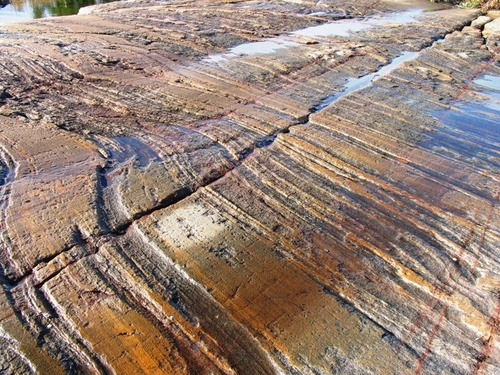
This is a picture of glacier scars found in Africa. What are these evidence for?
This is a picture of glacier scars found in Africa.  What are these evidence for?
a)
Africa has always been near the equator
b)
Africa was once in an area of the Earth that had a very cold climate
c)
The continents have not moved
d)
sea floor spreading
6.
What evidence did Wegener use to support his theory?

What evidence did Wegener use to support his theory?

a)

Continents and fossils fitting together/matching-up like puzzle pieces

b)

glacier scars and other climate evidence from temperature

c)

mountain ranges and rocks line up across continents

d)

all of the above

7.

Which type of evidence was NOT used by Alfred Wegener to support his continental drift hypothesis?

a)

evidence from fossils

b)

evidence from human remains

c)

evidence from climates

d)

evidence from landforms

8.

Order the pictures of Pangaea from oldest to present day.

a)
Order the pictures of Pangaea from oldest to present day.
b)
Order the pictures of Pangaea from oldest to present day.
c)
Order the pictures of Pangaea from oldest to present day.
d)
Order the pictures of Pangaea from oldest to present day.
e)
Order the pictures of Pangaea from oldest to present day.
1)
2)
3)
4)
5)
9.

The process of ___________ continually adds new crust to the ocean floor along both sides of the mid-ocean ridge.

a)

plate tectonics

b)

seafloor spreading

c)

continental drift

d)

convection

10.

The farther from a mid-ocean ridge a rock sample is taken, the (a)   the rock is.

เลือกจากคำด้านล่าง
older
younger
11.
In the Atlantic ocean, where is the youngest seafloor located?

In the Atlantic ocean, where is the youngest seafloor located?

a)

Towards the edges, near the eastern and western continents.

b)

Towards the middle of the ocean at ocean ridges.

c)

Towards the north and south poles.

d)

Young seafloor is located randomly throughout the ocean.

12.

Which scientist discovered mountain ranges located the ocean floor and developed the theory of seafloor spreading?

a)

Marie Tharp

b)

Charles Darwin

c)

Alfred Wegener

d)

None of these

Waygroundแป้นคำตอบ

3.5 Lesson Check - Continental Drift & Seafloor Spreading

คำถามทั้งหมด: 12

1.
a)

The continents have moved slowly apart to their current locations.

2.
c) Alfred Wegener
3.
a)

True

4.
c)

Pangaea

5.
b) Africa was once in an area of the Earth that had a very cold climate
6.
d)

all of the above

7.
b)

evidence from human remains

8.
a, b, c, d, e
9.
b)

seafloor spreading

10.
older
11.
b)

Towards the middle of the ocean at ocean ridges.

12.
a)

Marie Tharp

คำถามที่พบบ่อย

แบบฝึกหัดนี้ครอบคลุมเนื้อหาอะไรบ้าง และช่วยให้นักเรียนเข้าใจเรื่องการเคลื่อนตัวของทวีปและการขยายตัวของพื้นทะเลได้อย่างไร?

แบบฝึกหัดวิทยาศาสตร์สำหรับนักเรียนชั้นประถมศึกษาปีที่ 6 นี้ ประกอบด้วยคำถามแบบเลือกตอบ 10 ข้อ งานเรียงลำดับ และตัวเลือกแบบดรอปดาวน์ เพื่อประเมินหลักฐานการเคลื่อนตัวของทวีปและการขยายตัวของพื้นทะเล นักเรียนจะต้องตีความหลักฐานจากฟอสซิล รอยแผลจากธารน้ำแข็ง สภาพภูมิอากาศ เทือกเขา และหิน เรียงลำดับการแตกตัวของมหาทวีปแพนเจีย และประยุกต์ใช้รูปแบบที่ว่าพื้นทะเลจะมีอายุมากขึ้นเมื่ออยู่ห่างจากสันกลางมหาสมุทร

ฉันจะใช้แบบฝึกหัดนี้ในการสอนเรื่องการเคลื่อนตัวของทวีปและการขยายตัวของพื้นทะเลได้อย่างไร?

เริ่มด้วยการให้นักเรียนจัดเรียงหลักฐานต่างๆ ออกเป็นหมวดหมู่ เช่น ฟอสซิล หลักฐานเกี่ยวกับสภาพภูมิอากาศ และลักษณะภูมิประเทศที่ตรงกัน ก่อนที่จะตอบคำถามแบบเลือกตอบ จากนั้นใช้ข้อมูลเกี่ยวกับการเรียงลำดับของมหาทวีปแพนเจียเพื่ออธิบายการเคลื่อนที่ของทวีป และใช้คำถามเกี่ยวกับพื้นทะเลเพื่อเชื่อมโยงสันกลางมหาสมุทร เปลือกโลกใหม่ และอายุของหิน ถามนักเรียนว่าทำไมพื้นทะเลที่อายุน้อยที่สุดจึงพบอยู่ใกล้กับสันเขา

ฉันควรระวังข้อผิดพลาดอะไรบ้างเมื่อนักเรียนทำแบบฝึกหัดเรื่องการเคลื่อนตัวของทวีปนี้?

นักเรียนอาจสับสนระหว่างอัลเฟรด เวเกเนอร์ แฮร์รี เฮสส์ และมารี ธาร์ป หรือเลือกซากมนุษย์แทนหลักฐานประเภทอื่นๆ ที่ระบุไว้ในแบบฝึกหัด นอกจากนี้ พวกเขาอาจสลับลำดับของมหาทวีปแพนเจีย เลือกการเคลื่อนตัวของทวีปแทนการขยายตัวของพื้นทะเลเพื่อสร้างเปลือกโลกใต้มหาสมุทรใหม่ หรือคิดว่าหินมีอายุอ่อนลงแทนที่จะมีอายุมากขึ้นเมื่อเคลื่อนตัวออกไปไกลจากสันกลางมหาสมุทร

ฉันจะมอบหมายและให้คะแนนแบบฝึกหัดเรื่องการเคลื่อนตัวของทวีปและการขยายตัวของพื้นทะเลนี้ได้อย่างไร?

แบบฝึกหัดนี้มีให้ดาวน์โหลดในรูปแบบไฟล์ PDF ที่สามารถพิมพ์ได้ และเป็นแบบทดสอบดิจิทัลบน Wayground โดยมีเฉลยคำตอบครบถ้วนสำหรับทั้ง 12 ข้อ สำหรับการส่งงานแบบพิมพ์ ให้สแกนงานของนักเรียนด้วยแอป Wayground for Teachers เพื่อตรวจให้คะแนนได้อย่างมีประสิทธิภาพ

แบบฝึกหัดนี้เชื่อมโยงหลักฐานของเวเกเนอร์เข้ากับทฤษฎีการขยายตัวของพื้นทะเลได้อย่างไร?

แบบฝึกหัดนี้เริ่มต้นด้วยการให้นักเรียนระบุว่าฟอสซิล รอยแผลจากธารน้ำแข็ง หลักฐานทางภูมิอากาศ และลักษณะภูมิประเทศที่เรียงตัวกันนั้นสนับสนุนทฤษฎีการเคลื่อนตัวของทวีปอย่างไร จากนั้นจึงเปลี่ยนไปพูดถึงการก่อตัวและอายุของเปลือกโลกใต้มหาสมุทร ลำดับและการนำเสนอเนื้อหาเกี่ยวกับพื้นมหาสมุทรช่วยให้นักเรียนเชื่อมโยงการแตกตัวของมหาทวีปแพนเจียกับการก่อตัวของเปลือกโลกใหม่ที่สันกลางมหาสมุทรและการเคลื่อนตัวของเปลือกโลกเก่าออกไปจากสันกลางมหาสมุทร

ฉันจะหาแบบฝึกหัดแบบนี้เพิ่มเติมได้ที่ไหนบน Wayground?

Wayground มีแบบฝึกหัดและโจทย์ฝึกหัดมากมายให้ดาวน์โหลดฟรีในหลากหลายวิชา พร้อมไฟล์ PDF และเฉลยคำตอบ เพื่อช่วยให้นักเรียนพัฒนาทักษะและความเข้าใจในแนวคิดที่สำคัญ ดูแหล่งข้อมูลเพิ่มเติมได้ที่ https://wayground.com/en-us/worksheets