

Wayground
Continental Drift and Seafloor Spreading - Printable ศาสตร์ Worksheets 6th ระดับชั้น - Wayground

Continental Drift and Seafloor Spreading

Alexa Biscaha

สร้างโดย Alexa Biscaha

19 คำถาม

6th ระดับชั้น

ศาสตร์

อัปเดตแล้ว ก.ย. 2569

แบบฝึกหัดวิทยาศาสตร์สำหรับนักเรียนชั้นประถมศึกษาปีที่ 6 เรื่อง การเคลื่อนตัวของทวีปและการขยายตัวของพื้นทะเล ช่วยเสริมสร้างความเข้าใจเกี่ยวกับวิธีการเคลื่อนตัวของทวีปจากมหาทวีปแพนเจีย และการก่อตัวของเปลือกโลกใต้มหาสมุทรใหม่ที่สันกลางมหาสมุทร นักเรียนจะได้ระบุชื่อของอัลเฟรด เวเกเนอร์ และแฮร์รี เฮสส์ แยกแยะความแตกต่างระหว่างการเคลื่อนตัวของทวีปและการขยายตัวของพื้นทะเล และเชื่อมโยงทฤษฎีแต่ละทฤษฎีกับหลักฐานต่างๆ เช่น ฟอสซิล ลักษณะภูมิประเทศ สภาพภูมิอากาศโบราณ และอายุของหินใต้ทะเล แบบฝึกหัดประกอบด้วย 19 ข้อ แบ่งเป็นข้อเลือกตอบ 16 ข้อ และข้อเลือกคำตอบ 3 ข้อ นักเรียนจะได้ระบุสันกลางมหาสมุทร กำหนดตำแหน่งที่พบหินใต้ทะเลที่อายุน้อยที่สุดและเก่าแก่ที่สุด และเลือกข้อความและหลักฐานที่ถูกต้องเกี่ยวกับการขยายตัวของพื้นทะเล แบบฝึกหัดที่พิมพ์ได้ฟรีนี้มีเฉลยคำตอบครบถ้วนเพื่อตรวจสอบความเข้าใจของนักเรียนเกี่ยวกับคำศัพท์ หลักฐาน นักวิทยาศาสตร์ และความสัมพันธ์ระหว่างสาเหตุและผลกระทบในแนวคิดวิทยาศาสตร์โลกเหล่านี้

การตั้งค่าแผ่นงาน

ขนาดตัวอักษร

S
M
L
XL
Waygroundแผ่นงาน

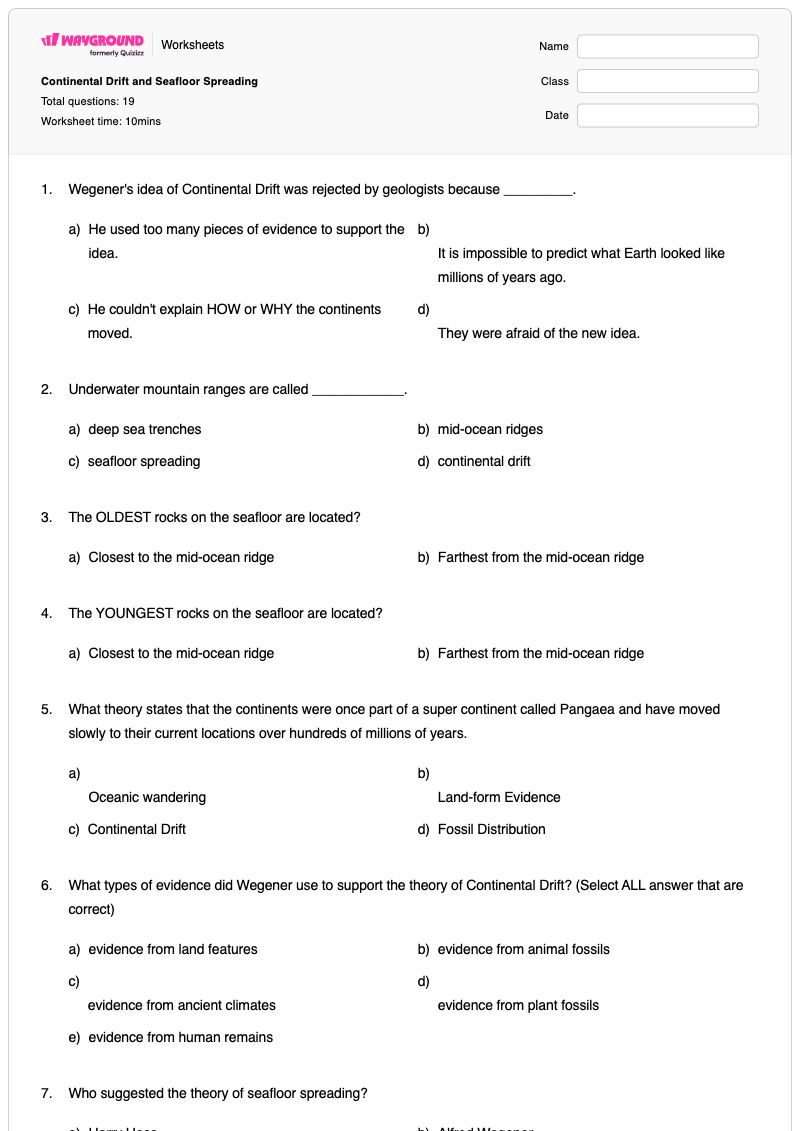
Continental Drift and Seafloor Spreading

คำถามทั้งหมด: 19

ชื่อ
ระดับ
วันที่
1.

Wegener's idea of Continental Drift was rejected by geologists because _________.

a)

He used too many pieces of evidence to support the idea.

b)


It is impossible to predict what Earth looked like millions of years ago.

c)

He couldn't explain HOW or WHY the continents moved.

d)


They were afraid of the new idea.

2.

Underwater mountain ranges are called ____________.

a)

deep sea trenches

b)

mid-ocean ridges

c)

seafloor spreading

d)

continental drift

3.

The OLDEST rocks on the seafloor are located?

a)

Closest to the mid-ocean ridge

b)

Farthest from the mid-ocean ridge

4.

The YOUNGEST rocks on the seafloor are located?

a)

Closest to the mid-ocean ridge

b)

Farthest from the mid-ocean ridge

5.

What theory states that the continents were once part of a super continent called Pangaea and have moved slowly to their current locations over hundreds of millions of years.

a)


Oceanic wandering

b)


Land-form Evidence

c)

Continental Drift

d)

Fossil Distribution

6.

What types of evidence did Wegener use to support the theory of Continental Drift? (Select ALL answer that are correct)

a)

evidence from land features

b)

evidence from animal fossils

c)


evidence from ancient climates

d)


evidence from plant fossils

e)

evidence from human remains

7.

Who suggested the theory of seafloor spreading?

a)

Harry Hess

b)

Alfred Wegener

c)

Albert Einstein

d)

Mrs. Moskowitz

8.

According to Wegener, the continents used to be joined together as one supercontinent known as:

a)

South Africa

b)

Eurasia

c)

Gonwandaland

d)

Pangaea

9.

How long did it take the continents to move from Pangaea into their current position?

a)

Hundreds of years

b)

Thousands of years

c)

Millions of years

10.

Who is the person credited with developing the theory of continental drift?

a)

Harry Hess

b)

Mrs. Moskowitz

c)

Albert Einstein

d)

Alfred Wegener

11.
What is this a picture of?

What is this a picture of?

a)

Eurasia

b)

Pangaea

c)

Laurasia

d)

Gonwandaland

12.

The youngest seafloor crust is located...

a)

Farthest from the mid-ocean ridges

b)

Closest to the mid ocean ridges

c)

Nearest the continents

d)

On the land

13.

The process of new seafloor forming when magma rises at the mid-ocean ridges and solidifies, pushing older rock away is called _____.

a)

Seafloor Spreading

b)

Continental Drift

14.

Select all the TRUE statements about seafloor spreading

a)

The oldest rocks are located closest to the mid-ocean ridges.

b)


Seafloor spreading explains how mid-ocean ridges are formed.

c)

Seafloor spreading explains how the continents moved apart.

d)

New seafloor is formed at mid-ocean ridges.

15.

What are TWO pieces of evidence for Seafloor Spreading

a)

Youngest rocks are located closest to mid-ocean ridges

b)


Similar animal fossils are found on continents separated by oceans.

c)


It is very hot in the United States in the summer.

d)

Older rocks are further away from mid-ocean ridges

16.

At the Mid-Ocean Ridges you can find:

a)

deep sea trenches

b)

the oldest crust

c)

the newest crust

17.
The image shows a diagram of the ocean floor near a mid-ocean ridge. Where would the oldest rock be found?

The image shows a diagram of the ocean floor near a mid-ocean ridge. Where would the oldest rock be found?

a)

L

b)

M

c)

N

d)

O

18.

True or false: The tectonic plates will never stop moving

a)

True

b)

False

19.

Convection currents in the _________ pull the seafloor apart.

a)

crust

b)

mantle

c)

core

Waygroundแป้นคำตอบ

Continental Drift and Seafloor Spreading

คำถามทั้งหมด: 19

1.
c)

He couldn't explain HOW or WHY the continents moved.

2.
b)

mid-ocean ridges

3.
b)

Farthest from the mid-ocean ridge

4.
a)

Closest to the mid-ocean ridge

5.
c)

Continental Drift

6.
a)

evidence from land features

, b)

evidence from animal fossils

, c)


evidence from ancient climates

, d)


evidence from plant fossils

7.
a)

Harry Hess

8.
d)

Pangaea

9.
c)

Millions of years

10.
d)

Alfred Wegener

11.
b)

Pangaea

12.
b)

Closest to the mid ocean ridges

13.
a)

Seafloor Spreading

14.
b)


Seafloor spreading explains how mid-ocean ridges are formed.

, c)

Seafloor spreading explains how the continents moved apart.

, d)

New seafloor is formed at mid-ocean ridges.

15.
a)

Youngest rocks are located closest to mid-ocean ridges

, d)

Older rocks are further away from mid-ocean ridges

16.
c)

the newest crust

17.
d)

O

18.
a)

True

19.
b)

mantle

คำถามที่พบบ่อย

แบบฝึกหัดเรื่องการเคลื่อนตัวของทวีปและการขยายตัวของพื้นทะเลครอบคลุมเนื้อหาอะไรบ้าง?

แบบฝึกหัดวิทยาศาสตร์สำหรับนักเรียนชั้นประถมศึกษาปีที่ 6 นี้ ประกอบด้วยคำถามแบบเลือกตอบ 16 ข้อ และคำถามแบบเลือกคำตอบ 3 ข้อ เพื่อประเมินความเข้าใจเกี่ยวกับทฤษฎีการเคลื่อนตัวของทวีป มหาทวีปแพนเจีย การขยายตัวของพื้นทะเล และสันกลางมหาสมุทร นักเรียนจะได้เชื่อมโยงหลักฐานของเวเกเนอร์เกี่ยวกับการเคลื่อนตัวของทวีปกับทฤษฎีการขยายตัวของพื้นทะเลของเฮสส์ ระบุตำแหน่งที่พบหินใต้ทะเลที่อายุน้อยที่สุดและเก่าแก่ที่สุด และเลือกหลักฐานและข้อความที่ถูกต้อง

ฉันจะใช้แบบฝึกหัดนี้ในการสอนเรื่องการเคลื่อนตัวของทวีปและการขยายตัวของพื้นทะเลได้อย่างไร?

แนะนำทฤษฎีแพนเจียและหลักฐานของเวเกเนอร์ จากนั้นให้นักเรียนแยกแยะความแตกต่างระหว่างแนวคิดที่ว่าทวีปเคลื่อนที่กับกระบวนการที่สร้างพื้นทะเลใหม่ ใช้ข้อสอบแบบเลือกตอบเพื่อทบทวนคำศัพท์และนักวิทยาศาสตร์ และหยุดที่ข้อสอบแบบเลือกหลายข้อเพื่ออภิปรายว่าเหตุใดฟอสซิล ลักษณะภูมิประเทศ สภาพภูมิอากาศโบราณ และอายุของหินใต้ทะเลจึงสนับสนุนทฤษฎีเหล่านั้น ถามนักเรียนว่าแมกมาที่สันกลางมหาสมุทรสร้างเปลือกโลกใหม่และผลักดันหินเก่าออกไปได้อย่างไร

ฉันควรสังเกตข้อผิดพลาดอะไรบ้างเมื่อนักเรียนทำแบบฝึกหัดนี้เสร็จ?

นักเรียนอาจสับสนระหว่างอัลเฟรด เวเกเนอร์ ผู้พัฒนาทฤษฎีการเคลื่อนตัวของทวีป กับแฮร์รี เฮสส์ ผู้เสนอทฤษฎีการขยายตัวของพื้นทะเล นอกจากนี้ พวกเขาอาจสลับลำดับอายุของพื้นทะเลโดยเลือกสันกลางมหาสมุทรเป็นหินที่เก่าแก่ที่สุดแทนที่จะเป็นหินที่อายุน้อยที่สุด หรือเลือกเพียงตัวเลือกเดียวในคำถามแบบเลือกตอบหลายข้อ โปรดระวังนักเรียนที่มองว่าการเคลื่อนตัวของทวีปและการขยายตัวของพื้นทะเลเป็นคำเดียวกัน แทนที่จะตระหนักว่าการขยายตัวของพื้นทะเลอธิบายถึงการก่อตัวของเปลือกโลกใต้มหาสมุทรและช่วยอธิบายการเคลื่อนตัวแยกออกจากกันของทวีป

ฉันจะมอบหมายและให้คะแนนแบบฝึกหัดเรื่องการเคลื่อนตัวของทวีปและการขยายตัวของพื้นทะเลนี้ได้อย่างไร?

Wayground จัดเตรียมแบบฝึกหัดนี้ในรูปแบบไฟล์ PDF ที่สามารถพิมพ์ได้ และในรูปแบบแบบทดสอบดิจิทัล โดยมีเฉลยคำตอบครบถ้วนสำหรับทั้ง 19 ข้อ การส่งงานในรูปแบบไฟล์ PDF สามารถตรวจได้โดยการสแกนงานของนักเรียนด้วยแอป Wayground for Teachers ในขณะที่แบบทดสอบดิจิทัลรองรับการรวบรวมและตรวจงานทางออนไลน์

ฉันจะปรับแบบฝึกหัดนี้ให้เหมาะสมกับนักเรียนของฉันได้อย่างไร?

ใช้การตั้งค่าขั้นสูงของแบบฝึกหัดเพื่อปรับระยะห่างระหว่างตัวอักษรและขนาดตัวอักษร เพื่อให้ตัวเลือกคำตอบแบบปรนัยและแบบเลือกหลายข้ออ่านง่ายขึ้น นอกจากนี้ คุณยังสามารถใช้แบบอักษรที่เหมาะสำหรับผู้ที่มีภาวะดิสเล็กเซีย หรือแปลแบบฝึกหัดเป็นภาษาอื่น เพื่อช่วยให้นักเรียนเข้าถึงคำถามเกี่ยวกับมหาทวีปแพนเจีย สันกลางมหาสมุทร และอายุของหินใต้ทะเลได้ง่ายขึ้น

ฉันจะหาแบบฝึกหัดแบบนี้เพิ่มเติมได้ที่ไหนบน Wayground?

Wayground มีแบบฝึกหัดและโจทย์ฝึกหัดมากมายให้ดาวน์โหลดฟรีในหลากหลายวิชา พร้อมไฟล์ PDF และเฉลยคำตอบ เพื่อช่วยให้นักเรียนพัฒนาทักษะและความเข้าใจในแนวคิดสำคัญๆ ดูแหล่งข้อมูลเพิ่มเติมได้ที่ https://wayground.com/en-us/worksheets