

 แผ่นงาน
How populations grow, limits to growth & human population growth
คำถามทั้งหมด: 21
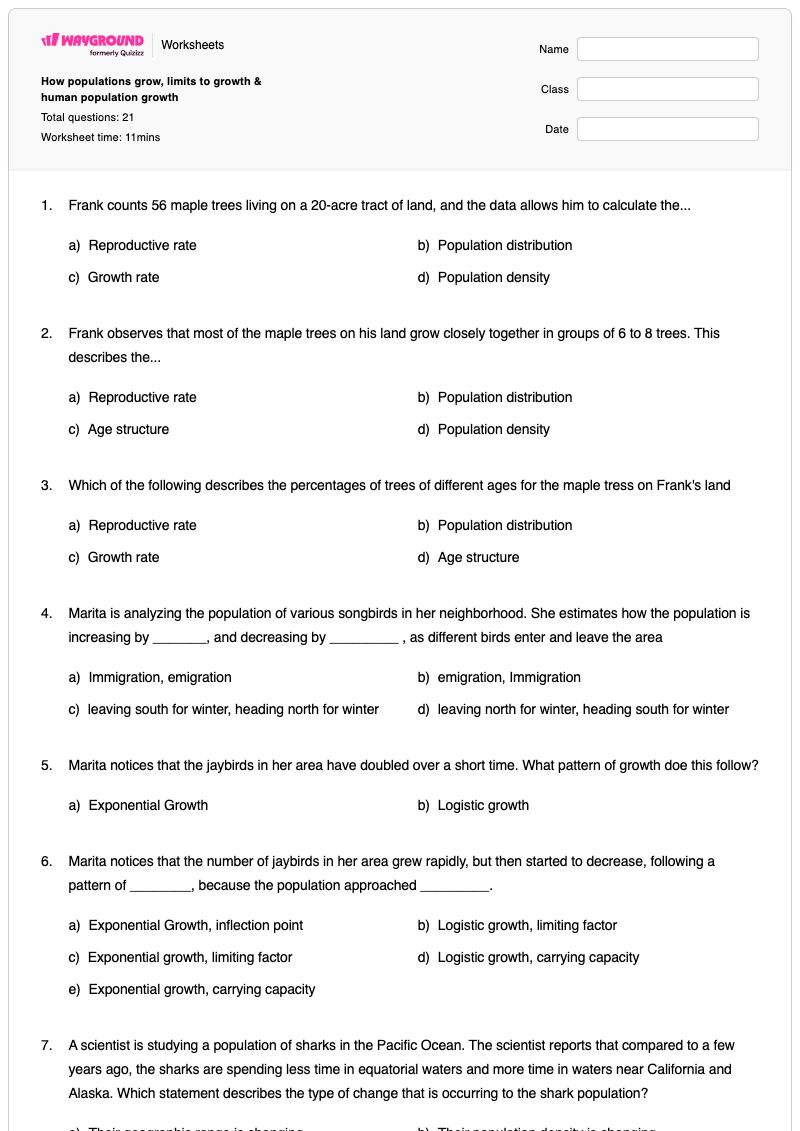
Frank counts 56 maple trees living on a 20-acre tract of land, and the data allows him to calculate the...
Reproductive rate
Population distribution
Growth rate
Population density
Frank observes that most of the maple trees on his land grow closely together in groups of 6 to 8 trees. This describes the...
Reproductive rate
Population distribution
Age structure
Population density
Which of the following describes the percentages of trees of different ages for the maple tress on Frank's land
Reproductive rate
Population distribution
Growth rate
Age structure
Marita is analyzing the population of various songbirds in her neighborhood. She estimates how the population is increasing by _______, and decreasing by _________ , as different birds enter and leave the area
Immigration, emigration
emigration, Immigration
leaving south for winter, heading north for winter
leaving north for winter, heading south for winter
Marita notices that the jaybirds in her area have doubled over a short time. What pattern of growth doe this follow?
Exponential Growth
Logistic growth
Marita notices that the number of jaybirds in her area grew rapidly, but then started to decrease, following a pattern of ________, because the population approached _________.
Exponential Growth, inflection point
Logistic growth, limiting factor
Exponential growth, limiting factor
Logistic growth, carrying capacity
Exponential growth, carrying capacity
A scientist is studying a population of sharks in the Pacific Ocean. The scientist reports that compared to a few years ago, the sharks are spending less time in equatorial waters and more time in waters near California and Alaska. Which statement describes the type of change that is occurring to the shark population?
Their geographic range is changing.
Their population density is changing.
Their population distribution is changing.
Their carrying capacity is changing.
Vernon is studying the population of deer in a tract of forest. He gathers the following data.
Birth rate:~50 deer/year
Death rate:~70 deer/year.
Which additional observation would support the conclusion that the deer population is NOT changing size from year to year, meaning that the net population change is 0?
About 20 deer per year immigrate to the tract of forest.
About 20 deer per year emigrate from the tract of forest.
The average life span of a member of the deer population is 20 years.
If a deer survives its first year of life, its average life span is 20 years.

The graph describes the population of dandelions in a field over the course of one summer.
Which statement best describes the growth of the dandelions?
Linear growth occurs because the field provides abundant but limited resources during the summer.
Logistic growth occurs because the field provides unlimited resources during the summer.
Exponential growth occurs because the field provides unlimited resources during the summer.
Fluctuating growth patterns occur because the population reached the carrying capacity of the field during the summer.
The population of adult frogs in a wetlands ecosystem has increased to 1000 individuals, which is its carrying capacity. The frogs eat flies and other small animals, and they are prey for raccoons, snakes, and a variety of large birds.
Which most likely would happen if an additional 200 adult frogs immigrated to the ecosystem?
The carrying capacity for frogs in the ecosystem would increase by 200 frogs.
The carrying capacity for frog predators in the ecosystem would increase by 200 individuals.
The frog population would experience a pattern of exponential growth.
About 200 adult frogs would die because of lack of resources, or by predation.
Which of the following are : density-dependent limiting factors. (check all that apply)
Hurricanes or drought
All population sizes
Competition
Virus outbreak
Which of the following are : density-independent limiting factors. (check all that apply)
extreme weather
small and large populations
species competing for food
parasite infections
A scientist is developing a computer model to determine the maximum population size, or ________, of eagles and other birds of prey in a forest ecosystem. The model should represent all of the _________, that affect the populations.
Limiting factors, carrying capacity
carrying capacity, limiting factors
Limiting population, population factors
Population factors, Limiting population
A population of mountain lions lives in an alpine forest. The mountain lions hunt deer, rabbits, and other prey. As the population increases, which of these events becomes more likely to occur?
Female mountain lions raise an increasing number of pups per litter, and a greater percentage of pups survive to adulthood.
Competition for territory and other resources acts to slow the growth rate of the population.
A wildfire, drought, or other natural disaster acts to decrease the mountain lion population by at least 50 percent.
A decrease in competition acts to increase the growth rate of the population
A team of scientists visits an island in the Caribbean Sea. They find a diverse community of turtles, lizards, birds, and a variety of trees, shrubs, and grasses. No humans live on the island.
Several years later, the scientists return to the island. They find a much smaller community, with reduced populations of all of the species they had identified earlier. Some of the animals now appear to be absent from the island.
Which is the most likely explanation for the changes that the scientists observed?
Competition for resources caused all of the island populations to decrease at the same time.
A disease or parasite affected all of the island populations.
A natural disaster, such as a hurricane, struck the island.
Stress from overcrowding affected all of the island populations.
Gibbons are small apes that live in the trees of southeast Asia. A scientist predicts that at the current rate of deforestation in southeast Asia, the region's carrying capacity for gibbons will decrease by 10 percent every year. The scientist's prediction provides the strongest support for which of these conclusions?
The gibbon population will decrease by 5 percent every year until reaching a certain minimum size, which it will maintain.
The gibbon population will decrease by 10 percent every year until reaching a certain minimum size, which it will maintain.
Gibbons will maintain their current population size as they adapt to new environments.
Gibbons will eventually become extinct in the wild.
Throughout human history, major migrations have been spurred by sharp decreases in the availability of food caused by hazards or changes in climate. For example, the ________ was caused by a fungal disease that infected an important crop.
Dust bowl
Irish potato famine
China rice famine
Fungal scurvy
Over various spans of time, human populations have increased, decreased, or remained the same, and at both global and local levels. Which statement best explains this observation?
Unlike other populations, the human population changes size because of specific choices of its members.
Unlike other populations, the human population has the ability to grow rapidly without limit.
Like other populations, the human population is affected by a variety of factors in the environment.
Like other populations, the human population increases and decreases in a cyclical pattern.
A scientist is studying the human population of Country X. To predict the future growth rate of the population, which three statistics about the population of Country X would be most useful for the scientist to analyze?
Select three answer choices.
birthrate
death rate
population distribution
population density
age structure
The human population of the United States passed through the demographic transition between 1790 and 1910. How has the population changed after 1910?
The population has been increasing exponentially.
The population has been increasing in a pattern explained by logistic growth.
The population has been fluctuating at or near carrying capacity.
The population has been decreasing at a steady rate.
The global human population was growing exponentially up until the second half of the twentieth century. Could this exponential growth have continued indefinitely?
Yes, because the human population is capable of adapting to a wide variety of environments.
Yes, because developments in technology allow an increase in the carrying capacity of the human population.
No, because the human population depends on limited resources, and may suffer from war, disease, and famine.
No, because the human population increases and decreases in a cyclical pattern, similar to patterns of predator and prey populations
แป้นคำตอบHow populations grow, limits to growth & human population growth
คำถามทั้งหมด: 21
Population density
Population distribution
Age structure
Immigration, emigration
Exponential Growth
Logistic growth, carrying capacity
Their geographic range is changing.
About 20 deer per year immigrate to the tract of forest.
Exponential growth occurs because the field provides unlimited resources during the summer.
About 200 adult frogs would die because of lack of resources, or by predation.
Competition
, d)Virus outbreak
extreme weather
, b)small and large populations
carrying capacity, limiting factors
Competition for territory and other resources acts to slow the growth rate of the population.
A natural disaster, such as a hurricane, struck the island.
Gibbons will eventually become extinct in the wild.
Irish potato famine
Like other populations, the human population is affected by a variety of factors in the environment.
birthrate
, e)age structure
The population has been increasing exponentially.
No, because the human population depends on limited resources, and may suffer from war, disease, and famine.