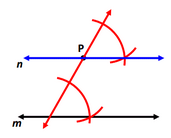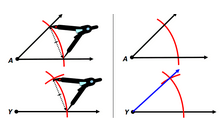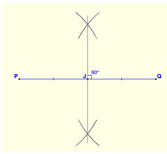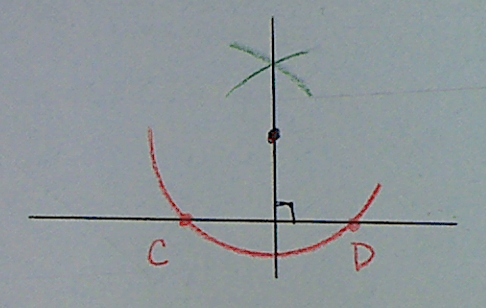

Which of the following constructions is illustrated?
a)
An angle is congruent to a given angle
b)
The bisector of a given angle
c)
The bisector of a given segment
d)
The perpendicular bisector of a given segment.
2.
Name the construction.
a)
Angle bisector
b)
Perpendicular line to a point not on a line
c)
Perpendicular line to a point on the line
d)
Perpendicular bisector of a line segment
3.
Name the construction.
a)
Corresponding angles
b)
Parallel line to a point not on the line
c)
Perpendicular line to a point not on the line
d)
Angle bisector
4.
Name the construction.
a)
Angle bisector
b)
Di-sect an angle
c)
Copy an angle
d)
Vertical angles
5.
What type of construction do you see?
a)
midpoint
b)
angle bisector
c)
perpendicular bisector
d)
altitude
6.
What type of construction do you see?
a)
midpoint
b)
angle bisector
c)
perpendicular bisector
d)
altitude
7.
Which one is the correct construction for a perpendicular bisector?
a)
1
b)
2
c)
3
d)
4
8.
Name the construction.
a)
midpoint
b)
perpendicular through a point on the line
c)
perpendicular through a point NOT on the line
d)
Circumcenter of a right triangle
9.
Classify the triangle in the construction.
a)
scalene triangle
b)
equilateral triangle
c)
isosceles triangle
d)
right triangle
10.
Suppose we wish to construct a perpendicular bisector of line segment EF. We can correctly begin by placing the compass point on E and marking off the distance to which point?
a)
A
b)
B
c)
C
d)
D
11.
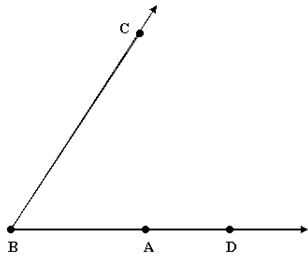
Suppose we wish to construct angle EFG congruent to angle DBC using a compass and straightedge. Which step would be correct to do first?
a)
Place the compass point at B
b)
Place the compass point at C
c)
Place the straightedge along A and C
d)
Place the straightedge along C and D
12.
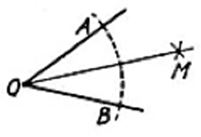
When bisecting an angle, the straightedge should be used to:
a)
Mark the point M
b)
Measure the angle AOB
c)
Copy the angle with an arc
d)
Connect point M and vertex O
13.
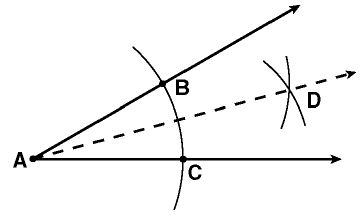
Given: angle A What is the first step in constructing the angle bisector of angle A?
a)
Draw ray AD
b)
Draw a line segment connecting points B and C.
c)
From points B and C, draw equal arcs that intersect at D.
d)
From point A, draw an arc that intersects the sides of theangle at points B and C.
14.
a)
1
b)
2
c)
3
d)
4
15.
a)
1
b)
2
c)
3
d)
4
16.
What does the word BISECT mean?
a)
To cut something into more than five pieces.
b)
It is a plane with two sets of wings.
c)
A shape that has three sides.
d)
To cut something into two congruent pieces or in half.
17.
Eric was attempting to construct a perpendicular bisector to the segment AB with a compass and straight edge. Which of the below statements explains what Eric may have done wrong?
a)
Eric should have started by putting the compass needle point at the midpoint of the segment AB.
b)
On the second step, Eric should have placed the compass needle point where the first arc intersected the segment AB.
c)
Erick just needed to open the compass more to create arcs that have a radius of more than half the length of the segment AB.
d)
Erick didn’t do anything wrong he just needs to connect the opposite endpoints of each arc to finish the construction.
18.
What does this symbol mean?
≅
a)
not equal
b)
congruent
c)
equal
d)
half
19.
a)
A
b)
B
c)
C
d)
D
20.
Name the construction.
a)
midpoint
b)
perpendicular through a point on the line
c)
perpendicular through a point NOT on the line
d)
Circumcenter of a right triangle
แป้นคำตอบ
Test 1 Constructions Review
คำถามทั้งหมด: 20
1.
b) The bisector of a given angle
2.
d) Perpendicular bisector of a line segment
3.
b) Parallel line to a point not on the line
4.
c) Copy an angle
5.
c) perpendicular bisector
6.
b) angle bisector
7.
a) 1
8.
c)
perpendicular through a point NOT on the line
9.
b)
equilateral triangle
10.
a) A
11.
a) Place the compass point at B
12.
d) Connect point M and vertex O
13.
d) From point A, draw an arc that intersects the sides of theangle at points B and C.
14.
a) 1
15.
c) 3
16.
d) To cut something into two congruent pieces or in half.
17.
c)
Erick just needed to open the compass more to create arcs that have a radius of more than half the length of the segment AB.