

Wayground
Synovial Joint Structure and Types - Printable ศาสตร์ Worksheets 11th ระดับชั้น - Wayground

Synovial Joint Structure and Types

STEPHANIE BRITTON

สร้างโดย STEPHANIE BRITTON

17 คำถาม

11th ระดับชั้น

ศาสตร์

อัปเดตแล้ว ต.ค. 2569

แบบฝึกหัดวิทยาศาสตร์สำหรับนักเรียนชั้นมัธยมศึกษาปีที่ 4 เรื่อง โครงสร้างและประเภทของข้อต่อไซโนเวียล ช่วยให้นักเรียนจำแนกข้อต่อไซโนเวียลตามโครงสร้าง การเคลื่อนไหว และตำแหน่งทางกายวิภาค แบบฝึกหัดนี้ประกอบด้วย 17 ข้อ ช่วยให้นักเรียนระบุข้อต่อแบบบานพับ ข้อต่อแบบลูกบอลและเบ้า ข้อต่อแบบหมุน ข้อต่อแบบเลื่อน ข้อต่อแบบอานม้า และข้อต่อแบบคอนดิลอยด์ เชื่อมโยงตัวอย่างเช่น ข้อไหล่ ข้อศอก ข้อข้อมือ กระดูกข้อมือ และกระดูกข้อเท้า กับประเภทที่ถูกต้อง และตีความภาพแสดงการเคลื่อนไหวของข้อต่อและรูปร่างของกระดูกที่เชื่อมต่อกัน นอกจากนี้ นักเรียนยังตอบคำถามเกี่ยวกับบทบาทของแคปซูลเส้นใย เยื่อหุ้มไซโนเวียล กระดูกอ่อนข้อต่อ และน้ำไขข้อ แบบฝึกหัดนี้ประกอบด้วยคำถามแบบเลือกตอบ 15 ข้อ คำถามแบบเลือกหลายข้อ 1 ข้อ และแบบฝึกหัดลากและวางรูปภาพ 1 ข้อ ช่วยให้นักเรียนได้ฝึกฝนการใช้คำศัพท์มากกว่าการท่องจำคำจำกัดความเพียงอย่างเดียว แบบฝึกหัดนี้ออกแบบมาสำหรับใช้ในการสอน การทบทวน หรือการประเมินผลระหว่างเรียนวิชากายวิภาคศาสตร์หรือชีววิทยาของมนุษย์ในชั้นมัธยมศึกษาปีที่ 4 แบบฝึกหัดที่ดาวน์โหลดได้ฟรีนี้มีเฉลยคำตอบครบถ้วน ทำให้สะดวกต่อการฝึกฝนด้วยตนเอง การเรียนในห้องเรียน หรือการเตรียมสอบ

การตั้งค่าแผ่นงาน

ขนาดตัวอักษร

S
M
L
XL
Waygroundแผ่นงาน

Synovial Joint Structure and Types

คำถามทั้งหมด: 17

ชื่อ
ระดับ
วันที่
1.

All of the following are hinge joints EXCEPT:

a)

knee (tibia/femur)

b)

elbow (humerus/ulna)

c)

between the phalanges

d)

wrist (radius/carpals)

e)

hip (coxal/femur)

2.

The joint which allows the maximum movement is the

a)

Slightly movable joint

b)

Ball and socket joint

c)

hinge joint

d)

Gliding joint

3.

Where is a ball and socket joint located ?

a)

shoulder (glenohumeral)

b)

atlantoaxial (C1/C2)

c)

elbow (humeroulnar)

d)

wrist (radiocarpal)

e)

shoulder

(acromio-clavicular)

4.

This type of joint allows the your first vertebra to rotate or spin as in shaking your head no....

a)

condyloid

b)

gliding

c)

pivot

d)

saddle

5.
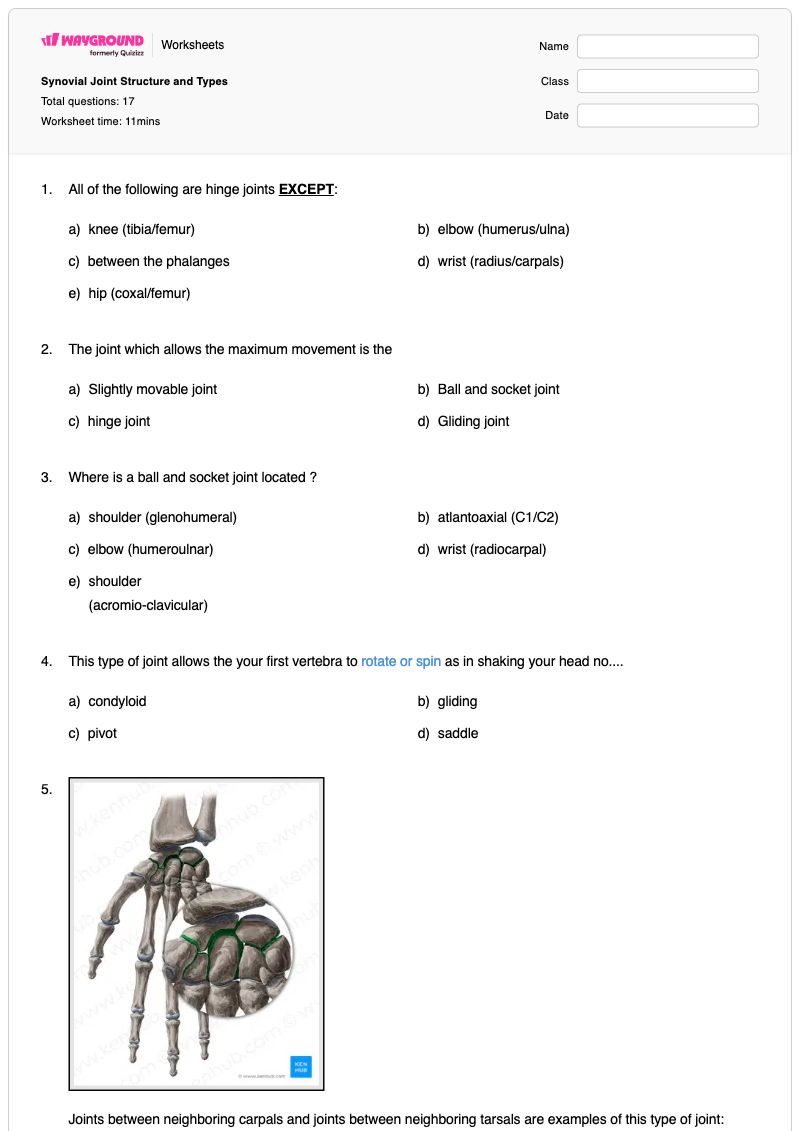
Joints between neighboring carpals and joints between neighboring tarsals are examples of this type of joint:

Joints between neighboring carpals and joints between neighboring tarsals are examples of this type of joint:

a)

condyloid

b)

gliding

c)

hinge

d)

saddle

6.

What is the role of the fibrous capsule?

a)

Lubricates the moving parts within the joint

b)

produces the synovial fluid

c)

Holds joint together

d)

cushions the bone ends in the joint

7.
8.
Identify the type of synovial joint represented here. Watch the animation carefully.

Identify the type of synovial joint represented here. Watch the animation carefully.

a)

hinge

b)

condyloid

c)

gliding

d)

saddle

e)

ball & socket

9.
Identify the type of synovial joint represented here.

Identify the type of synovial joint represented here.

a)

hinge

b)

condyloid

c)

gliding

d)

saddle

e)

ball & socket

10.
Identify the type of synovial joint represented here. Notice the shape of the articulating bones.

Identify the type of synovial joint represented here. Notice the shape of the articulating bones.

a)

hinge

b)

condyloid

c)

gliding

d)

saddle

e)

ball & socket

11.
Identify the type of synovial joint represented here. Notice what movements are allowed.

Identify the type of synovial joint represented here. Notice what movements are allowed.

a)

hinge

b)

condyloid

c)

gliding

d)

saddle

e)

ball & socket

12.
Identify the type of synovial joint represented here.

Identify the type of synovial joint represented here.

a)

hinge

b)

condyloid

c)

gliding

d)

pivot

e)

ball & socket

13.
Identify the type of synovial joint represented here.

Identify the type of synovial joint represented here.

a)

hinge

b)

condyloid

c)

gliding

d)

pivot

e)

ball & socket

14.

What is the role of the synovial membrane?

a)

Lubricates the moving parts within the joint

b)

produces the synovial fluid

c)

Holds joint together

d)

cushions the bone ends in the joint

15.

What is the role of the articular cartilage?

a)

Lubricates the moving parts within the joint

b)

produces the synovial fluid

c)

Holds joint together

d)

cushions the bone ends in the joint

16.

What is the role of the synovial fluid?

a)

Lubricates the moving parts within the joint

b)

produces the synovial fluid

c)

Holds joint together

d)

cushions the bone ends in the joint

17.
This 1st carpometacarpal joint is the only example of a _____ joint.

This 1st carpometacarpal joint is the only example of a _____ joint.

a)

ball and socket

b)

hinge

c)

saddle

d)

condyloid

e)

pivot

Waygroundแป้นคำตอบ

Synovial Joint Structure and Types

คำถามทั้งหมด: 17

1.
d)

wrist (radius/carpals)

, e)

hip (coxal/femur)

2.
b)

Ball and socket joint

3.
a)

shoulder (glenohumeral)

4.
c)

pivot

5.
b)

gliding

6.
c)

Holds joint together

7.
8.
e)

ball & socket

9.
a)

hinge

10.
d)

saddle

11.
b)

condyloid

12.
d)

pivot

13.
c)

gliding

14.
b)

produces the synovial fluid

15.
d)

cushions the bone ends in the joint

16.
a)

Lubricates the moving parts within the joint

17.
c)

saddle

คำถามที่พบบ่อย

แบบฝึกหัดเรื่องโครงสร้างและประเภทของข้อต่อไซโนเวียลครอบคลุมหัวข้ออะไรบ้าง?

แบบฝึกหัดวิทยาศาสตร์สำหรับนักเรียนชั้นมัธยมศึกษาปีที่ 4 นี้ ครอบคลุมข้อต่อไซโนเวียล 6 ชนิด ได้แก่ ข้อต่อแบบบานพับ ข้อต่อแบบลูกบอลและเบ้า ข้อต่อแบบหมุน ข้อต่อแบบเลื่อน ข้อต่อแบบอานม้า และข้อต่อแบบคอนดิลอยด์ โดยให้นักเรียนระบุข้อต่อเหล่านี้จากลักษณะการเคลื่อนไหว รูปร่างของกระดูก และตัวอย่างทางกายวิภาค แบบฝึกหัดนี้ยังประกอบด้วยคำถามแบบเลือกตอบ เลือกคำตอบที่ถูกต้อง การระบุด้วยภาพ และการลากและวาง ซึ่งช่วยประเมินหน้าที่ของแคปซูลเส้นใย เยื่อหุ้มข้อ กระดูกอ่อนข้อ และน้ำไขข้อด้วย

ฉันจะใช้แบบฝึกหัดนี้ในการสอนเรื่องประเภทและโครงสร้างของข้อต่อไซโนเวียลได้อย่างไร?

แนะนำข้อต่อแต่ละประเภทโดยใช้ลักษณะการเคลื่อนไหวและตำแหน่งที่คุ้นเคย จากนั้นให้นักเรียนใช้ข้อมูลเหล่านั้นในการจำแนกประเภทข้อต่อตัวอย่างในแบบฝึกหัด ก่อนที่นักเรียนจะทำงานด้วยตนเอง ให้พูดคุยเกี่ยวกับวิธีที่ข้อไหล่แสดงการเคลื่อนไหวแบบลูกบอลและเบ้า วิธีที่กระดูกข้อมือและกระดูกข้อเท้าที่อยู่ใกล้เคียงแสดงการเคลื่อนไหวแบบเลื่อน และวิธีที่โครงสร้างของข้อต่อแต่ละส่วนช่วยในการเคลื่อนไหวหรือการป้องกัน

ฉันควรระวังข้อผิดพลาดอะไรบ้างเมื่อนักเรียนทำแบบฝึกหัดเกี่ยวกับข้อต่อไซโนเวียลนี้?

นักเรียนอาจสับสนระหว่างข้อต่อประเภทต่างๆ ที่เคลื่อนไหวไปในทิศทางเดียวกัน หรือจัดประเภทข้อต่อตามตำแหน่งโดยไม่พิจารณาการเคลื่อนไหวหรือรูปร่างที่แสดงออกมา นอกจากนี้ พวกเขายังอาจสับสนเกี่ยวกับหน้าที่ของเยื่อหุ้มข้อ น้ำไขข้อ กระดูกอ่อนข้อ และแคปซูลเส้นใย เช่น การระบุว่าน้ำไขข้อทำหน้าที่ผลิตของเหลว หรือเยื่อหุ้มข้อทำหน้าที่หล่อลื่น โปรดตรวจสอบข้อสอบแบบเลือกหลายข้ออย่างละเอียด เนื่องจากมีข้อต่อมากกว่าหนึ่งข้อในรายการที่ไม่ใช่ข้อต่อแบบบานพับ

ฉันจะมอบหมายและให้คะแนนแบบฝึกหัดเกี่ยวกับข้อต่อไซโนเวียลนี้ได้อย่างไร?

คุณสามารถมอบหมายงานเรื่องโครงสร้างและประเภทของข้อต่อไซโนเวียลในรูปแบบไฟล์ PDF ที่พิมพ์ได้ หรือเป็นแบบทดสอบดิจิทัลบน Wayground งานนี้ประกอบด้วยเฉลยคำตอบครบถ้วนสำหรับ 17 ข้อ และงานของนักเรียนที่พิมพ์ได้สามารถตรวจได้โดยการสแกนด้วยแอป Wayground for Teachers รูปแบบที่พิมพ์ได้ยังช่วยให้โรงเรียนมีตัวเลือกในการลดเวลาการใช้หน้าจออีกด้วย

ฉันจะปรับแบบฝึกหัดเกี่ยวกับข้อต่อไซโนเวียลนี้ให้เหมาะสมกับนักเรียนของฉันได้อย่างไร?

ใช้การตั้งค่าขั้นสูงของแบบฝึกหัดเพื่อปรับระยะห่างระหว่างตัวอักษรหรือเลือกขนาดตัวอักษรที่ใหญ่ขึ้น เพื่อให้ตัวเลือกประเภทข้อต่อ ตัวเลือกโครงสร้างและหน้าที่ และคำแนะนำในการระบุภาพอ่านง่ายขึ้น นอกจากนี้ คุณยังสามารถเปิดใช้งานแบบอักษรที่เป็นมิตรต่อผู้ที่มีภาวะดิสเล็กเซีย หรือแปลแบบฝึกหัดเป็นภาษาอื่นได้ เมื่อตัวเลือกเหล่านั้นสนับสนุนการเข้าถึงคำศัพท์ทางกายวิภาคศาสตร์

ฉันจะหาแบบฝึกหัดแบบนี้เพิ่มเติมได้ที่ไหนบน Wayground?

Wayground นำเสนอชุดแบบฝึกหัดและโจทย์ฝึกหัดฟรีที่ครอบคลุมหลากหลายวิชา พร้อมไฟล์ PDF และเฉลยคำตอบ เพื่อสนับสนุนทักษะและแนวคิดที่สำคัญ ดูแหล่งข้อมูลเพิ่มเติมได้ที่ https://wayground.com/en-us/worksheets