

Wayground
Scarcity: The Basic Economic Problem - Printable สังคมศึกษา Worksheets ระดับ 12 - Wayground

Scarcity: The Basic Economic Problem

Michael Laubacher

สร้างโดย Michael Laubacher

19 คำถาม

12th ระดับชั้น

สังคมศึกษา

ความขาดแคลน: ปัญหาพื้นฐานทางเศรษฐศาสตร์ เป็นแบบฝึกหัดวิชาสังคมศึกษาสำหรับนักเรียนชั้นมัธยมศึกษาปีที่ 6 ที่สร้างพื้นฐานการคิดเชิงเศรษฐศาสตร์เกี่ยวกับทรัพยากรที่มีจำกัดและความต้องการที่ไม่จำกัด นักเรียนจะได้เรียนรู้การแยกแยะความต้องการจากความปรารถนา ระบุสินค้า แรงงาน แรงจูงใจ อรรถประโยชน์ การแลกเปลี่ยน และต้นทุนค่าเสียโอกาส และเชื่อมโยงคำศัพท์เหล่านี้กับคำถามสามข้อที่ทุกสังคมต้องตอบ ได้แก่ จะผลิตอะไร จะผลิตอย่างไร และผลิตเพื่อใคร แบบฝึกหัดนี้ยังแนะนำต้นทุนส่วนเพิ่มและผลประโยชน์ส่วนเพิ่ม แบบจำลองทางเศรษฐศาสตร์ เส้นความเป็นไปได้ในการผลิต (PPC) เทคโนโลยีคงที่ และการใช้ทรัพยากรไม่เต็มที่ แบบฝึกหัดประกอบด้วย 19 ข้อ แบ่งเป็นคำถามแบบเลือกตอบ 16 ข้อ คำถามแบบเลือกคำตอบ 2 ข้อ และคำถามแบบจับคู่ 1 ข้อ ช่วยให้นักเรียนได้ฝึกฝนการจดจำความหมายและความสัมพันธ์ระหว่างแนวคิดหลักอย่างหลากหลาย แบบฝึกหัดที่พิมพ์ได้ฟรีนี้มีเฉลยคำตอบและออกแบบมาเพื่อสนับสนุนการสอนโดยตรง การทบทวน หรือการประเมินผลระหว่างเรียนในวิชาเศรษฐศาสตร์และสังคมศึกษาในระดับมัธยมปลาย

การตั้งค่าแผ่นงาน

ขนาดตัวอักษร

S
M
L
XL
Waygroundแผ่นงาน

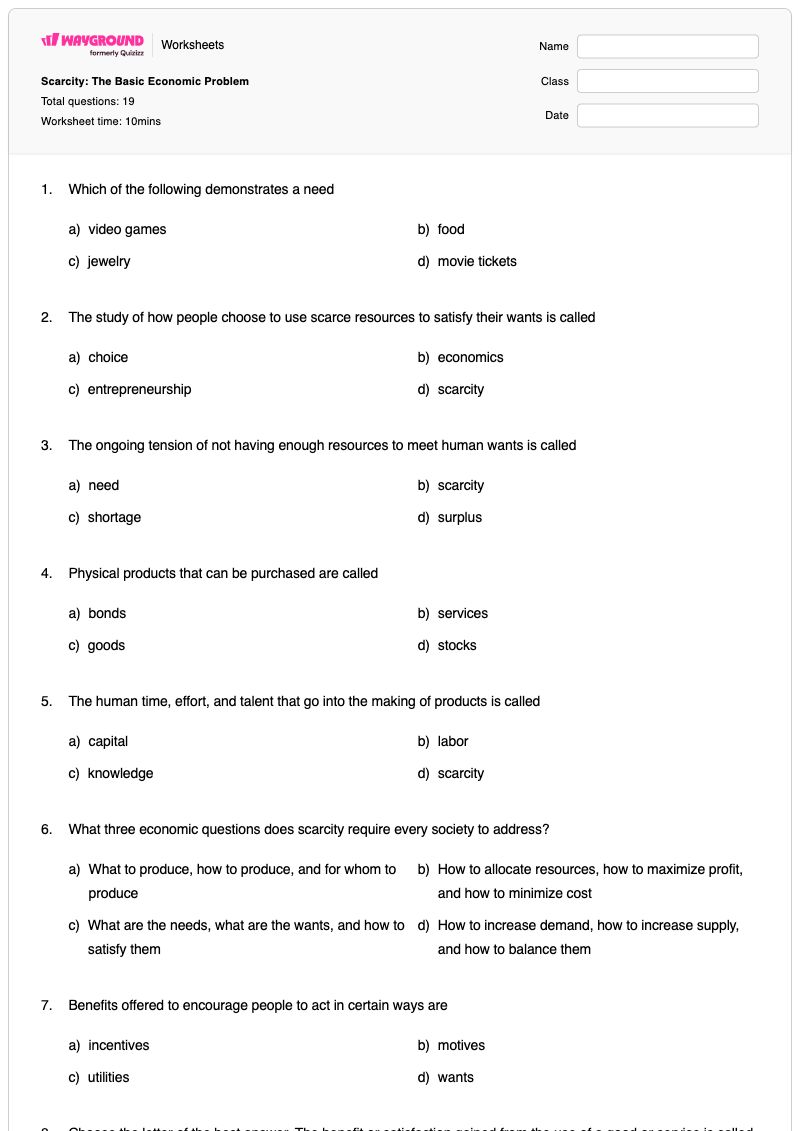
Scarcity: The Basic Economic Problem

คำถามทั้งหมด: 19

ชื่อ
ระดับ
วันที่
1.

Which of the following demonstrates a need

a)

video games

b)

food

c)

jewelry

d)

movie tickets

2.

The study of how people choose to use scarce resources to satisfy their wants is called

a)

choice

b)

economics

c)

entrepreneurship

d)

scarcity

3.

The ongoing tension of not having enough resources to meet human wants is called

a)

need

b)

scarcity

c)

shortage

d)

surplus

4.

Physical products that can be purchased are called

a)

bonds

b)

services

c)

goods

d)

stocks

5.

The human time, effort, and talent that go into the making of products is called

a)

capital

b)

labor

c)

knowledge

d)

scarcity

6.

What three economic questions does scarcity require every society to address?

a)

What to produce, how to produce, and for whom to produce

b)

How to allocate resources, how to maximize profit, and how to minimize cost

c)

What are the needs, what are the wants, and how to satisfy them

d)

How to increase demand, how to increase supply, and how to balance them

7.

Benefits offered to encourage people to act in certain ways are

a)

incentives

b)

motives

c)

utilities

d)

wants

8.

Choose the letter of the best answer. The benefit or satisfaction gained from the use of a good or service is called a(n)

a)

cost

b)

incentive

c)

utility

d)

desire

9.

The alternative you give up when you make an economic choice is a(n)

a)

compromise

b)

option

c)

trade-off

d)

utility

10.

The value of what you give up by choosing one alternative over another is called

a)

marginal benefit

b)

marginal cost

c)

opportunity benefit

d)

opportunity cost

11.

The difference between marginal cost and marginal benefit is:

a)

Marginal cost is the additional cost of producing one more unit, while marginal benefit is the additional benefit received from consuming one more unit.

b)

Marginal cost is the total cost of production, while marginal benefit is the total benefit received from consumption.

c)

Marginal cost and marginal benefit are the same and can be used interchangeably.

d)

Marginal cost is the cost of producing all units, while marginal benefit is the benefit of consuming all units.

12.

Simplified representations of complex economic activities are called economic:

a)

curves

b)

models

c)

prototypes

d)

templates

13.

PPC is an acronym for:

a)

preliminary production chart

b)

preliminary production curve

c)

production possibilities chart

d)

production possibilities curve

14.

When creating a PPC, economists assume that:

a)

resources are not fixed

b)

resources are inefficiently used

c)

only three things can be produced

d)

technology is fixed

15.

The condition in which economic resources are not being used to their full potential is called:

a)

efficiency

b)

scarcity

c)

utilization

d)

underutilization

16.

Any point outside the curve of a PPC represents a goal that is:

a)

impossible to meet because resources are fixed

b)

impossible to meet because resources are not fixed

c)

possible to meet because resources are fixed

d)

possible to meet because resources are not fixed

17.

The law of increasing opportunity costs states that:

a)

as production of a good increases, the opportunity cost of producing an additional unit rises.

b)

as production of a good increases, the opportunity cost of producing an additional unit falls.

c)

opportunity costs remain constant regardless of production levels.

d)

opportunity costs are irrelevant to production decisions.

18.

shows statistical changes over time

microeconomics

study of the behavior of individuals in

line graph

shows statistical changes over time

statistics

numerical data or information

macroeconomics

study of the behavior of the economy as

chart

displays data in rows and columns

19.

Adam Smith used the term “invisible hand” to describe:

a)

the self-regulating nature of the marketplace

b)

a literal hand guiding economic decisions

c)

government intervention in the economy

d)

the role of banks in financial markets

Waygroundแป้นคำตอบ

Scarcity: The Basic Economic Problem

คำถามทั้งหมด: 19

1.
b)

food

2.
b)

economics

3.
b)

scarcity

4.
c)

goods

5.
b)

labor

6.
a)

What to produce, how to produce, and for whom to produce

7.
a)

incentives

8.
c)

utility

9.
c)

trade-off

10.
d)

opportunity cost

11.
a)

Marginal cost is the additional cost of producing one more unit, while marginal benefit is the additional benefit received from consuming one more unit.

12.
b)

models

13.
d)

production possibilities curve

14.
d)

technology is fixed

15.
d)

underutilization

16.
a)

impossible to meet because resources are fixed

17.
a)

as production of a good increases, the opportunity cost of producing an additional unit rises.

18.

microeconomics

 - 

study of the behavior of individuals in

, 

line graph

 - 

shows statistical changes over time

, 

statistics

 - 

numerical data or information

, 

macroeconomics

 - 

study of the behavior of the economy as

, 

chart

 - 

displays data in rows and columns

19.
a)

the self-regulating nature of the marketplace

คำถามที่พบบ่อย

แบบฝึกหัดเรื่อง "ความขาดแคลน: ปัญหาพื้นฐานทางเศรษฐศาสตร์" ครอบคลุมเนื้อหาอะไรบ้าง?

แบบฝึกหัดสำหรับนักเรียนชั้นมัธยมศึกษาปีที่ 6 นี้ ประกอบด้วยคำถามแบบเลือกตอบ 16 ข้อ คำถามแบบเลือกคำตอบ 2 ข้อ และคำถามแบบจับคู่ 1 ข้อ เพื่อประเมินความเข้าใจพื้นฐานเกี่ยวกับแนวคิดเรื่องความขาดแคลนและการตัดสินใจทางเศรษฐกิจ นักเรียนจะได้ระบุความต้องการ ความปรารถนา สินค้า แรงงาน แรงจูงใจ อรรถประโยชน์ การแลกเปลี่ยน และต้นทุนค่าเสียโอกาส จากนั้นจึงนำแนวคิดที่เกี่ยวข้องมาประยุกต์ใช้ เช่น ต้นทุนส่วนเพิ่มเทียบกับผลประโยชน์ส่วนเพิ่ม เส้นกราฟความเป็นไปได้ในการผลิต เทคโนโลยีคงที่ และการใช้ทรัพยากรไม่เต็มที่ การทำแบบฝึกหัดเหล่านี้จะช่วยให้นักเรียนสามารถแยกแยะคำศัพท์ทางเศรษฐศาสตร์ที่เกี่ยวข้องกันอย่างใกล้ชิด และเชื่อมโยงความขาดแคลนกับการตัดสินใจในการผลิตได้

ฉันจะใช้แบบฝึกหัดนี้ในการสอนเรื่องความขาดแคลนและการตัดสินใจทางเศรษฐกิจได้อย่างไร?

แนะนำแนวคิดเรื่องความขาดแคลนโดยให้นักเรียนแยกแยะความต้องการพื้นฐานออกจากความต้องการทั่วไป จากนั้นสร้างแผนผังคำศัพท์ที่เชื่อมโยงทรัพยากรที่ขาดแคลนกับทางเลือก การแลกเปลี่ยน และต้นทุนค่าเสียโอกาส ก่อนที่นักเรียนจะตอบคำถาม ให้สาธิตความแตกต่างระหว่างการแลกเปลี่ยนกับมูลค่าของทางเลือกที่ดีที่สุดรองลงมาที่ต้องสละไป และระหว่างต้นทุนส่วนเพิ่มกับผลประโยชน์ส่วนเพิ่ม ใช้ข้อสอบแบบเลือกตอบหลายข้อเกี่ยวกับเส้นโค้งความเป็นไปได้ในการผลิต (PPC) เป็นหัวข้อสนทนาต่อยอดเกี่ยวกับเทคโนโลยีคงที่และการใช้ทรัพยากรอย่างเต็มที่

ฉันควรระวังข้อผิดพลาดอะไรบ้างเมื่อนักเรียนทำแบบฝึกหัดเรื่องความขาดแคลนนี้?

นักเรียนอาจสับสนระหว่างความขาดแคลนกับภาวะขาดแคลนชั่วคราว หรือเลือกใช้ความต้องการและความปรารถนาเป็นหมวดหมู่ที่สลับกันได้ นอกจากนี้ พวกเขาอาจมองว่าการแลกเปลี่ยนเหมือนกับต้นทุนค่าเสียโอกาส หรือสลับความหมายของต้นทุนส่วนเพิ่มและผลประโยชน์ส่วนเพิ่ม ในข้อสอบแบบเลือกตอบหลายข้อเกี่ยวกับเส้นโค้งความเป็นไปได้ในการผลิต ให้ตรวจสอบว่านักเรียนระบุเส้นโค้งความเป็นไปได้ในการผลิตและข้อสมมติฐานที่ว่าเทคโนโลยีคงที่ ในขณะที่ข้อเกี่ยวกับการใช้ทรัพยากรไม่เต็มศักยภาพนั้นต้องการให้นักเรียนตระหนักว่าทรัพยากรไม่ได้ถูกนำมาใช้อย่างเต็มศักยภาพ

ฉันจะมอบหมายและให้คะแนนแบบฝึกหัดเรื่องความขาดแคลนนี้อย่างไร?

บน Wayground คุณสามารถกำหนดแบบทดสอบได้ทั้งในรูปแบบไฟล์ PDF ที่พิมพ์ได้ หรือแบบทดสอบดิจิทัล โดยทั้งสองรูปแบบมีเฉลยคำตอบครบถ้วน การส่งงานในรูปแบบไฟล์พิมพ์สามารถตรวจได้โดยการสแกนงานของนักเรียนด้วยแอป Wayground for Teachers ในขณะที่แบบทดสอบดิจิทัลรองรับการรวบรวมและตรวจงานทางออนไลน์ ตัวเลือกแบบพิมพ์ยังช่วยสนับสนุนโรงเรียนที่ต้องการลดเวลาการใช้หน้าจอได้อีกด้วย

ฉันจะปรับแบบฝึกหัดเรื่องความขาดแคลนนี้ให้เหมาะสมกับนักเรียนของฉันได้อย่างไร?

ในการตั้งค่าขั้นสูงของแบบฝึกหัด ให้ปรับระยะห่างระหว่างตัวอักษรหรือเลือกขนาดตัวอักษรที่ใหญ่ขึ้นเพื่อให้คำศัพท์ทางเศรษฐศาสตร์และตัวเลือกคำตอบอ่านง่ายขึ้น นอกจากนี้ คุณยังสามารถเปิดใช้งานแบบอักษรที่เหมาะสำหรับผู้ที่มีภาวะดิสเล็กเซียสำหรับคำถามแบบเลือกตอบหลายตัวเลือก เลือกหลายรายการ และจับคู่ หรือแปลแบบฝึกหัดเป็นภาษาอื่นสำหรับผู้เรียนหลายภาษา ตัวเลือกเหล่านี้จะเปลี่ยนแปลงไฟล์แบบฝึกหัดในขณะที่ยังคงรักษาเนื้อหาเกี่ยวกับความขาดแคลนและตัวเลือกทางเศรษฐศาสตร์ไว้

ฉันจะหาแบบฝึกหัดแบบนี้เพิ่มเติมได้ที่ไหนบน Wayground?

Wayground มีแบบฝึกหัดและโจทย์ฝึกหัดมากมายให้ดาวน์โหลดฟรีในหลากหลายวิชา พร้อมไฟล์ PDF และเฉลยคำตอบ เพื่อช่วยให้นักเรียนพัฒนาทักษะและความเข้าใจในแนวคิดสำคัญๆ ดูแหล่งข้อมูลเพิ่มเติมได้ที่ https://wayground.com/en-us/worksheets