

Wayground
Unit 2 European Exploration Review - Printable สังคมศึกษา Worksheets ระดับ 5 - Wayground

Unit 2 European Exploration Review

Steve Leon

สร้างโดย Steve Leon

22 คำถาม

5th ระดับชั้น

สังคมศึกษา

อัปเดตแล้ว พ.ค. 2568

แบบฝึกหัดทบทวนหน่วยที่ 2 การสำรวจของยุโรป สำหรับนักเรียนชั้นประถมศึกษาปีที่ 5 นี้ รวบรวมแนวคิดสำคัญจากยุคการสำรวจของยุโรป นักเรียนจะได้ศึกษาว่าทำไมชาวยุโรปจึงเดินทางมายังโลกใหม่ รวมถึงแรงจูงใจที่เกี่ยวข้องกับอำนาจ ความมั่งคั่ง ทรัพยากรธรรมชาติ และที่ดิน ระบุเส้นทางที่โคลัมบัสตั้งใจจะเดินทาง และทบทวนบทบาทของโจรสลัด นักพิชิตดินแดน คอร์เตส และมอนเตซูมา แบบฝึกหัดนี้ยังกล่าวถึงการแลกเปลี่ยนโคลัมเบีย การควบคุมดินแดนของยุโรป การอพยพ และประสบการณ์ของชนพื้นเมืองที่สะท้อนอยู่ในแผนที่และแหล่งข้อมูลทางประวัติศาสตร์ แบบฝึกหัดนี้ประกอบด้วยคำถาม 22 ข้อ—17 ข้อเป็นแบบเลือกตอบ 4 ข้อเป็นแบบเลือกคำตอบ และ 1 ข้อเป็นคำถามปลายเปิด—นักเรียนจะได้นิยามคำศัพท์สำคัญ เช่น การอพยพ นักพิชิตดินแดน การรับรู้ มุมมอง และแรงจูงใจ แบบฝึกหัดนี้มีคำถามที่อ้างอิงจากแหล่งข้อมูล รูปภาพ และแผนที่ เพื่อให้นักเรียนตีความหลักฐานเกี่ยวกับการโจรสลัด การแลกเปลี่ยนสินค้า มุมมองของชาวยุโรป และการเปลี่ยนแปลงการควบคุมทวีปอเมริกาเหนือ แบบฝึกหัดที่พิมพ์ได้ฟรีนี้มีเฉลยคำตอบครบถ้วน และสนับสนุนการทบทวน การฝึกฝนด้วยตนเอง หรือการตรวจสอบความเข้าใจในตอนท้ายหน่วย

การตั้งค่าแผ่นงาน

ขนาดตัวอักษร

S
M
L
XL
Waygroundแผ่นงาน

Unit 2 European Exploration Review

คำถามทั้งหมด: 22

ชื่อ
ระดับ
วันที่
1.

During the age of European exploration, many Europeans migrated from Europe to the New World. What do you think migrated means as it was used in this sentence?

a)

A. to discover something

b)

B. to move from one place to another

c)

C. to sail over the ocean

d)

D. to bring war

2.
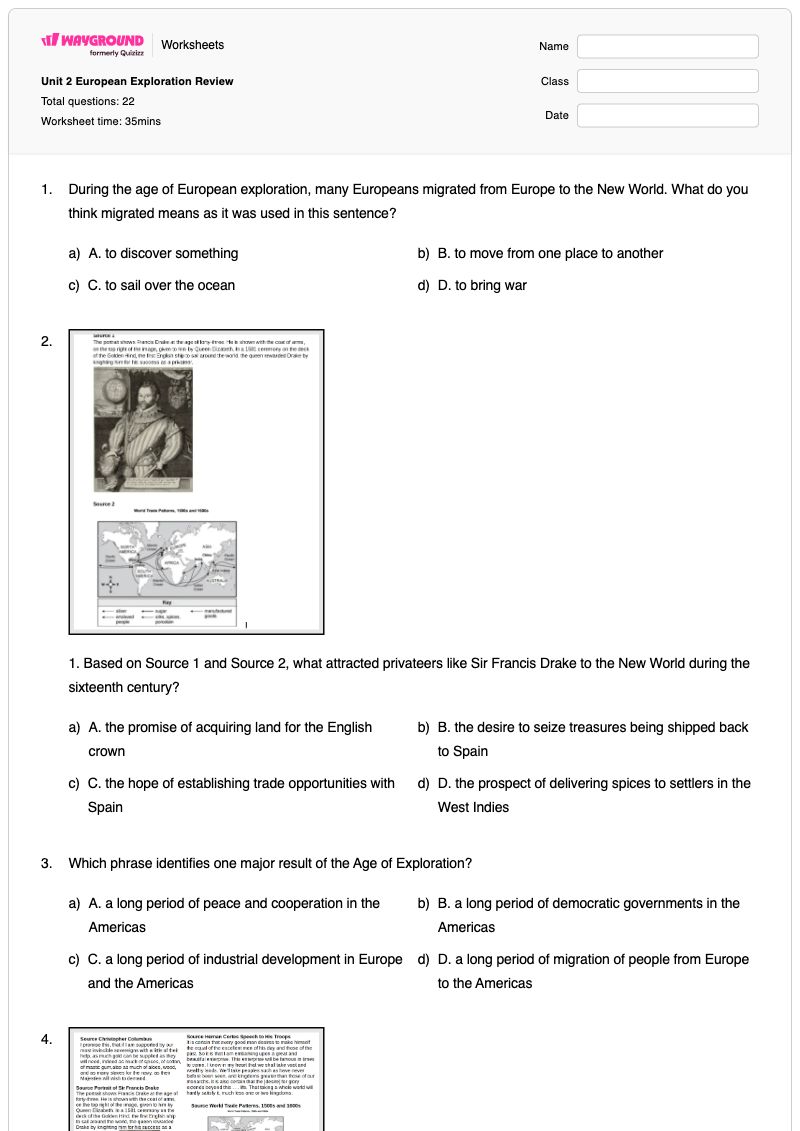
1. Based on Source 1 and Source 2, what attracted privateers like Sir Francis Drake to the New World during the sixteenth…

1. Based on Source 1 and Source 2, what attracted privateers like Sir Francis Drake to the New World during the sixteenth century?

a)

A. the promise of acquiring land for the English crown

b)

B. the desire to seize treasures being shipped back to Spain

c)

C. the hope of establishing trade opportunities with Spain

d)

D. the prospect of delivering spices to settlers in the West Indies

3.

Which phrase identifies one major result of the Age of Exploration?

a)

A. a long period of peace and cooperation in the Americas

b)

B. a long period of democratic governments in the Americas

c)

C. a long period of industrial development in Europe and the Americas

d)

D. a long period of migration of people from Europe to the Americas

4.
Based on all of the sources, how did Europeans view the New World in the 1400s and 1500s? Select the three correct answers.

Based on all of the sources, how did Europeans view the New World in the 1400s and 1500s? Select the three correct answers.

a)

A. a world filled with pollution and waste

b)

B. a world to be controlled by the Europeans

c)

C. a world occupied by unfamiliar civilizations

d)

D. a world filled with wealth

e)

E. a world with advanced laws and science

5.
Based on the image, what are the things that were given to the New World from Europe during the Columbian Exchange? Select 4…

Based on the image, what are the things that were given to the New World from Europe during the Columbian Exchange? Select 4 correct answers.

a)

A. Coffee Bean

b)

B. Sugar Cane

c)

C. Tomato

d)

D. Livestock and Horses

e)

E. Disease

6.

Why did Christopher Columbus set sail for the New World? Choose the BEST answer.

a)

A. He wanted to prove that world was not flat.

b)

B. He wanted to find a shorter route to China. (the Indies)

c)

C. He wanted to find America.

d)

D. He wanted to help out the king and queen of Spain.

7.

Most European explorers were motivated to come to the New World for what reasons? Choose the BEST 3 answers.

a)

A. Power and Wealth

b)

B. The need for more natural resources

c)

C. For religious freedom

d)

D. For adventure

e)

E. To claim more land

8.
Based on the map, what two European countries controlled most of the land from 1762-1783?

Based on the map, what two European countries controlled most of the land from 1762-1783?

a)

A. France

b)

B. Britain (England)

c)

C. Canada

d)

D. Spain

e)

E. Louisiana

9.
8. Based on the map, the indigenous groups still controlled most of the land in North America. True or False?

8. Based on the map, the indigenous groups still controlled most of the land in North America. True or False?

a)

TRUE. According to this map, indigenous groups were spread out through out North America.

b)

FALSE. According to this map, indigenous groups were put in a small reserve, while other European countries controlled most of North America.

10.

Hernan Cortes was a Spanish Conquistador. He took over the Aztec Empire from Montezuma. What does the word Conquistador mean?

a)

A. He who conquers

b)

B. Explorer

c)

C. Warrior

d)

D. Soldier

11.

Who was Montezuma? Choose the BEST answer.

a)

A. The king of the Aztecs.

b)

B. The emperor of the Aztecs.

c)

C. He was the god Quetzalcoatl.

d)

D. He was a Spanish Conquistador, who worked with Hernan Cortes.

12.

What is an explorer?

a)

A. A person who conquers.

b)

B. A person who makes maps.

c)

C. Another name for the captain of a ship.

d)

D. A person who explores.

13.

What is perception?

a)

A. The way we think about someone or something. Our judgement or attitude towards a particular thing or person.

b)

B. Rain or snow falling from the sky.

c)

C. The way you like someone or not.

d)

D. A feeling.

14.

What is perspective?

a)

A. The opposite of perception.

b)

B. A particular attitude toward or way of regarding something; a point of view.

c)

C. The ability to known everyone.

d)

D. A feeling you have when you think you are right.

15.

What is motivation?

a)

A. The ability to move.

b)

B. The process of exploring.

c)

C. The reason or desire to want to do something.

d)

D. The motion that an object makes.

16.

What does indigenous mean?

a)

A. It is another word for indigo.

b)

B. It means to originate in a particular place or to be the first or native.

c)

C. It means another word for Indian.

d)

D. It is another word for intelligent or smart.

17.

Most European explorers thought they were invincible when it came to the indigenous groups they encountered. What does invincible mean?

a)

A. Unbeatable

b)

B. Can't been seen

c)

C. Fast

d)

D. Better hunters

18.

Many European explorers were trying to impress their sovereigns for the country they sailed for with the land and riches they claimed in the New World. What does sovereigns mean?

a)

A. rulers; queen and king

b)

B. commanders of a ship

c)

C. emperors

d)

D. friends

19.

Hernan Cortes, the great Spanish conquistador, spoke of his take over of the Aztec Empire as a great enterprise. One that will be famous in times to come. What does enterprise mean as it was used in this sentence?

a)

A. A business organization.

b)

B. A party or get together.

c)

C. A mission or an undertaking.

d)

D. A spaceship.

20.

What perception do you think the indigenous people had about the European explorers?

a)

A. Spiritually Powerful

b)

B. As allies

c)

C. New enemies, invading their territory

d)

D. As guests, treated them warmly, taught them new survival skills for the New World

e)

E. All of the above

21.

What perception do you think the European explorers had about the indigenous groups?

a)

A. Simple nature, peaceful

b)

B. Not very civilized, almost savage like

c)

C. A lower class than their own

d)

D. Their religion was wrong

e)

E. All of the above

22.

What role did perceptions play in the early interactions between the European explorers and indigenous groups of the Americas? Explain your answer by thinking about what you have learned in Unit 2 and your prior knowledge of social studies. Make sure to use RACES when answering the question.

4 เส้น
Waygroundแป้นคำตอบ

Unit 2 European Exploration Review

คำถามทั้งหมด: 22

1.
b)

B. to move from one place to another

2.
b)

B. the desire to seize treasures being shipped back to Spain

3.
d)

D. a long period of migration of people from Europe to the Americas

4.
b)

B. a world to be controlled by the Europeans

, c)

C. a world occupied by unfamiliar civilizations

, d)

D. a world filled with wealth

5.
a)

A. Coffee Bean

, b)

B. Sugar Cane

, d)

D. Livestock and Horses

, e)

E. Disease

6.
b)

B. He wanted to find a shorter route to China. (the Indies)

7.
a)

A. Power and Wealth

, b)

B. The need for more natural resources

, e)

E. To claim more land

8.
b)

B. Britain (England)

, d)

D. Spain

9.
b)

FALSE. According to this map, indigenous groups were put in a small reserve, while other European countries controlled most of North America.

10.
a)

A. He who conquers

11.
b)

B. The emperor of the Aztecs.

12.
d)

D. A person who explores.

13.
a)

A. The way we think about someone or something. Our judgement or attitude towards a particular thing or person.

14.
b)

B. A particular attitude toward or way of regarding something; a point of view.

15.
c)

C. The reason or desire to want to do something.

16.
b)

B. It means to originate in a particular place or to be the first or native.

17.
a)

A. Unbeatable

18.
a)

A. rulers; queen and king

19.
c)

C. A mission or an undertaking.

20.
e)

E. All of the above

21.
e)

E. All of the above

22.
ไม่มี

คำถามที่พบบ่อย

แบบฝึกหัดทบทวนเรื่องการสำรวจยุโรป หน่วยที่ 2 ครอบคลุมเนื้อหาอะไรบ้าง?

แบบฝึกหัดวิชาสังคมศึกษา ชั้นประถมศึกษาปีที่ 5 นี้ ทบทวนแรงจูงใจและผลกระทบของการสำรวจของชาวยุโรป ผ่านคำถามแบบเลือกตอบ 17 ข้อ คำถามแบบเลือกคำตอบ 4 ข้อ และคำถามปลายเปิด 1 ข้อ นักเรียนใช้แหล่งข้อมูลทางประวัติศาสตร์ รูปภาพ และแผนที่ เพื่อวิเคราะห์การอพยพ การปล้นสะดมทางทะเล การแลกเปลี่ยนโคลัมเบีย การควบคุมดินแดนของยุโรป และมุมมองเกี่ยวกับโลกใหม่ พร้อมทั้งให้คำจำกัดความของคำศัพท์ที่เกี่ยวข้องด้วย

ฉันจะใช้แบบฝึกหัดนี้ในการสอนเรื่องการสำรวจยุโรปได้อย่างไร?

ใช้แบบฝึกหัดนี้หลังจากแนะนำแรงจูงใจในการสำรวจและการแลกเปลี่ยนโคลัมเบีย โดยขอให้นักเรียนอธิบายว่าเหตุใดคำตอบจึงได้รับการสนับสนุนจากแหล่งข้อมูล รูปภาพ หรือแผนที่ หยุดที่ข้อคำถามแบบเลือกหลายข้อเพื่อให้นักเรียนแยกแยะความแตกต่างระหว่างอำนาจและความมั่งคั่ง ทรัพยากรธรรมชาติ และการอ้างสิทธิ์ในที่ดิน จากนั้นอภิปรายว่าคำถามเกี่ยวกับแผนที่และแหล่งข้อมูลเผยให้เห็นมุมมองที่แตกต่างกันระหว่างชาวยุโรปและชนพื้นเมืองอย่างไร

ฉันควรสังเกตข้อผิดพลาดอะไรบ้างเมื่อนักเรียนทำแบบฝึกหัดนี้เสร็จ?

นักเรียนอาจเลือกเพียงตัวเลือกเดียวในคำถามแบบเลือกหลายตัวเลือก มองข้ามไปว่าสินค้าในการแลกเปลี่ยนโคลัมเบียนั้นต้องประกอบด้วยสินค้าหรือสิ่งของจากยุโรปหลายอย่าง หรือสับสนระหว่างการแสดงภาพการควบคุมดินแดนบนแผนที่กับการควบคุมของชนพื้นเมืองในทวีปอเมริกาเหนือส่วนใหญ่ นอกจากนี้ พวกเขายังอาจสับสนระหว่างการรับรู้และมุมมอง ตีความแรงจูงใจว่าเป็นความสามารถในการเคลื่อนย้าย หรือเลือกจุดหมายปลายทางของโคลัมบัสแทนที่จะเป็นเป้าหมายของเขาในการค้นหาเส้นทางที่สั้นกว่าไปยังประเทศจีน

ฉันจะมอบหมายและให้คะแนนแบบฝึกหัดทบทวนการสำรวจยุโรปนี้ได้อย่างไร?

แบบฝึกหัดนี้มีให้ดาวน์โหลดในรูปแบบไฟล์ PDF ที่สามารถพิมพ์ได้ และเป็นแบบทดสอบดิจิทัลบน Wayground พร้อมเฉลยคำตอบครบถ้วนสำหรับทั้ง 22 ข้อ ตรวจงานในรูปแบบดิจิทัลผ่าน Wayground หรือสแกนงานที่นักเรียนส่งมาในรูปแบบไฟล์ที่พิมพ์ได้โดยใช้แอป Wayground for Teachers เพื่อความรวดเร็วในการตรวจงาน

แบบฝึกหัดนี้ประเมินการใช้หลักฐานทางประวัติศาสตร์ของนักเรียนอย่างไร?

คำถามหลายข้อต้องการให้นักเรียนตีความมากกว่าแค่การท่องจำคำศัพท์ พวกเขาใช้แหล่งข้อมูลเพื่อระบุสิ่งที่ดึงดูดโจรสลัด ใช้ภาพเพื่อจำแนกประเภทสิ่งของที่ถ่ายโอนจากยุโรปในช่วงการแลกเปลี่ยนโคลัมเบีย และใช้แผนที่เพื่อกำหนดการควบคุมดินแดนของยุโรป รายการที่หลากหลายเหล่านี้แสดงให้เห็นว่านักเรียนสามารถเชื่อมโยงหลักฐานภาพและหลักฐานที่เป็นลายลักษณ์อักษรเข้ากับข้อกล่าวอ้างเกี่ยวกับการสำรวจ แรงจูงใจ และผลกระทบของการสำรวจได้หรือไม่

ฉันจะหาแบบฝึกหัดแบบนี้เพิ่มเติมได้ที่ไหนบน Wayground?

Wayground มีแบบฝึกหัดและโจทย์ฝึกหัดมากมายให้ดาวน์โหลดฟรีในหลากหลายวิชา พร้อมไฟล์ PDF และเฉลยคำตอบ เพื่อช่วยให้นักเรียนพัฒนาทักษะและความเข้าใจในแนวคิดสำคัญๆ ดูแหล่งข้อมูลเพิ่มเติมได้ที่ https://wayground.com/en-us/worksheets