

Wayground
Reaction Rate and Le Chatelier - Printable ศาสตร์ Worksheets ระดับ 11 - Wayground

Reaction Rate and Le Chatelier

AMANDA BOLANDER

สร้างโดย AMANDA BOLANDER

20 คำถาม

11th ระดับชั้น

ศาสตร์

อัปเดตแล้ว ก.ค. 2569

แบบฝึกหัดวิทยาศาสตร์สำหรับนักเรียนชั้นมัธยมศึกษาปีที่ 4 เรื่อง อัตราการเกิดปฏิกิริยาและหลักการของเลอชาเตลิเยร์ ประกอบด้วยคำถามแบบเลือกตอบ 20 ข้อ ครอบคลุมทักษะทางเคมีสองส่วนที่เชื่อมโยงกัน ได้แก่ การระบุปัจจัยที่มีผลต่ออัตราการเกิดปฏิกิริยา และการทำนายว่าสมดุลจะตอบสนองต่อการเปลี่ยนแปลงในปฏิกิริยาผันกลับได้อย่างไร นักเรียนจะได้ประเมินผลกระทบของอุณหภูมิ พื้นที่ผิว ความเข้มข้น และตัวเร่งปฏิกิริยา จากนั้นจึงนำหลักการของเลอชาเตลิเยร์ไปใช้กับการเปลี่ยนแปลงของสารตั้งต้น ผลิตภัณฑ์ และความร้อน นอกจากนี้ คำถามยังถามให้นักเรียนรู้จักว่าเมื่อใดที่สมดุลเกิดขึ้น โดยการเปรียบเทียบอัตราการเกิดปฏิกิริยาไปข้างหน้าและย้อนกลับ และพิจารณาว่าระบบจะเลื่อนไปทางซ้ายหรือขวาหลังจากมีการเปลี่ยนแปลง รูปแบบนี้ช่วยให้ครูสามารถตรวจสอบความสามารถของนักเรียนในการแยกแยะความเร็วของปฏิกิริยาจากตำแหน่งสมดุล และใช้สมการเคมีในการให้เหตุผลเกี่ยวกับการเปลี่ยนแปลงได้อย่างมีประสิทธิภาพ แบบฝึกหัดนี้มีให้ดาวน์โหลดฟรีพร้อมเฉลยสำหรับฝึกฝน ทบทวน หรือประเมินผลวิชาวิทยาศาสตร์ชั้นมัธยมศึกษาปีที่ 4

การตั้งค่าแผ่นงาน

ขนาดตัวอักษร

S
M
L
XL
Waygroundแผ่นงาน

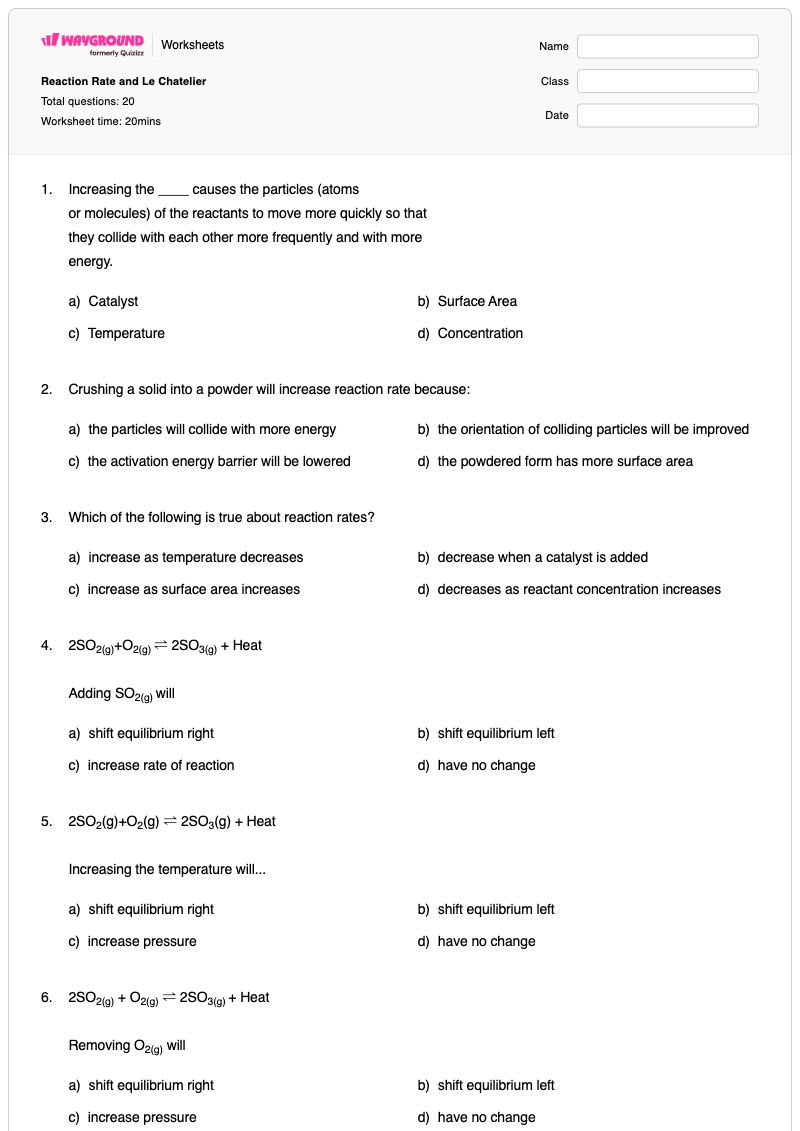
Reaction Rate and Le Chatelier

คำถามทั้งหมด: 20

ชื่อ
ระดับ
วันที่
1.

Increasing the ____ causes the particles (atoms

or molecules) of the reactants to move more quickly so that

they collide with each other more frequently and with more

energy.

a)

Catalyst

b)

Surface Area

c)

Temperature

d)

Concentration

2.

Crushing a solid into a powder will increase reaction rate because:

a)

the particles will collide with more energy

b)

the orientation of colliding particles will be improved

c)

the activation energy barrier will be lowered

d)

the powdered form has more surface area

3.

Which of the following is true about reaction rates?

a)

increase as temperature decreases

b)

decrease when a catalyst is added

c)

increase as surface area increases

d)

decreases as reactant concentration increases

4.

2SO2(g)+O2(g) ⇌ 2SO3(g) + Heat


Adding SO2(g) will

a)

shift equilibrium right

b)

shift equilibrium left

c)

increase rate of reaction

d)

have no change

5.

2SO2(g)+O2(g) ⇌ 2SO3(g) + Heat


Increasing the temperature will...

a)

shift equilibrium right

b)

shift equilibrium left

c)

increase pressure

d)

have no change

6.

2SO2(g) + O2(g) ⇌ 2SO3(g) + Heat


Removing O2(g) will

a)

shift equilibrium right

b)

shift equilibrium left

c)

increase pressure

d)

have no change

7.

2SO2(g)+O2(g) ⇌ 2SO3(g) + Heat


Adding SO3(g) will

a)

shift equilibrium right

b)

shift equilibrium left

c)

increase K

d)

have no change

8.

2SO2(g) + O2(g) ⇌ 2SO3(g) + Heat


Using a catalyst

a)

shift equilibrium right

b)

shift equilibrium left

c)

increase the rate of reaction

d)

have no change

9.
At what time (in seconds) is equilibrium established?

At what time (in seconds) is equilibrium established?

a)

0 seconds

b)

1 second

c)

5 seconds

d)

2 seconds

10.
What are the two factors to look for when determining if the reaction is at equilibrium?
a)

The concentrations of the reactants and products are equal

b)

Forward and reverse reaction rates are the same

c)

Forward reaction rate is faster than the reverse and concentration is equal

11.
What happens to the equilibrium if we add methane (CH 4 )?

What happens to the equilibrium if we add methane (CH4)?

a)

It shifts left, towards the reactants

b)

It shifts right, towards the products

c)

It does not shift

12.
What happens to the equilibrium if we remove water (H 2 O)?

What happens to the equilibrium if we remove water (H2O)?

a)

It shifts left, towards the reactants

b)

It shifts right, towards the products

c)

It does not shift

13.
What happens to the equilibrium if we remove heat?

What happens to the equilibrium if we remove heat?

a)

It shifts left, towards the reactants

b)

It shifts right, towards the products

c)

It does not shift

14.
What happens to the equilibrium if we add hydrogen (H 2 )?

What happens to the equilibrium if we add hydrogen (H2)?

a)

It shifts left, towards the reactants

b)

It shifts right, towards the products

c)

It does not shift

15.
What happens to the equilibrium if we remove carbon monoxide (CO)?

What happens to the equilibrium if we remove carbon monoxide (CO)?

a)

It shifts left, towards the reactants

b)

It shifts right, towards the products

c)

It does not shift

16.
This symbol indicates that a reaction is ____________
a)
reversible
b)
irreversible
17.
When the rate of the forward reaction is equal to the rate of backward reaction, the system is said to be in
a)
Chemical Equilibrium
b)
Chemical Balance
c)
Stoichiometry
d)
Chemical Reaction
18.
At what time does the reaction reach equilibrium?
a)
t1
b)
t2
c)
t3
d)
t4
19.
If I want to make MORE SO3, how could I stress the reaction so that it wants to make more SO3? (think about how it will need…

If I want to make MORE SO3, how could I stress the reaction so that it wants to make more SO3? (think about how it will need to fix itself!)

a)

Add SO3

b)

Add SO2

c)

Remove O2

d)

Add heat to one side

20.

Activation energy is...

a)

The energy that is released throughout a reaction

b)

The energy that needs to be overcome for the reaction to happen

c)

The energy the products have at the end of the reaction

d)

The energy that the reactants have at the end of the reaction

Waygroundแป้นคำตอบ

Reaction Rate and Le Chatelier

คำถามทั้งหมด: 20

1.
c)

Temperature

2.
d)

the powdered form has more surface area

3.
c)

increase as surface area increases

4.
a)

shift equilibrium right

5.
b)

shift equilibrium left

6.
b)

shift equilibrium left

7.
b)

shift equilibrium left

8.
c)

increase the rate of reaction

9.
c)

5 seconds

10.
b)

Forward and reverse reaction rates are the same

11.
b)

It shifts right, towards the products

12.
a)

It shifts left, towards the reactants

13.
b)

It shifts right, towards the products

14.
a)

It shifts left, towards the reactants

15.
b)

It shifts right, towards the products

16.
a) reversible
17.
a) Chemical Equilibrium
18.
b) t2
19.
b)

Add SO2

20.
b)

The energy that needs to be overcome for the reaction to happen

คำถามที่พบบ่อย

แบบฝึกหัดเรื่องอัตราการเกิดปฏิกิริยาและกฎของเลอชาเตลิเยร์ครอบคลุมเนื้อหาอะไรบ้าง?

แบบฝึกหัดวิทยาศาสตร์สำหรับนักเรียนชั้นมัธยมศึกษาปีที่ 4 (เกรด 11) นี้ ประกอบด้วยคำถามแบบเลือกตอบ 20 ข้อ เพื่อประเมินว่าอุณหภูมิ พื้นที่ผิว ความเข้มข้น และตัวเร่งปฏิกิริยามีผลต่ออัตราการเกิดปฏิกิริยาอย่างไร รวมถึงการเปลี่ยนแปลงของสารตั้งต้น ผลิตภัณฑ์ และความร้อน ส่งผลต่อสมดุลอย่างไร นักเรียนยังสามารถระบุได้ว่าเมื่อใดจึงจะเข้าสู่สภาวะสมดุล โดยการสังเกตว่าอัตราการเกิดปฏิกิริยาไปข้างหน้าและย้อนกลับนั้นเท่ากัน ซึ่งช่วยให้พวกเขาสามารถแยกแยะความเร็วของปฏิกิริยาออกจากตำแหน่งของสมดุลได้

ฉันจะใช้แบบฝึกหัดนี้ในการสอนเรื่องอัตราการเกิดปฏิกิริยาและหลักการของเลอชาเตลิเยร์ได้อย่างไร?

เริ่มด้วยการแนะนำหัวข้อเกี่ยวกับอัตราการเกิดปฏิกิริยา โดยให้นักเรียนอธิบายว่าเหตุใดการเปลี่ยนแปลงอุณหภูมิหรือพื้นที่ผิวจึงส่งผลต่อการชนกันของอนุภาค จากนั้นจึงอภิปรายว่าเหตุใดตัวเร่งปฏิกิริยาจึงเปลี่ยนแปลงอัตราการเกิดปฏิกิริยาโดยไม่เลือกทิศทางสมดุลใหม่ ต่อมา ให้ใช้สมการของซัลเฟอร์ไดออกไซด์ ออกซิเจน ซัลเฟอร์ไตรออกไซด์ และความร้อนซ้ำๆ เพื่อจำลองว่าการเพิ่มหรือลดสารบางชนิดเปลี่ยนแปลงการเปลี่ยนแปลงอย่างไร และปิดท้ายด้วยหัวข้อมีเทน น้ำ ไฮโดรเจน และคาร์บอนมอนอกไซด์ ในรูปแบบการฝึกฝนอิสระ

ฉันควรสังเกตข้อผิดพลาดอะไรบ้างเมื่อนักเรียนทำแบบฝึกหัดนี้เสร็จ?

นักเรียนอาจสับสนระหว่างพื้นที่ผิวกับอุณหภูมิเมื่ออธิบายว่าทำไมของแข็งที่เป็นผงจึงทำปฏิกิริยาได้เร็วกว่า หรือเลือกตัวเร่งปฏิกิริยาเป็นปัจจัยที่ทำให้สมดุลเปลี่ยนไป แทนที่จะเป็นปัจจัยที่เพิ่มอัตราการเกิดปฏิกิริยา ในคำถามเกี่ยวกับสมดุล ให้สังเกตนักเรียนที่เข้าใจผิดว่าสมดุลหมายถึงความเข้มข้นของสารตั้งต้นและผลิตภัณฑ์เท่ากัน กลับทิศทางการเลื่อนไปทางซ้าย/ขวาหลังจากเพิ่มหรือลดสาร หรือถือว่าการเพิ่มอุณหภูมิและการลดความร้อนมีผลเหมือนกันในสมการคายความร้อน

ฉันจะมอบหมายและให้คะแนนแบบฝึกหัดเรื่องอัตราการเกิดปฏิกิริยาและกฎของเลอชาเตลิเยร์นี้ได้อย่างไร?

บน Wayground คุณสามารถมอบหมายงานได้ทั้งในรูปแบบไฟล์ PDF ที่พิมพ์ได้ หรือแบบทดสอบดิจิทัล โดยแบบฝึกหัดจะมีเฉลยคำตอบครบถ้วนสำหรับคำถามแบบเลือกตอบทั้ง 20 ข้อ สำหรับการส่งงานแบบพิมพ์ คุณสามารถตรวจงานของนักเรียนได้โดยการสแกนด้วยแอป Wayground for Teachers ในขณะที่แบบทดสอบดิจิทัลรองรับการทำและตรวจงานทางออนไลน์

ฉันจะปรับแบบฝึกหัดนี้ให้เหมาะสมกับนักเรียนของฉันได้อย่างไร?

สำหรับข้อสอบแบบเลือกตอบ 20 ข้อ ให้ใช้การตั้งค่าขั้นสูงของแบบฝึกหัดเพื่อปรับระยะห่างระหว่างตัวอักษร หรือเลือกขนาดตัวอักษรที่ใหญ่ขึ้น เพื่อให้นักเรียนสามารถอ่านสมการปฏิกิริยาและตัวเลือกคำตอบได้ง่ายขึ้น นอกจากนี้ คุณยังสามารถเปิดใช้งานแบบอักษรที่เหมาะสำหรับผู้ที่มีภาวะดิสเล็กเซีย หรือแปลแบบฝึกหัดเป็นภาษาอื่นโดยคงรูปแบบคำถามเกี่ยวกับอัตราการเกิดปฏิกิริยาและสมดุลเอาไว้ได้

ฉันจะหาแบบฝึกหัดแบบนี้เพิ่มเติมได้ที่ไหนบน Wayground?

Wayground มีแบบฝึกหัดและโจทย์ฝึกหัดมากมายให้ดาวน์โหลดฟรีในหลากหลายวิชา พร้อมไฟล์ PDF และเฉลยคำตอบ เพื่อช่วยเสริมสร้างทักษะและความเข้าใจในแนวคิดสำคัญ ดูแหล่งข้อมูลเพิ่มเติมได้ที่ https://wayground.com/en-us/worksheets