

Wayground
Test Unit 5 Moles - Printable Science Worksheets - Wayground

Test Unit 5 Moles

20 คำถาม

9th - 9th ระดับชั้น

Science

แบบทดสอบหน่วยที่ 5 เรื่องโมล เป็นแบบฝึกหัดวิทยาศาสตร์สำหรับนักเรียนชั้นมัธยมศึกษาปีที่ 3 ที่ตรวจสอบความเข้าใจของนักเรียนเกี่ยวกับโมลในฐานะหน่วยนับ และความสามารถในการเชื่อมโยงโมลกับมวล อนุภาค และปริมาตรของแก๊ส แบบฝึกหัดนี้ประกอบด้วย 20 ข้อ—แบบเลือกตอบ 13 ข้อ แบบเลือกคำตอบหลายข้อ 2 ข้อ แบบเรียงลำดับ 1 ข้อ และแบบดรอปดาวน์ 4 ข้อ—นักเรียนจะได้ระบุ มวลโมลาร์ สัญลักษณ์โมล เลขอะโวกาโด และอนุภาคตัวแทน ตีความสูตรเคมี เช่น C₂H₆ และ SF₆ และรู้จักปริมาณที่เทียบเท่ากับหนึ่งโมล แบบฝึกหัดนี้ยังให้ฝึกฝนการเลือกตัวแปลงหน่วยและการคำนวณโมล รวมถึงมวลโมลาร์สำหรับ CuSO₄·5H₂O การแปลงกรัมเป็นโมล โมลเป็นมวล อนุภาคเป็นโมล และปริมาตรของแก๊ส ข้อแบบเรียงลำดับจะเสริมลำดับการวิเคราะห์มิติสำหรับการแปลงกรัมของ O₂ เป็นลิตร รวมถึงหน่วยและป้ายกำกับสารในคำตอบสุดท้าย แบบฝึกหัดนี้ออกแบบมาสำหรับทบทวนหรือประเมินผลวิชาวิทยาศาสตร์ระดับชั้น ม.3 และมีเฉลยคำตอบครบถ้วนเพื่อการตรวจทานที่มีประสิทธิภาพ (สามารถดาวน์โหลดไปพิมพ์ได้ฟรี)

การตั้งค่าแผ่นงาน

ขนาดตัวอักษร

S
M
L
XL
แผ่นงาน

Test Unit 5 Moles

คำถามทั้งหมด: 20

ชื่อ
ระดับ
วันที่
1.

The mass of 1 mole for an element or compound can be found on the periodic table. This mass is known as...

a)

molality

b)

molar mass

c)

formal mass

d)

molarity

2.

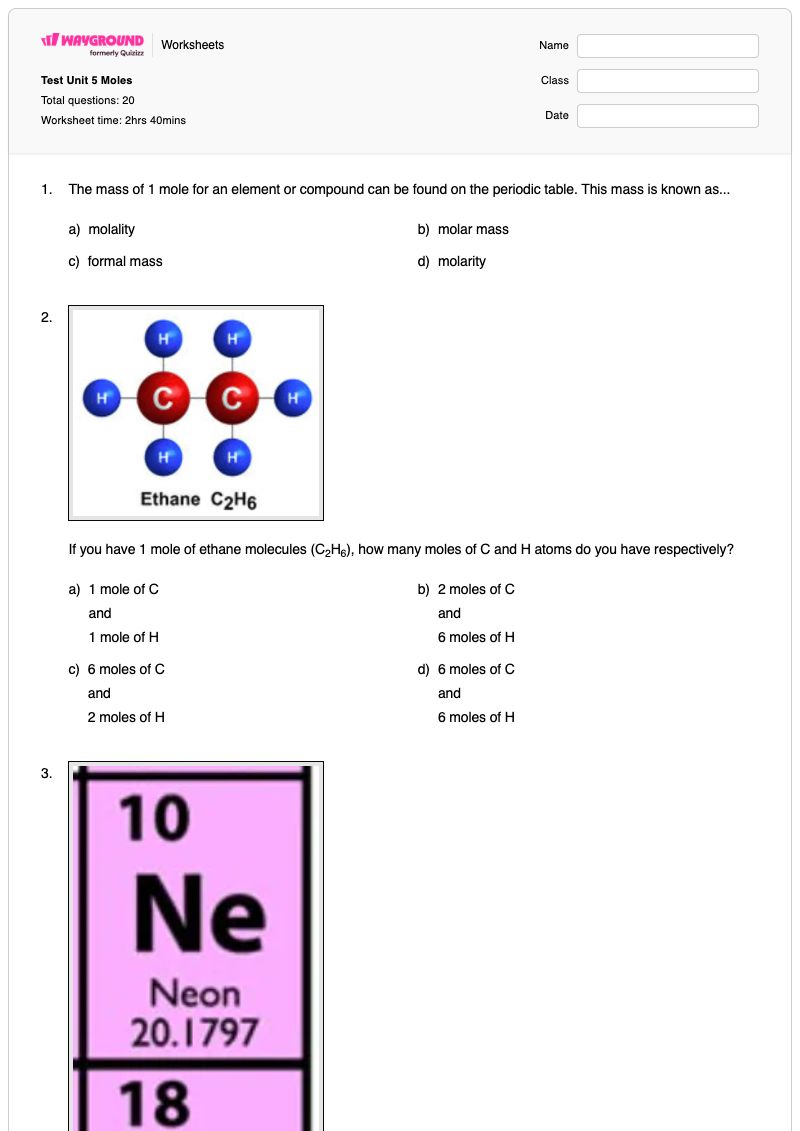
If you have 1 mole of ethane molecules (C2H6), how many moles of C and H atoms do you have respectively?

a)

1 mole of C

and

1 mole of H

b)

2 moles of C

and

6 moles of H

c)

6 moles of C

and

2 moles of H

d)

6 moles of C

and

6 moles of H

3.

Identify the sample with the most moles:

20.18 g of neon

or

39.95 g of argon

a)

20.18 g of neon

b)

39.95 g of argon

c)

They are both equal to 1 mole

4.

Identify the number of moles in 6.02 x 10²³ molecules of H2O.

a)

1 mole

b)

2 moles

c)

6.02 moles

d)

6.02 x 10²³ moles

5.

Identify the type of Representative Particle.

One mole of sulfur hexafluoride (SF6) contains 6.02 x 10²³ _____.

a)

atoms

b)

formula units

c)

ions

d)

molecules

6.

Identify the conversion factor (ratio) needed to calculate the following:

Calculate the number of molecules in 4 moles of glucose, C6H12O6.

a)
b)
c)
d)

7.

SELECT ALL CORRECT ANSWERS - The mole can be used to measure:

a)

The amount of volume for a gas at STP.

b)

The amount of molecules in a covalent substance

c)

The amount of mass for a compound.

d)

The amount of pressure an object applies.

8.

Identify the conversion factor (ratio) needed to calculate the following:

Calculate the number of moles in 7.0x1044 formula units of (NH4)3PO4.

a)
b)
c)
d)
9.

Identify the abbreviation for mole.

a)

M

b)

m

c)

mol

d)

ml

10.

Identify the unit of measurement for Avogadro's number.

a)

meters

b)

particles

c)

grams

d)

liters

11.

SELECT ALL THAT APPLY:

Which of the following is equivalent to 1 mole?

a)

1 mole of Scandium

b)

72.61 grams of Germanium

c)

6.02x1026

formula units of LiBr

d)

6.02x10²³ molecules of CO2

12.

Calculate the molar mass of copper(II)sulfate pentahydrate:

CuSO4 ⋅ 5H2O

a)

90.10 g

b)

14,381.76 g

c)

159.62 g

d)

249.72 g

13.

Calculate the moles magnesium in a 91.0 gram sample.

a)

8.4 mol Mg

b)

21 mol Mg

c)

2.5 mol Mg

d)

3.6 mol Mg

14.

Calculate the mass, in grams, of a gas sample containing 52.0 L of nitrogen (N2).

a)

41.57 g N2

b)

52.0 g N2

c)

41.57 L N2

d)

65.05 g N2

15.

Reorder the following instructions on how to complete the given mole conversion:

Convert 2.5 grams of oxygen gas (O2) to liters.

a)

Write the value that is given as the first ratio, in grams.

b)

Write the ratio to convert the given mass value, to moles.

c)

Write the ratio to convert the given mole value, to liters.

d)

Multiply all top ratio values together, then multiply all the bottom ratio values together, then divide the top value by the bottom value.

e)

Give an answer with the appropriate units, in liters, and substance, O2.

1)
2)
3)
4)
5)
16.

Identify the type of Representative Particle.

One mole of calcium carbonate (CaCO3) contains 6.02 x 10²³ _____.

a)

atoms

b)

formula units

c)

ions

d)

molecules

17.

Identify the following as ionic, covalent or metallic:

FeCl3

​ (a)  

เลือกจากคำด้านล่าง
Ionic
Covalent
metallic
18.

Identify the following as ionic, covalent or metallic:

NaNO3

​ (a)  

เลือกจากคำด้านล่าง
Ionic
Covalent
metallic
19.

Identify the following as ionic, covalent or metallic:

C6H12O6

​ (a)  

เลือกจากคำด้านล่าง
Covalent
Metallic
Ionic
20.

Identify the following as ionic, covalent or metallic:

H2S

​ (a)  

เลือกจากคำด้านล่าง
Covalent
Metallic
Ionic
แป้นคำตอบ

Test Unit 5 Moles

คำถามทั้งหมด: 20

1.
b)

molar mass

2.
b)

2 moles of C

and

6 moles of H

3.
c)

They are both equal to 1 mole

4.
a)

1 mole

5.
d)

molecules

6.
b)
7.
a)

The amount of volume for a gas at STP.

, b)

The amount of molecules in a covalent substance

, c)

The amount of mass for a compound.

8.
a)
9.
c)

mol

10.
b)

particles

11.
a)

1 mole of Scandium

, b)

72.61 grams of Germanium

, d)

6.02x10²³ molecules of CO2

12.
d)

249.72 g

13.
d)

3.6 mol Mg

14.
d)

65.05 g N2

15.
a, b, c, d, e
16.
b)

formula units

17.
Ionic
18.
Ionic
19.
Covalent
20.
Covalent

คำถามที่พบบ่อย

แบบฝึกหัดหน่วยที่ 5 เรื่องโมล ครอบคลุมเนื้อหาอะไรบ้าง?

แบบฝึกหัดวิทยาศาสตร์สำหรับนักเรียนชั้น ม.3 นี้ครอบคลุมความสัมพันธ์ของโมล รวมถึงมวลโมลาร์ เลขอะโวกาโด อนุภาคตัวแทน ตัวเลขห้อยในสูตรเคมี และการแปลงหน่วยระหว่างมวล โมล อนุภาค และปริมาตรของแก๊ส แบบฝึกหัดประกอบด้วย 20 ข้อ โดยใช้รูปแบบคำถามแบบเลือกตอบ เลือกหลายข้อ แบบดรอปดาวน์ และการเรียงลำดับ เพื่อให้นักเรียนระบุตัวประกอบการแปลง คำนวณปริมาณต่างๆ เช่น มวลโมลาร์ของ CuSO₄·5H₂O และเรียงลำดับขั้นตอนในการแปลงกรัมของ O₂ เป็นลิตร

ฉันจะใช้แบบฝึกหัดนี้สอนเรื่องการแปลงหน่วยโมลได้อย่างไร?

เริ่มแบบฝึกหัดโดยทบทวนโมลซึ่งเท่ากับ 6.02 × 10²³ อนุภาค และจำลองวิธีการที่สูตรเคมีกำหนดจำนวนอะตอมในหนึ่งโมลของสารประกอบ เช่น อะตอมคาร์บอน 2 อะตอมและอะตอมไฮโดรเจน 6 อะตอมใน C₂H₆ จากนั้นให้นักเรียนใช้รายการตัวประกอบการแปลงและงานเรียงลำดับ O₂ จากกรัมเป็นลิตรเพื่ออธิบายแต่ละขั้นตอนของการวิเคราะห์มิติ รวมถึงเหตุผลที่หน่วยตัดกันและเหตุผลที่คำตอบสุดท้ายต้องมีลิตรและ O₂ ใช้คำถามเกี่ยวกับการคำนวณมวล อนุภาค และปริมาตรของแก๊สสำหรับการฝึกฝนแบบมีแนวทางก่อนที่จะมอบหมายแบบฝึกหัดฉบับเต็มให้นักเรียนทำด้วยตนเอง

ฉันควรระวังข้อผิดพลาดอะไรบ้างในแบบฝึกหัดเรื่องโมล หน่วยที่ 5?

ระวังนักเรียนสับสนระหว่างตัวเลขห้อยกับจำนวนโมลในตัวอย่าง เช่น อ่าน C₂H₆ เป็นคาร์บอนและไฮโดรเจนอย่างละ 1 โมล แทนที่จะเป็นคาร์บอน 2 โมล และไฮโดรเจน 6 โมล นักเรียนอาจใช้คำแทนอนุภาคผิด อ่าน 6.02 × 10²³ ผิดเป็นจำนวนโมลแทนที่จะเป็นอนุภาค หรือเลือกเลขยกกำลังสิบที่ไม่ถูกต้องในตัวแปลงหน่วย ในการคำนวณและการเรียงลำดับ ให้ตรวจสอบว่านักเรียนใช้มวลโมลาร์ในการแปลงมวล คำนึงถึงทุกส่วนของ CuSO₄·5H₂O ตัดหน่วยตามลำดับที่ถูกต้อง และรายงานหน่วยและสารที่ต้องการ

ฉันจะมอบหมายและให้คะแนนแบบฝึกหัดเรื่องตัวตุ่นนี้ได้อย่างไร?

คุณสามารถมอบหมายแบบทดสอบหน่วยที่ 5 เรื่องโมล ในรูปแบบไฟล์ PDF ที่พิมพ์ได้ หรือเป็นแบบทดสอบดิจิทัลบน Wayground แบบฝึกหัดนี้มีเฉลยคำตอบครบถ้วน และสามารถตรวจให้คะแนนงานที่ส่งมาได้โดยการสแกนงานของนักเรียนด้วยแอป Wayground for Teachers ตัวเลือกไฟล์ PDF ยังช่วยสนับสนุนห้องเรียนที่ลดเวลาการใช้หน้าจอในขณะที่นักเรียนฝึกคำนวณเรื่องโมลอีกด้วย

ฉันจะปรับแบบฝึกหัดเรื่องโมลนี้ให้เหมาะสมกับนักเรียนของฉันได้อย่างไร?

ใช้การตั้งค่าขั้นสูงของแบบฝึกหัดเพื่อปรับระยะห่างระหว่างตัวอักษรและขนาดตัวอักษรบริเวณสูตรเคมี ตัวเลือกตัวประกอบการแปลง และคำแนะนำการคำนวณหลายขั้นตอน นอกจากนี้ คุณยังสามารถเปิดใช้งานแบบอักษรที่เป็นมิตรต่อผู้ที่มีภาวะดิสเล็กเซีย หรือแปลแบบฝึกหัดเป็นภาษาอื่นเพื่อช่วยให้นักเรียนเข้าถึงคำแนะนำการแปลงโมลและตัวเลือกคำตอบได้ง่ายขึ้น ตัวเลือกในระดับไฟล์เหล่านี้สามารถทำให้แบบฝึกหัดแบบผสม 20 ข้อนี้อ่านง่ายขึ้นโดยไม่เปลี่ยนแปลงเนื้อหาทางเคมี

ฉันจะหาแบบฝึกหัดฟรีแบบนี้เพิ่มเติมได้ที่ไหนบน Wayground?

Wayground มีแบบฝึกหัดและโจทย์ฝึกหัดมากมายให้ดาวน์โหลดฟรีในหลากหลายวิชา พร้อมไฟล์ PDF และเฉลยคำตอบ เพื่อช่วยให้นักเรียนพัฒนาทักษะและความเข้าใจในแนวคิดสำคัญๆ ดูแหล่งข้อมูลเพิ่มเติมได้ที่ https://wayground.com/en-us/worksheets