

Wayground
Limiting Factors of Photosynthesis - Printable ศาสตร์ Worksheets 10th ระดับชั้น - Wayground

Limiting Factors of Photosynthesis

Kemon Jones

สร้างโดย Kemon Jones

20 คำถาม

10th ระดับชั้น

ศาสตร์

อัปเดตแล้ว ก.ย. 2569

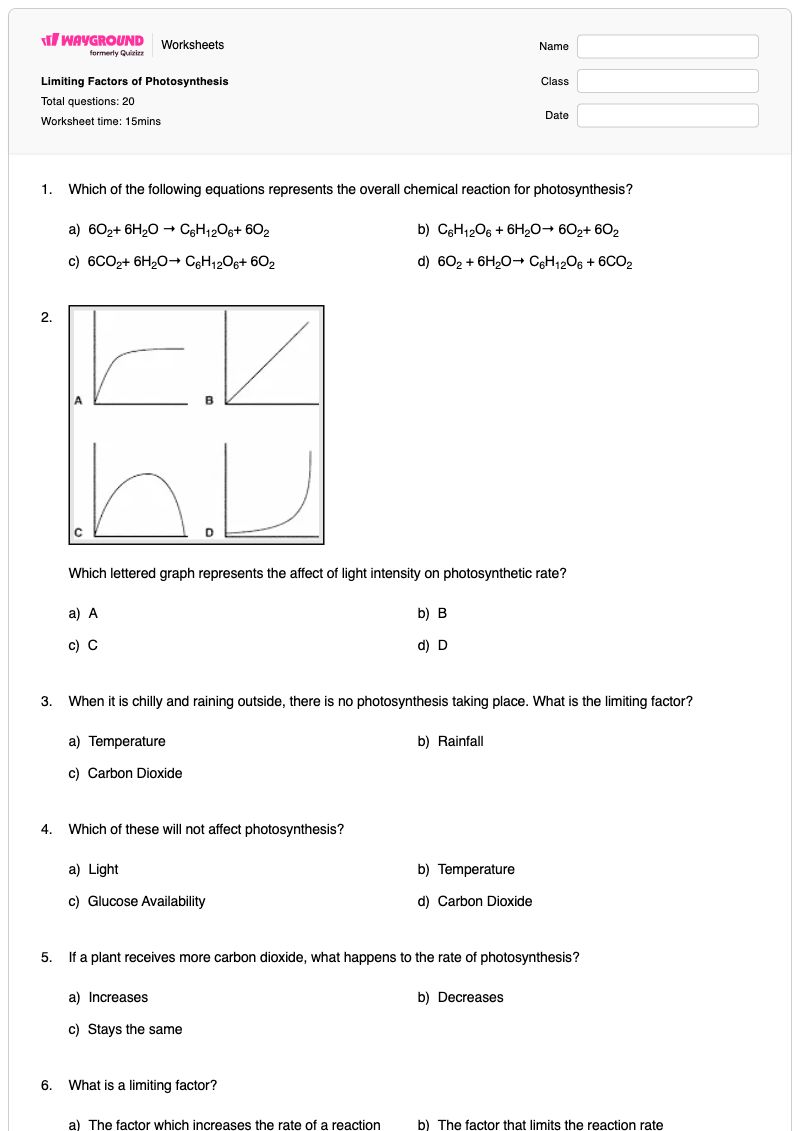
แบบฝึกหัดวิทยาศาสตร์ระดับชั้น ม.4 นี้ช่วยให้นักเรียนระบุและอธิบายปัจจัยจำกัดที่ควบคุมอัตราการสังเคราะห์แสง ผ่านคำถามแบบเลือกตอบ 20 ข้อ นักเรียนจะได้ทบทวนสมการการสังเคราะห์แสง แยกแยะสารตั้งต้นและผลิตภัณฑ์ ระบุบทบาทของคาร์บอนไดออกไซด์ น้ำ แสง และอุณหภูมิ และตระหนักถึงปัจจัยที่ไม่ส่งผลกระทบโดยตรงต่อกระบวนการ คำถามหลายข้อต้องการให้นักเรียนตีความกราฟที่แสดงให้เห็นว่าความเข้มของแสงและอุณหภูมิมีอิทธิพลต่ออัตราการสังเคราะห์แสงอย่างไร แบบฝึกหัดนี้ยังเชื่อมโยงการสังเคราะห์แสงกับการผลิตกลูโคสและการเจริญเติบโตของพืช ช่วยให้นักเรียนนำแนวคิดไปประยุกต์ใช้แทนที่จะท่องจำคำจำกัดความ เหมาะสำหรับใช้ในการสอนชีววิทยา การฝึกฝนแบบมีผู้แนะนำ การทบทวน หรือการประเมินผลหลังจากที่นักเรียนได้เรียนรู้ปฏิกิริยาการสังเคราะห์แสงขั้นพื้นฐานและความสัมพันธ์ของปัจจัยจำกัดแล้ว แบบฝึกหัดที่พิมพ์ได้ฟรีนี้มีเฉลยคำตอบครบถ้วนเพื่อการตรวจสอบและให้ข้อเสนอแนะอย่างมีประสิทธิภาพ

การตั้งค่าแผ่นงาน

ขนาดตัวอักษร

S
M
L
XL
Waygroundแผ่นงาน

Limiting Factors of Photosynthesis

คำถามทั้งหมด: 20

ชื่อ
ระดับ
วันที่
1.

Which of the following equations represents the overall chemical reaction for photosynthesis?

a)

6O2+ 6H2O → C6H12O6+ 6O2

b)

C6H12O6 + 6H2O→ 6O2+ 6O2

c)

6CO2+ 6H2O→ C6H12O6+ 6O2

d)

6O2 + 6H2O→ C6H12O6 + 6CO2

2.
Which lettered graph represents the affect of light intensity on photosynthetic rate?

Which lettered graph represents the affect of light intensity on photosynthetic rate?

a)

A

b)

B

c)

C

d)

D

3.
When it is chilly and raining outside, there is no photosynthesis taking place. What is the limiting factor?
a)
Temperature
b)
Rainfall
c)
Carbon Dioxide
4.
Which of these will not affect photosynthesis?
a)
Light
b)
Temperature
c)
Glucose Availability
d)
Carbon Dioxide
5.
If a plant receives more carbon dioxide, what happens to the rate of photosynthesis?
a)
Increases
b)
Decreases
c)
Stays the same
6.
What is a limiting factor?
a)
The factor which increases the rate of a reaction
b)
The factor that limits the reaction rate
c)
The factor that limits the rate at which an enzyme is destroyed
7.
Which lettered graph represents the effect of temperature on photosynthetic rate?

Which lettered graph represents the effect of temperature on photosynthetic rate?

a)

A

b)

B

c)

C

d)

D

8.
Glucose (sugar) is also produced during photosynthesis. What do plants use glucose for?
a)
Source of energy.
b)
Supports plant growth and development.
c)
Keeps plants warm.
d)
Prevents plants from dying.
9.
How does temperature affects photosynthesis rate?
a)
As temperature increases, photosynthesis rate also increases.
b)
As temperature decreases, photosynthesis rate also decreases.
c)
Plants cannot photosynthesis if the temperature is too cold or too hot. 
d)
All of the statements are true.
10.
The rate of photosynthesis is affected by all of the following except
a)
the amount of salt.
b)
the availability of water.
c)
light intensity.
d)
temperature (enzymes).
11.
Which conclusion best matches the trends shown on the graph?
a)
Bean plants produce more ATP than corn plants.
b)
Corn plants require more oxygen than bean plants.
c)
Corn plants release more carbon dioxide than bean plants.
d)
Corn plants produce sugars at a faster rate than bean plants.
12.

Which of these pairs represents the reactants of photosynthesis?

a)

Oxygen and water

b)

Glucose and oxygen

c)

Water and glucose

d)

Carbon dioxide and water

13.

Which of these pairs represents the products of photosynthesis?

a)

Oxygen and water

b)

Glucose and oxygen

c)

Water and glucose

d)

Carbon dioxide and water

14.

Which of these is NOT needed for photosynthesis to occur

a)

Glucose

b)

Sunlight

c)

Carbon dioxide

d)

Water

15.

Which of these is a source of carbon used to make glucose?

a)

Oxygen

b)

Sunlight

c)

Carbon dioxide

d)

Water

16.
What is the purpose  of an enzyme?
a)
give permission for the reaction
b)
raise activation energy
c)
speed up reactions
d)
control how many reactions occur
17.
After the enzyme and substrate bind together and perform the reaction, what does the substrate become?
a)
a substrate
b)
an enzyme
c)
a product
d)
an active site
18.
Any substance that is acted upon by an enzyme is called a(n)?
a)
Coenzyme
b)
Substrate
c)
Vitamin
d)
Polypeptide
19.
What is the rate of reaction?
a)
How fast a reaction is 
b)
How big a reaction is
c)
How loud a reaction is
d)
How much gas a reaction produces
20.

What happens when enzymes are heated to a high temperature?

a)

The enzymes die.

b)

The shape of the enzyme are changed and it denatures

c)

The enzymes' amino acid sequence changes.

d)

The enzymes remain the same

Waygroundแป้นคำตอบ

Limiting Factors of Photosynthesis

คำถามทั้งหมด: 20

1.
c)

6CO2+ 6H2O→ C6H12O6+ 6O2

2.
a)

A

3.
a) Temperature
4.
c) Glucose Availability
5.
a) Increases
6.
b) The factor that limits the reaction rate
7.
c)

C

8.
b) Supports plant growth and development.
9.
d) All of the statements are true.
10.
a) the amount of salt.
11.
d) Corn plants produce sugars at a faster rate than bean plants.
12.
d)

Carbon dioxide and water

13.
b)

Glucose and oxygen

14.
a)

Glucose

15.
c)

Carbon dioxide

16.
c) speed up reactions
17.
c) a product
18.
b) Substrate
19.
a) How fast a reaction is 
20.
b)

The shape of the enzyme are changed and it denatures

คำถามที่พบบ่อย

แบบฝึกหัดเรื่องปัจจัยจำกัดของการสังเคราะห์แสงครอบคลุมหัวข้ออะไรบ้าง?

แบบฝึกหัดวิทยาศาสตร์สำหรับนักเรียนชั้น ม.4 นี้ ประกอบด้วยคำถามแบบเลือกตอบ 20 ข้อ เพื่อประเมินว่าความเข้มของแสง อุณหภูมิ คาร์บอนไดออกไซด์ และน้ำ มีผลต่ออัตราการสังเคราะห์แสงอย่างไร นักเรียนยังต้องตีความกราฟที่เกี่ยวข้องกับแสงและอุณหภูมิ ระบุสารตั้งต้นและผลิตภัณฑ์ของการสังเคราะห์แสง และเชื่อมโยงการผลิตกลูโคสกับการเจริญเติบโตของพืชด้วย

ฉันจะใช้แบบฝึกหัดนี้ในการสอนเรื่องปัจจัยจำกัดในการสังเคราะห์แสงได้อย่างไร?

ใช้สมการการสังเคราะห์แสงและคำถามเกี่ยวกับสารตั้งต้น/ผลิตภัณฑ์เพื่อกำหนดสิ่งที่กระบวนการต้องการก่อนที่จะแนะนำปัจจัยจำกัด จากนั้นให้นักเรียนอธิบายตัวเลือกในกราฟสำหรับความเข้มของแสงและอุณหภูมิ และให้เหตุผลว่าทำไมคาร์บอนไดออกไซด์จึงสามารถเพิ่มอัตราการสังเคราะห์แสงได้ ในขณะที่ปริมาณกลูโคสไม่มีผลโดยตรง แบบฝึกหัดแบบเลือกตอบที่ทำเสร็จแล้วสามารถใช้สนับสนุนการอภิปรายในชั้นเรียนเกี่ยวกับเหตุผลที่อัตราการสังเคราะห์แสงของพืชเปลี่ยนแปลงไปเมื่อสภาวะหนึ่งกลายเป็นปัจจัยจำกัด

ฉันควรระวังข้อผิดพลาดอะไรบ้างเมื่อนักเรียนทำแบบฝึกหัดเรื่องการสังเคราะห์แสงนี้?

ระวังนักเรียนที่สลับสารตั้งต้นและผลิตภัณฑ์ในสมการการสังเคราะห์แสง เลือกใช้กลูโคสแทนคาร์บอนไดออกไซด์เป็นสารตั้งต้น หรือมองว่าปริมาณกลูโคสเป็นปัจจัยจำกัดของกระบวนการ นอกจากนี้ นักเรียนอาจสับสนระหว่างรูปแบบกราฟกับความเข้มของแสงและอุณหภูมิ หรือเลือกสภาวะอื่น เช่น ปริมาณน้ำฝนหรือปริมาณเกลือ แทนที่จะระบุว่าอุณหภูมิ แสง น้ำ หรือคาร์บอนไดออกไซด์เป็นปัจจัยที่เกี่ยวข้อง

ฉันจะมอบหมายและให้คะแนนแบบฝึกหัดเรื่องปัจจัยจำกัดนี้ได้อย่างไร?

แบบฝึกหัดนี้มีให้เลือกทั้งในรูปแบบไฟล์ PDF ที่สามารถพิมพ์ได้ และแบบทดสอบดิจิทัลบน Wayground โดยมีเฉลยคำตอบครบถ้วนสำหรับคำถามแบบเลือกตอบทั้ง 20 ข้อ สำหรับการส่งงานแบบพิมพ์ คุณสามารถตรวจงานของนักเรียนได้โดยการสแกนด้วยแอป Wayground for Teachers นอกจากนี้ ตัวเลือกไฟล์ PDF ยังช่วยให้โรงเรียนลดเวลาการใช้หน้าจอลงได้ ในขณะที่ยังคงฝึกฝนกระบวนการสังเคราะห์แสงเช่นเดิม

ฉันจะปรับแบบฝึกหัดเรื่องการสังเคราะห์แสงนี้ให้เหมาะสมกับนักเรียนของฉันได้อย่างไร?

ในการตั้งค่าขั้นสูงของแบบฝึกหัด ให้ปรับระยะห่างระหว่างตัวอักษรหรือเลือกขนาดตัวอักษรที่ใหญ่ขึ้น เพื่อให้สมการการสังเคราะห์แสง ตัวเลือกคำตอบ และคำถามที่อิงตามกราฟอ่านง่ายขึ้น นอกจากนี้ คุณยังสามารถใช้แบบอักษรที่เหมาะสำหรับผู้ที่มีภาวะดิสเล็กเซีย หรือแปลแบบฝึกหัดเป็นภาษาอื่นได้ โดยยังคงรูปแบบคำถามแบบเลือกตอบที่เน้นปัจจัยจำกัดและอัตราการสังเคราะห์แสงไว้

ฉันจะหาแบบฝึกหัดแบบนี้เพิ่มเติมได้ที่ไหนบน Wayground?

Wayground นำเสนอชุดแบบฝึกหัดและโจทย์ฝึกหัดฟรีที่ครอบคลุมหลากหลายวิชา พร้อมไฟล์ PDF และเฉลยคำตอบ เพื่อช่วยให้นักเรียนเชี่ยวชาญทักษะและแนวคิดที่สำคัญ ดูแหล่งข้อมูลเพิ่มเติมได้ที่ https://wayground.com/en-us/worksheets