

Wayground
Ecology-Levels of Organization - Printable ศาสตร์ Worksheets 6th ระดับชั้น - Wayground

Ecology-Levels of Organization

Brianna Oliver

สร้างโดย Brianna Oliver

20 คำถาม

6th ระดับชั้น

ศาสตร์

อัปเดตแล้ว ก.ย. 2569

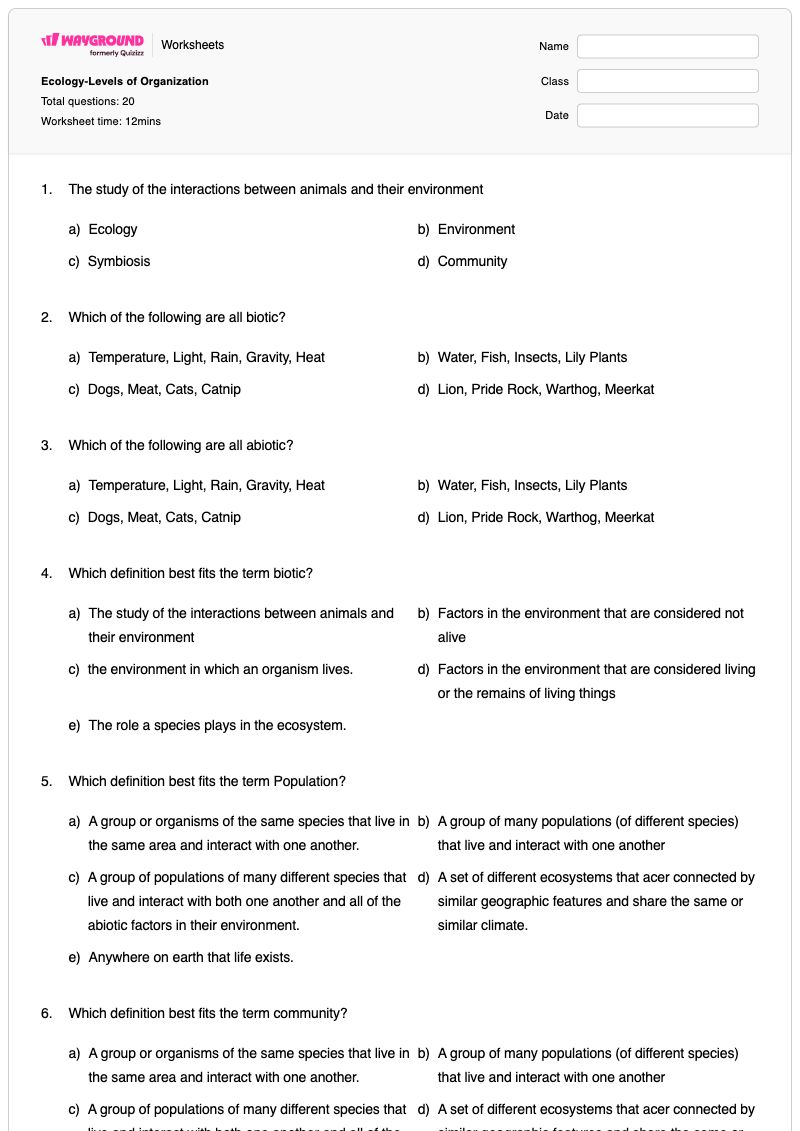
แบบฝึกหัดวิทยาศาสตร์สำหรับชั้นประถมศึกษาปีที่ 6 เรื่อง นิเวศวิทยา - ระดับขององค์ประกอบทางนิเวศวิทยา ประกอบด้วยคำถามแบบเลือกตอบ 20 ข้อ เพื่อสร้างความเข้าใจเกี่ยวกับนิเวศวิทยาและวิธีที่ปัจจัยทางชีวภาพและปัจจัยที่ไม่ใช่สิ่งมีชีวิตกำหนดสภาพแวดล้อม นักเรียนจะได้ระบุปัจจัยทางชีวภาพ ได้แก่ สิ่งมีชีวิตและซากของสิ่งมีชีวิต แยกแยะปัจจัยที่ไม่ใช่สิ่งมีชีวิต เช่น อุณหภูมิ แสง ฝน แรงโน้มถ่วง และความร้อน และจับคู่คำศัพท์สำคัญกับคำจำกัดความ แบบฝึกหัดนี้ยังช่วยพัฒนาความสามารถของนักเรียนในการแยกแยะระดับขององค์ประกอบทางนิเวศวิทยา ได้แก่ ประชากร ชุมชน ระบบนิเวศ ชีวนิเวศ และชีวมณฑล คำถามหลายข้อถามให้นักเรียนระบุระดับจากภาพ ในขณะที่คำถามอื่นๆ ต้องการให้นักเรียนเปรียบเทียบคำจำกัดความและตัวอย่าง แบบฝึกหัดที่พิมพ์ได้ฟรีนี้มีเฉลยคำตอบครบถ้วน ทำให้มีประโยชน์สำหรับการสอนวิทยาศาสตร์ชั้นประถมศึกษาปีที่ 6 การฝึกฝนด้วยตนเอง การทบทวน หรือการประเมินผล

การตั้งค่าแผ่นงาน

ขนาดตัวอักษร

S
M
L
XL
Waygroundแผ่นงาน

Ecology-Levels of Organization

คำถามทั้งหมด: 20

ชื่อ
ระดับ
วันที่
1.

The study of the interactions between animals and their environment

a)

Ecology

b)

Environment

c)

Symbiosis

d)

Community

2.

Which of the following are all biotic?

a)

Temperature, Light, Rain, Gravity, Heat

b)

Water, Fish, Insects, Lily Plants

c)

Dogs, Meat, Cats, Catnip

d)

Lion, Pride Rock, Warthog, Meerkat

3.

Which of the following are all abiotic?

a)

Temperature, Light, Rain, Gravity, Heat

b)

Water, Fish, Insects, Lily Plants

c)

Dogs, Meat, Cats, Catnip

d)

Lion, Pride Rock, Warthog, Meerkat

4.

Which definition best fits the term biotic?

a)

The study of the interactions between animals and their environment

b)

Factors in the environment that are considered not alive

c)

the environment in which an organism lives.

d)

Factors in the environment that are considered living or the remains of living things

e)

The role a species plays in the ecosystem.

5.

Which definition best fits the term Population?

a)

A group or organisms of the same species that live in the same area and interact with one another.

b)

A group of many populations (of different species) that live and interact with one another

c)

A group of populations of many different species that live and interact with both one another and all of the abiotic factors in their environment.

d)

A set of different ecosystems that acer connected by similar geographic features and share the same or similar climate.

e)

Anywhere on earth that life exists.

6.

Which definition best fits the term community?

a)

A group or organisms of the same species that live in the same area and interact with one another.

b)

A group of many populations (of different species) that live and interact with one another

c)

A group of populations of many different species that live and interact with both one another and all of the abiotic factors in their environment.

d)

A set of different ecosystems that acer connected by similar geographic features and share the same or similar climate.

e)

Anywhere on earth that life exists.

7.

Which definition best fits the term ecosystem?

a)

A group or organisms of the same species that live in the same area and interact with one another.

b)

A group of many populations (of different species) that live and interact with one another

c)

A group of populations of many different species that live and interact with both one another and all of the abiotic factors in their environment.

d)

A set of different ecosystems that acer connected by similar geographic features and share the same or similar climate.

e)

Anywhere on earth that life exists.

8.
Which level of organization is depicted in this image?

Which level of organization is depicted in this image?

a)

Population

b)

Community

c)

Ecosystem

d)

Biome

e)

Biosphere

9.
Which level of organization is depicted in this image?

Which level of organization is depicted in this image?

a)

Population

b)

Community

c)

Ecosystem

d)

Biome

e)

Biosphere

10.
Which level of organization is depicted in this image?

Which level of organization is depicted in this image?

a)

Population

b)

Community

c)

Ecosystem

d)

Biome

e)

Biosphere

11.
Which level of organization is depicted in this image?

Which level of organization is depicted in this image?

a)

Population

b)

Community

c)

Ecosystem

d)

Biome

e)

Biosphere

12.
Which level of organization is depicted in this image?

Which level of organization is depicted in this image?

a)

Population

b)

Community

c)

Ecosystem

d)

Biome

e)

Biosphere

13.
Which level of organization is depicted in this image?

Which level of organization is depicted in this image?

a)

Population

b)

Community

c)

Ecosystem

d)

Biome

e)

Biosphere

14.

Biotic

a)

Dead

b)

Non-living

c)

Alone

d)

Living

15.

Abiotic

a)

Living

b)

Alive

c)

Non-living

d)

Bacteria

16.

The biotic and abiotic factors that work together in an area

a)

Community

b)

Ecosystem

c)

Organism

d)

Population

17.
Which is an example of an abiotic factor?
a)
Grass
b)
Trees
c)
Rain
d)
Birds
18.
What are the biotic factors in this image?
a)
sunlight, elephants, and grasses
b)
sunlight, water,  and air
c)
elephants, plants, trees 
19.
What are the abiotic factors in this image?
What are the abiotic factors in this image? 
a)
water, sunlight, dirt, air
b)
birds and plants
c)
water, plants, and birds 
20.
What level of organization can be observed in the image?
a)
Species
b)
Population
c)
Community
d)
Ecosystem
Waygroundแป้นคำตอบ

Ecology-Levels of Organization

คำถามทั้งหมด: 20

1.
a)

Ecology

2.
c)

Dogs, Meat, Cats, Catnip

3.
a)

Temperature, Light, Rain, Gravity, Heat

4.
d)

Factors in the environment that are considered living or the remains of living things

5.
a)

A group or organisms of the same species that live in the same area and interact with one another.

6.
b)

A group of many populations (of different species) that live and interact with one another

7.
c)

A group of populations of many different species that live and interact with both one another and all of the abiotic factors in their environment.

8.
a)

Population

9.
b)

Community

10.
c)

Ecosystem

11.
d)

Biome

12.
e)

Biosphere

13.
b)

Community

14.
d)

Living

15.
c)

Non-living

16.
b)

Ecosystem

17.
c) Rain
18.
c) elephants, plants, trees 
19.
a) water, sunlight, dirt, air
20.
d) Ecosystem

คำถามที่พบบ่อย

แบบฝึกหัดเรื่องระดับการจัดระเบียบทางนิเวศวิทยาครอบคลุมหัวข้ออะไรบ้าง?

แบบฝึกหัดวิทยาศาสตร์สำหรับนักเรียนชั้นประถมศึกษาปีที่ 6 นี้ ประกอบด้วยคำถามแบบเลือกตอบ 20 ข้อ เพื่อประเมินปัจจัยทางชีวภาพและอชีวภาพ คำศัพท์ทางนิเวศวิทยา และระดับการจัดระเบียบตั้งแต่ระดับประชากรไปจนถึงชีวมณฑล นักเรียนจะนำคำจำกัดความไปใช้กับตัวอย่าง และระบุระดับประชากร ชุมชน ระบบนิเวศ ชีวนิเวศ หรือชีวมณฑลจากภาพ เพื่อสร้างความแม่นยำในการจำแนกระบบนิเวศ

ฉันจะใช้แบบฝึกหัดนี้ในการสอนเรื่องระดับการจัดระเบียบทางนิเวศวิทยาได้อย่างไร?

เริ่มแบบฝึกหัดโดยการจัดตัวอย่างที่คุ้นเคยลงในหมวดหมู่สิ่งมีชีวิตและสิ่งไม่มีชีวิต จากนั้นค่อยๆ ขยายจากประชากรชนิดเดียวไปสู่ชุมชน ระบบนิเวศ ชีวนิเวศ และชีวมณฑล ก่อนที่นักเรียนจะตอบคำถามจากรูปภาพ ให้พวกเขาอธิบายว่าหลักฐานใดที่แยกแยะแต่ละระดับ เช่น ตัวอย่างแสดงถึงสิ่งมีชีวิตชนิดเดียว หลายชนิด หรือปฏิสัมพันธ์กับปัจจัยทางกายภาพ จากนั้นใช้ตัวเลือกแบบปรนัยเพื่ออภิปรายว่าทำไมระดับอื่นๆ จึงไม่เหมาะสม

ฉันควรระวังข้อผิดพลาดอะไรบ้างในแบบฝึกหัดเรื่องนิเวศวิทยาชุดนี้?

นักเรียนอาจสับสนระหว่างประชากรกับชุมชน โดยมองข้ามไปว่าสิ่งมีชีวิตทั้งหมดอยู่ในสปีชีส์เดียวกันหรือไม่ นอกจากนี้ พวกเขาอาจเรียกระบบนิเวศว่าชุมชนเมื่อไม่ได้รวมปัจจัยทางกายภาพ หรืออาจสลับบทบาทระหว่างสิ่งมีชีวิตและสิ่งไม่มีชีวิต โดยถือว่าสิ่งมีชีวิตหรือซากของสิ่งมีชีวิตเป็นปัจจัยที่ไม่มีชีวิต ในแบบฝึกหัดที่ใช้รูปภาพ ให้ตรวจสอบว่านักเรียนระบุระดับระบบนิเวศทั้งหมดหรือไม่ แทนที่จะมุ่งเน้นไปที่สิ่งมีชีวิตหรือวัตถุเพียงอย่างเดียว

ฉันจะมอบหมายและให้คะแนนแบบฝึกหัดเรื่องระดับการจัดระเบียบทางนิเวศวิทยาได้อย่างไร?

คุณสามารถมอบหมายแบบฝึกหัดนี้เป็นไฟล์ PDF ที่พิมพ์ได้ หรือเป็นแบบทดสอบดิจิทัลบน Wayground แบบฝึกหัดนี้มีเฉลยคำตอบครบถ้วนสำหรับคำถามแบบเลือกตอบ 20 ข้อ และสามารถตรวจให้คะแนนงานที่ส่งในรูปแบบไฟล์พิมพ์ได้โดยการสแกนงานของนักเรียนด้วยแอป Wayground for Teachers รูปแบบไฟล์พิมพ์ยังช่วยสนับสนุนโรงเรียนที่ต้องการลดเวลาการใช้หน้าจอในขณะที่ยังคงให้การเรียนรู้ด้านนิเวศวิทยาเข้าถึงได้ง่าย

ฉันจะปรับแบบฝึกหัดนิเวศวิทยานี้ให้เหมาะสมกับนักเรียนของฉันได้อย่างไร?

ใช้การตั้งค่าขั้นสูงของแบบฝึกหัดเพื่อปรับระยะห่างระหว่างตัวอักษรและขนาดตัวอักษร เพื่อให้คำจำกัดความแบบเลือกตอบและตัวเลือกการระบุรูปภาพใช้งานง่ายขึ้น นอกจากนี้ คุณยังสามารถเปิดใช้งานแบบอักษรที่เป็นมิตรต่อผู้ที่มีภาวะดิสเล็กเซีย หรือแปลแบบฝึกหัดเป็นภาษาอื่นได้ หากนั่นช่วยเหลือนักเรียนที่ทำงานกับคำศัพท์ต่างๆ เช่น สิ่งมีชีวิต สิ่งไม่มีชีวิต ประชากร และระบบนิเวศ ได้ดียิ่งขึ้น

ฉันจะหาแบบฝึกหัดแบบนี้เพิ่มเติมได้ที่ไหนบน Wayground?

Wayground นำเสนอชุดแบบฝึกหัดและโจทย์ฝึกหัดฟรีที่ครอบคลุมหลากหลายวิชา พร้อมไฟล์ PDF และเฉลยคำตอบ เพื่อช่วยให้นักเรียนเชี่ยวชาญทักษะและแนวคิดที่สำคัญ ดูแหล่งข้อมูลเพิ่มเติมได้ที่ https://wayground.com/en-us/worksheets