

Wayground
Science U4.1Forces - Printable ศาสตร์ Worksheets ระดับ 5 - Wayground

Science U4.1Forces

Brent Fulmer

สร้างโดย Brent Fulmer

15 คำถาม

5th ระดับชั้น

ศาสตร์

แบบฝึกหัดวิทยาศาสตร์ U4.1 เรื่องแรง สำหรับนักเรียนชั้นประถมศึกษาปีที่ 5 ช่วยให้นักเรียนนำแนวคิดเรื่องแรงไปใช้ในสถานการณ์ที่คุ้นเคย แบบฝึกหัดนี้มีคำถาม 15 ข้อ ช่วยให้นักเรียนวิเคราะห์แรงสมดุลและแรงไม่สมดุล เปรียบเทียบว่ามวลมีผลต่อการหยุดอย่างไร กำหนดทิศทางของแรงลัพธ์ แยกแยะความแตกต่างระหว่างแรงผลักและแรงดึง และอธิบายว่าแรงโน้มถ่วงและแรงเสียดทานมีผลต่อการเคลื่อนที่อย่างไร นอกจากนี้ นักเรียนยังประเมินว่าการเปลี่ยนแปลงแรง ความสูงของการปล่อย หรือแรงเสียดทานของพื้นผิว เปลี่ยนแปลงการเคลื่อนที่ของวัตถุอย่างไร แบบฝึกหัดนี้ประกอบด้วยคำถามแบบเลือกตอบ 10 ข้อ คำถามแบบเติมคำในช่องว่าง 4 ข้อ และคำถามแบบเลือกคำตอบหลายข้อ 1 ข้อ นักเรียนจะได้ยกตัวอย่างเช่น แรงที่มากกว่าในการแข่งขันงัดข้อที่ทำให้แขนของคู่ต่อสู้เคลื่อนที่ ความแตกต่างของแรงเสียดทานระหว่างน้ำแข็งและคอนกรีต แรงโน้มถ่วงที่ทำให้กระรอกที่กำลังร่อนลงมา และมวลที่ทำให้รถไฟหยุดยากขึ้น แบบฝึกหัดที่พิมพ์ได้ฟรีนี้มีเฉลยคำตอบครบถ้วน และออกแบบมาสำหรับการฝึกฝน ทบทวน หรือตรวจสอบความเข้าใจหลังจากการเรียนการสอนเรื่องแรงและการเคลื่อนที่ในวิชาวิทยาศาสตร์ชั้นประถมศึกษาปีที่ 5

การตั้งค่าแผ่นงาน

ขนาดตัวอักษร

S
M
L
XL
Waygroundแผ่นงาน

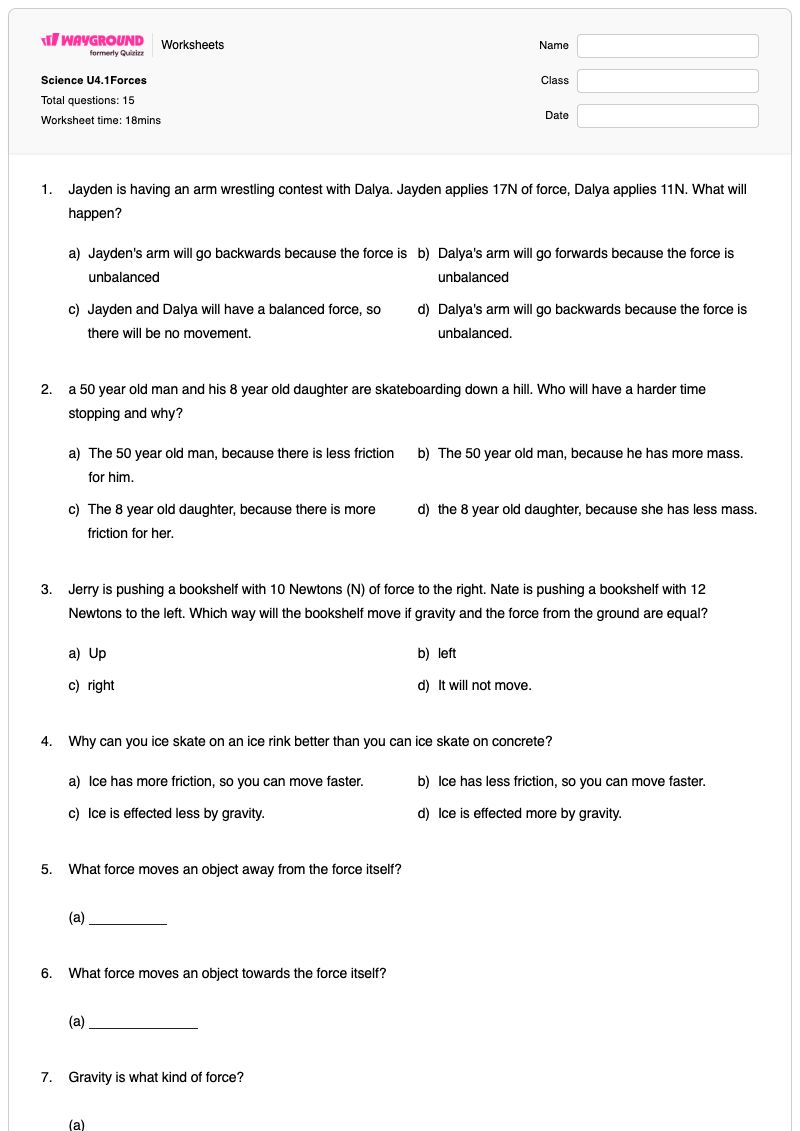
Science U4.1Forces

คำถามทั้งหมด: 15

ชื่อ
ระดับ
วันที่
1.

Jayden is having an arm wrestling contest with Dalya. Jayden applies 17N of force, Dalya applies 11N. What will happen?

a)

Jayden's arm will go backwards because the force is unbalanced

b)

Dalya's arm will go forwards because the force is unbalanced

c)

Jayden and Dalya will have a balanced force, so there will be no movement.

d)

Dalya's arm will go backwards because the force is unbalanced.

2.

a 50 year old man and his 8 year old daughter are skateboarding down a hill. Who will have a harder time stopping and why?

a)

The 50 year old man, because there is less friction for him.

b)

The 50 year old man, because he has more mass.

c)

The 8 year old daughter, because there is more friction for her.

d)

the 8 year old daughter, because she has less mass.

3.

Jerry is pushing a bookshelf with 10 Newtons (N) of force to the right. Nate is pushing a bookshelf with 12 Newtons to the left. Which way will the bookshelf move if gravity and the force from the ground are equal?

a)

Up

b)

left

c)

right

d)

It will not move.

4.

Why can you ice skate on an ice rink better than you can ice skate on concrete?

a)

Ice has more friction, so you can move faster.

b)

Ice has less friction, so you can move faster.

c)

Ice is effected less by gravity.

d)

Ice is effected more by gravity.

5.

What force moves an object away from the force itself?

(a)  

6.

What force moves an object towards the force itself?

(a)  

7.

Gravity is what kind of force?

(a)  

8.

A rollercoaster designer wants to increase the speed of the big drop that starts her rollercoaster. What can she do? (Choose two)

a)

decrease the angle of the drop.

b)

increase the amount of friction the drop has.

c)

increase the amount of force applied to the cart

d)

decrease the height of the drop

e)

increase the height of the drop

9.

A flying squirrel doesn't really "fly," it actually glides. What is the force that eventually brings it back down to Earth?

(a)  

10.

Which is an example of an object overcoming, or temporarily defying gravity?

a)

a basketball bouncing off of the court

b)

a bowling ball gliding down the lane

c)

a golf ball being putted into the hole

d)

a football laying on the ground

11.

Milo has a mass of 55kg. She throws the football with 9 N of force.

Michell has a mass of 46kg. She throws the football with 17 N of force. What is true about Michell's throw?

a)

The football will move with more distance but less speed because she has less mass.

b)

The football will move with less distance but more speed because she has less mass.

c)

The football will move with more distance and more speed, because the force applied to it is stronger.

d)

The football will move with less distance and less speed, because the force applied to it is stronger.

12.

Which surface has the MOST amount of friction?

a)

smooth concrete

b)

tall grass

c)

an air hockey table

d)

a waxed wooden floor bowling alley

13.

Seabass was showing off his dance moves on a wooden floor. He tried to slide barefoot but didn't go very far. Which decision he made would NOT decrease the friction to help him slide farther?

a)

put mountain boots with thick tread on

b)

put soft slick socks on

c)

put water on the floor

d)

put oil on his feet

14.

Trains that have many railroad cars attached to them cannot stop as easily as a train without. Why?

a)

Trains with railroad cars move faster.

b)

Trains with railroad cars have a bigger engine.

c)

Trains with railroad cars like to take their sweet time stopping.

d)

Trains with railroad cars have more mass.

15.

Which animal is best at overcoming gravity through the following actions?

a)

A hawk sitting on the ground eating a pigmy rattlesnake

b)

A pigmy rattlesnake slithering across your shoe.

c)

A dragonfly shedding its skin.

d)

A kangaroo jumping over a barrier fence.

Waygroundแป้นคำตอบ

Science U4.1Forces

คำถามทั้งหมด: 15

1.
d)

Dalya's arm will go backwards because the force is unbalanced.

2.
b)

The 50 year old man, because he has more mass.

3.
b)

left

4.
b)

Ice has less friction, so you can move faster.

5.
push
6.
pull, gravity
7.
pull
8.
e)

increase the height of the drop

, c)

increase the amount of force applied to the cart

9.
gravity
10.
a)

a basketball bouncing off of the court

11.
c)

The football will move with more distance and more speed, because the force applied to it is stronger.

12.
b)

tall grass

13.
a)

put mountain boots with thick tread on

14.
d)

Trains with railroad cars have more mass.

15.
d)

A kangaroo jumping over a barrier fence.

คำถามที่พบบ่อย

แบบฝึกหัดเรื่องแรงสำหรับนักเรียนชั้นประถมศึกษาปีที่ 5 นี้ครอบคลุมหัวข้ออะไรบ้าง?

แบบฝึกหัดนี้ให้นักเรียนนำแนวคิดเรื่องแรงและการเคลื่อนที่ไปประยุกต์ใช้ในคำถามสถานการณ์จำลอง 15 ข้อ ซึ่งประกอบด้วยคำถามแบบเลือกตอบ 10 ข้อ คำถามแบบเติมคำในช่องว่าง 4 ข้อ และคำถามแบบเลือกคำตอบหลายข้อ 1 ข้อ นักเรียนจะต้องพิจารณาผลกระทบของแรงที่ไม่สมดุล มวล แรงเสียดทาน แรงผลัก แรงดึง และแรงโน้มถ่วง ตัวอย่างเช่น การทำนายทิศทางการเคลื่อนที่ของวัตถุ หรือการระบุวิธีการเพิ่มความเร็วของรถไฟเหาะ

ฉันจะใช้แบบฝึกหัดนี้ในการสอนเรื่องแรงและการเคลื่อนที่ได้อย่างไร?

เริ่มแบบฝึกหัดโดยสาธิตวิธีการเปรียบเทียบแรงที่ตรงข้ามกัน เช่น แรงดึงแขน 17 นิวตันและ 11 นิวตัน และอธิบายว่าแรงที่มากกว่าเป็นตัวกำหนดการเคลื่อนที่ จากนั้นให้นักเรียนอธิบายเหตุผลของตนเองสำหรับสถานการณ์ชั้นวางหนังสือ การเล่นสเก็ตน้ำแข็ง รถไฟเหาะ และแรงโน้มถ่วง ก่อนที่จะทำแบบฝึกหัดเติมคำในช่องว่างและตอบคำถามแบบเลือกตอบข้อสุดท้ายด้วยตนเอง

ฉันควรระวังข้อผิดพลาดอะไรบ้างเมื่อนักเรียนทำแบบฝึกหัดเรื่องแรงนี้?

นักเรียนอาจเลือก "แรงสมดุล" เมื่อแรงสองแรงมีทิศทางตรงกันข้ามกัน โดยไม่ตรวจสอบว่าขนาดของแรงทั้งสองเท่ากันหรือไม่ เช่นในข้อเกี่ยวกับชั้นวางหนังสือและการเล่นมวยปล้ำแขน นอกจากนี้ พวกเขาอาจสับสนระหว่างมวลกับแรงที่กระทำ สลับความหมายของการผลักและการดึง หรือเลือกคำตอบเพียงข้อเดียวในข้อเกี่ยวกับรถไฟเหาะแทนที่จะระบุการเปลี่ยนแปลงทั้งสองอย่างที่ทำให้ความเร็วเพิ่มขึ้น

ฉันจะมอบหมายและให้คะแนนแบบฝึกหัดเรื่องแรงนี้อย่างไร?

แบบฝึกหัดนี้มีให้ดาวน์โหลดในรูปแบบไฟล์ PDF สำหรับพิมพ์ และเป็นแบบทดสอบดิจิทัลบน Wayground โดยมีเฉลยคำตอบครบถ้วนสำหรับทั้ง 15 ข้อ คุณสามารถตรวจงานที่พิมพ์ออกมาของนักเรียนได้โดยการสแกนด้วยแอป Wayground for Teachers ในขณะที่แบบทดสอบดิจิทัลสามารถทำและตรวจได้ทางออนไลน์

ฉันจะปรับแบบฝึกหัดเรื่องแรงและการเคลื่อนที่นี้ให้เหมาะสมกับนักเรียนของฉันได้อย่างไร?

ในการตั้งค่าขั้นสูง ให้ปรับระยะห่างระหว่างตัวอักษรและขนาดตัวอักษรเพื่อให้ตัวเลือกแบบปรนัยและคำถามเติมคำในช่องว่างอ่านง่ายขึ้น นอกจากนี้ คุณยังสามารถใช้แบบอักษรที่เหมาะสำหรับผู้ที่มีภาวะดิสเล็กเซีย หรือแปลคำถามเกี่ยวกับแรง แรงเสียดทาน มวล และแรงโน้มถ่วงในแบบฝึกหัดเป็นภาษาอื่นได้

ฉันจะหาแบบฝึกหัดแบบนี้เพิ่มเติมได้ที่ไหนบน Wayground?

Wayground นำเสนอชุดแบบฝึกหัดและโจทย์ฝึกหัดฟรีที่ครอบคลุมทุกวิชา พร้อมไฟล์ PDF และเฉลยคำตอบ เพื่อสนับสนุนทักษะและแนวคิดที่สำคัญ ดูแหล่งข้อมูลเพิ่มเติมได้ที่ https://wayground.com/en-us/worksheets