
Wayground
KE PE Calculations Practice - Printable ศาสตร์ Worksheets 8th - 8th ระดับชั้น - Wayground

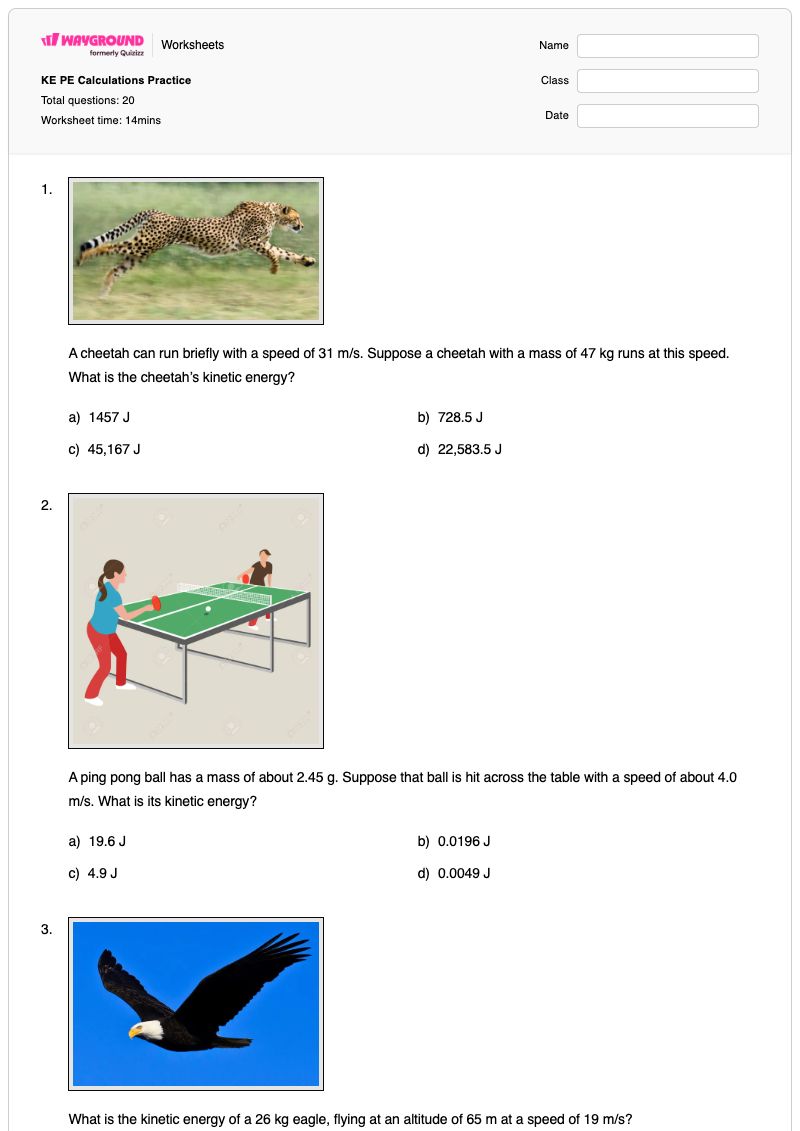
KE PE Calculations Practice

Carissa Neupert

By Carissa Neupert

20 คำถาม

8th - 8th ระดับชั้น

ศาสตร์

228 เล่น

อัปเดตแล้ว ก.ย. 2569

แบบฝึกหัดวิทยาศาสตร์สำหรับนักเรียนชั้น ม.2 นี้ ช่วยให้นักเรียนได้ฝึกฝนการคำนวณพลังงานจลน์และพลังงานศักย์โน้มถ่วงอย่างมีประสิทธิภาพ ประกอบด้วยคำถามแบบเลือกตอบ 20 ข้อ นักเรียนจะได้ใช้ความสัมพันธ์ของพลังงานจลน์ในการคำนวณพลังงาน มวล หรือความเร็ว ประยุกต์ใช้สูตรพลังงานศักย์โดยใช้มวล แรงโน้มถ่วง และความสูง ระบุสูตรที่ถูกต้อง และตีความว่าการเคลื่อนที่และตำแหน่งส่งผลต่อพลังงานอย่างไร บริบทในชีวิตจริงที่เกี่ยวข้องกับสัตว์ อุปกรณ์กีฬา ยานพาหนะ และสิ่งของในชีวิตประจำวัน ช่วยให้การคำนวณเป็นรูปธรรมมากขึ้น ในขณะเดียวกันก็กระตุ้นให้นักเรียนเลือกและประเมินคำตอบเชิงตัวเลข ใช้แบบฝึกหัดที่พิมพ์ได้ฟรีนี้พร้อมเฉลย เพื่อเสริมความเข้าใจเกี่ยวกับสูตรพลังงานหลังจากการสอนโดยตรง ให้แบบฝึกหัดอิสระ หรือตรวจสอบความพร้อมของนักเรียนในการแก้ปัญหาสำหรับตัวแปรต่างๆ คำถามที่หลากหลายช่วยให้เห็นว่านักเรียนสามารถแทนค่าได้อย่างถูกต้อง จัดการหน่วยต่างๆ เช่น กรัมและจูล และแยกแยะพลังงานจลน์จากพลังงานศักย์ได้หรือไม่ แบบฝึกหัดนี้ออกแบบมาสำหรับการทบทวนวิทยาศาสตร์ชั้น ม.2 งานในชั้นเรียน การบ้าน หรือการเตรียมการประเมินผล

การตั้งค่าแผ่นงาน

ขนาดตัวอักษร

S
M
L
XL
Waygroundแผ่นงาน

KE PE Calculations Practice

คำถามทั้งหมด: 20

ชื่อ
ระดับ
วันที่
1.
A cheetah can run briefly with a speed of 31 m/s. Suppose a cheetah with a mass of 47 kg runs at this speed. What is the…

A cheetah can run briefly with a speed of 31 m/s. Suppose a cheetah with a mass of 47 kg runs at this speed. What is the cheetah’s kinetic energy?

a)

1457 J

b)

728.5 J

c)

45,167 J

d)

22,583.5 J

2.
A ping pong ball has a mass of about 2.45 g. Suppose that ball is hit across the table with a speed of about 4.0 m/s. What…

A ping pong ball has a mass of about 2.45 g. Suppose that ball is hit across the table with a speed of about 4.0 m/s. What is its kinetic energy?

a)

19.6 J

b)

0.0196 J

c)

4.9 J

d)

0.0049 J

3.
What is the kinetic energy of a 26 kg eagle, flying at an altitude of 65 m at a speed of 19 m/s?

What is the kinetic energy of a 26 kg eagle, flying at an altitude of 65 m at a speed of 19 m/s?

a)

32,110 J

b)

16,055 J

c)

4693 J

d)

247 J

4.
A polar bear has an average mass of 500 kg. If its maximum kinetic energy is 60500 J, what is its top speed?

A polar bear has an average mass of 500 kg. If its maximum kinetic energy is 60500 J, what is its top speed?

a)

242 m/s

b)

121 m/s

c)

15.56 m/s

d)

15,125,000 m/s

5.
An airplane designed to carry a space shuttle has a top speed of 236 m/s, at which its kinetic energy is 9,760,000,000 J.…

An airplane designed to carry a space shuttle has a top speed of 236 m/s, at which its kinetic energy is 9,760,000,000 J. What is its mass?

a)

175,237 kg

b)

41,355,932 kg

c)

87618.5 kg

d)

350,474 kg

6.

My bowling ball, when dropped from a roof, has 78,750 J of kinetic energy. If the ball has a mass of 7 kg, at what speed does it hit the ground?

a)

22,500 m/s

b)

150 m/s

c)

33.9 m/s

d)

1148 m/s

7.

What is the mass of an object that creates 33,750 joules of energy by traveling at 30 m/s?

a)

75 kg

b)

15 kg

c)

1125 kg

d)

37.5 kg

8.

Find the speed of a model rocket that has a mass of 15 kg and Has 80,000 J of kinetic energy.

a)

10666.7 m/s

b)

103.9 m/s

c)

5333.3 m/s

d)

73.03 m/s

9.

A book with a mass of 1.5 kg is placed on a shelf 4 meters high. What is the potential energy of the book?

a)

0.5 J

b)

10.2 J

c)

100.5 J

d)

58.8 J

10.

A ball with a mass of 0.3 kg is thrown straight up into the air to a height of 6 meters. What is the potential energy of the ball at its highest point?

a)

3.42 Joules

b)

0.18 Joules

c)

9.81 Joules

d)

17.64 Joules

11.

A pencil with a mass of 0.1 kg is dropped from a height of 2 meters. What is the potential energy of the pencil just before it hits the ground?

a)

1.96 Joules

b)

0.02 Joules

c)

2 Joules

d)

0.2 Joules

12.

A toy car with a mass of 0.2 kg is placed on a ramp 5 meters high. What is the potential energy of the toy car?

a)

0.5 Joules

b)

2.5 Joules

c)

15 Joules

d)

9.8 Joules

13.

What is the formula to calculate potential energy?

a)

potential energy = mass * gravity * distance

b)

potential energy = mass * acceleration * height

c)

potential energy = mass * gravity * height

d)

potential energy = force * distance

14.
Which point has the most potential energy?

Which point has the most potential energy?

a)

G

b)

F

c)

B

d)

A

15.

The faster an object moves, the ________ kinetic energy it has.

a)

more

b)

less

16.
What is energy?
a)
rate of work
b)
Motion of an object
c)
ability to do work
d)
force over time
17.
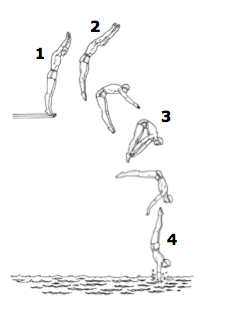
2. The diagram to the right represents a diver’s motion from the top of a high diving board into a pool of water. At what…
2. The diagram to the right represents a diver’s motion from the top of a high diving board into a pool of water. At what point does the diver have the greatest kinetic energy and the least potential energy?
a)
1
b)
2
c)
3
d)
4
18.
A stretched rubber band.
a)
Potential
b)
Kinetic
19.
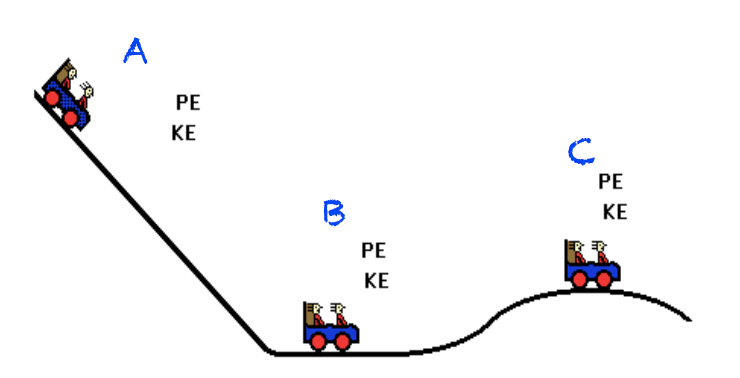
The coaster at B is at -

The coaster at B is at -

a)

Maximum PE, Minimum KE

b)

Minimum PE, Minimum KE

c)

Minimum PE, Maximum KE

d)

Maximum PE, Maximum KE

20.

Which of these has the most potential energy?

a)
Which of these has the most potential energy?
b)
Which of these has the most potential energy?
c)
Which of these has the most potential energy?
d)
Which of these has the most potential energy?
Waygroundแป้นคำตอบ

KE PE Calculations Practice

คำถามทั้งหมด: 20

1.
d)

22,583.5 J

2.
b)

0.0196 J

3.
c)

4693 J

4.
c)

15.56 m/s

5.
d)

350,474 kg

6.
b)

150 m/s

7.
a)

75 kg

8.
b)

103.9 m/s

9.
d)

58.8 J

10.
d)

17.64 Joules

11.
a)

1.96 Joules

12.
d)

9.8 Joules

13.
c)

potential energy = mass * gravity * height

14.
d)

A

15.
a)

more

16.
c) ability to do work
17.
d) 4
18.
a) Potential
19.
c)

Minimum PE, Maximum KE

20.
c)

คำถามที่พบบ่อย

แบบฝึกหัดการคำนวณ KE PE ครอบคลุมหัวข้ออะไรบ้าง?

แบบฝึกหัดวิทยาศาสตร์สำหรับนักเรียนชั้น ม.2 นี้ ประกอบด้วยคำถามแบบเลือกตอบ 20 ข้อ เพื่อฝึกฝนการคำนวณพลังงานจลน์และพลังงานศักย์โน้มถ่วง นักเรียนจะได้แก้หาค่าพลังงาน มวล หรือความเร็วในโจทย์เกี่ยวกับพลังงานจลน์ ประยุกต์ใช้สูตร พลังงานศักย์ = มวล × แรงโน้มถ่วง × ความสูง ระบุสูตรที่ถูกต้อง และตีความว่าความเร็วหรือตำแหน่งส่งผลต่อพลังงานอย่างไร

ฉันจะใช้แบบฝึกหัดนี้ในการสอนการคำนวณพลังงานจลน์และพลังงานศักย์ได้อย่างไร?

เริ่มแบบฝึกหัดด้วยการยกตัวอย่างปัญหาเกี่ยวกับพลังงานจลน์และพลังงานศักย์โน้มถ่วงอย่างละหนึ่งข้อ โดยแสดงให้นักเรียนเห็นวิธีการระบุตัวแปรที่ทราบค่าและเลือกสูตรที่เหมาะสม จากนั้นให้นักเรียนอธิบายว่าทำไมวัตถุที่เคลื่อนที่เร็วกว่าจึงมีพลังงานจลน์มากกว่า และทำไมความสูงจึงมีความสำคัญในคำถามเกี่ยวกับวัตถุและตำแหน่งในแบบฝึกหัด ก่อนที่จะทำโจทย์คำนวณแบบเลือกตอบที่เหลือด้วยตนเอง

ฉันควรระวังข้อผิดพลาดอะไรบ้างเมื่อนักเรียนทำแบบฝึกหัดการคำนวณพลังงานนี้?

สังเกตนักเรียนว่าใช้สูตรพลังงานศักยภาพในโจทย์พลังงานจลน์หรือไม่ ลืมยกกำลังสองความเร็วในการคำนวณพลังงานจลน์ หรือเลือกคำตอบโดยใช้การเรียงลำดับที่ไม่ถูกต้องเมื่อแก้หาค่ามวลหรือความเร็ว โจทย์ลูกปิงปองยังตรวจสอบว่านักเรียนแปลง 2.45 กรัมเป็นกิโลกรัมหรือไม่ ในขณะที่โจทย์พลังงานศักยภาพต้องการให้นักเรียนใช้ความสูงแทนความเร็วและเก็บผลลัพธ์ไว้ในหน่วยจูล

ฉันจะมอบหมายและให้คะแนนแบบฝึกหัดการคำนวณ KE PE นี้ได้อย่างไร?

บน Wayground คุณสามารถกำหนดแบบฝึกหัดเป็นไฟล์ PDF ที่พิมพ์ได้ หรือใช้เป็นแบบทดสอบดิจิทัลก็ได้ แบบฝึกหัดนี้มีเฉลยคำตอบครบถ้วน และสามารถตรวจให้คะแนนได้โดยการสแกนงานของนักเรียนด้วยแอป Wayground for Teachers รูปแบบที่พิมพ์ได้ยังช่วยสนับสนุนโรงเรียนที่ต้องการลดเวลาการใช้หน้าจอได้อีกด้วย

ฉันจะปรับแบบฝึกหัดนี้ให้เหมาะสมกับนักเรียนของฉันได้อย่างไร?

ใช้การตั้งค่าขั้นสูงของแบบฝึกหัดเพื่อปรับระยะห่างระหว่างตัวอักษรและขนาดตัวอักษร เพื่อให้การคำนวณพลังงานแบบปรนัยและตัวเลือกคำตอบอ่านง่ายขึ้น นอกจากนี้ คุณยังสามารถใช้แบบอักษรที่เหมาะสำหรับผู้ที่มีภาวะดิสเล็กเซีย หรือแปลแบบฝึกหัดเป็นภาษาอื่น เพื่อช่วยให้นักเรียนเข้าถึงคำถามเกี่ยวกับพลังงานจลน์และพลังงานศักย์ได้โดยไม่ต้องเปลี่ยนแปลงโจทย์ปัญหา

ฉันจะหาแบบฝึกหัดแบบนี้เพิ่มเติมได้ที่ไหนบน Wayground?

Wayground มีแบบฝึกหัดและโจทย์ฝึกหัดให้ดาวน์โหลดฟรีมากมายในทุกวิชา พร้อมไฟล์ PDF และเฉลยคำตอบ เพื่อช่วยให้นักเรียนเชี่ยวชาญทักษะและแนวคิดที่สำคัญ ดูแหล่งข้อมูลเพิ่มเติมได้ที่ https://wayground.com/en-us/worksheets