

Wayground
7.3 Monohybrid Punnett Squares 2023 - Printable Science Worksheets ระดับ 9 - Wayground

7.3 Monohybrid Punnett Squares 2023

20 คำถาม

9th - 9th ระดับชั้น

Science

แบบฝึกหัดตารางพันเน็ตต์แบบโมโนไฮบริด ปี 2023 (7.3 Monohybrid Punnett Squares 2023) ช่วยให้นักเรียนวิทยาศาสตร์ชั้น ม.3 วิเคราะห์การผสมพันธุ์ทางพันธุกรรมแบบลักษณะเดียวโดยใช้แอลลีลเด่นและแอลลีลด้อย แบบฝึกหัดนี้ประกอบด้วยคำถามแบบเลือกตอบ 20 ข้อ นักเรียนจะต้องระบุจีโนไทป์และฟีโนไทป์ที่คาดหวัง จากนั้นแสดงผลการถ่ายทอดทางพันธุกรรมเป็นเศษส่วน เปอร์เซ็นต์ และอัตราส่วน สำหรับการผสมพันธุ์ เช่น เฮเทโรไซกัส × โฮโมไซกัสด้อย เฮเทโรไซกัส × โฮโมไซกัสเด่น และโฮโมไซกัสเด่น × โฮโมไซกัสด้อย แบบฝึกหัดนี้ช่วยเสริมสร้างความเชื่อมโยงระหว่างการรวมกันของแอลลีลและลักษณะที่สังเกตได้ เช่น สีตา ความสูงของลำต้น สีขน ขนาดปีก การติดของติ่งหู และความยาวของเส้นผม นักเรียนต้องแยกแยะลูกหลานที่เป็นโฮโมไซกัสออกจากลูกหลานที่เป็นเฮเทโรไซกัส และระบุว่าเมื่อใดที่ฟีโนไทป์ด้อยสามารถปรากฏขึ้นได้ แบบฝึกหัดนี้ออกแบบมาสำหรับใช้ในการสอน ทบทวน หรือประเมินผลวิทยาศาสตร์ชั้น ม.3 และมีเฉลยคำตอบครบถ้วนเพื่อการตรวจสอบและให้ข้อเสนอแนะอย่างมีประสิทธิภาพ

การตั้งค่าแผ่นงาน

ขนาดตัวอักษร

S
M
L
XL
แผ่นงาน

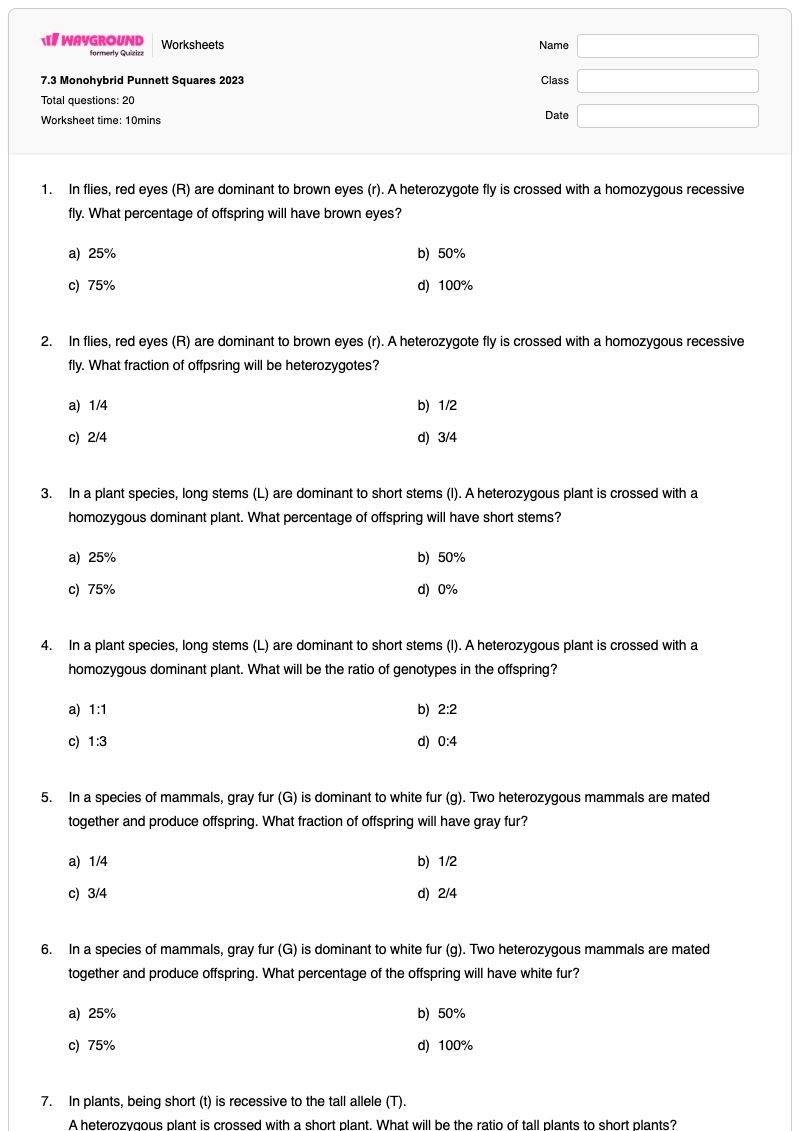
7.3 Monohybrid Punnett Squares 2023

คำถามทั้งหมด: 20

ชื่อ
ระดับ
วันที่
1.

In flies, red eyes (R) are dominant to brown eyes (r). A heterozygote fly is crossed with a homozygous recessive fly. What percentage of offspring will have brown eyes?

a)

25%

b)

50%

c)

75%

d)

100%

2.

In flies, red eyes (R) are dominant to brown eyes (r). A heterozygote fly is crossed with a homozygous recessive fly. What fraction of offpsring will be heterozygotes?

a)

1/4

b)

1/2

c)

2/4

d)

3/4

3.

In a plant species, long stems (L) are dominant to short stems (l). A heterozygous plant is crossed with a homozygous dominant plant. What percentage of offspring will have short stems?

a)

25%

b)

50%

c)

75%

d)

0%

4.

In a plant species, long stems (L) are dominant to short stems (l). A heterozygous plant is crossed with a homozygous dominant plant. What will be the ratio of genotypes in the offspring?

a)

1:1

b)

2:2

c)

1:3

d)

0:4

5.

In a species of mammals, gray fur (G) is dominant to white fur (g). Two heterozygous mammals are mated together and produce offspring. What fraction of offspring will have gray fur?

a)

1/4

b)

1/2

c)

3/4

d)

2/4

6.

In a species of mammals, gray fur (G) is dominant to white fur (g). Two heterozygous mammals are mated together and produce offspring. What percentage of the offspring will have white fur?

a)

25%

b)

50%

c)

75%

d)

100%

7.

In plants, being short (t) is recessive to the tall allele (T).

A heterozygous plant is crossed with a short plant. What will be the ratio of tall plants to short plants?

a)

1:1

b)

2:2

c)

1:3

d)

3:1

8.

In plants, being short (t) is recessive to the tall allele (T).

A heterozygous plant is crossed with a short plant. What fraction of offspring will be homozygous recessive?

a)

1/4

b)

2/4

c)

1/2

d)

3/4

9.

In a certain animal, brown eyes are dominant and blue eyes are recessive. A heterozygote is mated with a blue eyed animal. What fraction of offspring will have blue eyes?

a)

1/4

b)

2/4

c)

1/2

d)

4/4

10.

In a certain animal, brown eyes are dominant and blue eyes are recessive. A heterozygote is mated with a blue eyed animal. What percentage of the offspring will be heterozygotes?

a)

25%

b)

50%

c)

75%

d)

100%

11.

In flies, small wings (w) are recessive to large wings (W). A

homozygous dominant fly is mated with a homozygous recessive fly. What percentage of offspring will have a Ww genotype?

a)

25%

b)

50%

c)

75%

d)

100%

12.

In flies, small wings (w) are recessive to large wings (W). A

homozygous dominant fly is mated with a homozygous recessive fly. What percentage of offspring will have small wings?

a)

25%

b)

50%

c)

75%

d)

0%

13.

Having attached earlobes (e) is recessive to unattached earlobes (E). A man with genotype (Ee) and a woman with attached earlobes have a child. What is the percent chance the child has attached earlobes?

a)

25%

b)

50%

c)

75%

d)

100%

14.

Having attached earlobes (e) is recessive to unattached earlobes (E). A man with genotype (Ee) and a woman with attached earlobes have a child. What fraction of this couple’s children are likely to be genotype Ee?

a)

1/4

b)

1/2

c)

3/4

d)

4/4

15.

In cats, long hair (H) is dominant to short hair (h). A cat with long hair (Hh) is mated with a cat that also has long hair (Hh). What fraction of offspring will have short hair?

a)

1/4

b)

1/2

c)

2/4

d)

3/4

16.

In cats, long hair (H) is dominant to short hair (h). A cat with long hair (Hh) is mated with a cat that also has long hair (Hh). What will be the ratio of long hair to short hair?

a)

1:1

b)

2:2

c)

3:1

d)

1:3

17.

In pigeons, normal feathers are dominant to frizzy feathers.

Two heterozygote pigeons mate with each other and produce offspring. What fraction of offspring will have normal feathers?

a)

1/4

b)

1/2

c)

3/4

d)

4/4

18.

In pigeons, normal feathers are dominant to frizzy feathers.

Two heterozygote pigeons mate with each other and produce offspring. What percentage of the offspring will have frizzy feathers?

a)

25%

b)

50%

c)

75%

d)

100%

19.

In pea plants, yellow peas (g) are recessive to green peas (G). Two plants with yellow peas are crossed together. What percentage of offspring will have yellow peas?

a)

25%

b)

50%

c)

75%

d)

100%

20.

In pea plants, yellow peas (g) are recessive to green peas (G). Two plants with yellow peas are crossed together. What percentage of offspring will be heterozygotes?

a)

25%

b)

50%

c)

75%

d)

0%

แป้นคำตอบ

7.3 Monohybrid Punnett Squares 2023

คำถามทั้งหมด: 20

1.
b)

50%

2.
b)

1/2

3.
d)

0%

4.
a)

1:1

5.
c)

3/4

6.
a)

25%

7.
a)

1:1

8.
c)

1/2

9.
c)

1/2

10.
b)

50%

11.
d)

100%

12.
d)

0%

13.
b)

50%

14.
b)

1/2

15.
a)

1/4

16.
c)

3:1

17.
c)

3/4

18.
a)

25%

19.
d)

100%

20.
d)

0%

คำถามที่พบบ่อย

แบบฝึกหัดตารางพุนเน็ตต์แบบโมโนไฮบริดนี้ช่วยให้นักเรียนชั้น ม.3 เรียนรู้อะไรบ้าง?

แบบฝึกหัดนี้มีแบบทดสอบปรนัย 20 ข้อให้นักเรียนได้วิเคราะห์การผสมพันธุ์ที่มีลักษณะเดียว และคำนวณจีโนไทป์และฟีโนไทป์ที่คาดหวัง นักเรียนจะได้หาค่าเศษส่วน ร้อยละ และอัตราส่วนสำหรับการผสมพันธุ์ เช่น เฮเทโรไซกัส × โฮโมไซกัสรีเซสซีฟ และเฮเทโรไซกัส × เฮเทโรไซกัส โดยเชื่อมโยงการรวมกันของอัลลีลกับลักษณะต่างๆ เช่น สีตา สีขน ความสูงของลำต้น และความยาวของเส้นผม

ฉันจะใช้แบบฝึกหัดนี้สอนเรื่องการผสมพันธุ์แบบโมโนไฮบริดได้อย่างไร?

แนะนำสัญลักษณ์ของอัลลีลเด่นและอัลลีลด้อย จากนั้นจำลองการผสมพันธุ์หนึ่งครั้งโดยแสดงรายการเซลล์สืบพันธุ์ที่เป็นไปได้และเชื่อมโยงจีโนไทป์ของลูกหลานแต่ละตัวกับฟีโนไทป์ของมัน ให้นักเรียนแก้โจทย์ในแบบฝึกหัดเป็นคู่ โดยให้พวกเขาอธิบายว่าเหตุใดผลลัพธ์เช่น ขนสีเทา 3/4 หรือลำต้นสั้น 0% จึงเกิดขึ้นจากจีโนไทป์ของพ่อแม่ จบด้วยการอธิบายว่าความน่าจะเป็นเดียวกันสามารถแสดงในรูปของเศษส่วน เปอร์เซ็นต์ หรืออัตราส่วนได้อย่างไร

ฉันควรระวังข้อผิดพลาดอะไรบ้างเมื่อนักเรียนทำแบบฝึกหัดตารางพุนเน็ตต์เหล่านี้?

ระวังนักเรียนสับสนระหว่างจีโนไทป์กับฟีโนไทป์ เช่น การใช้ลักษณะเด่นเป็นหลักฐานว่าลูกหลานเป็นโฮโมไซกัส นักเรียนอาจแปลงเศษส่วน เปอร์เซ็นต์ และอัตราส่วนผิดพลาด มองข้ามว่าฟีโนไทป์แบบด้อยต้องมีอัลลีลด้อยสองตัว หรือคิดว่าการผสมพันธุ์ทุกครั้งจะได้ผลลัพธ์ 3:1 โดยเฉพาะอย่างยิ่ง ตรวจสอบว่าพวกเขาระบุจีโนไทป์ของลูกหลานที่เป็นไปได้ทั้งหมดก่อนที่จะคำนวณผลลัพธ์ที่ต้องการหรือไม่

ฉันจะมอบหมายและให้คะแนนแบบฝึกหัดเรื่องการผสมพันธุ์แบบโมโนไฮบริดนี้ได้อย่างไร?

แบบฝึกหัดนี้มีให้เลือกทั้งในรูปแบบไฟล์ PDF ที่สามารถพิมพ์ได้ และแบบทดสอบดิจิทัลบน Wayground คุณจึงสามารถมอบหมายคำถามแบบเลือกตอบ 20 ข้อในรูปแบบที่เหมาะสมกับบทเรียนของคุณได้ แบบฝึกหัดนี้มีเฉลยคำตอบครบถ้วน และสามารถตรวจให้คะแนนงานที่ส่งในรูปแบบไฟล์พิมพ์ได้โดยการสแกนงานของนักเรียนด้วยแอป Wayground for Teachers ตัวเลือกแบบพิมพ์ยังช่วยสนับสนุนโรงเรียนที่ต้องการลดเวลาการใช้หน้าจอได้อีกด้วย

ฉันจะปรับแบบฝึกหัดตารางพุนเน็ตต์แบบโมโนไฮบริดนี้ให้เหมาะสมกับนักเรียนของฉันได้อย่างไร?

ใช้การตั้งค่าขั้นสูงของแบบฝึกหัดเพื่อปรับระยะห่างระหว่างตัวอักษรและขนาดตัวอักษร เพื่อให้คำถามพันธุศาสตร์แบบเลือกตอบอ่านและทำเครื่องหมายได้ง่ายขึ้น นอกจากนี้ คุณยังสามารถใช้แบบอักษรที่เหมาะสำหรับผู้ที่มีภาวะดิสเล็กเซีย หรือแปลแบบฝึกหัดเป็นภาษาอื่นได้ เมื่อตัวเลือกเหล่านั้นช่วยให้เข้าถึงปัญหาเกี่ยวกับอัลลีล จีโนไทป์ และฟีโนไทป์ได้ง่ายขึ้น

ฉันจะหาแบบฝึกหัดแบบนี้เพิ่มเติมได้ที่ไหนบน Wayground?

Wayground นำเสนอชุดแบบฝึกหัดและโจทย์ฝึกหัดฟรีที่ครอบคลุมทุกวิชา พร้อมไฟล์ PDF และเฉลยคำตอบ เพื่อช่วยให้นักเรียนเชี่ยวชาญทักษะและแนวคิดที่สำคัญ ดูแหล่งข้อมูลเพิ่มเติมได้ที่ https://wayground.com/en-us/worksheets