

Wayground
Plant and Animal Classification Review - Printable ศาสตร์ Worksheets ระดับ 5 - Wayground

Plant and Animal Classification Review

Erica Williams

สร้างโดย Erica Williams

20 คำถาม

5th ระดับชั้น

ศาสตร์

อัปเดตแล้ว มิ.ย. 2569

แบบฝึกหัดทบทวนการจำแนกพืชและสัตว์ ชั้นประถมศึกษาปีที่ 5 เป็นแบบฝึกหัดวิทยาศาสตร์ที่สามารถพิมพ์ได้ฟรี มีคำถามแบบเลือกตอบ 20 ข้อ พร้อมเฉลยคำตอบครบถ้วน ช่วยให้นักเรียนทบทวนวิธีการจำแนกพืชเป็นพืชมีท่อลำเลียงหรือไม่มีท่อลำเลียง วิธีการจัดกลุ่มพืชที่ผลิตเมล็ดเป็นพืชมีดอกหรือไม่มีดอก และความสัมพันธ์ระหว่างพืชมีดอก พืชเมล็ดเปลือย พืชไม่มีเมล็ด ดอกไม้ ผลไม้ กรวย เมล็ด และสปอร์ นักเรียนใช้ลักษณะที่สังเกตได้และลักษณะการสืบพันธุ์เพื่อเลือกการจำแนกที่ถูกต้อง รวมถึงการระบุว่าดอกไม้ ผลไม้ กรวย และสปอร์บ่งบอกอะไรเกี่ยวกับพืช แบบฝึกหัดนี้ยังรวมถึงการประยุกต์ใช้การจำแนกสัตว์ ซึ่งนักเรียนจะระบุสัตว์มีกระดูกสันหลังเลือดอุ่น มีขน และวางไข่ว่าเป็นนก เหมาะสำหรับการทบทวนวิทยาศาสตร์ชั้นประถมศึกษาปีที่ 5 การฝึกฝนด้วยตนเอง หรือการตรวจสอบความเข้าใจเกี่ยวกับคำศัพท์และแนวคิดการจำแนก

การตั้งค่าแผ่นงาน

ขนาดตัวอักษร

S
M
L
XL
Waygroundแผ่นงาน

Plant and Animal Classification Review

คำถามทั้งหมด: 20

ชื่อ
ระดับ
วันที่
1.

How do we classify plants as?

a)

Vertebrates and invertebrates

b)

Inherited traits and acquired traits

c)

Vascular and nonvascular

d)

Spongebob and Patrick

2.

What are the two types of vascular plants?

a)

Vertebrates and invertebrates

b)

Angie and Jim

c)

Angiosperms and gymnosperms

d)

Moss and oak

3.

Which type of vascular plant produces seeds but NOT flowers and fruits?

a)

Angiosperms

b)

Gymnosperms

4.

What type of vascular plant produces flowers AND fruits?

a)

Gymnosperms

b)

Angiosperms

5.

The plant kingdom is divided into two main groups:

a)

flowering & non-flowering

b)

seed & seedless

c)

trees & plants

d)

conifers & flowering plants

6.

Plants that reproduce from seeds can be further divided into:

a)

monocots & dicots

b)

angiosperms & dicotyledons

c)

flowering & non-flowering plants

d)

spores & conifers

7.
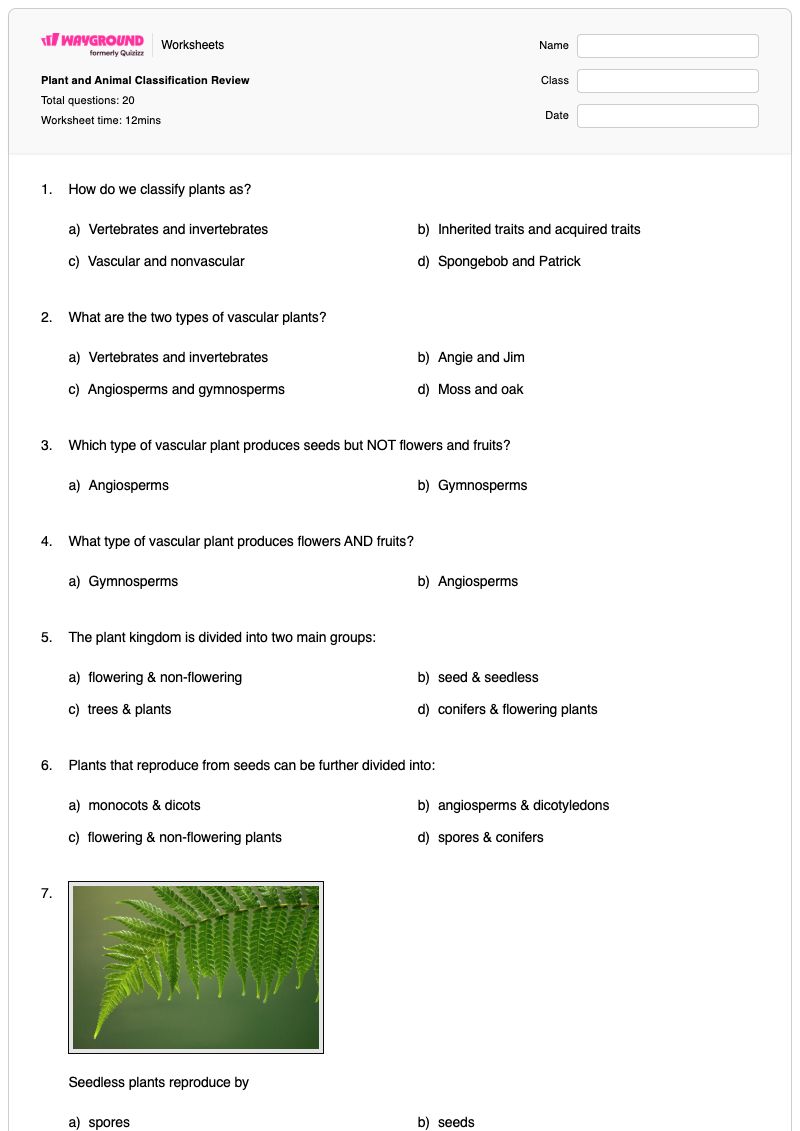
Seedless plants reproduce by
a)
spores
b)
seeds
c)
binary fission
d)
mitosis
8.

Pine trees have cones that...

a)

make seeds

b)

do not make seeds

9.

Magnolia trees have flowers that...

a)

make seeds

b)

do not make seeds

10.

Which of the following plants produces spores?

a)
Which of the following plants produces spores?
b)
Which of the following plants produces spores?
c)
Which of the following plants produces spores?
d)
Which of the following plants produces spores?
11.

Ken has a flower from an unknown plant. What does Ken know about this plant just because it has a flower?

a)

The plant does not have significant leaf development.

b)

The plant does not have a significant root system.

c)

The plant reproduces using spores.

d)

The plant reproduces using seeds

12.

Which of the following is true of ferns and daisies?

a)

Ferns have flowers and daisies do not.

b)

Ferns have stems and daisies do not.

c)

Ferns do not produce seeds and daisies do.

d)

Ferns do not produce spores and daisies do.

13.

Which plant is flowering and seed forming?

a)
Which plant is flowering and seed forming?
b)
Which plant is flowering and seed forming?
c)
Which plant is flowering and seed forming?
d)
Which plant is flowering and seed forming?
14.

Vertebrates that are warm blooded, have feathers and reproduce by laying eggs would be classified as

a)

reptile

b)

bird

c)

fish

d)

amphibian

15.

Seeds grow into plants. Some flowering plants produce fruits. What does the fruit contain?

a)

water

b)

roots

c)

seeds

d)

other plants

16.

Brooke made a list of organisms and classified them into two groups, What would be the best titles for these groups?


Group 1: fish, amphibians, reptile

Group 2: mollusks, arthropods, insects

a)

Group 1: Exoskeleton

Group 2: Endoskeleton

b)

Group 1: Vertebrates

Group 2: Invertebrates

c)

Group 1: Mammals

Group 2: Invertebrates

d)

Group 1: Invertebrates

Group 2: Endoskeleton

17.

Which two types of animals share these characteristics?


cold-blooded

hatch from eggs

born with gills

a)

insect and fish

b)

amphibians and reptiles

c)

fish and amphibians

d)

reptiles and insects

18.

Which two types of animals share these characteristics?


warm-blooded

four-chambered hearts

breathe with lungs

vertebrates

a)

fish and amphibians

b)

mammals and fish

c)

reptiles and birds

d)

birds and mammals

19.

I have dry scales, am cold blooded, lay leathery shelled eggs, and have a vertebrate. What am I?

a)

a bird

b)

a fish

c)

a mammal

d)

a reptile

20.

I am cold blooded and live both on land water. I have moist skin, a backbone and lay jelly coated eggs in the water. What am I?

a)

A reptile

b)

An amphibian

c)

A mammal

d)

A fish

Waygroundแป้นคำตอบ

Plant and Animal Classification Review

คำถามทั้งหมด: 20

1.
c)

Vascular and nonvascular

2.
c)

Angiosperms and gymnosperms

3.
b)

Gymnosperms

4.
b)

Angiosperms

5.
b)

seed & seedless

6.
c)

flowering & non-flowering plants

7.
a) spores
8.
a)

make seeds

9.
a)

make seeds

10.
c)
11.
d)

The plant reproduces using seeds

12.
c)

Ferns do not produce seeds and daisies do.

13.
c)
14.
b)

bird

15.
c)

seeds

16.
b)

Group 1: Vertebrates

Group 2: Invertebrates

17.
c)

fish and amphibians

18.
d)

birds and mammals

19.
d)

a reptile

20.
b)

An amphibian

คำถามที่พบบ่อย

แบบฝึกหัดทบทวนการจำแนกประเภทพืชและสัตว์ครอบคลุมเนื้อหาอะไรบ้าง?

แบบฝึกหัดวิทยาศาสตร์ชั้นประถมศึกษาปีที่ 5 นี้ประกอบด้วยคำถามแบบเลือกตอบ 20 ข้อ เพื่อประเมินการจำแนกพืชตามโครงสร้างแบบมีท่อลำเลียงและไม่มีท่อลำเลียง การสืบพันธุ์แบบมีเมล็ดและไม่มีเมล็ด และลักษณะการออกดอกและไม่มีดอก นักเรียนจะใช้เบาะแสต่างๆ เช่น ดอกไม้ ผลไม้ กรวย เมล็ด และสปอร์ จากนั้นใช้ลักษณะของสัตว์ในการจำแนกนก

ฉันจะใช้แบบฝึกหัดนี้ในการสอนการจำแนกประเภทพืชได้อย่างไร?

เริ่มแบบฝึกหัดโดยให้นักเรียนจัดเรียงตัวอย่างพืชตามว่าพวกมันผลิตเมล็ดหรือสปอร์ จากนั้นเชื่อมโยงพืชที่ผลิตเมล็ดเข้ากับกลุ่มพืชมีดอกและพืชไม่มีดอก ขณะที่นักเรียนตอบคำถามแบบเลือกตอบ ให้พวกเขาอธิบายว่าหลักฐานใด เช่น ดอกไม้ ผลไม้ หรือกรวย สนับสนุนการจำแนกประเภทแต่ละอย่าง ก่อนที่จะตรวจสอบเฉลย

ฉันควรระวังข้อผิดพลาดอะไรบ้างเมื่อนักเรียนทำแบบฝึกหัดการจำแนกประเภทนี้?

นักเรียนอาจสับสนระหว่างพืชมีท่อลำเลียงและพืชไม่มีท่อลำเลียง กับพืชมีดอกและพืชไม่มีดอก หรือเข้าใจผิดว่าพืชเมล็ดเปลือยไม่ผลิตเมล็ดเพราะไม่ผลิตดอกหรือผล ควรระวังนักเรียนที่สลับบทบาทระหว่างพืชมีดอกและพืชเมล็ดเปลือย ระบุสปอร์เป็นเมล็ด หรือมองข้ามไปว่าเฟิร์นไม่ผลิตเมล็ดในขณะที่ดอกเดซี่ผลิตเมล็ด

ฉันจะมอบหมายและให้คะแนนแบบฝึกหัดทบทวนการจำแนกประเภทพืชและสัตว์นี้ได้อย่างไร?

แบบฝึกหัดนี้มีให้ดาวน์โหลดในรูปแบบไฟล์ PDF ที่สามารถพิมพ์ได้ และเป็นแบบทดสอบดิจิทัลบน Wayground โดยมีเฉลยคำตอบครบถ้วนสำหรับตรวจสอบคำตอบแบบเลือกตอบ สำหรับการส่งงานแบบพิมพ์ ให้สแกนงานของนักเรียนด้วยแอป Wayground for Teachers เพื่อตรวจให้คะแนนได้อย่างมีประสิทธิภาพ

ฉันจะปรับแบบฝึกหัดการจำแนกประเภทพืชนี้ให้เหมาะสมกับนักเรียนของฉันได้อย่างไร?

ในการตั้งค่าขั้นสูงของแบบฝึกหัด ให้ปรับระยะห่างระหว่างตัวอักษรหรือเลือกขนาดตัวอักษรที่ใหญ่ขึ้นเพื่อให้คำถามแบบเลือกตอบและคำศัพท์เกี่ยวกับการจำแนกประเภทอ่านง่ายขึ้น นอกจากนี้ คุณยังสามารถเปิดใช้งานแบบอักษรที่เหมาะสำหรับผู้ที่มีภาวะดิสเล็กเซีย หรือแปลแบบฝึกหัดเป็นภาษาอื่นได้ เมื่อตัวเลือกเหล่านั้นรองรับการเข้าถึงเนื้อหาเกี่ยวกับการจำแนกประเภทพืชและสัตว์

ฉันจะหาแบบฝึกหัดแบบนี้เพิ่มเติมได้ที่ไหนบน Wayground?

Wayground นำเสนอชุดแบบฝึกหัดและโจทย์ฝึกหัดฟรีที่ครอบคลุมทุกวิชา พร้อมไฟล์ PDF และเฉลยคำตอบ เพื่อช่วยให้นักเรียนเชี่ยวชาญทักษะและแนวคิดที่สำคัญ ดูแหล่งข้อมูลเพิ่มเติมได้ที่ https://wayground.com/en-us/worksheets